
What Does “Transcend” Mean?
Transcend is a formal verb meaning to go beyond a limit, barrier, category, or ordinary experience. It is usually followed by the thing that is surpassed: The song transcends genre. In this example, the song reaches beyond the boundaries of one musical category. The word can describe something concrete, such as an achievement exceeding a standard, or something abstract, such as an idea crossing cultural divisions. It does not simply mean “move upward” or “fly.”
Quick answer: Use transcend + object when a person, idea, work, or experience goes beyond something: Her work transcends national borders. Cambridge labels the verb formal and defines it in terms of going further or rising above something, especially a limit. Oxford also gives the pattern transcend something and lists exceed as a synonym. Cambridge Dictionary; Oxford Learner’s Dictionaries.

How to Use Transcend in a Sentence
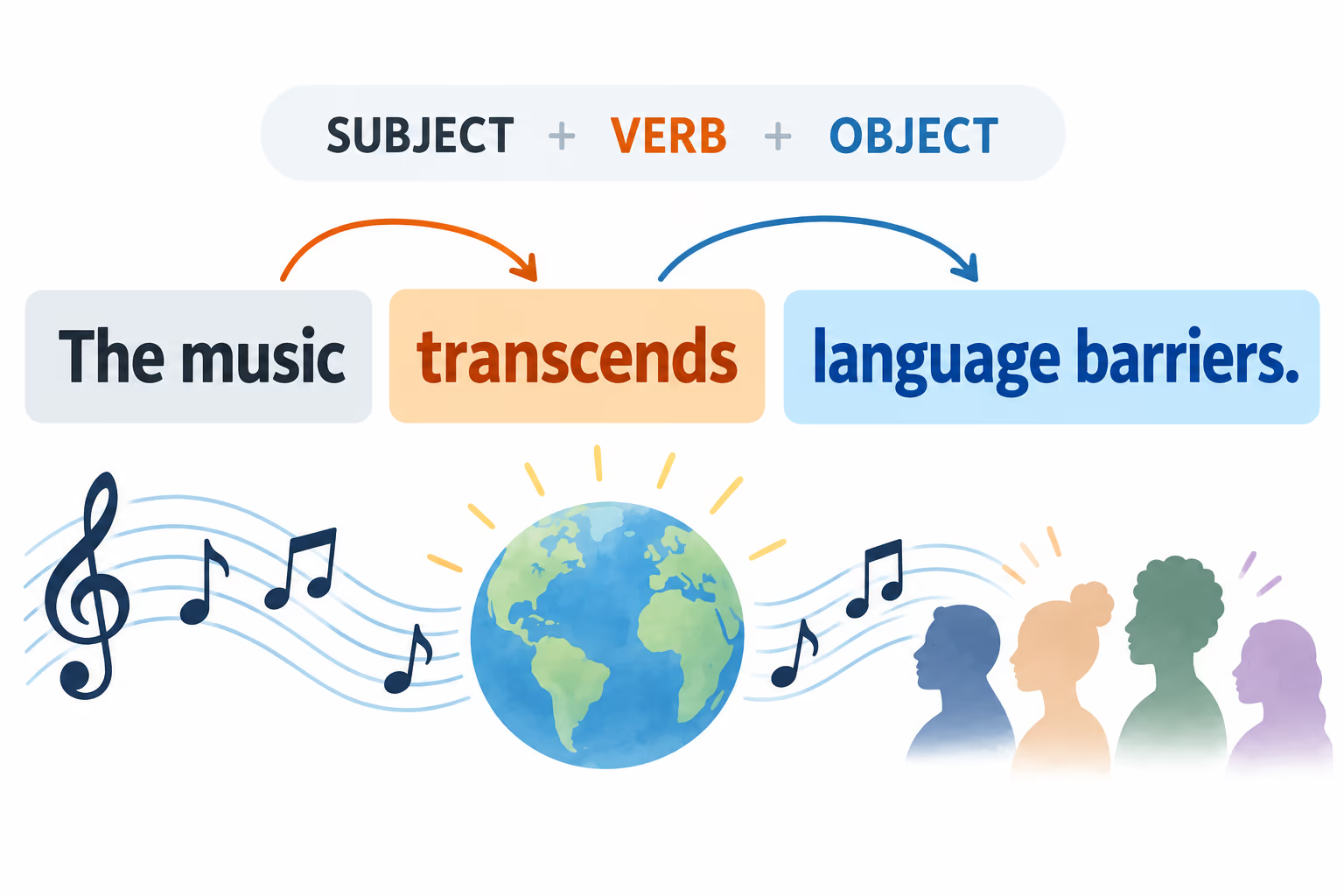
The clearest pattern is subject + transcend + direct object. The subject is what goes beyond something, and the object names the boundary or standard:
- The documentary transcends political labels. (The documentary speaks beyond one political category.)
- Her kindness transcended the disagreement. (Her kindness mattered more than the disagreement.)
- The design transcends short-lived trends. (It remains appealing beyond passing trends.)
- The team’s result transcended its original goal. (The result went beyond the goal.)
The object can be a noun or noun phrase: transcend a barrier, transcend differences, transcend expectations, transcend the limits of a format. A pronoun can also serve as the object: The importance of the discovery transcends it. Often the object is abstract because the verb describes a boundary in meaning, value, or category rather than literal movement.
For a clearer example with a concrete boundary, write: The discovery transcends the limits of its field.
Conjugation and Pronunciation
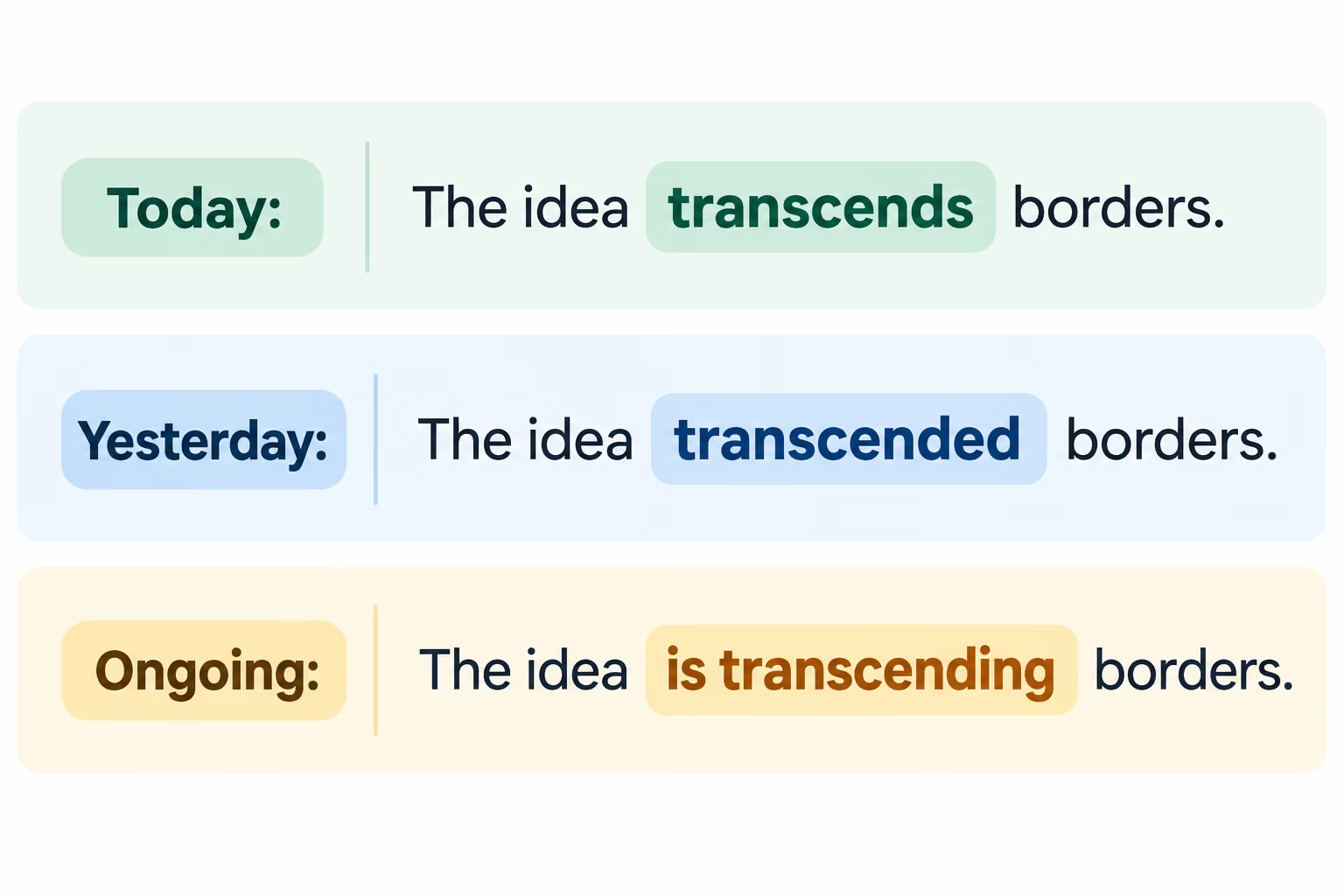
Transcend is a regular verb. Its forms are transcend (base form), transcends (third-person singular), transcended (simple past and past participle), and transcending (-ing form). The verb has two syllables and is pronounced /trænˈsend/, with stress on the second syllable.
- Present: This story transcends its original setting.
- Past: The artist transcended the conventions of her time.
- Present perfect: The issue has transcended local politics.
- Ongoing action: The conversation is transcending the usual boundaries.
Choose the verb form to match the subject and time. Use transcends with a singular third-person subject (the story transcends), but transcend with plural subjects or after to and modal verbs (the stories transcend; can transcend; hopes to transcend).
Transcend, Exceed, and Surpass
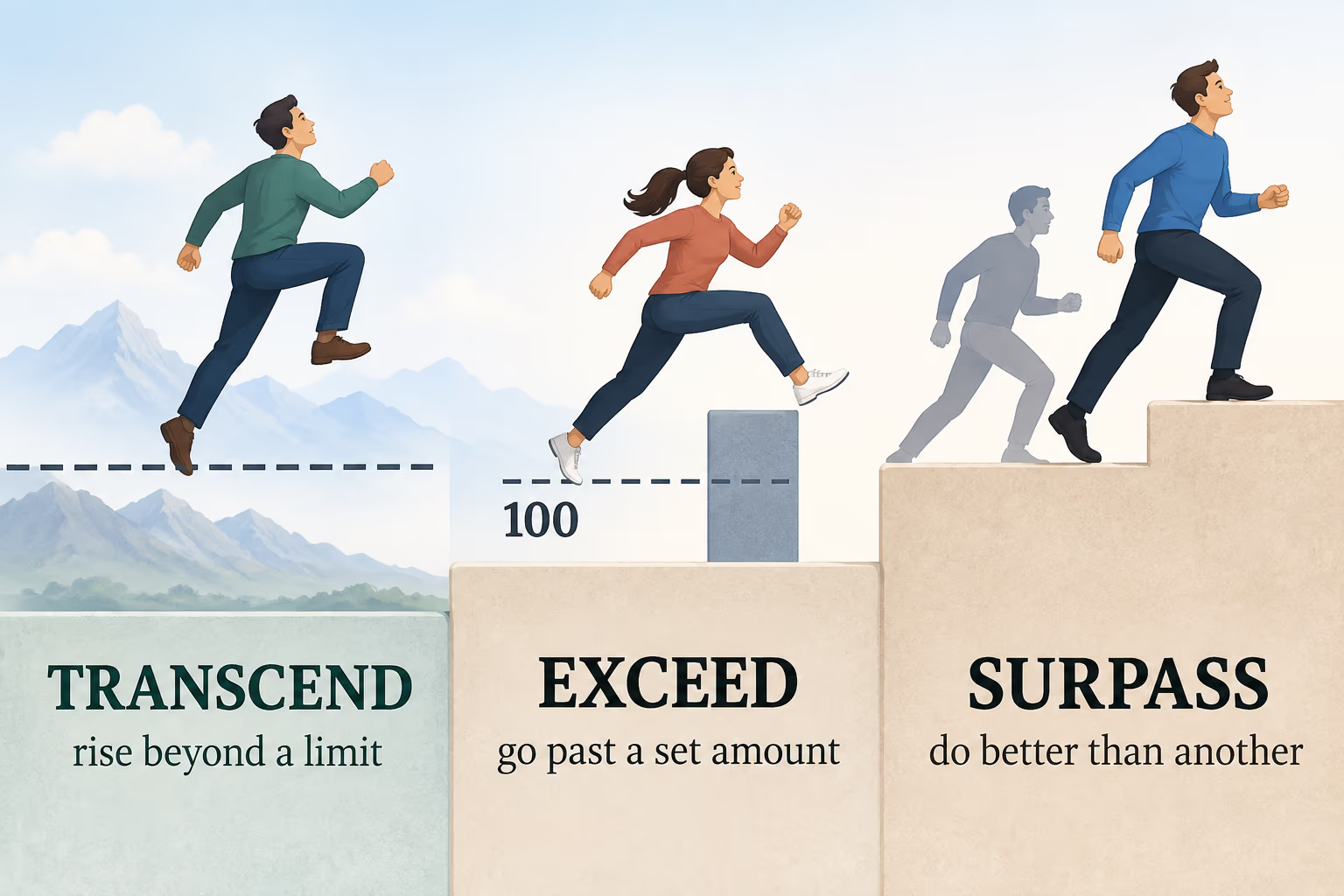
These verbs overlap, but their emphasis differs. Exceed commonly means to go past a stated amount, limit, or expectation: The repair bill exceeded the estimate. Surpass often means to do better than a person, result, or previous standard: This year’s sales surpassed last year’s. Transcend emphasizes going beyond a boundary or category, sometimes by rising above its usual significance: The story transcends its historical setting and speaks to readers today.
These are tendencies, not rigid rules: an expectation can be transcended, exceeded, or surpassed depending on the sentence’s emphasis. Pick transcend when the idea is a boundary being crossed or a work reaching beyond its category; pick exceed for a measurable amount or limit; pick surpass for a comparison of performance or quality.
Frequent Usage Problems
- Do not use it to mean simply “fly” or “rise.” A bird may fly over a building, but it does not normally “transcend over” it. Use transcend when the meaning involves going beyond an abstract limit or exceeding a boundary in a figurative sense.
- Avoid “transcend over.” Transcend already carries the idea of going beyond, and it usually takes a direct object without a preposition: The message transcends language barriers.
- Name what is being transcended. The film transcends may work when the object is understood from context, but learners usually make the meaning clearer by adding one: The film transcends genre.
- Use the right subject. The person, work, idea, or quality is what transcends; the boundary is its object: The novel transcends its genre, not “the genre transcends the novel” if you mean the novel goes beyond the category.
- Keep the register in mind. The word sounds formal, reflective, or emphatic. In casual conversation, go beyond, rise above, or go past may sound more natural. In academic, critical, or literary writing, transcend can be precise.
Corrected Versions of the Children’s Examples
The older seven-item list preserved later in this page contains wording such as “the kite transcend higher” and “birds transcend over buildings.” Those examples confuse transcend with physical movement and do not model its usual grammar. Here are natural alternatives that keep a child-friendly idea while using the verb correctly:
- The kite soared higher than the trees. (Use soared for physical movement.)
- A story about courage can transcend age groups.
- The view from the mountain seemed to transcend words.
- In the story, Superman flew over the buildings to help people.
- The balloon rose high into the sky. (Use rose for upward motion.)
- The sunrise filled the whole valley with light.
- The butterfly’s beauty seemed to transcend the garden around it.
These examples show why the choice of verb matters: fly, soar, rise, and climb describe movement, while transcend usually describes crossing a conceptual boundary or going beyond a standard.
More Example Sentences With Transcend
- By blending folk music with electronic sounds, the album transcends genre.
- The community project transcended neighborhood boundaries and brought residents together.
- Her explanation transcended technical jargon without losing its accuracy.
- The athlete’s performance transcended the expectations set before the season.
- The play’s questions about loyalty transcend its historical setting.
- Shared responsibilities can help a group transcend personal differences.
- The photograph transcends its original purpose as a family keepsake.
- For some readers, the poem’s rhythm transcends its literal meaning.
Frequently Asked Questions
Is “transcend” a transitive verb?
Yes. It is commonly used transitively with a direct object: The idea transcends national boundaries. In some sentences the object is implied, but naming it usually improves clarity.
Is “transcend over” correct?
Usually, no. In its ordinary sense, transcend takes the boundary directly: The work transcends borders. Use fly over or rise above for literal motion, depending on what you mean.
What is the past tense of “transcend”?
The simple past and past participle are both transcended: The book transcended its original audience; The book has transcended its original audience.
What is a simple synonym for “transcend”?
Depending on context, try go beyond, rise above, exceed, or surpass. For a measurable cap, exceed may fit better; for a comparison, surpass may be clearer.
Original Examples and Article Text
The original examples below are retained as published. The corrected child-friendly alternatives above provide natural models of transcend and distinguish figurative “go beyond” from literal movement.

Have you ever encountered a concept that seems to effortlessly rise above boundaries and limitations? That, my friend, is what it means to transcend – to go beyond the ordinary or material and reach a higher state.
When something transcends, it surpasses the usual constraints and conventions, elevating itself to a level that leaves the familiar behind. It’s like breaking free from the norm and entering a realm where possibilities expand and limitations fade away.
7 Examples Of Transcend Used In a Sentence For Kids
- The kite transcend higher than the trees.
- Birds can transcend over buildings and fly freely.
- The clouds transcend over the mountains.
- Superman can transcend over buildings to save people.
- Hot air balloons can transcend high in the sky.
- The sun can transcend over the horizon in the morning.
- Butterflies can transcend over flowers in the garden.
14 Sentences with Transcend Examples
- The goal of every college student should be to transcend their limitations and strive for excellence.
- By studying hard and staying focused, you can transcend academic challenges and achieve success in your classes.
- It’s important for students to transcend their comfort zones and take on new opportunities for growth.
- With dedication and perseverance, you can transcend obstacles and reach your full potential in college.
- Joining a student organization can help you transcend your social circles and meet new friends with common interests.
- Attending workshops and seminars can help you transcend your knowledge and skills in your field of study.
- By actively participating in class discussions, you can transcend mere memorization and truly understand the subject matter.
- Setting high goals for yourself can inspire you to transcend mediocrity and aim for greatness in your academic pursuits.
- Volunteering for community service projects can help you transcend self-centeredness and develop empathy for others.
- Seeking guidance from mentors and professors can help you transcend self-doubt and gain confidence in your abilities.
- Taking on leadership roles in student organizations can help you transcend follower mentality and develop strong leadership skills.
- Engaging in extracurricular activities can help you transcend the monotony of daily college life and explore your passions.
- By staying open-minded and receptive to new ideas, you can transcend narrow thinking and expand your intellectual horizons.
- Embracing diversity and cultural differences can help you transcend ethnocentrism and develop a global perspective on issues.
How To Use Transcend in Sentences?
To use the word Transcend in a sentence, you should first understand that Transcend means to go beyond the usual limits or exceed in excellence.
Here is an example sentence: “Through her dedication and hard work, she was able to transcend the expectations set by others and achieve great success.”
When constructing a sentence with Transcend, think about a situation where someone or something surpasses expectations, boundaries, or norms in a remarkable way. This could be in terms of personal achievements, societal standards, or even in the realm of art and creativity.
It’s important to keep in mind the context in which you are using Transcend to ensure that the sentence accurately conveys the idea of moving beyond limitations or excelling in a particular area.
By practicing incorporating Transcend into your everyday vocabulary and writing, you will become more comfortable using this word effectively. Remember that clarity and context are key when using sophisticated vocabulary like Transcend. With practice, you will become more adept at expressing complex ideas with precision using this powerful word.
Conclusion
In conclusion, the concept of transcendence refers to surpassing or going beyond the limits of ordinary experience. It is often associated with reaching a higher state of existence or understanding that goes beyond the physical or material world. The sentences provided in this article demonstrate how this idea can be expressed in various contexts, from spiritual to philosophical, and how it can inspire contemplation on the limitless possibilities of human potential.
By exploring different examples of sentences with the keyword “transcend,” we can appreciate the richness and depth of this concept in conveying profound insights and touching on themes of transformation, growth, and enlightenment. Ultimately, the notion of transcendence offers a powerful lens through which to view our existence and strive for a deeper connection with the universe and our inner selves.


