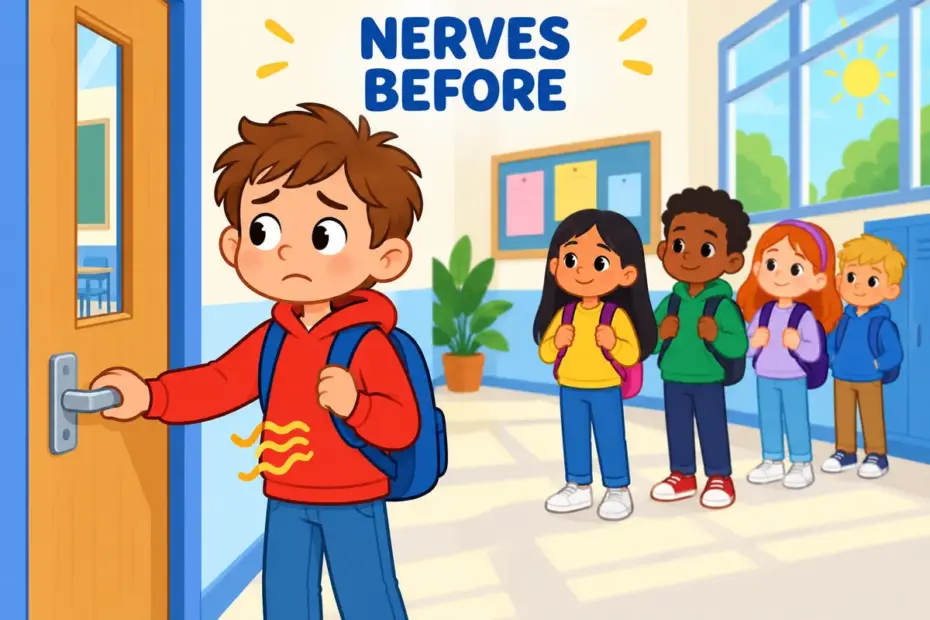
Trepidation is a formal noun for the nervous fear felt before something uncertain, and it usually follows with or the words a feeling of. “She opened the letter with trepidation.” The word names anticipation rather than the danger itself, so it rarely appears in the middle of an event.
Trepidation at a glance
- Trepidation is an uncountable noun meaning nervous fear about something that may happen.
- Its fixed patterns are with trepidation and a feeling of trepidation.
- It appears with some, considerable or a trace of, rather than with a number.
- The register is formal and literary, common in narrative and careful reporting.
- The commonest error is treating it as countable or confusing it with terror, which is much stronger.
What does trepidation mean?
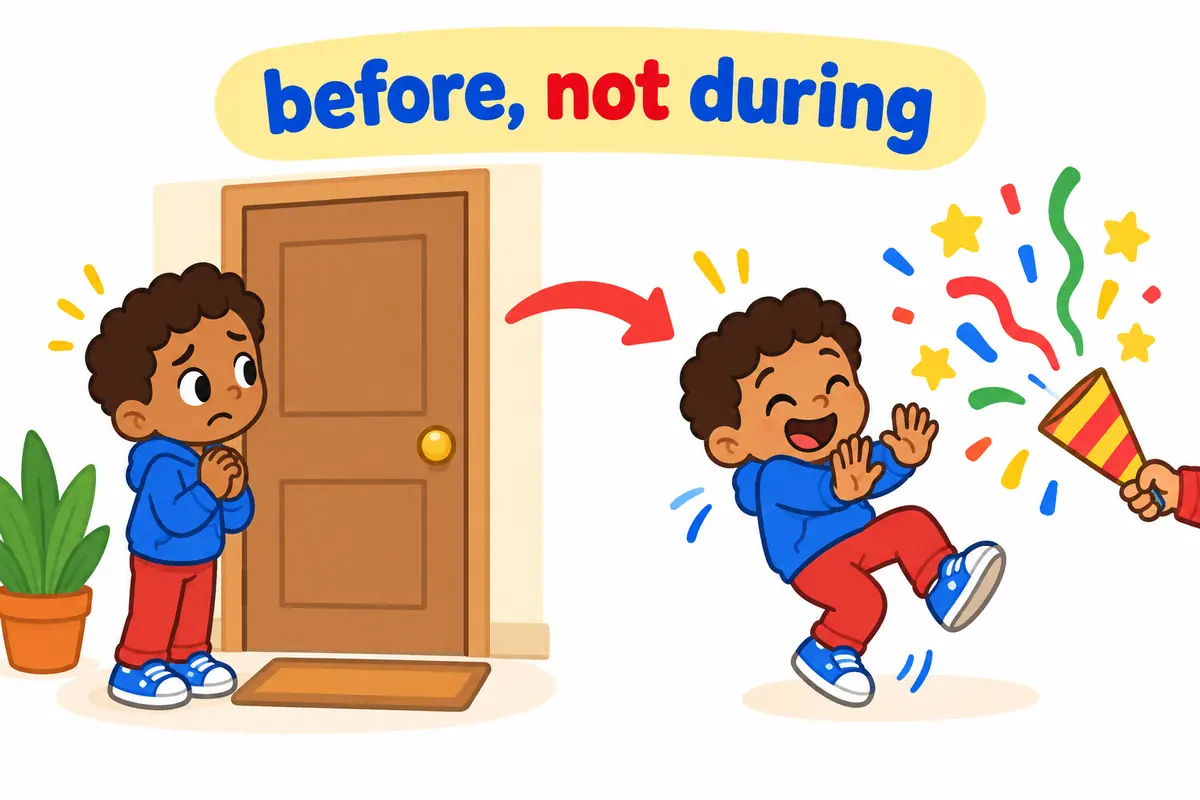
Trepidation is an uncountable noun meaning a feeling of nervous fear about something that may happen. The Cambridge entry for trepidation gives the sense of worry or fear about a future event, and that focus on what is coming is what makes the word precise. It describes the quiet anxiety before an exam or a diagnosis, not the reaction during one.
| Shade of meaning | Plain meaning | Example sentence |
|---|---|---|
| Nervous fear | Anxious anticipation of something uncertain | He waited for the results with trepidation. |
| Quiet misgiving | A gentle sense that something may go wrong | She agreed, but with some trepidation. |
One limitation is worth stating plainly. Trepidation is mild to moderate, not terror, and it is not a medical term for anxiety. It also implies that the feared event has not arrived, so it cannot describe a reaction to immediate danger. A general general unease with no clear object is a different feeling.
How do you use trepidation in a sentence?
Attach the feeling to the person and the coming event, usually with with or about: she waited with trepidation, their trepidation about the merger. Five patterns cover almost every real sentence, and the quantifier pattern is the one that keeps the noun uncountable.
| Pattern | Example | What it signals |
|---|---|---|
| with trepidation | She entered the exam hall with trepidation. | The standard adverbial phrase for how an action is done. |
| a feeling of trepidation | A feeling of trepidation spread through the team. | Names the emotion as its own subject. |
| some / considerable + trepidation | He agreed with considerable trepidation. | Uses a quantifier, never a number. |
| trepidation about / at + noun | Their trepidation about the merger was obvious. | Attaches the fear to its actual cause. |
| there was trepidation | There was trepidation in the room before the vote. | Places the feeling in a setting rather than a person. |
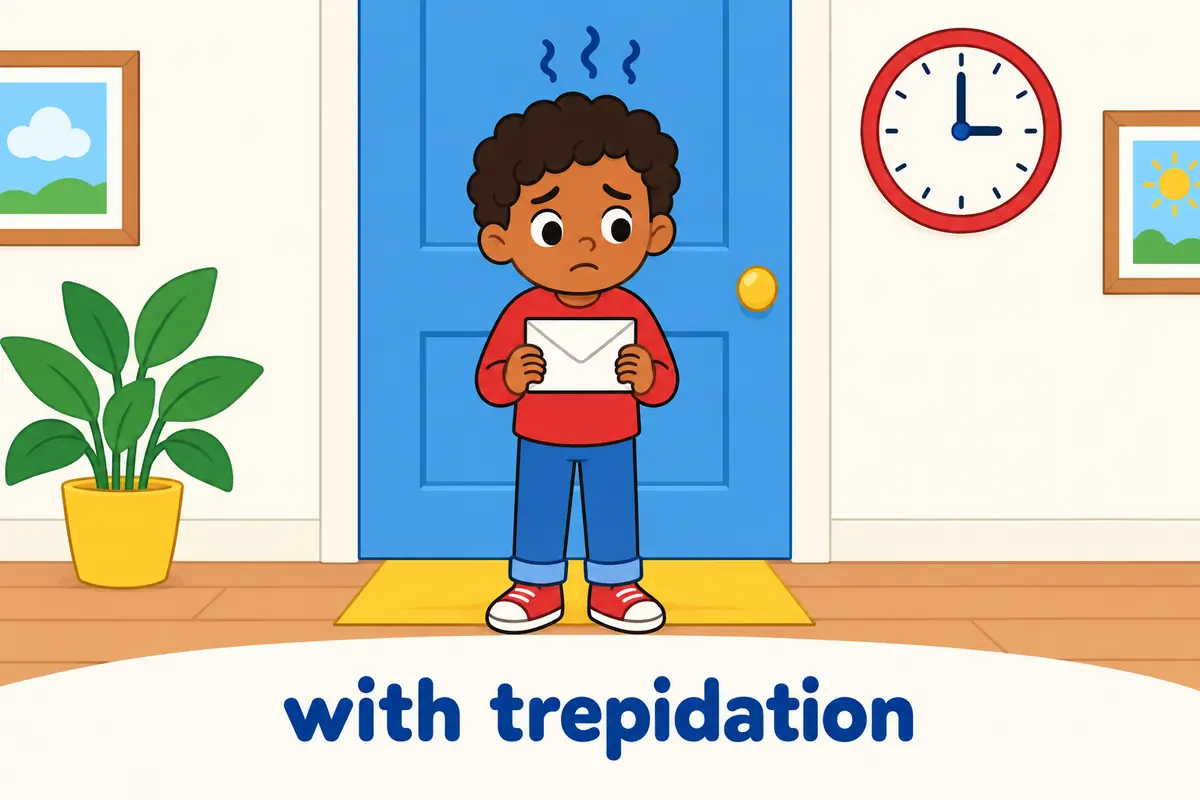
Trepidation in a sentence: examples across contexts
Trepidation keeps its meaning while the coming event changes from a test to a tribunal. The nine sentences below each name the event that is feared, which is what keeps the noun grounded.
| Context | Example sentence | Why this works |
|---|---|---|
| Classroom | She raised her hand with trepidation, unsure of the answer. | The feared moment is small and immediate, which suits the word. |
| Workplace email | We approach the audit with some trepidation. | Formal, collective and tied to a known future event. |
| News report | Residents watched the river with trepidation as the rain continued. | Pictures the waiting, not the flood itself. |
| Medical writing | Many patients describe trepidation before the first scan. | Names a common feeling without claiming a diagnosis. |
| Memoir | I opened the acceptance letter with trepidation. | First person fits the personal, reflective register. |
| Business writing | Investors greeted the merger with trepidation. | An abstract subject with a concrete stance. |
| Academic writing | The committee noted widespread trepidation about the reform. | Formal, impersonal and attached to a policy. |
| Sports commentary | The goalkeeper waited for the penalty with visible trepidation. | A single coming moment that the outcome will settle. |
| Conversation | I felt a little trepidation before my first driving lesson. | Everyday use with a mild quantifier keeps it natural. |
The medical and academic sentences show the word at its most formal, while the conversation sentence keeps it plain. In every case the fear points forward in time, which is the single feature that holds the meaning together.
Trepidation vs apprehension
Trepidation overlaps with apprehension, dread and misgiving, and it is interchangeable with none of them. Apprehension about the results is calmer and more reasoned, and a deep dread is heavier and lasts longer.
| Attribute | trepidation | apprehension |
|---|---|---|
| Core meaning | Nervous fear tinged with trembling before an event | Anxious expectation that something will be difficult |
| Intensity | A shade more emotional | More neutral and reasoned |
| Typical pattern | with trepidation | apprehension about something |
| Register | Literary and slightly old-fashioned | Common in formal and everyday prose |
| What it attaches to | A coming event or first attempt | A looming problem or outcome |
Verdict: choose trepidation for a personal, slightly dramatic flutter before an unknown moment, and apprehension for a cooler expectation that something may prove difficult.
Word forms and grammar of trepidation
Trepidation is almost always uncountable, so it takes no article and no plural. The adjective a private misgiving is a close noun relative, and it is countable, which is exactly why the two are mixed up.
| Form | Part of speech | Example |
|---|---|---|
| trepidation | noun, uncountable | They crossed the bridge with trepidation. |
| trepidatious | adjective, less common | He felt trepidatious about the move. |
| trepidly | adverb, archaic | The form survives only in older writing. |
| misgiving | noun, countable | She had one misgiving about the plan. |
| apprehension | noun, uncountable | His apprehension grew as the day approached. |
Common mistakes with trepidation
- Incorrect:
She had a trepidation about the flight.Correct: She had a feeling of trepidation about the flight. Rule: trepidation is uncountable and takes no a. - Incorrect:
He felt trepidation when the tiger charged.Correct: He felt terror when the tiger charged. Rule: trepidation is anticipatory, not a response to immediate danger. - Incorrect:
I am trepidation about the trip.Correct: I am apprehensive about the trip. Rule: trepidation is a noun; the adjective is apprehensive or trepidatious. - Incorrect:
There were many trepidations in the queue.Correct: There was considerable trepidation in the queue. Rule: the noun has no plural in this sense. - Incorrect:
She waited in trepidation for the good news.Correct: She waited in trepidation for the results. Rule: trepidation implies uncertainty, so calling the news good weakens it.
Practice using trepidation
Work through the six items, then read the reasoning rather than only the answer.
- Fill the gap: He climbed the steps to the stage with ______.
- Choose the better word: As the storm grew nearer, her (trepidation / terror) about the crossing deepened.
- Correct the error: They felt a trepidation before the interview.
- Build a sentence: use a feeling of trepidation about a school trip.
- Spot the register: which belongs in a formal report — The board approached the restructure with trepidation, or Everyone was super scared about the whole thing?
- Rewrite with the adjective: She felt trepidation about the move. Use trepidatious.
Answers
- trepidation — the noun follows with and needs no article.
- trepidation — the danger has not arrived, so the milder, anticipatory noun fits.
- They felt trepidation before the interview — the noun is uncountable.
- Model answer: A feeling of trepidation spread through the class before the trip.
- The board approached the restructure with trepidation — a report stays formal and avoids slang and the second person.
- She felt trepidatious about the move — the adjective replaces the noun and keeps about.
The bottom line
Use trepidation in a sentence when a person faces an uncertain event and feels a nervous flutter beforehand, and attach it to that event with with or about. The two details that decide most sentences are its uncountable grammar, which forbids a and plurals, and its forward-looking quality, which makes it wrong for present danger. A sense of a sense of foreboding predicts a specific trouble, while trepidation only fears the unknown.
Frequently asked questions about trepidation
Is trepidation a formal word?
Trepidation belongs to literary, journalistic and formal writing. In casual speech people usually say nerves or a bit scared instead. The noun would sound out of place in a text message, yet it fits naturally in a memoir, a news feature or a reflective essay about facing something new.
Is trepidation countable?
No. Trepidation is uncountable in standard use, so it takes no article and no plural. You have some trepidation or a feeling of trepidation, never a trepidation or many trepidations. When writers want a countable noun, they switch to misgiving, which does take an article and a plural.
What is the adjective form of trepidation?
The adjective is trepidatious, formed by adding the usual ending, and it means feeling nervous fear about a coming event. It is less common than the noun and sounds a little formal. Most writers prefer the adjective apprehensive, which is far more frequent and carries almost the same meaning.
Does trepidation mean the same as terror?
No. Terror is intense, overwhelming fear, often in the middle of something frightening, while trepidation is a milder nervous flutter before an event. A person can feel trepidation about a speech and no terror at all while giving it. The difference in intensity is the reason the two are not interchangeable.
Have you ever felt that sense of unease or fear when faced with a new or uncertain situation? This feeling, known as trepidation, is a common human emotion experienced when venturing into the unknown or confronting challenges.
Trepidation can manifest as anxiety, nervousness, or hesitation, often leading individuals to feel unsure or cautious about taking action. It is a natural response to potential risks or dangers, serving as a warning signal that encourages careful consideration before proceeding.
7 Examples Of Trepidation Used In a Sentence For Kids
- Trepidation is feeling scared or nervous.
- You can overcome trepidation by taking deep breaths.
- It’s normal to feel trepidation before trying something new.
- Talking to a friend can help ease your trepidation.
- Remember, everyone feels trepidation sometimes.
- Facing your trepidation can make you stronger.
- You can conquer trepidation by being brave.
14 Sentences with Trepidation Examples
- Trepidation filled the room as the students waited for their midterm exam papers to be handed out.
- Walking into the professor’s office for a meeting always brought a sense of trepidation to the students.
- The idea of giving a presentation in front of the entire class caused trepidation among the college students.
- As the deadline for submitting their research papers drew closer, the students felt a growing sense of trepidation.
- The thought of approaching their crush at a college party filled the students with trepidation.
- Trepidation loomed over the students as they prepared for their first ever job interview.
- The prospect of moving away from home for higher studies was met with trepidation by many college students.
- Trying out for the college football team brought a mix of excitement and trepidation to the aspiring athletes.
- The apprehension and trepidation was palpable as the students waited to receive their semester grades.
- Joining a new club on campus sparked feelings of trepidation in the shy and introverted students.
- The anticipation and trepidation of attending a college festival for the first time made the freshmen nervous yet excited.
- The possibility of failing a crucial course filled the students with trepidation and anxiety.
- The never-ending list of assignments and deadlines often led to a sense of trepidation among the college students.
- As the final year approached, the students felt a sense of trepidation about what the future held for them post-graduation.
How To Use Trepidation in Sentences?
Trepidation is used to describe a feeling of fear or anxiety about something that may happen. To use trepidation in a sentence, you can follow these steps:
-
Identify a situation or event that causes you to feel uneasy or anxious. For example, “I felt a sense of trepidation before my big presentation at work.”
-
Insert the word trepidation into your sentence in a way that conveys your feelings of fear or anxiety. For instance, “Despite my trepidation, I knew I had to face my fear and give the presentation.”
-
Make sure the context of your sentence aligns with the meaning of trepidation as a feeling of unease or apprehension. For example, “Her hands shook with trepidation as she reached for the door handle of the haunted house.”
-
Practice using the word trepidation in different sentences to become more familiar with its meaning and how it can be applied in various situations.
Remember, using trepidation in a sentence can help you express your feelings of fear or anxiety in a clear and concise manner. Experiment with different sentence structures and scenarios to become more comfortable incorporating trepidation into your vocabulary.
Conclusion
In conclusion, the examples of sentences with “trepidation” illustrate a common theme of fear, anxiety, and hesitation. The word is often associated with feelings of unease or apprehension, reflecting a sense of caution or reluctance in facing uncertain situations. These sentences convey a range of emotions and scenarios where trepidation plays a pivotal role in decision-making and actions.
Overall, the use of “trepidation” in sentences highlights the complex nature of human emotions and the internal struggles we face when confronted with challenges or risks. Through these examples, we see how trepidation can influence behavior and mindset, serving as a reminder of our innate vulnerability and the importance of courage in overcoming our fears.


