
True blue in a sentence: “A true-blue friend stayed to help when everyone else left.” The adjective true-blue usually describes firm loyalty or faithfulness, and can also mean genuine. It does not simply turn any sentence into a statement of truth; the expression must describe a suitable person, commitment, or quality.
True-blue at a glance
- The dictionary adjective is hyphenated: true-blue.
- A true-blue supporter remains loyal to a person, team, or cause.
- The genuine sense can fit an enthusiast, such as a romantic.
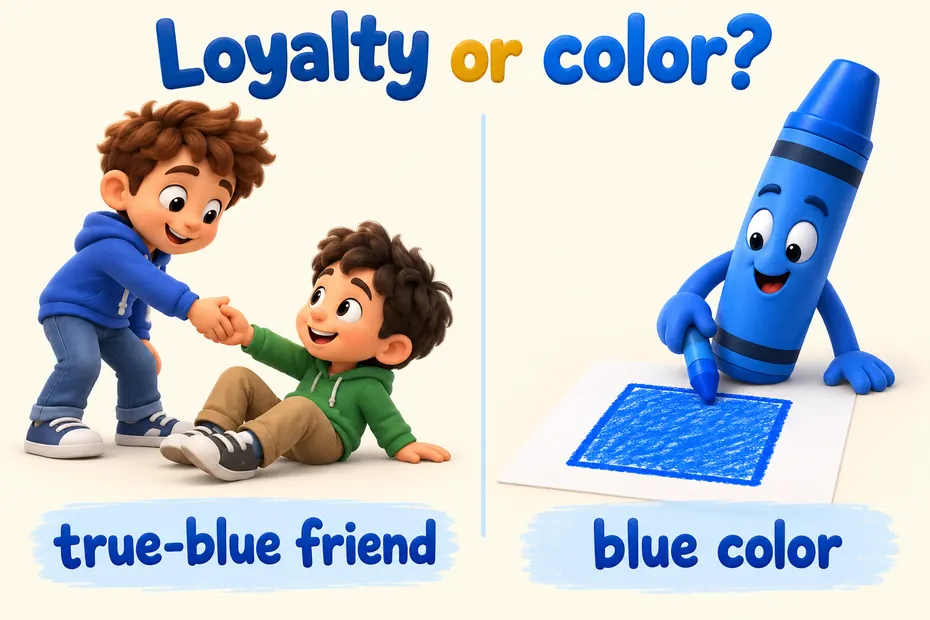
- A blue object and a loyal person express different meanings.
- Specific actions explain loyalty more clearly than a label alone.

What does true-blue describe?
True-blue describes steadfast attachment or allegiance. “The club’s true-blue supporters attended even during the losing season” makes the loyalty clear because those supporters continued showing up when doing so was less rewarding. “The supporters wore blue shirts” reports clothing color; it does not, by itself, establish loyalty.
Merriam-Webster’s true-blue entry lists both loyalty and genuineness. The earlier color examples below are preserved as source material, but they should not be treated as examples of the loyalty idiom. For learning the expression, examples about a devoted friend or supporter give the clearest starting point.
How do you use true-blue in a sentence?
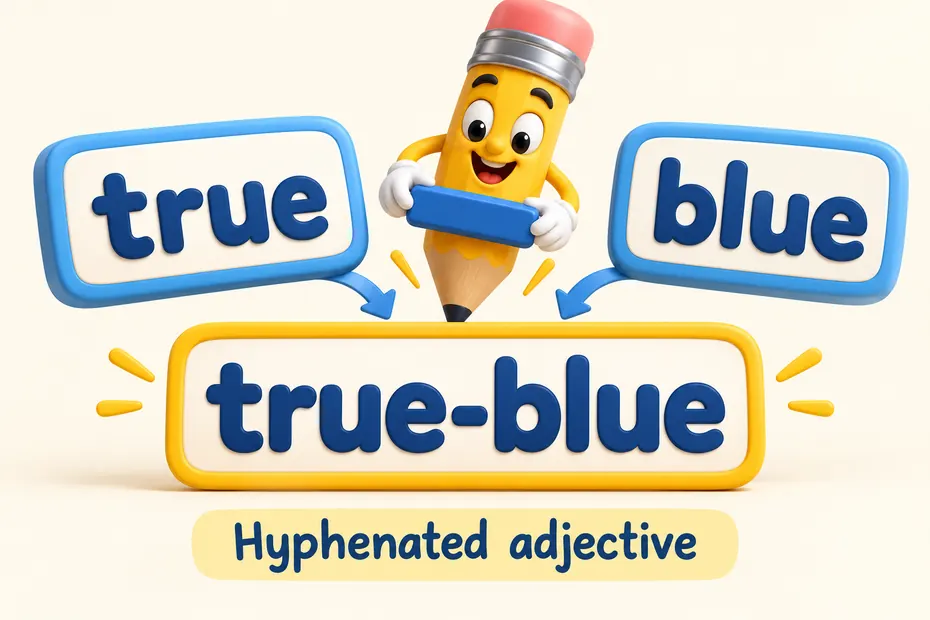
Put the adjective before the noun it describes: “a true-blue friend,” “a true-blue supporter,” or “a true-blue romantic.” Then add a verb and an action to make a complete sentence. “A true-blue friend” is a noun phrase; “A true-blue friend helped us move” is a complete clause.
| Phrase | Complete original sentence | Meaning |
|---|---|---|
| A true-blue friend | A true-blue friend checked on us after the storm. | Faithful friendship. |
| True-blue supporters | The true-blue supporters stayed until the last whistle. | Continued allegiance. |
| A true-blue romantic | A true-blue romantic planned the anniversary picnic. | A genuine enthusiast for romance. |
| A blue jacket | A blue jacket hung beside the door. | Literal clothing color. |
Do not insert the expression before or after an unrelated statement merely to emphasize truth. “The train leaves at six, true blue” is not a useful ordinary model. If your purpose is to confirm a fact, say “The train definitely leaves at six” or provide the timetable. The adjective serves a descriptive role, not a general truth marker.
Which older examples need clarification?
The sentence “We can mix yellow and blue to make true blue” below is not a reliable lesson in ordinary pigment mixing: yellow and blue paint generally produce green, with the actual result depending on the pigments. It also does not demonstrate the loyalty meaning. For this vocabulary lesson, use “The true-blue friend kept her promise” instead.
The original introduction offers a specific cloth-and-indigo origin story. The dictionary checked for this refresh connects blue with constancy and dates the adjective to approximately 1636; that does not establish the original article’s proposed sixteenth-century dye explanation. Treat the precise origin story as unverified rather than repeating it as a settled fact.
Original examples with clear context
- Our true-blue volunteers returned every weekend.
- She remained a true-blue supporter of the local theater.
- A true-blue friend listened before offering advice.
- The true-blue fans cheered through the final minute.
- He was a true-blue romantic who saved every anniversary card.
- The club thanked its true-blue members for years of service.
- Her actions showed that she was a true-blue friend.
- The narrator describes the neighbor as a true-blue ally.
The actions carry the meaning in these examples. Returning, listening, cheering, and serving make loyalty visible. “A true-blue person did something” is much harder to interpret because person names no relationship and something names no evidence. Add the relationship and action whenever the sentence needs to teach the phrase.
Frequently asked questions about true blue
Does true-blue mean that something is blue?
In the loyalty expression, no. A true-blue friend can wear any color. A phrase about a blue shade may describe color literally, but context must distinguish that use from faithfulness. If you are teaching the idiom, choose a person’s commitment or behavior rather than a crayon, bicycle, or shirt.
Should I use a hyphen?
The dictionary headword for the adjective is true-blue, so that is a straightforward spelling to follow in a phrase such as “a true-blue friend.” The two-word form can appear in other uses. Keep the spelling consistent and distinguish a dictionary adjective from a product name or title that has its own styling.
Is loyal an exact replacement in every example?
Loyal works well when the expression describes steadfast support: “a loyal friend” or “loyal fans.” It does not cover every genuine-type use equally well. “A genuine romantic” is closer to “a true-blue romantic” than “a loyal romantic.” Choose a replacement after identifying which meaning the sentence expresses.
Can true-blue be used in a formal tribute?
Yes, when the audience understands the expression and loyalty is the intended meaning. For example, a club tribute can thank “our true-blue volunteers.” Add the work they performed to make the praise concrete. In a technical report, a more specific term such as long-serving may communicate a measurable fact better.
More true blue sentence examples

Have you ever heard someone being described as “true blue”? This common phrase describes someone who is loyal, faithful, and genuinely trustworthy. In essence, a “true blue” person is someone who can be counted on in any situation.
The term “true blue” dates back to the 16th century and is believed to have originated from the blue cloth dyed with indigo, which was seen as a symbol of loyalty and trustworthiness. Today, being “true blue” is still celebrated as a commendable trait, signifying someone who is unwavering in their loyalty and commitment.
7 Examples Of True Blue Used In a Sentence For Kids
- True blue is the color of the sky on a sunny day.
- My friend has a true blue bicycle.
- I wear a true blue shirt to school sometimes.
- The peacock has feathers that are true blue.
- My favorite crayon is true blue.
- The ocean is a beautiful shade of true blue.
- We can mix yellow and blue to make true blue.
14 Sentences with True Blue Examples
- True blue is the color you’ll find on our college flag.
- As a symbol of loyalty and support, we proudly wear the true blue college t-shirt.
- The alumni association organizes events for all the true blue supporters of the college.
- The college library is known for its collection of true blue classics.
- The sports teams always compete with true blue determination.
- During the annual fest, everyone must come dressed in true blue attire.
- To join the prestigious academic club, one must prove themselves as a true blue scholar.
- The college canteen serves the best chai for all the true blue chai lovers.
- The true blue sky was a stunning backdrop for the graduation ceremony.
- As a mark of solidarity, the student council required members to wear a true blue ribbon.
- The teachers appreciate students who show true blue dedication to their studies.
- The college website is adorned with pictures of true blue students excelling in various fields.
- To represent the college at intercollegiate events, one must have a true blue spirit.
- The true blue soul of the college reflects in its commitment to social causes.
How To Use True Blue in Sentences?
True Blue is a versatile expression that can be used in various contexts to convey sincerity or authenticity. To use True Blue in a sentence, simply place it before or after a statement to emphasize the truthfulness or genuineness of the statement.
For example:
– “I can assure you that my friend is True Blue, and you can trust her with anything.”
– “His loyalty to the team is unquestionable; he is a True Blue supporter.”
You can also use True Blue to describe a person, place, or thing that is considered genuine or authentic.
– “She is a True Blue friend who always has your back.”
– “The restaurant’s True Blue commitment to using locally sourced ingredients sets it apart from the competition.”
Remember, True Blue is a casual expression, so it is best used in informal conversations or writing. Whether you are praising someone’s loyalty or highlighting the authenticity of a product or service, using True Blue adds a touch of sincerity to your statement.
In conclusion, using True Blue in a sentence is a simple and effective way to emphasize honesty, authenticity, and loyalty. Just remember to place it before or after your statement to convey its true meaning.
Conclusion
In conclusion, “true blue” is a phrase often used to describe something or someone that is absolutely loyal, steadfast, or genuine. It conveys a sense of deep trustworthiness and authenticity. When describing a person as “true blue,” it signifies a strong bond of trust that is unwavering, reflecting their honesty and dedication. Similarly, when used to describe a feeling or statement as “true blue,” it emphasizes the sincerity and genuineness of that sentiment. Overall, “true blue” serves as a powerful descriptor that evokes feelings of loyalty, genuineness, and trust in various contexts.


