Truncated in a Sentence: Meaning and Clear Examples
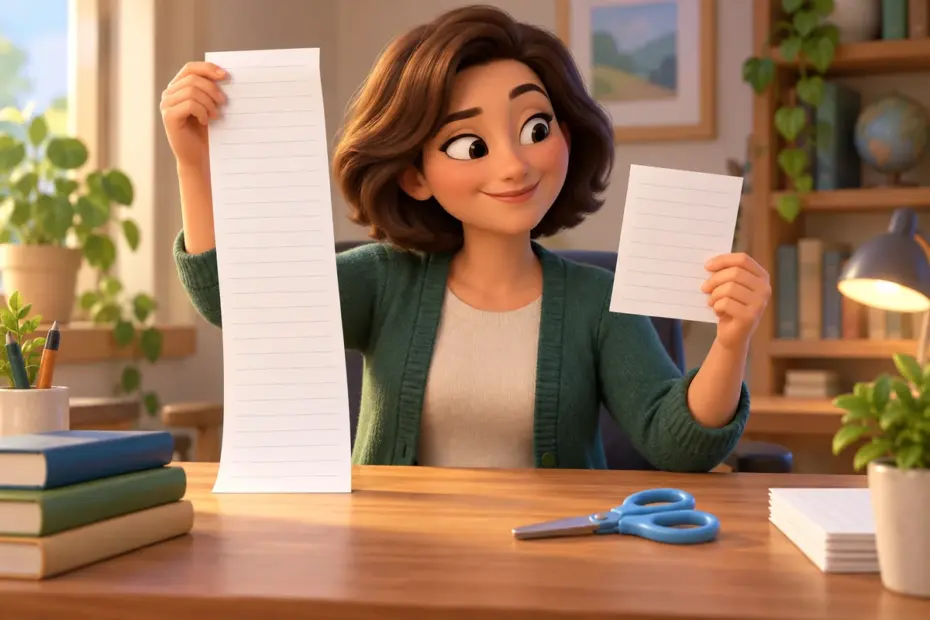
Use truncated in a sentence to describe something shortened by removing part of it. “The email displayed a truncated version of the announcement” means the displayed text was cut down. A truncated sentence may be cut off, but a short sentence is not automatically incomplete or grammatically incorrect.
Key facts at a glance
- Truncated means shortened or cut down.
- Truncated is the past tense and past participle of truncate.
- A truncated message may lose information at its end.
- A short complete sentence is different from an incomplete fragment.
- Truncating a decimal drops digits rather than rounding the value.
What does truncated describe?
Truncated describes a reduced version of something: a report, a meeting, a message, or a number. The American Heritage definition of truncate includes general shortening and the specific numerical operation of discarding decimal digits.
The word becomes useful when the reduction matters. “We received the truncated report” suggests that readers did not receive the whole report. “We received the short report” only describes length. The short report could have been written as a complete brief document from the beginning.
Truncated in a sentence: everyday examples
| Context | Original example | What was shortened? |
|---|---|---|
| Text | The phone showed a truncated preview of the email. | The visible message |
| Time | The storm forced us to follow a truncated schedule. | The planned activities |
| Editing | The producer used a truncated version of the interview. | The recorded conversation |
| Data | The field contained a truncated customer name. | The stored name |
| Numbers | The value was truncated to two decimal places. | The digits retained |
A good example identifies either the original item or the result of shortening. “The announcement was truncated” leaves the cause and effect unstated. “The announcement was truncated to fit the display, hiding the final instruction” explains why the reduction affects the reader.

Is a truncated sentence always a fragment?
A truncated sentence can become a fragment if essential grammatical material is removed, but shortening alone does not produce a fragment. “We waited outside the station until noon” can become “We waited.” The shorter version still contains a subject and a complete verb, and it expresses a complete statement.
By contrast, “Because the train was late” leaves a dependent clause without a main clause. Purdue OWL explains sentence fragments as incomplete constructions and notes that fragments may be deliberately used for emphasis in some writing contexts. Formal prose usually needs a complete statement.
When discussing a piece of dialogue, distinguish an unfinished utterance from a short complete reply. “I was going to tell you—” ends before the speaker finishes. “Wait.” is a complete imperative, although it contains one written word. Word count alone cannot tell you whether grammar is missing.
How do you use the verb and adjective forms?
Use “truncated the report” when a subject performs the action: “The editor truncated the report to meet the limit.” Use “was truncated” when the sentence focuses on the affected item: “The report was truncated before publication.” Use “a truncated report” to describe the resulting document.
- The software truncated the filename after twenty characters.
- The interview was truncated to leave room for the weather forecast.
- We heard only a truncated account of the debate.
- The truncated message omitted the meeting location.
- She compared the full transcript with the truncated version.
In a numerical example, be explicit about the operation. Truncating 8.769 to two decimal places gives 8.76; rounding it to two decimal places gives 8.77. That difference makes “rounded” an inaccurate substitute in this example, even though both results use fewer displayed digits.

Clear alternatives and editing checks
Choose shortened for a neutral everyday description, cut off when an ending disappears abruptly, and abridged when discussing a deliberately reduced text. Truncated often draws attention to the missing portion. The best choice depends on what the reader needs to understand about the reduction.
- Name the item that was shortened.
- Identify the context, such as a character limit or time limit.
- Explain any missing information that affects meaning.
- Check whether the result remains a complete sentence.
- For numbers, distinguish digit removal from rounding.
“The truncated message caused confusion” becomes more useful as “The truncated message omitted the room number, so three guests waited in the lobby.” The added detail explains the consequence instead of leaving the reader to guess.
Do not assume truncation is always a mistake. A preview can be intentionally shortened while the full message remains available elsewhere. However, a truncated emergency instruction or address may cause a real loss of meaning. An example should describe that difference rather than treating every shorter text as defective.
Frequently asked questions
Can truncated describe a meeting?
Yes. “The committee held a truncated meeting because the building closed early” describes a meeting shortened from its planned length. Adding the reason makes the example clearer. A meeting that was simply scheduled to be brief would more naturally be called short unless a reduction actually took place.
What is the noun related to truncated?
Truncation is the noun for the shortening process or its result. “The truncation removed the final paragraph” identifies what the editing operation did. Use truncated to describe the affected item, as in “a truncated message,” and truncate when naming the action, as in “Do not truncate the address.”
Does truncated mean summarized?
Not necessarily. A summary selects and restates the main ideas, while a truncated version has been shortened by removing a portion. “The preview was truncated after the first line” does not imply that the remaining line captures every main idea. Choose summarized when selection and condensation are the important actions.
How can I fix an accidentally cut-off sentence?
Check the full source if it is available, then restore the missing words or rewrite the sentence as a complete statement. Adding a period does not supply a missing verb or main clause. If the missing material is unknown, acknowledge the gap instead of inventing an ending that changes the message.
Conclusion
To use truncated in a sentence, choose the intended meaning first, then add a context clue that makes that meaning clear. Match the grammar and spelling to the example rather than relying on the sound of the word alone.
Ever encountered a truncated sentence? This type of sentence is one that has been cut short, often leaving out important information. When a sentence is truncated, it can change the meaning or leave the reader hanging, prompting them to fill in the missing pieces.
Truncated sentences can be a powerful tool in writing, adding a sense of mystery or urgency to the text. By abruptly ending a sentence, the writer can evoke suspense or emphasize a point. Understanding how to use truncated sentences effectively can enhance the flow and impact of your writing.
7 Examples Of Truncated Used In a Sentence For Kids
- The sun sets when the day is truncated.
- His story was truncated by the loud noise.
- The flower’s stem was truncated when it was picked.
- The long line was truncated by the sudden turn.
- The caterpillar’s body looked truncated after it turned into a butterfly.
- The teacher’s lesson was truncated by the bell ringing.
- Her hair was truncated to just above her shoulders.
14 Sentences with Truncated Examples
- The professor truncated the lecture to leave time for questions at the end.
- I had to submit a truncated version of my research paper because of the word limit.
- The internet connection was so slow that the video lecture kept getting truncated.
- The workshop on time management was truncated due to technical difficulties.
- I had to truncated my study session because I had to attend a meeting.
- The library hours were truncated during the exam period to accommodate for extended study hours.
- The group project presentation got truncated because one of the team members was absent.
- The college festival was truncated due to unexpected rain, causing many activities to be canceled.
- The guest lecture was truncated when the speaker had to leave early for another commitment.
- The sports tournament had to be truncated because of bad weather conditions.
- The discussion on the new curriculum was truncated as the faculty had to attend an urgent meeting.
- The debate competition was truncated when the judges had to leave before the final round.
- The training workshop was truncated to allow participants to catch their transport on time.
- The study group meeting got truncated because everyone had to rush to another class.
How To Use Truncated in Sentences?
Truncated is used when you want to indicate that something has been shortened or cut off. It can help make your writing more concise and to the point.
To use “truncated” in a sentence:
-
Start by identifying a situation where something has been shortened or cut off. For example, “The speaker’s presentation was truncated due to technical difficulties.”
-
Place the word “truncated” in your sentence where you want to convey the idea of something being shortened. For instance, “The novel’s ending felt truncated, leaving readers wanting more.”
-
Make sure the context of your sentence clearly indicates that something is being shortened or cut off to use the word “truncated” correctly. An example could be, “The email’s content was truncated in order to fit within the character limit.”
-
Remember that “truncated” is typically used in more formal or technical contexts to describe cases where information or text has been cut short. It is not commonly used in casual conversations.
By following these steps and considering the context of your sentence, you can effectively incorporate the word “truncated” into your writing to convey the idea of something being shortened or cut off.
Conclusion
In conclusion, sentences with truncated information are concise and to the point, making them easy to understand and quick to digest. While they may lack detail and context, they serve a specific purpose of conveying essential information in a succinct manner. Truncated sentences can be effective in various contexts, such as headlines, bullet points, or social media posts, where brevity is key.
By utilizing sentences with truncated content, writers can convey their message efficiently and capture the reader’s attention. Whether used for emphasis, clarity, or impact, truncated sentences are a valuable tool in communication that can help convey important information in a clear and straightforward manner.


