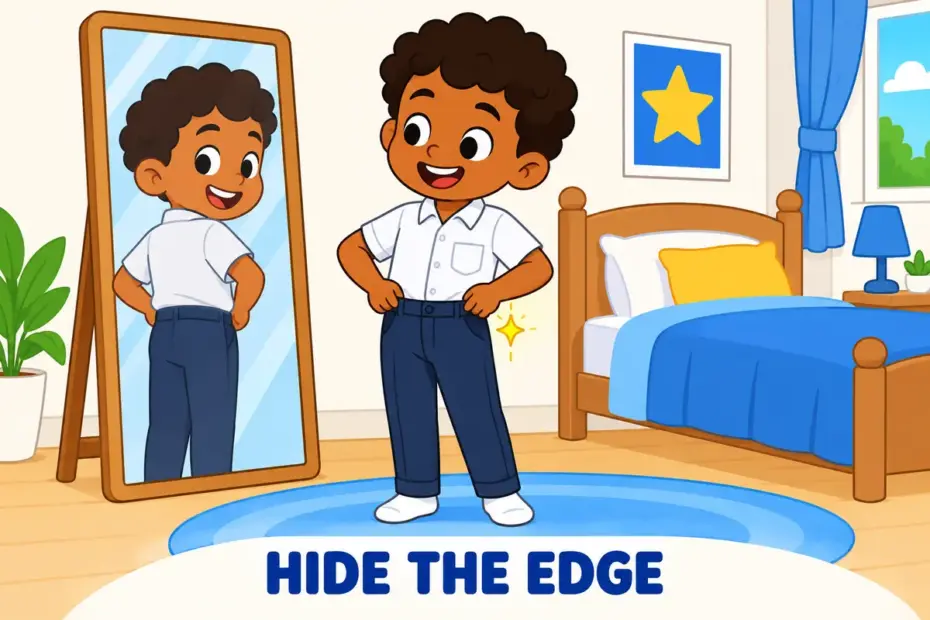
Tuck in has three everyday meanings: to push fabric or bedding into place, to settle a child into bed, and, in British English, to start eating with appetite. To use tuck in in a sentence, let the object show which sense you mean: “Tuck in your shirt” or “Tuck the children in.”
Tuck in at a glance
- Tuck in is a phrasal verb with the forms tuck, tucks, tucking and tucked.
- It is separable in the clothing and bedtime senses but fixed in the eating sense.
- The three meanings are fold fabric away, settle someone into bed, and begin eating.
- A pronoun must sit between verb and particle: tuck them in, never tuck in them.
- The eating sense belongs to British English and to relaxed, spoken settings.
What does tuck in mean?
Tuck in is a phrasal verb meaning to push the loose edge of fabric or bedding into place, to settle someone into bed, or, in British English, to start eating heartily. The Cambridge entry for tuck in records the clothing and eating senses, and the context tells them apart.
| Sense | Plain meaning | Example sentence |
|---|---|---|
| Clothing and fabric | Push a loose edge out of sight | Tuck in your shirt before the photo. |
| Bedtime | Settle someone into bed | She tucked the children in at eight. |
| Eating, British | Begin eating with appetite | Tuck in; the soup is getting cold. |
One limitation is worth stating plainly: tuck in is informal in its eating sense and easy to misread without context. In American English the phrase usually means the clothing or the bedtime sense, so a sign saying tuck in at a canteen reads as British to many readers.
How do you use tuck in in a sentence?
Tuck in is separable in the clothing and bedtime senses, so you can say tuck in your shirt or tuck your shirt in. The eating sense is intransitive and fixed, and tuck into takes the food as its object.
| Pattern | Example | What it signals |
|---|---|---|
| tuck in + object | Tuck in your shirt. | Neutral order for the clothing sense. |
| tuck + object + in | Tuck your shirt in. | Separated order, equally natural. |
| tuck + pronoun + in | She tucked them in. | The pronoun must sit between verb and particle. |
| tuck in (no object) | Tuck in, everyone. | The British eating sense, used alone. |
| tuck into + food | They tucked into the pie. | Adds the food being eaten as an object. |
When fabric is folded back rather than hidden, fold is the more exact verb, and when something is snuggled closely into a space, nestle describes the position.
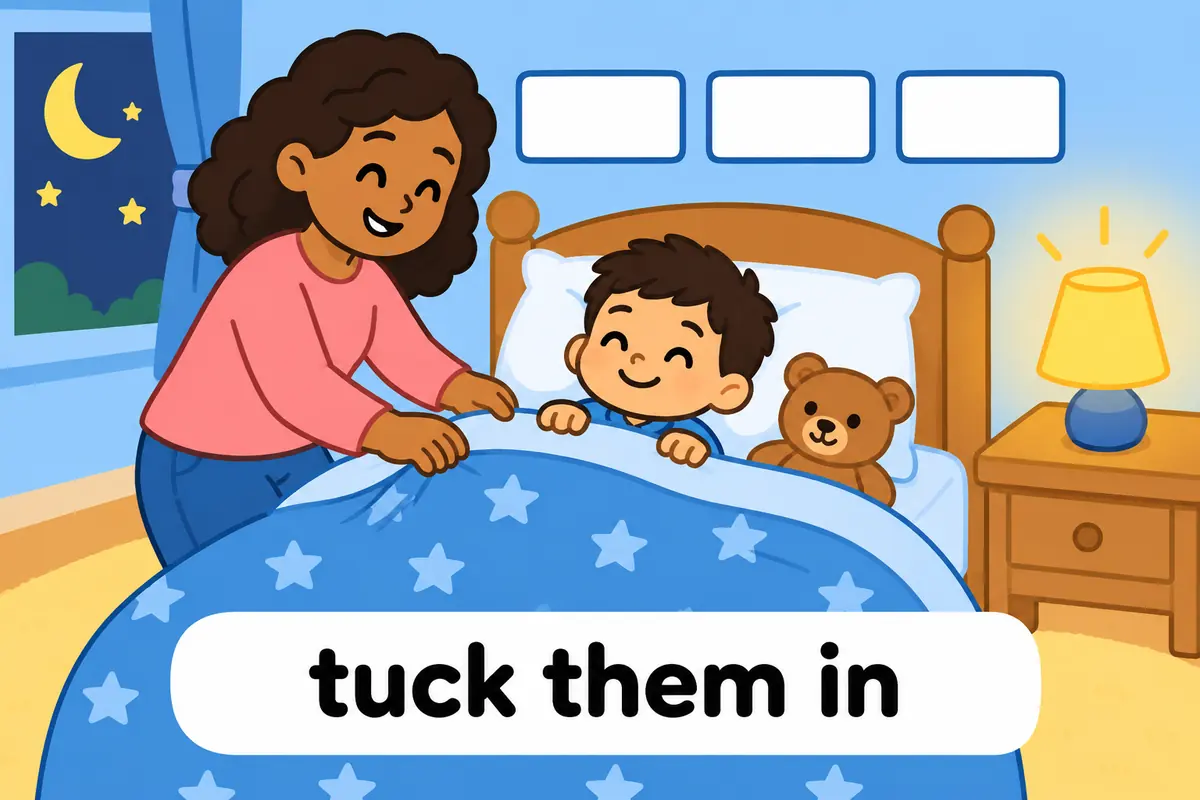
Tuck in in a sentence: examples across contexts
Tuck in shifts meaning with its object, so context does all the work. The ten sentences below move from a school cloakroom to a British kitchen, and each one signals its sense clearly.
| Context | Example sentence | Why this works |
|---|---|---|
| School | The teacher asked him to tuck in his shirt before assembly. | Clothing plus a clear object fixes the sense. |
| Fabric | Tuck in the loose corner of the sheet. | A fabric object signals the making-the-bed use. |
| Home | She tucked the baby in and turned off the light. | The pronoun between verb and particle is mandatory. |
| Fiction | He tucked in the blanket and crept out of the room. | A separated order with a long noun. |
| British meal | Tuck in, everyone, before it gets cold. | No object, so the eating sense is unmistakable. |
| Restaurant review | We tucked into a huge plate of pasta. | Tuck into adds the food as an object. |
| Conversation | Come on, tuck in; there is plenty left. | A warm host encouraging guests to eat. |
| Narrative | She tucked her scarf in against the wind. | The separated form suits a short possessive object. |
| Photography | Tuck in that stray collar before I take the picture. | The demonstrative object keeps the clothing sense. |
| Advice | Tuck in properly and the line of the jacket improves. | An impersonal instruction in the clothing sense. |
Tuck in vs tuck away and tuck into
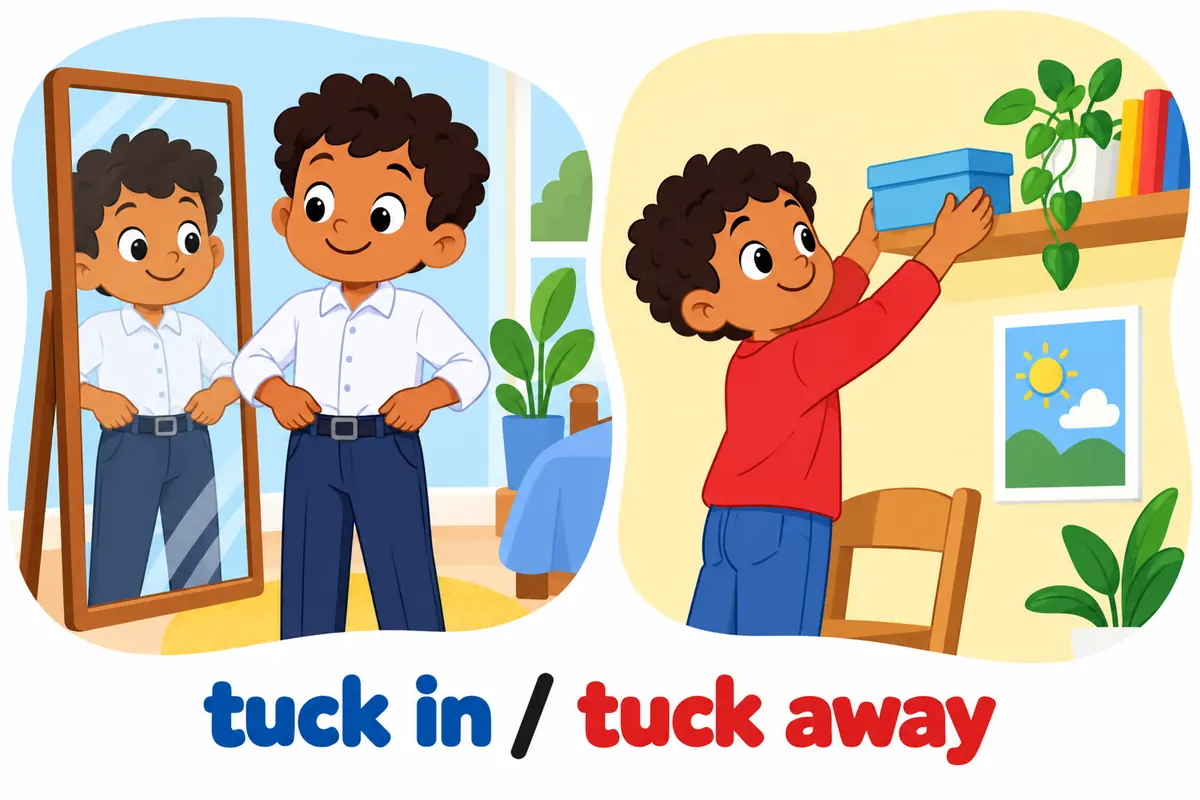
Tuck in overlaps with tuck away and tuck into, and the three are separated by what follows the verb. The table keeps them apart by meaning and by object.
| Phrase | Core idea | Typical object | Separable? |
|---|---|---|---|
| tuck in | Push an edge into place, or settle to bed | A shirt, a sheet, a child | Yes, in these senses |
| tuck away | Store something out of sight | Money, a letter, a machine | Yes |
| tuck into | Eat with appetite | Food and drink | No, the particle is fixed |
| tuck in (eating) | Begin eating, British | None; used alone | No |
Verdict: choose tuck in for fabric or bedtime, tuck away for storing something out of sight, and tuck into when you want to name the food being eaten.
Word forms and grammar of tuck in
Tuck in inflects regularly, and the base verb tuck also works alone in the clothing sense. To smooth a crease before tucking, people often smooth the fabric first, and the forms below cover every ordinary use.
| Form | Part of speech | Example |
|---|---|---|
| tuck in | phrasal verb, base | Tuck in your shirt. |
| tucks in | phrasal verb, third person | He tucks in his tie each morning. |
| tucking in | phrasal verb, present participle | She is tucking the children in. |
| tucked in | phrasal verb, past and participle | The bed was neatly tucked in. |
| tuck | verb and noun | He gave the blanket a final tuck. |
| tuck in it | non-standard order | Correct to tuck it in. |
The separated order matters most with pronouns, so a learner who writes tuck in them reveals the grammar of the clothing sense even when the meaning is otherwise clear.
Common mistakes with tuck in
- Incorrect:
Tuck in them and say goodnight.Correct: Tuck them in and say goodnight. Rule: A pronoun object must sit between the verb and the particle. - Incorrect:
The restaurant sign said tuck in the food.Correct: Tuck into the food. Rule: The eating sense is intransitive, so food follows into, not in. - Incorrect:
Please tuck in your scarf the drawer.Correct: Please tuck your scarf away in the drawer. Rule: Storing something out of sight needs tuck away, not tuck in. - Incorrect:
The instruction was to tuck in the blanket tightly around the bed.Correct: The instruction was to tuck the blanket in tightly around the bed. Rule: A long object is clearer when the particle separates it from the verb.
Practice using tuck in
Work through the six items, then read the reasons rather than only the answers.
- Fill the gap: Remember to ______ your shirt ______ before the school photo.
- Choose the better word: The children (tucked into / tucked away) their dinner happily.
- Correct the error: She tuck in them at seven o clock.
- Build a sentence: use tuck in about a loose bedsheet.
- Spot the register: which belongs in a British canteen — tuck in, there is plenty, or begin your meal, please?
- Rewrite with a pronoun: Tuck in the blanket.
Answers
- tuck your shirt in — the separated order is natural with a possessive object.
- tucked into — the food follows into, while tuck away would mean storing it out of sight.
- She tucked them in at seven — the pronoun goes between the verb and the particle.
- Model answer: Tuck in the loose corner of the sheet before you leave the room.
- The first sentence fits a British canteen — it is the warm, informal eating sense.
- Tuck it in — a pronoun replaces the noun and moves between verb and particle.
The bottom line
Use tuck in in a sentence when you want to hide a loose edge, settle someone into bed, or, in British English, begin eating. The two facts that decide most sentences are these: the clothing and bedtime senses are separable, so a pronoun goes between tuck and in, while the eating sense is fixed and takes no object. Where fabric is folded rather than hidden, wrap or unfold describes the movement more exactly.
Frequently asked questions about tuck in
Does tuck in need an object?
It depends on the sense. The clothing and bedtime meanings need an object, as in tuck in your shirt or tuck the children in. The British eating sense takes no object at all, so tuck in works as a complete instruction on its own.
Can tuck in be separated?
Yes, in the clothing and bedtime senses. You can say tuck in your shirt or tuck your shirt in, and a pronoun must go between, as in tuck them in. The eating sense is fixed, so nothing can be inserted.
Is tuck into the same as tuck in?
They are related but not identical. Tuck into takes the food as an object, as in they tucked into the pie, while tuck in stands alone. Both describe eager eating, and tuck into is the more common form in writing.
Why do British people say tuck in at meals?
The phrase is a British idiom that invites people to eat with appetite, and it feels warm and informal rather than polite and distant. In American English the same words usually describe clothing or bedtime, so a canteen sign can sound oddly British to some readers.
Tuck in in a sentence can describe pushing fabric or another loose end into place, making someone comfortable under bedcovers, or beginning to eat eagerly. These uses depend on the object and context: “tuck in a shirt,” “tuck a child in,” and “tuck into dinner” follow different patterns.
Key facts at a glance
- Tuck in can mean arrange clothing or fabric neatly.
- Tuck someone in means settle someone in bed with covers.
- Tuck in or tuck into food means begin eating eagerly; this use is informal and especially common in British English.
- Tuck something into or under something names its destination.
- Context and the direct object distinguish the phrasal verb meanings.
What does tuck in mean?
Tuck in has several phrasal-verb uses. A person can tuck a loose edge into a garment or another place, tuck someone in under bedcovers, or, in informal British English, tuck in to a meal. Cambridge Dictionary lists these as separate meanings, so the object and surrounding phrase matter.
Compare “Mara tucked her shirt in,” “Mara tucked her child in,” and “Mara tucked into supper.” The first describes clothing, the second bedtime, and the third eating eagerly. A sentence with no context may allow more than one reading.
How do you use tuck in for clothing and fabric?
Use tuck something in or tuck something into a place when you push a loose edge neatly into position: “Tuck your shirt in,” “Tuck the sheet under the mattress,” or “She tucked the note into her pocket.” The destination often follows into, under, or behind.
When the object is a pronoun, place it before the particle: “Tuck it in,” not “Tuck in it.” With a full noun, both “tuck your shirt in” and “tuck in your shirt” are used. Add the destination when it helps explain where the item goes.
What does tuck someone in mean?
Tuck someone in means settle someone comfortably in bed by arranging the covers around them. The object is the person: “The sitter tucked the child in after the story.” Cambridge also records the British variant tuck someone up.
This use is distinct from tucking in a garment because the person is the direct object and the bed is understood from context. In a sentence about sleep, a pillow, or a bedtime story, readers will usually recognize the bedtime meaning.
When does tuck in mean start eating?
In informal British English, tuck in or tuck into something means begin eating eagerly: “Everyone sat down and tucked into the pie.” A host can say “Please tuck in” as a friendly invitation to start.
This sense usually has food as its object when into is present. In American English, readers may more readily associate tuck in with clothing or bedtime, so use “start eating” or “help yourself” if the audience might misread it.
Examples of tuck in in a sentence
- Please tuck your shirt in before the school photo.
- She tucked the blanket under the mattress on both sides.
- He tucked the train ticket into the pocket of his coat.
- The babysitter tucked the toddler in after a bedtime story.
- After the host served dinner, the guests tucked in.
- The children tucked into warm bread after the hike.
- Tuck the loose strap in so it does not catch on the door.
- Before bed, I tucked the dog’s blanket around its cushion.

Frequently asked questions
What does tuck in mean in a sentence?
Tuck in has several related uses. It can mean push a loose edge of clothing or bedding into place, settle someone under covers, or—especially in informal British English—begin eating eagerly. The object and surrounding words show which sense the sentence intends.
How do you use tuck in for clothing?
Use tuck something in or tuck something into something when you push fabric into place: “Tuck your shirt in” or “Tuck the hem into your trousers.” With a pronoun, say “tuck it in,” not “tuck in it.” You can also tuck a sheet under a mattress.
What does tuck someone in mean?
Tuck someone in means make a person comfortable in bed, usually by arranging the covers around them. The phrase often refers to a bedtime routine: “Her father tucked her in after reading a story.” It is different from tucking a shirt in or inviting people to eat.
Is tuck in formal or informal?
The neat-clothing and bedtime meanings are ordinary conversational English. The eating sense—“Please tuck in”—is informal and especially associated with British English; “start eating” or “help yourself” may suit a more formal setting. Choose the phrase that matches the audience and context.

Conclusion
Use tuck in with its object and context in mind: tuck fabric into place, tuck a person into bed, or tuck in to food in informal British usage. Naming the shirt, covers, or meal makes the sentence easy to understand.
Sources
- Cambridge Dictionary: tuck
- Cambridge Dictionary: tuck someone in
- Cambridge Dictionary: tuck in/tuck into something
Ever wondered how to use the phrase “tuck in” correctly in English? “Tuck in” is a versatile phrasal verb that can mean to put something into a snug or secure place, or to begin eating with enthusiasm. It is often used in casual conversations and informal writing to convey the act of starting to eat a meal with gusto or to neatly arrange something.
Understanding the different meanings and contexts of “tuck in” can help you express yourself more clearly and accurately in English. Whether you’re talking about enjoying a delicious meal or neatly fixing your sheets, mastering this phrasal verb will enhance your language skills and enable you to communicate effectively in various situations.
7 Examples Of Tuck In Used In a Sentence For Kids
- Tuck in your shirt before going to school.
- Don’t forget to tuck in your teddy bear when you go to sleep.
- It’s time to tuck in for a nap after lunch.
- Tuck in your blanket tightly to stay warm at night.
- Remember to tuck in your chair after you finish eating.
- Let’s tuck in our napkins before we start eating.
- Tuck in your shoelaces so they don’t come undone.
14 Sentences with Tuck In Examples
- Tuck in your shirt before you go for your presentation.
- Make sure to tuck in your bedsheets properly to avoid them slipping off during the night.
- It’s getting cold, so don’t forget to tuck in your scarf before heading out.
- Remember to tuck in your ID card in your pocket so you don’t lose it.
- Before entering the exam hall, tuck in your phone in your bag so you don’t get into trouble.
- Don’t leave any loose papers lying around, tuck them in your folder.
- Tuck in your chair under the table after you finish studying to save space.
- When attending a formal event, always tuck in your shirt for a polished look.
- While sitting in the library, tuck in your hair to avoid distractions.
- Before leaving your hostel room, remember to tuck in your belongings to keep them safe.
- If you’re feeling cold at night, tuck in your blanket snugly.
- Before starting your group study session, tuck in your notebooks and pens for easy access.
- As a gesture of respect, always tuck in your dupatta properly while wearing traditional attire.
- When going for a job interview, make sure to tuck in your shirt and look presentable.
How To Use Tuck In in Sentences?
To use “Tuck In” in a sentence, follow these steps:
-
Understand the meaning: “Tuck In” means to make someone comfortable in bed by pulling the covers tightly around them or by making sure they are settled and snug.
-
Select your context: Decide how you want to use “Tuck In” in your sentence. For example, you can use it in a literal sense like “I will tuck in my child before bedtime,” or in a figurative sense like “The cozy atmosphere of the cabin tucked us in for the night.”
-
Construct your sentence: Start your sentence with a subject, followed by the phrase “tuck in,” and then add the object of the action. For example, “She will tuck in the blanket around the baby” or “He always makes sure to tuck in his friends before leaving.”
-
Check your sentence: Make sure your sentence makes sense and accurately conveys the idea of making someone comfortable before sleep.
-
Practice using it: Try creating different sentences using “Tuck In” to become more comfortable with incorporating it into your conversations or writing.
Remember to be mindful of the context in which you use “Tuck In” to ensure clarity in your communication. Practice using it regularly to become more confident in incorporating this phrase into your vocabulary.
Conclusion
In conclusion, “tuck in” is a commonly used phrase that refers to the act of securing or covering someone or something in a neat and snug manner. This phrase is often used in the context of children being tucked into bed, where they are carefully and lovingly covered with blankets or sheets. Similarly, clothes can be tucked in to ensure a sleek and tidy appearance.
Whether it’s tucking in a child at night, tucking in a shirt for a professional look, or tucking in sheets for a clean bed, the phrase “tuck in” conveys a sense of care, attention to detail, and completeness. It signifies a final act of preparation or comfort, making the individual or object feel safe, secure, and well-kept.


