
In a sentence, tumultuously means in a noisy, disorderly, or emotionally turbulent way. “The crowd cheered tumultuously” describes loud, unruly excitement; “her thoughts shifted tumultuously” uses the word figuratively for inner upheaval. The adverb tells how an action unfolds, so match it with a verb and a context that supports that intensity.
Quick guide
- Use tumultuously for noisy commotion, disorderly movement, or a strongly turbulent emotional process.
- It modifies a verb: “The waves surged tumultuously.” Use the adjective tumultuous before a noun: “tumultuous waves.”
- It can appear before or after the verb it modifies, or with an introductory participial phrase. Choose the position that makes the sentence easy to follow.
- The word itself does not require a comma. Punctuate according to the sentence structure; never use a comma alone to join two complete clauses.


What Does “Tumultuously” Mean?
Tumultuously is the adverb form of tumultuous. It describes an action carried out amid loud commotion or confusion, or a process marked by turbulence and strong feelings. Oxford Learner’s Dictionary gives the adjective senses “very loud” and “involving strong feelings,” as well as a sense involving difficulty and change; the American Heritage Dictionary also distinguishes noise, disorderly commotion, and mental or emotional agitation. The exact shade comes from the subject and verb.
| Context | What is turbulent? | Example |
|---|---|---|
| Noise or reaction | A crowd’s loud response | “The audience applauded tumultuously after the final song.” |
| Physical motion | Irregular, forceful movement | “The river churned tumultuously beneath the bridge.” |
| Figurative emotion | A person’s intense inner state | “He considered the decision tumultuously, pulled between relief and regret.” |
| Events or change | A confused, unstable sequence | “The negotiations progressed tumultuously, with sudden reversals.” |
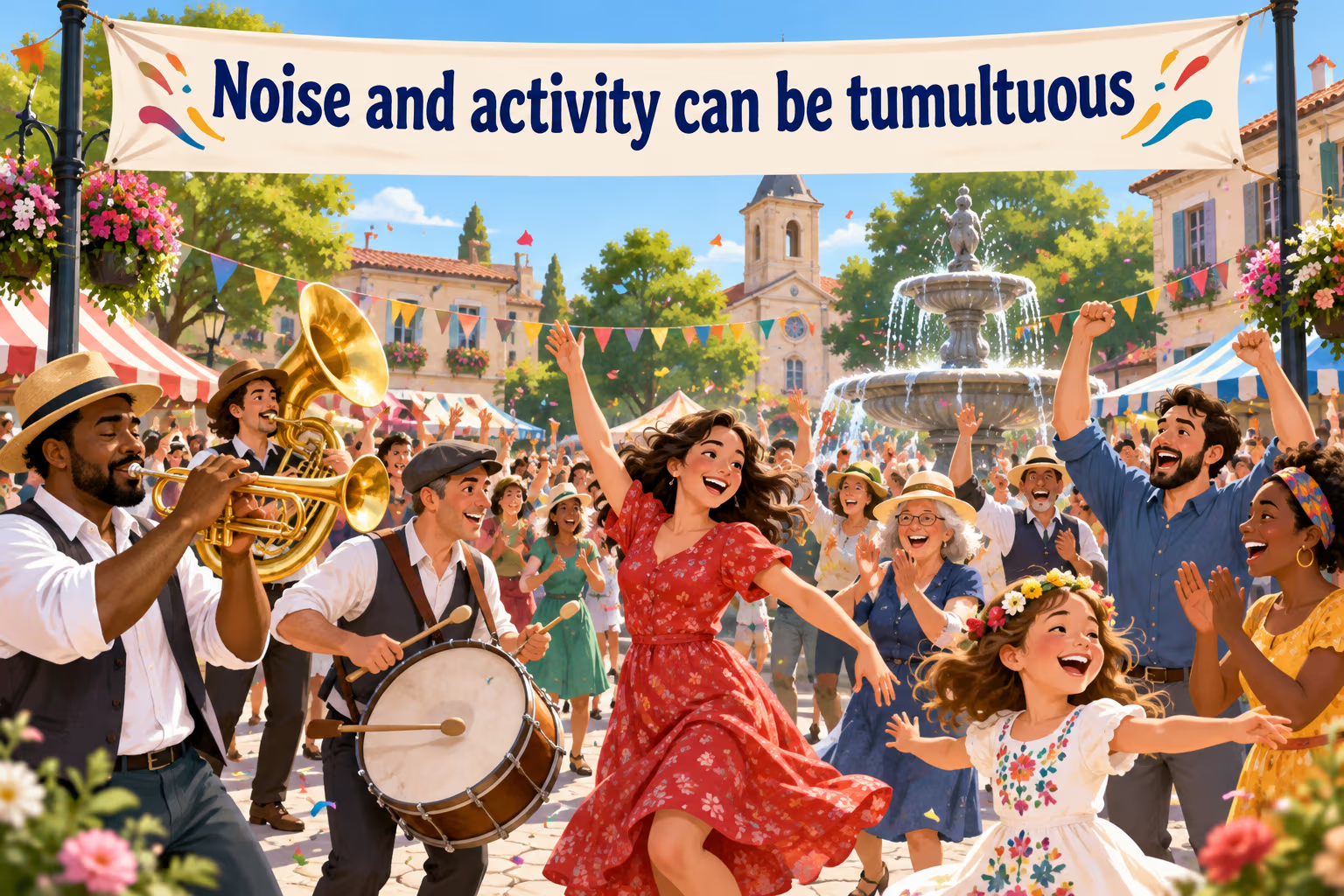
A scene can be busy without being tumultuous. The adverb suggests commotion, disorder, force, or strong agitation, not simply speed or activity. It can describe visible action directly, as with crashing waves, or emotional experience figuratively. In the figurative use, surrounding details should make the inner conflict clear.

Where Does “Tumultuously” Go in a Sentence?
Place tumultuously near the verb it modifies so readers can tell which action is noisy or unsettled: “The crowd tumultuously welcomed the returning team” or “The crowd welcomed the returning team tumultuously.” Both positions can work; the end position often sounds more natural, while the earlier position may emphasize the manner.
At the beginning of a sentence, it can modify an action in an introductory phrase: “Tumultuously rushing through the station, the travelers searched for their platform.” Keep the phrase next to the person or thing doing that action. A misplaced opening modifier can wrongly suggest that the platform, rather than the travelers, was rushing.
How Do You Punctuate “Tumultuously”?
The adverb needs no special punctuation. Do not add commas just because tumultuously is emphatic: “The crowd tumultuously filled the square” is a complete sentence without an inserted comma. If an introductory phrase precedes the main clause, a comma may mark that phrase’s boundary: “Tumultuously cheering from the stands, the students welcomed the team.”
When the adverb appears between two independent clauses, punctuation must separate those clauses. Write “The crowd cheered tumultuously; the band continued playing” or use two sentences. A comma alone would make a comma splice. Purdue OWL explains the boundary choices for independent clauses and conjunctive adverbs; tumultuously itself is not a connector that joins clauses.
What Are the Related Forms?
Tumult is the noun for commotion or uproar; tumultuous is the adjective (“a tumultuous debate”); tumultuously is the adverb (“the debate continued tumultuously”); and tumultuousness is the quality or state. The spelling follows the common pattern of changing adjective-final -ous to -ously for the adverb. Do not use the adverb where a noun or adjective is needed: “the tumultuous crowd,” not “the tumultuously crowd.”

Fresh “Tumultuously” Sentence Examples
- When the final score appeared, supporters tumultuously chanted their team’s name.
- The loose sail flapped tumultuously as the wind shifted over the harbor.
- After the announcement, several speakers responded tumultuously, talking over one another.
- Her memories returned tumultuously, mixing the excitement of the trip with the sadness of its end.
- The council meeting moved tumultuously from one proposal to another before the chair called a recess.
Sources and Further Reading
- Cambridge Dictionary: “tumultuously”
- Oxford Learner’s Dictionaries: “tumultuous”
- American Heritage Dictionary: “tumultuously”
- Purdue OWL: commas vs. semicolons
- Purdue OWL: commas after introductions
Use tumultuously when context shows genuine commotion, turbulence, or emotional upheaval. Place it close to the action it describes, then check that the sentence’s punctuation follows its clause structure.
Have you ever struggled to find the right word to describe a situation where things are chaotic and disorderly? Look no further, as I introduce you to the term “tumultuously.” This word encapsulates the essence of a scenario marked by confusion, noise, and unrest.
When events unfold tumultuously, there is a sense of uproar and commotion that can be overwhelming and difficult to control. It signifies a state of turmoil and turbulence, where things are in a state of disorder and unrest.
7 Examples Of Tumultuously Used In a Sentence For Kids
- The children cheered tumultuously at the school play.
- The wind blew tumultuously during the storm.
- The students sang tumultuously during morning assembly.
- The birds chirped tumultuously in the forest.
- The waves crashed tumultuously against the shore.
- The monkeys played tumultuously in the trees.
- The cars honked tumultuously in the busy street.
14 Sentences with Tumultuously Examples
- Tumultuously cheering on their college sports team, the students painted their faces in school colors.
- The students celebrated the end of exams tumultuously by dancing and playing loud music in the dormitory.
- Tumultuously debating about the best study techniques, the college students couldn’t seem to agree on a strategy.
- Racing tumultuously to get to their last class on time, the students struggled to catch their breath as they entered the lecture hall.
- The students tumultuously protested outside the administration building, demanding better facilities on campus.
- Tumultuously flipping through their textbooks, the students tried to cram in as much information as possible before the exam.
- The students tumultuously brainstormed ideas for their group project, each one eager to contribute their thoughts.
- Tumultuously trying to find a seat in the crowded library during exam week, the students resorted to sitting on the floor.
- The students tumultuously applauded the guest speaker at the college event, inspired by her words of wisdom.
- Tumultuously celebrating after winning the inter-college debate competition, the students lifted their trophy with pride.
- Rushing tumultuously to submit their assignments before the deadline, the students juggled multiple tasks at once.
- The students tumultuously participated in the college festival, enjoying the lively music and food stalls.
- Tumultuously discussing the latest trends in fashion, the students eagerly shared their favorite style tips with each other.
- The students tumultuously lined up outside the exam hall, nervously waiting to begin their final test of the semester.
How To Use Tumultuously in Sentences?
Tumultuously means in a chaotic, noisy, and disorderly manner. When using Tumultuously in a sentence, it is important to create a context that helps convey the sense of chaos and commotion implied by the word.
Here is a guide on how to use Tumultuously in a sentence:
-
Identify a situation or scenario that involves a lot of noise, confusion, or disorder.
Example: “The crowd tumultuously cheered as the team scored the winning goal.” -
Use Tumultuously to describe the actions or reactions in that situation.
Example: “The children tumultuously ran around the playground, laughing and shouting.” -
Consider using adverbs or adjectives to enhance the description and emphasize the chaotic nature of the scene.
Example: “The wind howled tumultuously through the trees during the storm.” -
Ensure that the sentence conveys a sense of disorder, excitement, or high energy to effectively use Tumultuously.
Example: “The protesters marched tumultuously through the streets, demanding justice.”
By following this guide, you can effectively incorporate Tumultuously into your sentences to accurately portray scenes of chaos, noise, and disorder.
Conclusion
In conclusion, sentences using the word “tumultuously” often describe situations or events that are characterized by disorder, chaos, or upheaval. The word conveys a sense of chaos and volatility, suggesting a lack of control or calmness. When used in writing, “tumultuously” adds a vivid and dramatic element to the description of events or emotions, painting a picture of a turbulent and frenzied situation.
By incorporating sentences with “tumultuously” into one’s writing, the reader is able to grasp the intensity and tumult of the scene being described. Whether it’s a tumultuously raging storm, a tumultuously changing political landscape, or tumultuously conflicting emotions, the word effectively captures the essence of disruption and disorder. Its usage brings a sense of urgency and vividness to the narrative, making it an impactful word choice for conveying the chaos and tumult present in a given situation.


