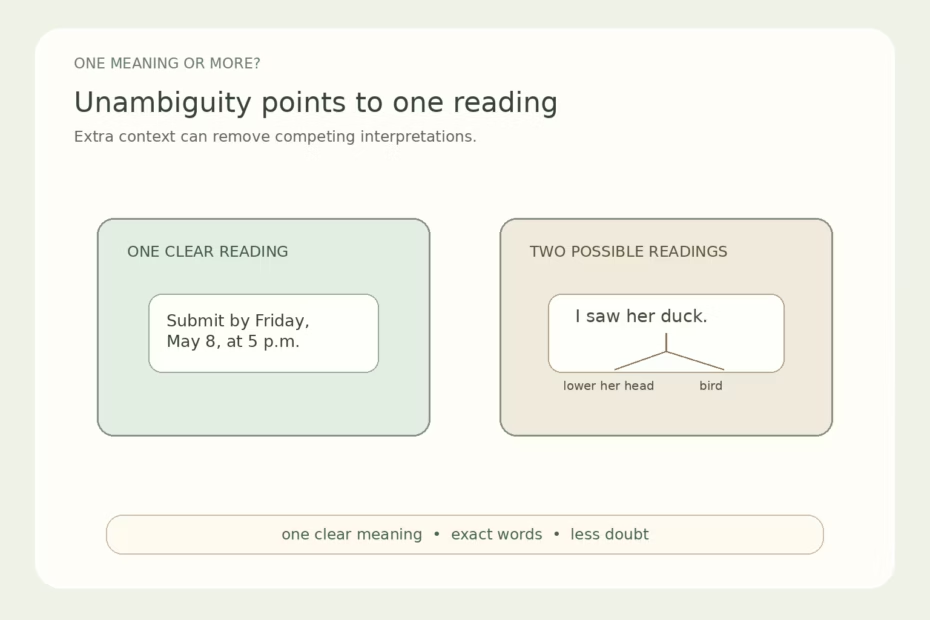
Unambiguity is the quality of being unambiguous: having one clear meaning rather than leaving room for competing interpretations. Oxford defines unambiguous as clear in meaning and understandable in only one way. The noun unambiguity is most at home in formal, academic, legal, or technical discussion. In everyday writing, clarity, clear wording, or a lack of ambiguity is often more natural.

How to use unambiguity in a sentence
Unambiguity is an abstract noun. It usually appears as a general quality or as something associated with a particular expression: unambiguity in a rule, the unambiguity of a definition, or unambiguity in the instructions. Because the word is relatively formal, sentences with clarity or clear may sound more conversational.
- “The unambiguity of the safety rule made it easier to follow.”
- “The editor checked the unambiguity of each label before printing the diagram.”
- “In formal grammar, unambiguity means that each valid expression has at most one parse structure.”
- “The contract depends on the unambiguity of the term used to set the deadline.”
In ordinary usage, the noun is generally treated as uncountable: say the unambiguity of the wording, not usually an unambiguity. If you mean one unclear phrase or reading, use an ambiguity. For instance, “The editor found an ambiguity in the second sentence” describes a specific problem. Oxford lists ambiguity both as a general state and as an instance of wording open to more than one meaning.
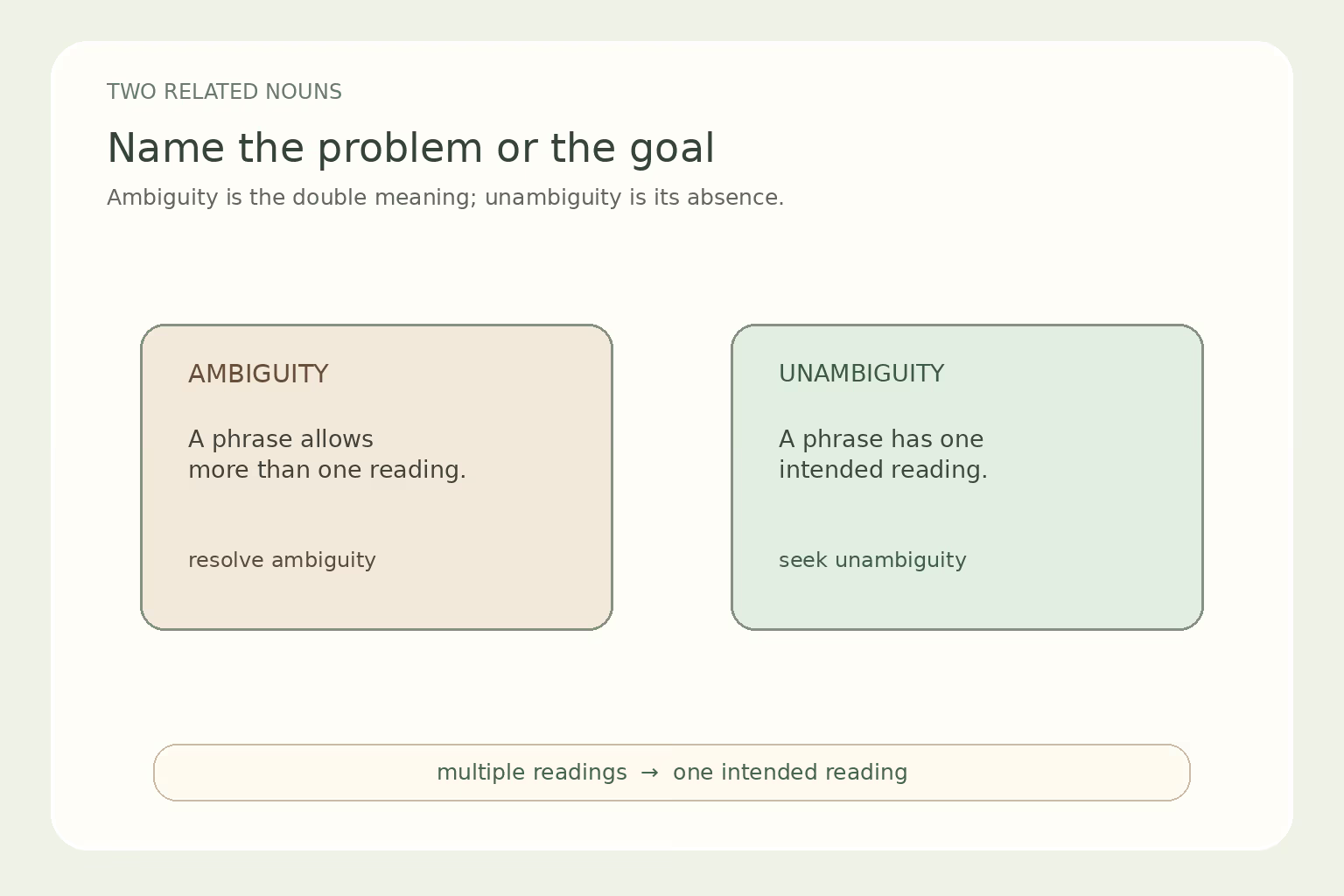
Unambiguity, clarity, precision, and explicitness
These ideas overlap, but they are not identical. Unambiguity concerns how many interpretations a phrase allows: an unambiguous phrase points to one. Clarity is broader and can include organization, familiar wording, and ease of understanding. Precision concerns exactness or fine detail. Explicitness means that information is directly stated rather than left for the reader to infer. A sentence can be precise but difficult to understand, or clear while still allowing more than one interpretation.
Compare these examples:
- Unambiguous: “Submit the form by 5 p.m. on Friday, May 8.” The date and time identify one deadline.
- Clear: “Please send your form before the office closes on Friday.” The instruction is easy to read, though the closing time may need clarification.
- Precise: “The sample weighed 12.4 grams.” The measurement is exact to a stated decimal place.
- Explicit: “The tenant, not the landlord, will arrange the inspection.” The responsible person is directly named.
Fix common sentence patterns
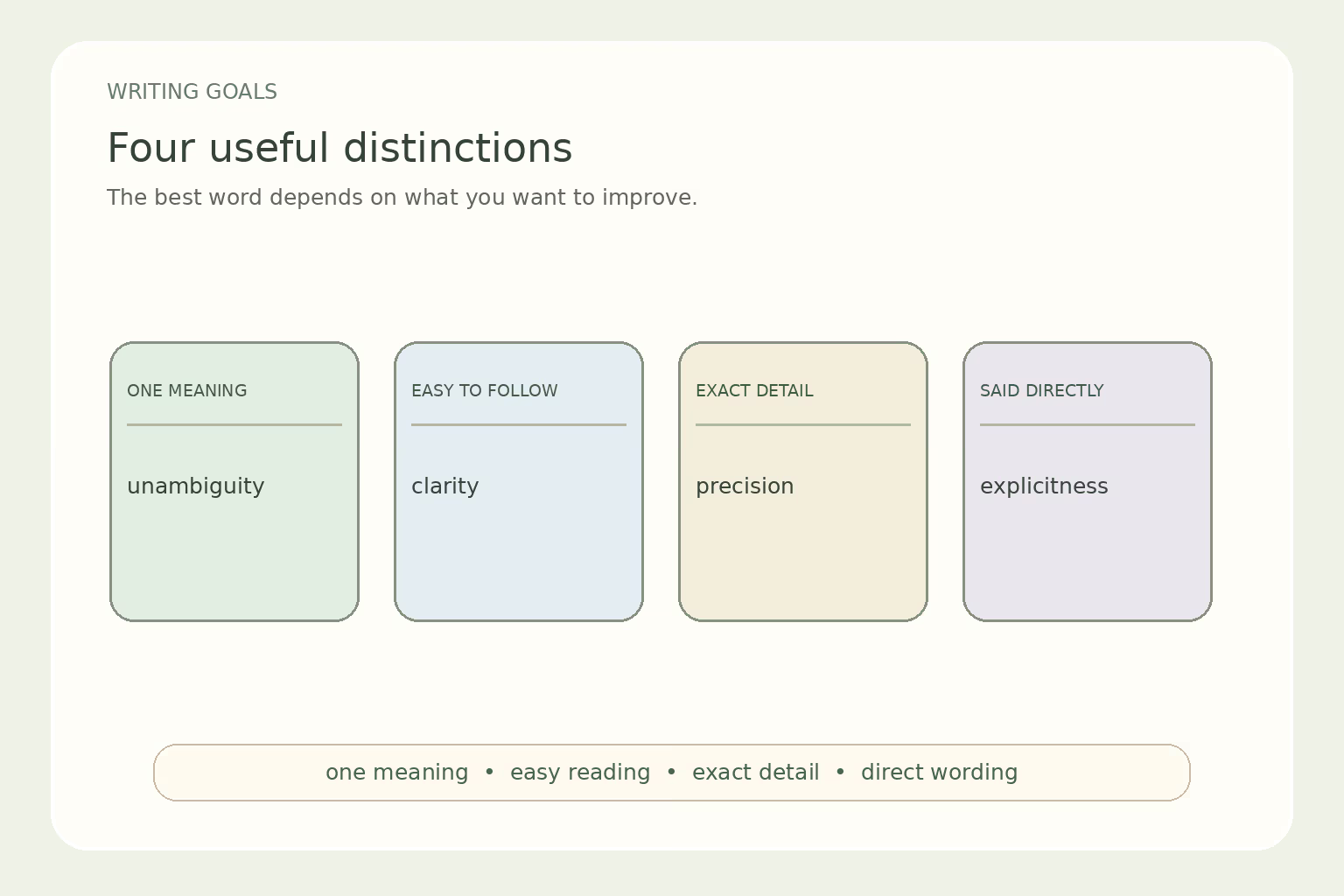
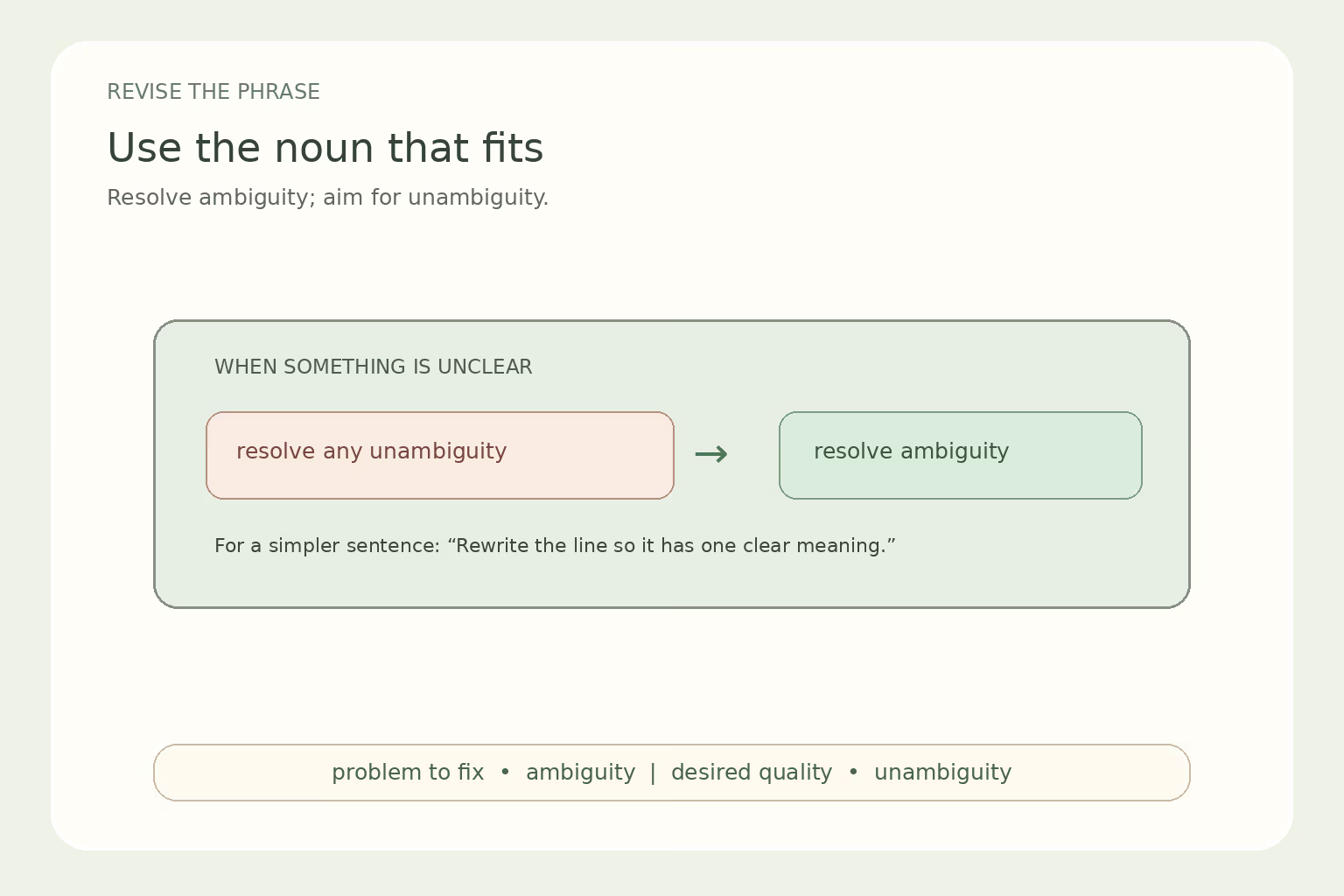
Because unambiguity names a positive quality, it usually does not fit after words that mean “remove” or “resolve.” Replace resolve any unambiguity with resolve any ambiguity. Replace add unambiguity to the paragraph with make the paragraph clearer or remove ambiguity from the paragraph. To describe a feature directly, use the adjective: “The revised directions are unambiguous.”
- Less natural: “The teacher resolved the unambiguity in the question.”
- Better: “The teacher resolved the ambiguity in the question.”
- More conversational: “The teacher rewrote the question so it had one clear meaning.”
- Formal: “The unambiguity of the revised definition reduced disagreement about its scope.”
For a useful example sentence, name what has one interpretation and explain why that matters. “The unambiguity of the warning label helped visitors identify the correct exit” gives both the quality and its practical effect. If the target reader is unfamiliar with the noun, choose the simpler adjective or phrase instead.
Have you ever wanted to clearly express your ideas without any room for confusion or misinterpretation? That’s where the concept of “unambiguity” comes into play. Unambiguity refers to the quality of being straightforward and lacking any ambiguity or uncertainty.
In writing, unambiguity is crucial for ensuring that your message is conveyed effectively and accurately. By using clear and concise language, you can avoid any potential misunderstandings or confusion among your readers.
7 Examples Of Unambiguity Used In a Sentence For Kids
- Unambiguity makes things clear and easy to understand.
- We should always strive for unambiguity in our communication.
- When there is unambiguity, there is no confusion.
- Let’s practice using unambiguity in our writing.
- Can you think of a way to improve unambiguity in this sentence?
- Unambiguity helps everyone know exactly what is meant.
- Remember, unambiguity is important for good communication.
14 Sentences with Unambiguity Examples
- Unambiguity is essential when conducting research in order to clearly communicate findings.
- Professors often appreciate unambiguity in student presentations to ensure clear understanding of the topic.
- When writing essays, it is important to maintain unambiguity to effectively convey your arguments.
- In group projects, establishing unambiguity in roles and responsibilities can prevent misunderstandings.
- Effective communication skills help maintain unambiguity in group discussions during seminars.
- Following the guidelines provided by the professor will help in achieving unambiguity in assignment submissions.
- Using proper formatting and citations can add unambiguity to your research papers.
- Maintaining unambiguity in online discussions can prevent misinterpretations of information.
- Clear and concise writing is key to achieving unambiguity in academic papers.
- Participating actively in class discussions can help clarify any unambiguity in complex topics.
- Utilizing visual aids such as diagrams and charts can enhance unambiguity in presentations.
- Revising and editing your work can help eliminate any unambiguity in your writing.
- Seeking clarification from professors or peers can help resolve unambiguity in course material.
- Properly defining key terms in your essays can contribute to unambiguity in your arguments.
How To Use Unambiguity in Sentences?
Unambiguity means clarity or lack of confusion in a sentence. To use it correctly, beginners can follow these simple steps:
-
Choose a topic: Decide on the main idea or topic you want to discuss in your sentence.
-
Choose your words carefully: Select words that clearly convey your intended message without any confusion or multiple interpretations.
-
Structure your sentence: Make sure the sentence is well-structured and easy to understand. Avoid long and complicated sentences that can lead to ambiguity.
-
Read your sentence aloud: Before finalizing your sentence, read it out loud to yourself. Check if it makes sense and if the meaning is clear without any room for doubt.
-
Get feedback: If possible, ask someone else to read your sentence and provide feedback. This will help you identify any areas of ambiguity that you may have missed.
-
Revise if necessary: If there is any confusion or ambiguity in your sentence, revise it to make it clearer and more straightforward.
Remember, the goal of using Unambiguity in a sentence is to ensure that your message is clear and easily understandable. By following these steps, beginners can improve their communication skills and avoid misunderstandings.
Conclusion
In communication, sentences with unambiguity play a crucial role in ensuring clarity and precision in conveying information. By eliminating any confusion or multiple interpretations, unambiguous sentences make it easier for the audience to understand the intended message accurately. This is especially important in formal writing, technical instructions, legal documents, and any situation where precision is paramount.
Employing sentences with unambiguity contributes to effective communication by leaving no room for misunderstanding or misinterpretation. It allows for clear and concise exchange of information, thereby enhancing comprehension and reducing the likelihood of errors. Whether in everyday conversations or professional settings, aiming for unambiguous sentences is key to fostering accurate and efficient communication.


