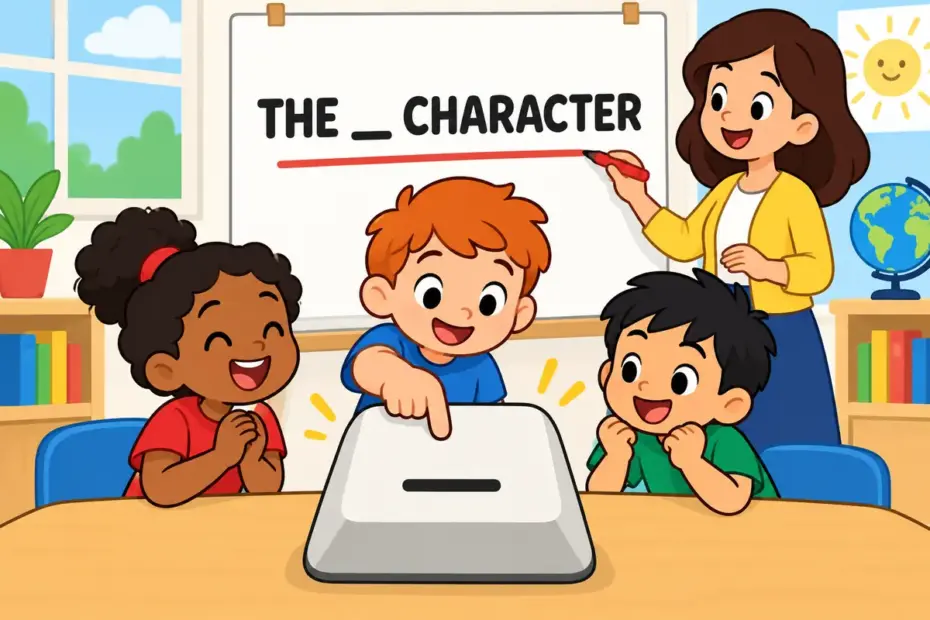
Underscore is the name of the _ character and a verb meaning to emphasise an important point. To use underscore in a sentence, name the thing being stressed: “The report underscores the need for repairs.” As a noun it points at a keyboard symbol, and as a verb it points at importance.
Underscore at a glance
- Underscore is both a noun and a verb; the verb forms are underscores, underscored and underscoring.
- As a noun it names the _ character; as a verb it means to emphasise or stress a point.
- The verb usually takes a direct object, as in underscore the risk, or a that-clause.
- Typical subjects are a report, a result, a delay, a trend or a speech.
- The verb belongs to formal, academic and business writing rather than everyday talk.
- The commonest error is writing underline when the character _ is meant.
What does underscore mean?
Underscore is a noun and a verb. As a noun it names the character _, typed with the shift key beside the zero on most keyboards. As a verb it means to emphasise or stress something, and in older printing it meant to draw a line beneath a word. The Cambridge entry for underscore records both the mark and the emphasis, and the two senses stay easy to separate: the noun points at a symbol, the verb points at importance. Where a sentence merely states a fact, emphasize the main point is the more direct verb and sounds less like a written report.
| Sense | Plain meaning | Example sentence |
|---|---|---|
| Noun, the character | The _ symbol on a keyboard | Type your user name with an underscore between the two words. |
| Verb, emphasise | To stress that something matters | The results underscore the value of early testing. |
| Verb, mark text | To draw a line beneath written words | The editor underscored the passage in red ink. |
One limitation is worth stating plainly. The phrase underscore the importance of has become a favourite of business writing, where it often adds length without adding information. If a sentence already shows what matters, shows or confirms can do the work and sound less inflated.
How do you use underscore in a sentence?
Underscore follows one of four shapes: it takes the stressed thing as a direct object, it introduces the point with that, it names the character, or it appears in the passive when the verb is literal. The table separates them.
| Pattern | Example | What it signals |
|---|---|---|
| underscore + noun | The delay underscores the risk of late payments. | Direct object is the thing being stressed. |
| underscore + that-clause | The memo underscores that deadlines are firm. | Introduces the point in a full clause. |
| underscore + the need or importance of | The audit underscores the importance of records. | Common but often padded; check whether shows is enough. |
| be underscored by | The speech was underscored by a low drumbeat. | Passive, and often literal and musical rather than emphatic. |
| the underscore (noun) | Add an underscore between the two words. | Names the character, never the emphasis. |
Underscore in a sentence: examples across contexts
Underscore moves between two registers: the technical noun for a keyboard mark and the formal verb for emphasis. The nine sentences below keep both senses apart and name what is being stressed.
| Context | Example sentence | Why this works |
|---|---|---|
| Classroom | The experiment underscores why we measure twice. | Links a concrete activity to the lesson it teaches. |
| Workplace email | These figures underscore the case for an extra engineer. | Names the evidence and the decision it supports. |
| News report | The floods underscore the strain on rural clinics. | Connects an event to a wider pressure readers recognise. |
| Academic writing | The findings underscore the need for longer trials. | Hedges nothing and states the implication of the data. |
| Technical writing | Replace each space with an underscore in the file name. | The noun sense, aimed at a precise machine instruction. |
| Business letter | We underscore our commitment to the schedule agreed in April. | Formal and slightly ceremonial, fitting a signed letter. |
| Sports report | The comeback underscores how quickly a match can turn. | Turns a single result into a general observation. |
| Speech | The applause underscored the mood in the hall. | Passive and atmospheric, with the mood as the focus. |
| Conversation | That bill underscores how expensive city parking has become. | The verb survives in speech when a fact proves a complaint. |
Only the technical row uses the noun. Everywhere else underscore is doing the same job as stress, which is why the noun and the verb should never be blended in one sentence.
Underscore vs emphasise and highlight
Underscore overlaps with two near-synonyms and keeps a character of its own. Highlight the key fact makes the reader look at one item; emphasise gives weight to a word or idea; underscore suggests that the evidence has already made the point. It also names the _ character, which neither of the others does.
| Attribute | underscore | emphasise | highlight |
|---|---|---|---|
| Core job | Show that evidence stresses a point | Give extra weight to a word or idea | Draw attention to one item |
| Also a noun | Yes, the _ character | No | No |
| Typical subject | A report, result or event | A speaker, teacher or writer | A reviewer, editor or guide |
| Typical object | A need, risk, trend or difference | A word, rule or point | A feature, fact or problem |
| Register | Formal, written and analytical | Neutral to formal, very common | Neutral, common in editing and reviews |
Verdict: use emphasise when a person is giving weight to something, highlight when a reader should notice one item, and underscore when the facts themselves make a point worth stressing.
Word forms and grammar of underscore
Underscore inflects regularly as a verb, and its noun keeps the same spelling, so word class comes only from the sentence around it. The table also lists a lookalike that shares the prefix but not the meaning.
| Form | Part of speech | Example |
|---|---|---|
| underscore | verb, base form or noun | These numbers underscore the trend. |
| underscores | verb, third person singular | The survey underscores one clear gap. |
| underscored | verb, past and past participle | The review underscored the cost of delays. |
| underscoring | verb, present participle | She kept underscoring the safety rules. |
| underscore | noun, the character | Use an underscore instead of a space. |
| undersigned | adjective and noun, different word | The undersigned parties agreed on Monday. |
The lookalike undersigned comes from sign, not from score, so it belongs to contracts rather than to keyboards. Keeping the two apart stops a formal document from reading like a computer manual.
Common mistakes with underscore
- Incorrect:
The report underscored about the funding gap.Correct: The report underscored the funding gap. Rule: Underscore takes a direct object or a that-clause, never about. - Incorrect:
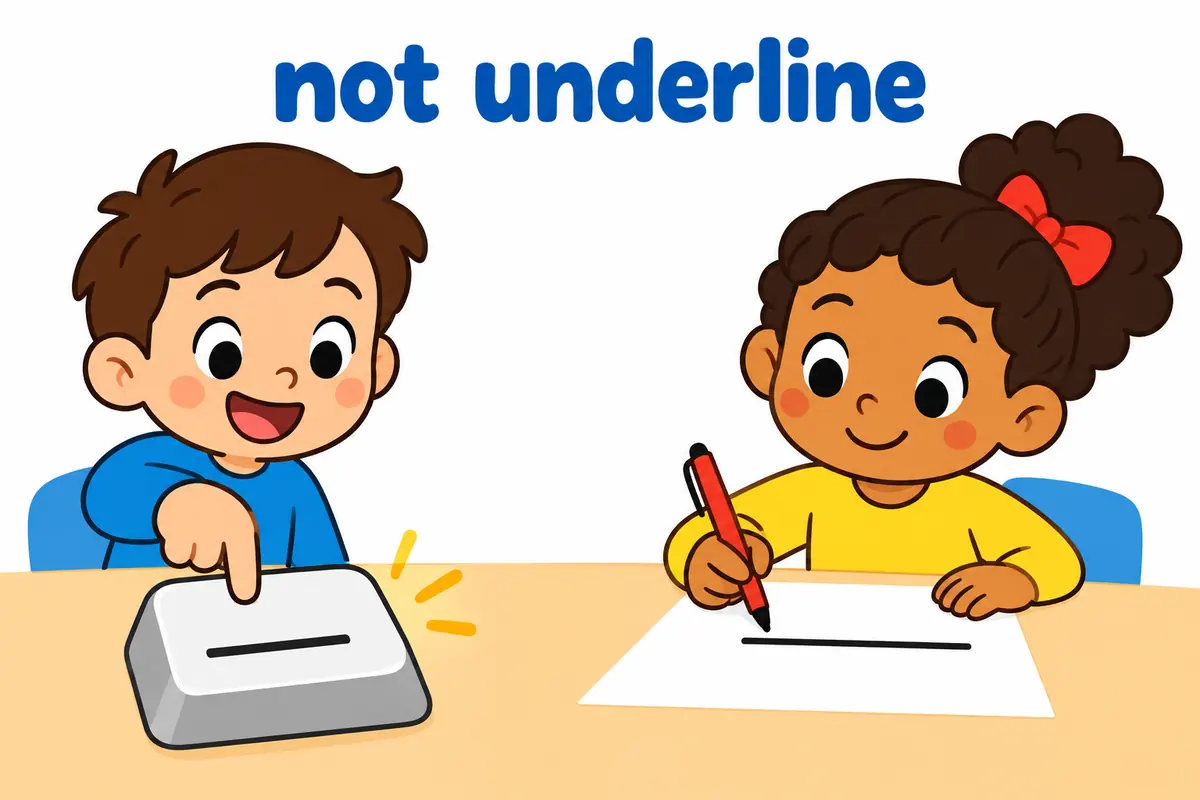
Please put an underline between the two words.Correct: Please put an underscore between the two words. Rule: The character _ is an underscore; an underline is the line drawn beneath text. - Incorrect:
He underscored under the heading.Correct: He underscored the heading. Rule: The verb already contains the idea of a line under, so under is redundant. - Incorrect:
The speech underscored to protect the coast.Correct: The speech underscored the need to protect the coast. Rule: Underscore is not followed directly by to plus a verb; it needs a noun first.
Practice using underscore
Work through the six items, then read the reasoning rather than only the answer.
- Fill the gap: The new timetable ______ how much the school values reading time.
- Choose the better word: In the file name, replace the space with an (underline / underscore).
- Correct the error: The findings underscored about the need for better drainage.
- Build a sentence: use underscore that about a survey showing pupils skip breakfast.
- Spot the register: which belongs in a lab report, the data underscore the trend, or the data really hammer the trend home?
- Rewrite with the noun: The report emphasised a shortage. Use underscore instead.
Answers
- underscores — the timetable is the subject stressing a point, so the third person form fits.
- underscore — the character _ is an underscore, while an underline is a drawn line.
- The findings underscored the need for better drainage — delete about, which the verb never takes.
- Model answer: The survey underscores that many pupils skip breakfast.
- The data underscore the trend — a lab report keeps the formal verb and avoids hammer.
- The report underscored a shortage — the verb carries the emphasis without extra words.
The bottom line
Use underscore in a sentence to stress that evidence makes an important point, and reserve the same word for the _ character when writing about keyboards or file names. Two details settle most choices: the verb takes a direct object or a that-clause, never about, and the noun names a symbol rather than an emphasis. Where a plainer verb will do, accentuate a detail and stress keep the same meaning without the report tone.
Frequently asked questions about underscore
Is underscore a noun or a verb?
It is both, and the sentence decides which. As a noun it names the _ character, as in type an underscore after the word. As a verb it means to emphasise, as in the figures underscore the problem. The spelling never changes, so only the words around it show the part of speech.
What is the difference between underscore and underline?
An underscore is the character _, found on the keyboard and used in file names and user names. An underline is the line drawn beneath text, whether by hand or by a word processor. The verb to underline can also mean to emphasise, which is where the two words most often get mixed up in writing.
Why do writers use underscore instead of emphasise?
Underscore sounds slightly more analytical, so it suits reports, audits and academic writing where the evidence itself is said to make the point. Emphasise is warmer and works in almost any register. Because underscore can sound inflated, the shorter verb is often the better choice in plain prose.
How do you type an underscore?
On a standard keyboard the underscore shares a key with the hyphen, usually to the right of the zero. Hold shift while pressing that key to produce _. The same character appears in web addresses and file names, where it replaces a space so that software reads the name as one unbroken string.
Underscore has two common uses. As a verb, it means to underline something or emphasize that it is important: “The final example underscores the rule.” As a noun, it names the character _, which is often used in computer text such as a file name. The meaning depends on how the word is used in the sentence.
“Underscore” as a Verb: Emphasize or Draw a Line Under
When underscore is a verb, it usually takes the thing being emphasized as its object. It can mean to stress an idea in speech or writing, or to mark text with a line beneath it.
- The latest results underscore the value of checking every measurement.
- Her short conclusion underscores the main point of the report.
- The teacher asked us to underscore the title with a ruler.
- The witness’s account underscored how quickly the situation changed.
- The speaker is underscoring the need for a clear plan.
In everyday nonfiction, the figurative sense—“emphasize”—is especially common. It does not require a literal line. For example, “The missed deadline underscores the need for a better schedule” means the missed deadline makes that need especially clear.

“Underscore” as a Noun: The Character _
As a noun, an underscore is the low horizontal character _. It is sometimes called an underbar or low line. On many keyboards, it is typed with the hyphen key and Shift, though keyboard layouts vary.
A common use is separating parts of a computer name when spaces are not accepted or convenient. For example, a person might name a file reading_notes.txt or choose a username such as sam_lee. Here the underscore is a literal character; it is not a space, and it does not underline the words.

Underscore, Underline, and Text Formatting
The words overlap, but it helps to separate the actions from the symbol:
- Underline a word: draw a line below it, often using an underline button in a word processor.
- Underscore a point: emphasize or call attention to it, with or without a visible line.
- Type an underscore: insert the character
_into a file name, code, or other text.
Typing an underscore before and after a word does not apply formatting in every app. Some markup systems interpret underscores as formatting markers. For example, CommonMark recognizes certain single underscores around text as emphasis and double underscores as strong emphasis, subject to its syntax rules. The underscores are markup in that context; the software renders the text with emphasis. If you are editing a document or email, use its built-in formatting controls unless its instructions specifically call for markup.
In a worksheet, a string such as _____ may be a visual blank where a student writes a missing word. That is a convention for filling in an answer, not the ordinary meaning of the punctuation character in prose.

Examples of “Underscore” in Different Sentences
Emphasize an idea
- The repeated reminders underscore how important it is to arrive on time.
- Her careful notes underscored the decisions the group had made.
- The bright contrast underscores the difference between the two designs.
- The final scene underscores the story’s theme of friendship.
Mark text with a line
- Please underscore the vocabulary word you want to review.
- Jalen underscored the heading so it would stand out on the worksheet.
Name the character
- There is an underscore between “first” and “name” in the example code.
- The form accepts letters, numbers, and one underscore, but no spaces.
Grammar and Quick Usage Tips
As a verb, underscore is regular: underscore (present), underscores (he/she/it), underscored (past), and underscoring (ongoing action). It is often followed by a noun phrase such as the importance of practice, a key point, or the need for change.
Use this quick check:
- If you could replace the word with emphasizes, it is the verb: “The data underscores the pattern.”
- If you mean the character
_, it is the noun: “Add an underscore between the two words.” - If you mean a line beneath text, describe the formatting clearly: “Underline the heading.” Some style guides use underscore for this action too, but readers may otherwise think of emphasis.
Cambridge Dictionary lists both the “emphasize” verb sense and the _ character as a noun. The CommonMark specification explains how underscores can also function as markup delimiters in that particular format.
Editorial note: The earlier version of this page is preserved below as an archive. Its formatting instructions confuse the underscore character with text styling and contain broken examples. Follow the corrected explanations above; whether underscore characters create formatting depends on the application or markup system.
When writing, using an example sentence with “underscore” can emphasize a point or concept. Typically denoted by a line underneath text, an underscore highlights crucial information or adds clarity to a statement. By featuring an underscore, writers draw attention to key details and make their message clearer for readers.
Including an example sentence with “underscore” can provide further context, support a thesis, or give weight to an argument. This simple formatting tool can elevate writing by pinpointing important elements and enhancing the overall coherence of the text.
7 Examples Of Underscore Used In a Sentence For Kids
- The cat ran __ the table.
- The sun shines __ the clouds.
- The ant crawled __ the rock.
- The bird flew __ the tree.
- The fish swam __ the bridge.
- The ball rolled __ the floor.
- The car drove __ the tunnel.
14 Sentences with Underscore Examples
- Make sure to underscore the key points in your notes for easy revision later.
- The professor’s main focus during the lecture was to underscore the importance of practical knowledge.
- It is crucial to underscore the theories and concepts that will be covered in the upcoming exam.
- When writing your research paper, remember to underscore all the relevant data and statistics.
- As a college student, you should always underscore the main ideas in your essays to make them more impactful.
- Don’t forget to underscore the formulas and equations that are most likely to appear in the exam.
- It is helpful to use different colored pens to underscore various sections of your textbooks.
- Before presenting your project, make sure to underscore the key findings and conclusions for clarity.
- When preparing for group discussions, it is essential to underscore your points to make them stand out.
- In your thesis statement, be sure to underscore the main argument you will be making throughout the paper.
- During a debate competition, remember to underscore your strongest arguments to make a lasting impression.
- As a college student, highlighting and underscoring important information can help you retain it better.
- When reviewing your study material, use a highlighter to underscore the most crucial details.
- Before submitting your assignment, double-check to see if you have underscored all the key points required for the task.
How To Use Underscore in Sentences?
Underscore is used to emphasize a word or phrase within a sentence. To use it effectively, simply place an underscore () before and after the word or phrase you want to highlight. For example, “Hello_ there” or “I love chocolate”.
It is important to note that there should be no spaces between the underscore and the word or phrase you are emphasizing. This ensures that the word or phrase stands out clearly within the sentence.
Underscore can also be used to create a visual separation between words or to represent missing letters in a word. For instance, “I will never give up” or “The cat chased the ball“.
Using Underscore effectively can help draw attention to specific words or phrases in your writing. However, it is important not to overuse it, as too many emphasized words can make the text difficult to read.
Overall, incorporating Underscore into your writing can enhance the clarity and impact of your message. Experiment with different placements of Underscore to see how it can best suit your writing style and effectively convey your intended emphasis.
Conclusion
In conclusion, using underscore in sentences can help emphasize a word or phrase, make text more readable, or denote spaces in online content where spaces are not allowed. By visually separating words or creating a clear break, underscore can improve the clarity and organization of written information. Additionally, in coding and online platforms, underscores are commonly used to represent spaces or placeholders in file and variable names.
Overall, whether for stylistic purposes, coding conventions, or online formatting requirements, learning how to use underscores effectively in sentences can enhance communication and presentation of written content. Understanding the different applications and benefits of underscore can help writers, developers, and online content creators utilize this simple yet versatile tool to convey their message clearly and effectively.