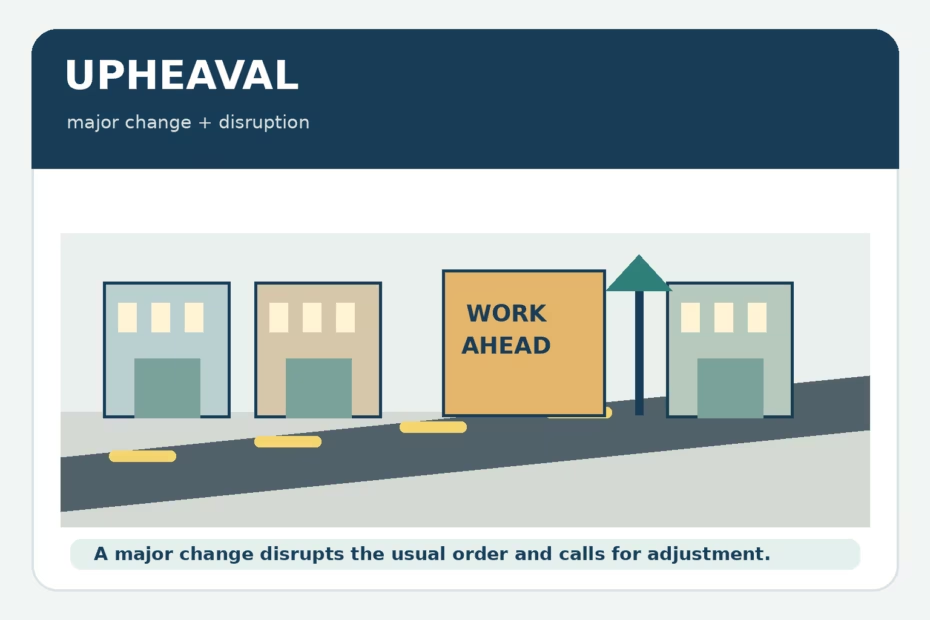
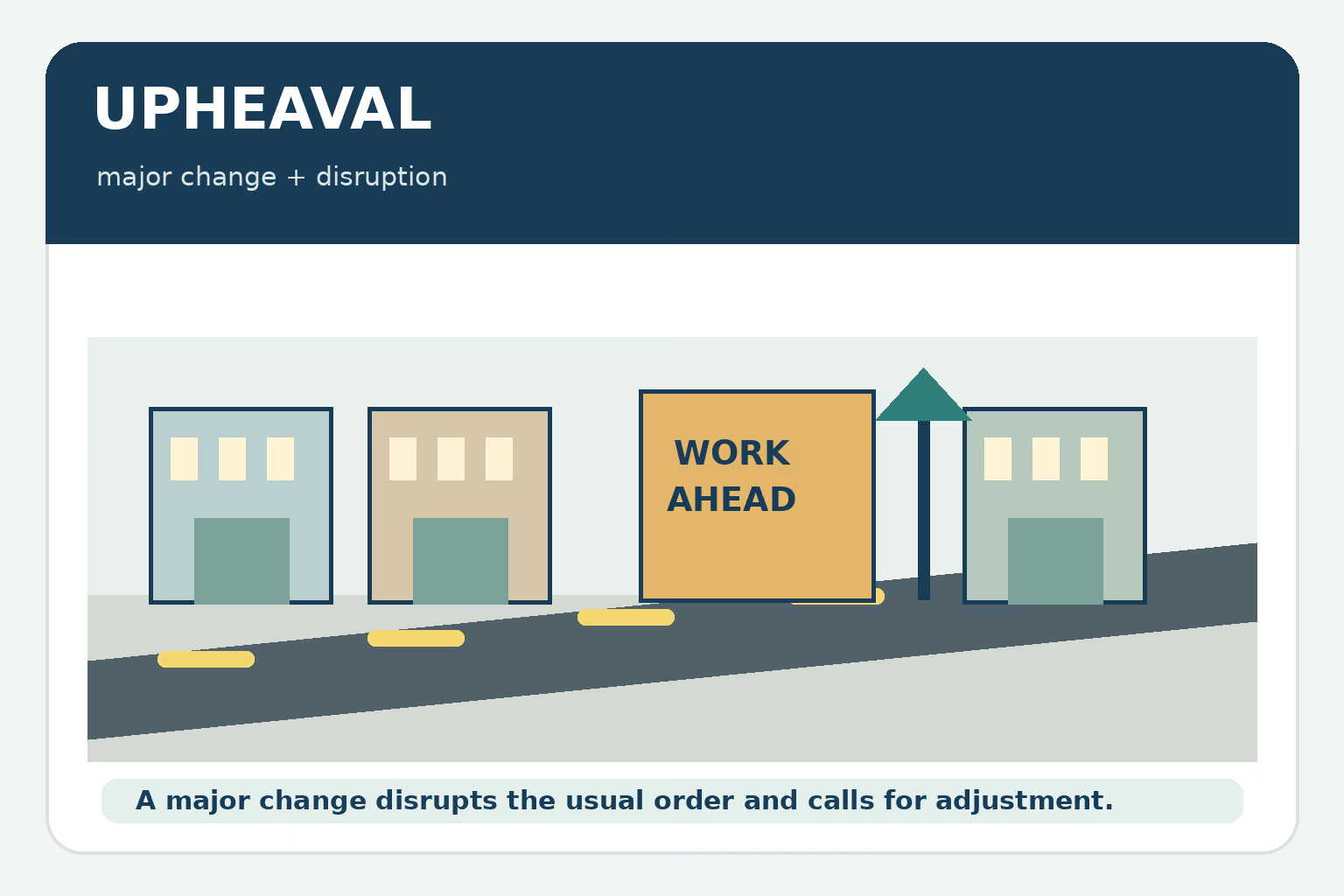
Upheaval: Meaning and Quick Answer
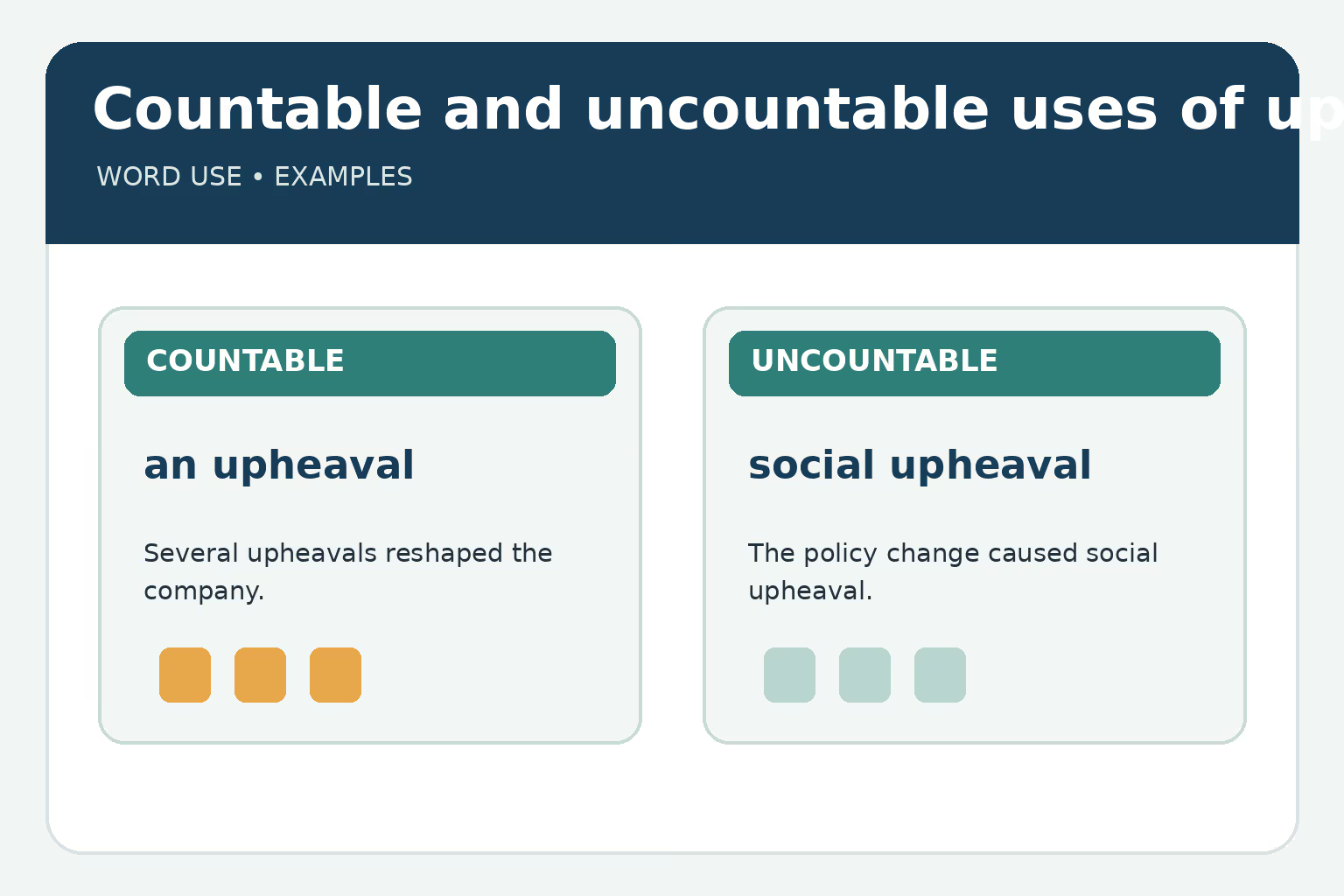
Upheaval is a noun for a major change or disruption that disturbs the usual order and often makes people adjust. It can describe a change at home, work, school, in a community, or across a country. An upheaval does not have to be violent: a company reorganization or a difficult move can also bring upheaval. The noun is both countable (an upheaval; several upheavals) and uncountable (political upheaval; much upheaval).
How to Use “Upheaval” in a Sentence
Use upheaval when a change is substantial enough to disturb routines, arrangements, or expectations. It commonly follows verbs such as cause, experience, undergo, or face: “The merger caused upheaval,” “Residents experienced an upheaval,” and “The country underwent political upheaval.” You can also name its area or source with a modifier: economic upheaval, emotional upheaval, or upheaval in the education system.
| Pattern | Example | What it shows |
|---|---|---|
| an upheaval / several upheavals | The merger caused an upheaval at the company. | Countable: one major disruptive event |
| political / emotional upheaval | Years of political upheaval changed the region. | Uncountable: a condition or broad period of change |
| upheaval in + area | The new schedule brought upheaval in the school. | Names the place or system affected |
35 Original Sentences Using “Upheaval”
These examples show the word in several everyday contexts. In each one, upheaval means more than a small change: it signals a disruption that affects routines or requires adjustment.
- The sudden merger brought upheaval to the small design firm.
- Moving across the country caused an upheaval in the family’s daily routines.
- Years of political upheaval reshaped the country’s public institutions.
- The new timetable created temporary upheaval at the school.
- After the sale, the department experienced months of organizational upheaval.
- Her unexpected transfer caused upheaval in the team’s work plans.
- The factory closure brought economic upheaval to the town.
- Construction on the main road created upheaval for local businesses.
- The software migration caused an upheaval in the company’s record-keeping.
- A change in leadership led to upheaval across the nonprofit organization.
- For the family, caring for a new baby brought both joy and upheaval.
- The abrupt cancellation caused upheaval in the festival schedule.
- Students faced upheaval when their campus housing was renovated midyear.
- Years of conflict produced social upheaval and forced many people to relocate.
- The merger triggered an upheaval in the industry’s usual competitive order.
- She felt emotional upheaval while adapting to life after graduation.
- The storm caused less upheaval than residents had expected.
- A change in ownership brought upheaval to the neighborhood’s familiar shops.
- The policy revision caused upheaval among workers who depended on the old schedule.
- Rather than risk another upheaval, the family postponed its move.
- The discovery prompted upheaval in the scientific team’s working assumptions.
- The transition to remote work created upheaval before the staff found a routine.
- Changes to the transit network caused upheaval for commuters for several weeks.
- After the unexpected resignation, the board worked to limit further upheaval.
- Economic upheaval can affect household plans as well as large businesses.
- The school tried to reduce the upheaval caused by changing the exam calendar.
- Her return to the workforce brought a period of upheaval as the household reorganized.
- The archive documents upheavals in the city’s government over several decades.
- Although the redesign looked dramatic, it caused little upheaval in daily operations.
- The company prepared employees for the upheaval of combining two departments.
- Rapid growth brought upheaval to a town whose roads and services were built for fewer residents.
- His retirement caused an upheaval in the small office, where he had handled many key tasks.
- The change in school boundaries led to upheaval for families planning their commutes.
- Emotional upheaval can make ordinary decisions feel unusually difficult for a time.
- Rock layers can record geological upheaval that occurred long before people lived there.
When Is “Upheaval” the Right Word?
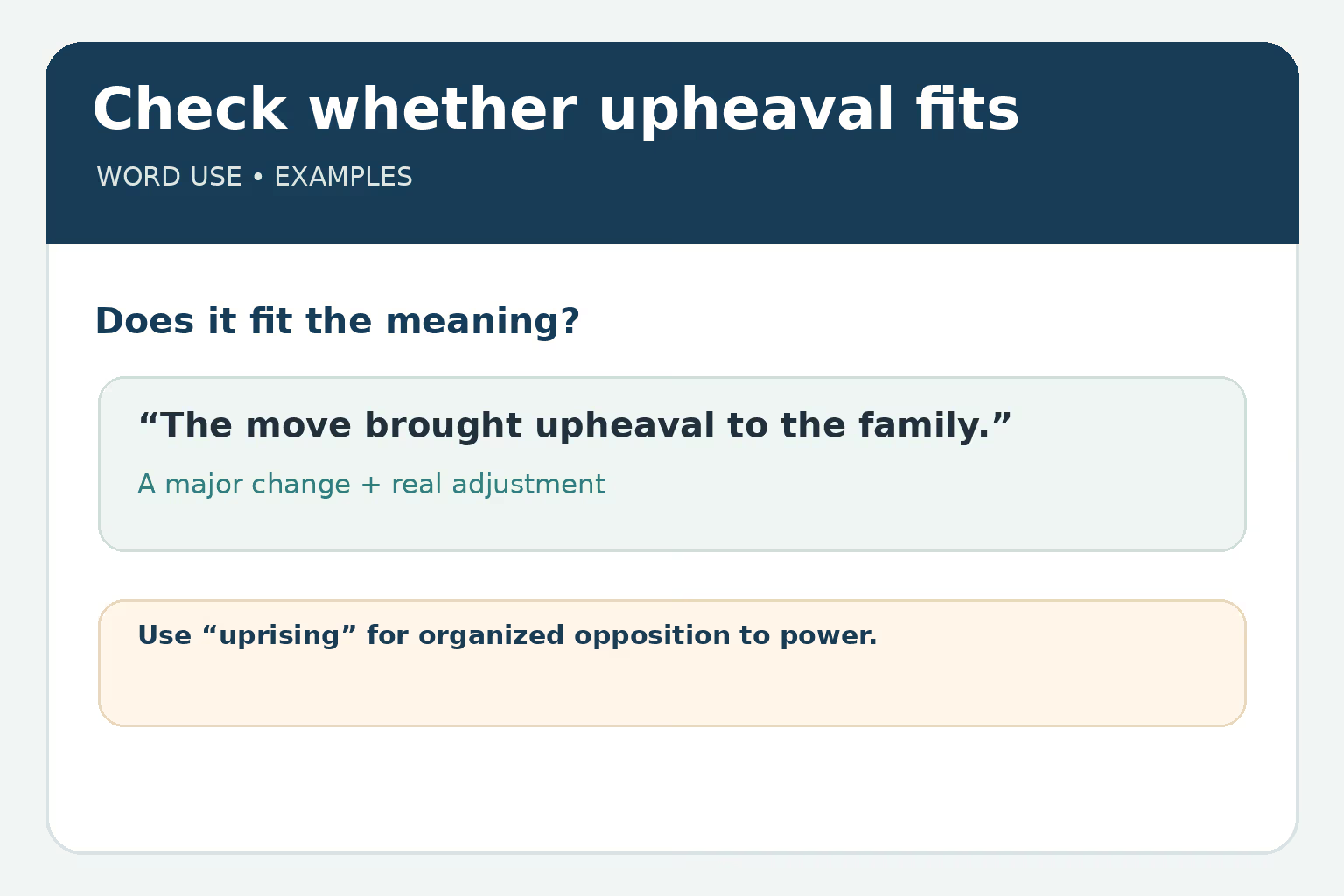
Upheaval fits when a change substantially disrupts an existing situation. If a meeting starts five minutes late, delay is more precise; if an entire organization must reorganize after a merger, upheaval may fit. The word often carries a negative or unsettled tone, though the eventual results of a change can be positive.
Do not treat upheaval as a synonym for every change, disagreement, or crisis. Uprising specifically refers to collective opposition against those in power; an upheaval may instead be a move, restructuring, rapid transformation, or period of disorder. Likewise, a disruption can be brief or limited, while upheaval usually suggests a broader or more consequential disturbance.
Frequently Asked Questions About “Upheaval”
Is “upheaval” a noun?
Yes. Upheaval is a noun. It can be countable, as in “an upheaval” or “several upheavals,” and uncountable, as in “social upheaval.”
Does upheaval always mean violence?
No. Upheaval can describe a difficult or disruptive change without violence, such as a move, a company reorganization, or a shift in school routines. Context determines its scale and cause.
What is a common phrase with “upheaval”?
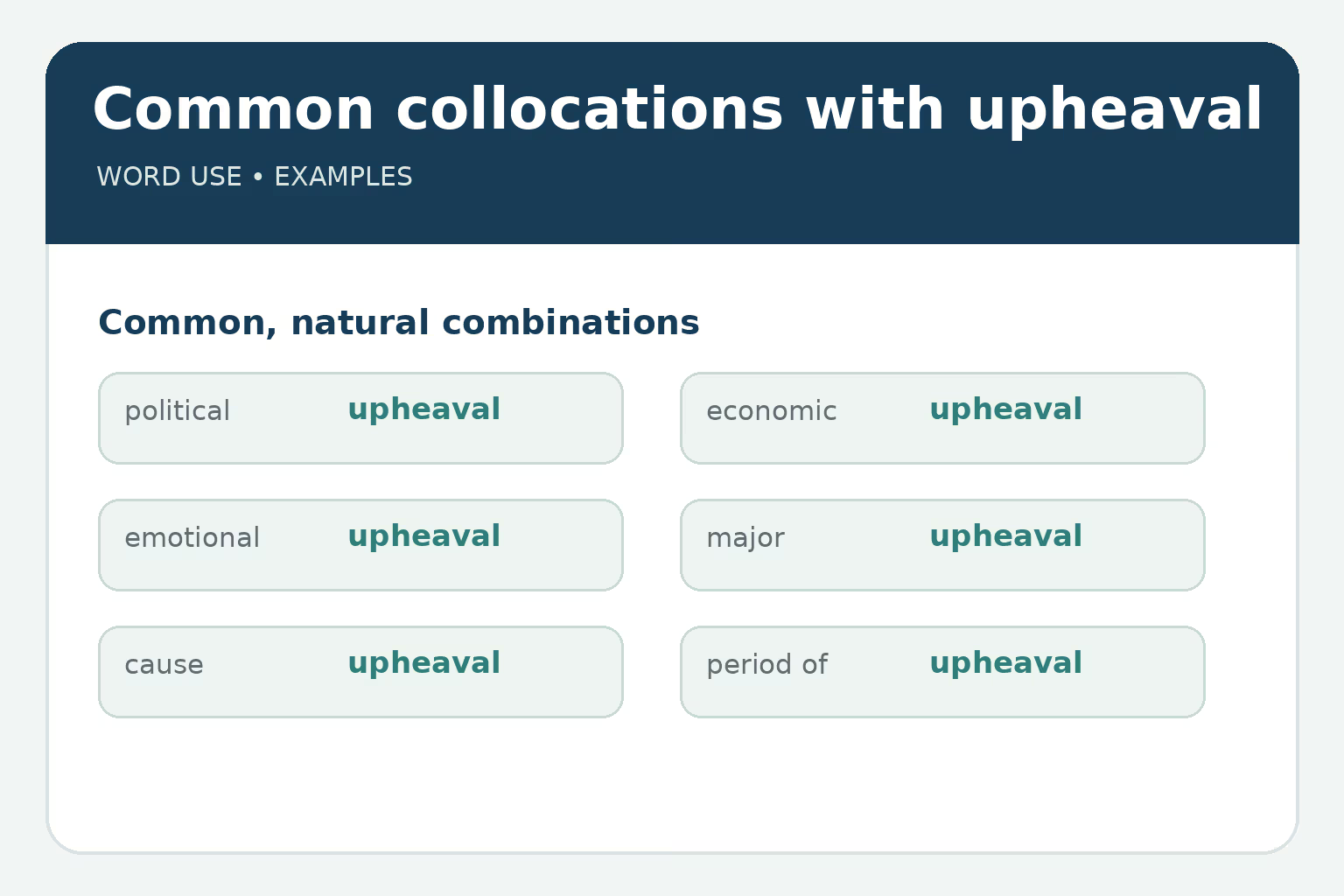
Common phrases include political upheaval, economic upheaval, emotional upheaval, a period of upheaval, and upheaval in a system. The modifier tells readers what area is affected.
What is the difference between upheaval and uprising?
Upheaval is a broad term for major disruptive change. An uprising is specifically an act of collective opposition, often against people in power. An uprising may cause upheaval, but the words are not interchangeable.
Sources: Cambridge Dictionary: upheaval; Oxford Learner’s Dictionaries: upheaval; Cambridge Dictionary: uprising.

7 Examples Of Upheaval Used In a Sentence For Kids
- Upheaval can mean big changes.
- Sometimes, we feel upheaval when things change.
- Upheaval can make us feel confused.
- It’s okay to feel scared during upheaval.
- Upheaval can also bring new opportunities.
- We can learn and grow from upheaval.
- It’s important to talk about our feelings during upheaval.
14 Sentences with Upheaval Examples
- Upheaval in the academic schedule caused by unexpected strikes can disrupt the flow of classes.
- Students may experience emotional upheaval when facing a sudden change in their living arrangements.
- Upheaval in campus policies can lead to confusion among students about new rules and regulations.
- The announcement of a major event cancellation caused an upheaval in student plans for the weekend.
- A sudden increase in tuition fees can create financial upheaval for many college students.
- Upheaval in the faculty department can impact the quality of education and mentorship available to students.
- Technology failures during online exams can cause a significant upheaval for students trying to submit their assignments.
- The decision to change the grading system midway through the semester resulted in upheaval among students.
- A delay in campus construction projects can cause logistical upheaval for students trying to navigate the campus.
- Upheaval in the academic calendar due to unforeseen circumstances can disrupt students’ study plans.
- A sudden shift to virtual classes can create an upheaval in students’ routines and study habits.
- Changes in internship opportunities can lead to upheaval among college students trying to secure valuable work experience.
- Unexpected changes in the course curriculum can cause academic upheaval for students trying to meet graduation requirements.
- The cancellation of extracurricular activities can lead to social upheaval among students looking for ways to connect with their peers outside of class.
How To Use Upheaval in Sentences?
To properly use Upheaval in a sentence, follow these steps:
Understand the meaning: Upheaval is a noun that refers to a violent or sudden change or disruption, usually causing confusion or disorder. It can be used to describe a major shift in a situation, organization, or society.
Context: Identify a situation where there is a significant change or disruption that you want to describe.
Structure your sentence: Place Upheaval in a position that accurately conveys the sudden and chaotic nature of the change you are referring to.
Example sentence: “The company experienced a period of upheaval when the CEO suddenly resigned, causing a ripple effect throughout the organization.”
Alternative use: Upheaval can also be used metaphorically to describe emotional or mental turmoil. For instance, “After the breakup, she felt a sense of upheaval as she tried to adjust to her new reality.”
Practice: Try using Upheaval in different contexts to get comfortable with its usage. Experiment with its placement in a sentence to see how it can convey the desired meaning effectively.
Remember, using Upheaval in a sentence will help you convey a sense of sudden and disruptive change, adding depth and emotion to your writing.
Conclusion In conclusion, upheaval refers to a state of sudden and significant change or disruption. This can manifest in various forms, such as political upheavals, social upheavals, or personal upheavals. The examples of sentences with the keyword demonstrate the wide range of contexts in which upheaval can occur, from revolutions and protests to upheavals in people’s personal lives. Overall, upheaval is a powerful term that conveys the intensity and impact of major transformations or disturbances. By understanding and recognizing upheaval in its various forms, we can gain insight into the complexities of change and disruption, and better navigate the tumultuous periods that may arise in society or in our own lives.

