In a sentence, verbatim means using the same words as the original. It commonly works as an adverb in phrases such as “quote the passage verbatim” and as an adjective in “a verbatim transcript.” Clear examples should show what word or passage stayed unchanged and identify its source when it is someone else’s work.
- Verbatim means in exactly the same words as the original.
- Use it as an adverb: “The reporter quoted the witness verbatim.”
- Use it before a noun as an adjective: “The archive holds a verbatim transcript.”
- For a direct quotation, mark the borrowed wording and credit its source.
- A paraphrase changes the wording but still needs attribution to the source idea.
What does “verbatim” mean?
Cambridge Dictionary defines verbatim as using exactly the same words that were originally used. The word can be an adverb, as in “repeat the sentence verbatim,” or an adjective before a noun, as in “a verbatim account.” It describes how faithfully words are reproduced; it does not by itself say whether the statement is accurate, complete, or legally reusable.
How do you use verbatim in a sentence?
Place verbatim near the verb it modifies when it is an adverb, or directly before a noun when it is an adjective. The intended meaning should be that the wording matches an original, not merely that a writer cited it.
| Use | Example | Why it works |
|---|---|---|
| Adverb | The editor copied the instruction verbatim. | Verbatim tells how the editor copied it: in the original words. |
| Adverb | “Please wait by the east entrance,” the guide said; Mara repeated the directions verbatim. | The adverb describes how Mara repeated the directions. |
| Adjective | The archive contains a verbatim transcript of the interview. | Verbatim describes the transcript as reproducing the original words. |
| Adjective | We compared the verbatim quotation with the recording. | The adjective modifies “quotation” and emphasizes exact wording. |
“She knows how to verbatim cite a source” is not a clear way to describe attribution. Prefer “She knows how to cite a direct quotation” or “She quoted the source verbatim and cited it.” The latter separates the exact wording from the citation practice.
How should you quote words verbatim?
Copy the quoted words accurately, mark them according to the required style, and give enough source information for readers to locate the original. Use a quotation only when the exact wording matters, such as when analyzing a phrase, preserving a speaker’s statement, or documenting a precise instruction.
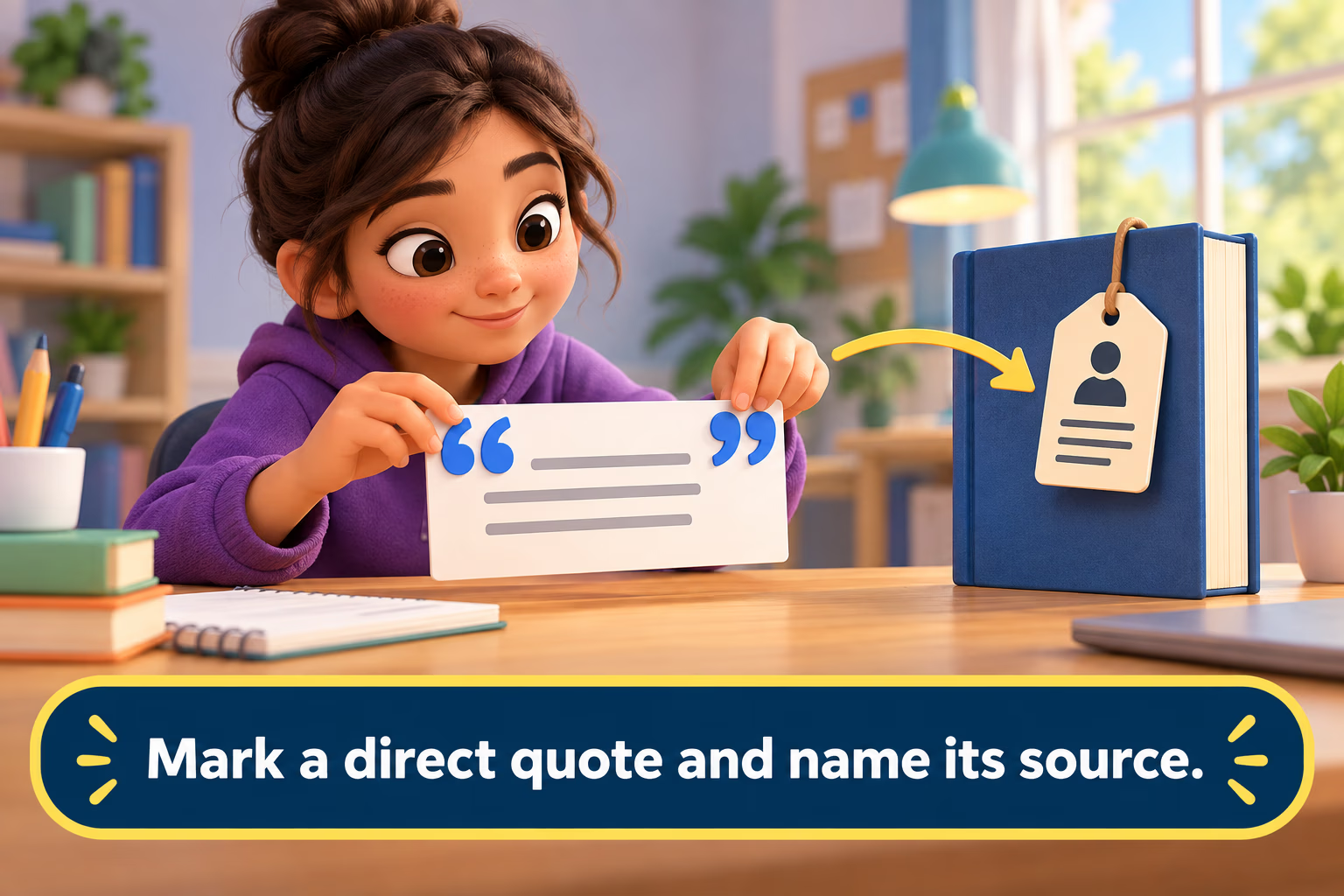
- Check the original source, not a quote copied from another page.
- Copy the passage carefully and keep its meaning and context intact.
- Use quotation marks or block-quote formatting according to the style guide.
- Add the citation details required by that style; page or paragraph locations may be needed.
- Use brackets or ellipses only when they accurately signal a change or omission.
Purdue OWL’s guidance on quoting, paraphrasing, and summarizing explains that direct quotations should be clearly distinguished and attributed, and that paraphrased ideas also need citation. The details differ by citation system, so follow the one required by the publication, instructor, or organization.
Does a verbatim quotation need attribution?
Yes, when the words come from someone else, identify the source even if the quotation is short or widely repeated. Quotation marks show that the wording is borrowed; a citation tells readers where it came from. Attribution supports academic integrity, but it does not automatically grant permission to reproduce copyrighted material.
Plagiarism rules and copyright rules answer different questions. A citation can credit the author while a use may still exceed a license or legal exception. The U.S. Copyright Office says fair use depends on the circumstances and its statutory factors; it gives no fixed number of words that is automatically safe. When permission or reuse rights are uncertain, check the applicable license or ask the rights holder rather than assuming that citation settles it.
Verbatim vs. paraphrase: what is the difference?
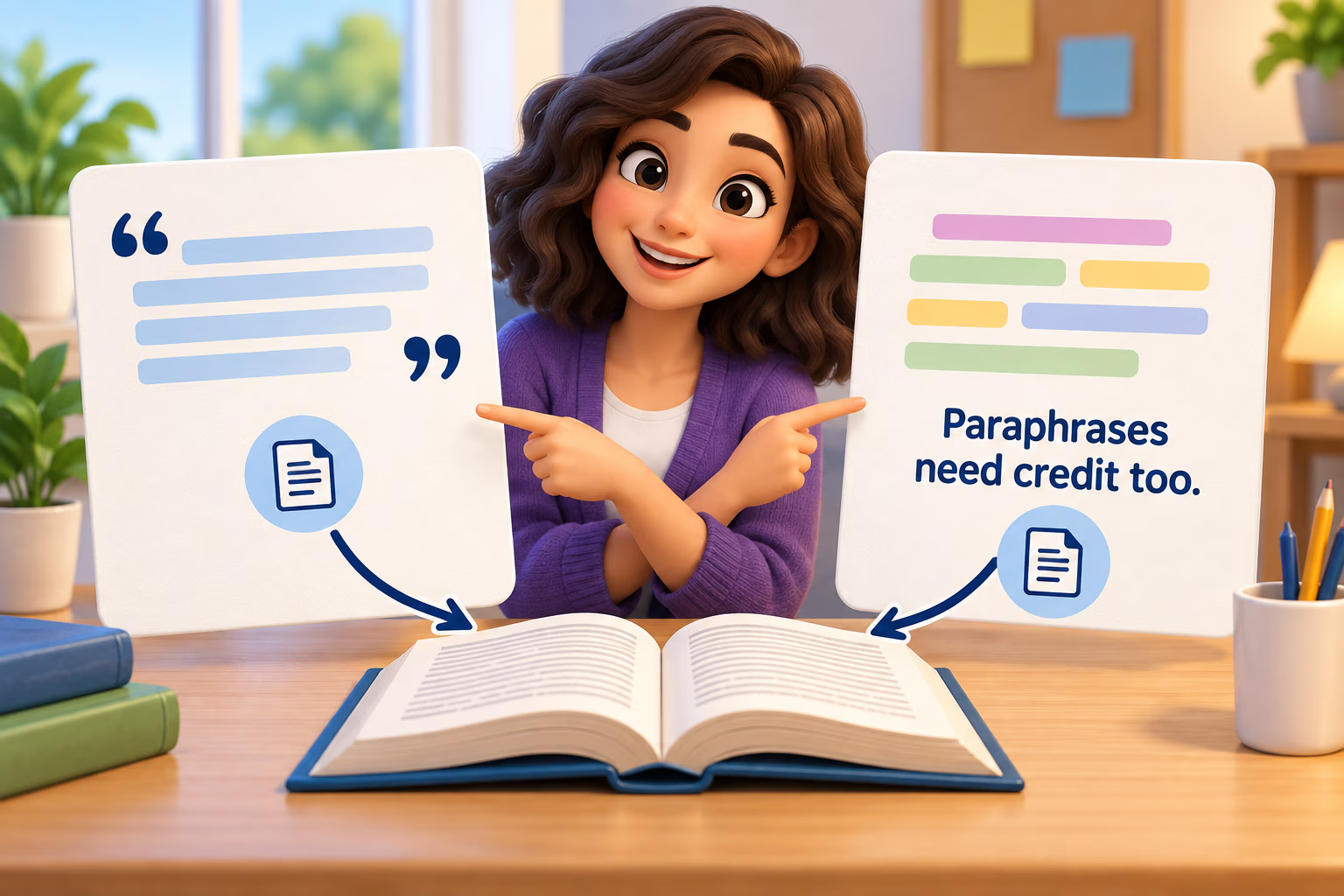
A verbatim quotation repeats the source’s exact words; a paraphrase expresses the source’s idea in new wording. Both need accurate representation and attribution. Use a direct quotation for wording that matters; paraphrase when the idea matters more than the original phrasing, while still citing the source.
| Method | Wording | Attribution | Example |
|---|---|---|---|
| Verbatim quote | Original wording is reproduced exactly and marked as a quotation. | Credit the source using the required style. | The guide says, “Keep the receipt.” |
| Paraphrase | The writer restates the idea in genuinely new wording. | Credit the source idea even though the words changed. | The guide advises readers to save proof of purchase. |
Changing a few words or rearranging a sentence does not necessarily make a passage an adequate paraphrase. Compare the result with the source to ensure the wording is your own and the idea remains faithful, then cite it.
Frequently asked questions
Is verbatim an adverb or an adjective?
It can be both. In “repeat the line verbatim,” it is an adverb describing how the line is repeated. In “a verbatim transcript,” it is an adjective before the noun. Choose the form that makes the relationship clear, and consult the required style guide for specialized editorial conventions.
Does verbatim mean exactly word for word?
Yes. Verbatim describes wording reproduced in the same words as the original. If a quotation omits, changes, or corrects part of the wording, signal that change using the relevant editorial convention instead of presenting the modified text as untouched.
Does a paraphrase need a citation?
Yes, if the idea or information came from another source. A paraphrase changes the wording but does not make the underlying idea yours. Cite the source using the required style, and make the new wording sufficiently distinct while preserving the meaning accurately.
Does citing a verbatim quote make every use legal?
No. Citation gives credit and helps readers locate a source, but copyright permission, licenses, and legal exceptions are separate issues. The U.S. Copyright Office explains that fair use depends on the circumstances and provides no automatic word-count threshold. Check the rights or license when reuse is uncertain.
Can I use verbatim in children’s sentences?
Yes. For example: “Dad repeated my words verbatim,” or “The class listened to a verbatim reading of the short note.” These examples show the adverb and adjective uses in familiar settings without asking a child to reproduce long or private text.
Note about the original examples: The article below is preserved exactly as published. Some of its wording treats “verbatim” as if it were a verb or gives broad plagiarism and citation advice. Use the grammar and attribution guidance above for current examples; the unchanged source block is retained for transparency, not as a claim that every sentence is a model of usage.

Are you familiar with the term “verbatim”? Verbatim refers to the action of quoting word-for-word without any alterations or interpretations. This approach entails reproducing a text or speech exactly as it was originally presented.
Being able to capture information verbatim is a valuable skill, especially in tasks such as transcribing interviews, recording legal statements, or ensuring accuracy in quotations. This word is often used when discussing the importance of maintaining the original wording without any changes or edits.
7 Examples Of Verbatim Used In a Sentence For Kids
- Verbatim means repeating words exactly as they were said.
- When you write or say something verbatim, you are not changing any words.
- It’s important to listen carefully to get the information verbatim.
- Can you repeat what I said verbatim?
- Remember to copy the instructions verbatim.
- Let’s practice writing verbatim sentences together.
- I want you to write this story verbatim without making any changes.
14 Sentences with Verbatim Examples
- Verbatim copying from the textbook will not help you understand the concepts.
- Submitting Verbatim assignments can lead to plagiarism charges.
- It is important to know how to verbatim cite sources in your research papers.
- The professor emphasized the importance of verbatim note-taking during lectures.
- Make sure to verbatim record the instructions given by the teacher for the project.
- Verbatim memorization without understanding will not help in the exams.
- The library database allows you to search for verbatim articles related to your research topic.
- Using verbatim quotes in your essays can enhance the credibility of your arguments.
- When quoting a source in your essay, remember to put it in verbatim format.
- The academic integrity policy strictly prohibits verbatim copying of work from other students.
- It is recommended to use verbatim sources for citing statistical data.
- The citation style guide explains how to use Verbatim quotations in academic writing.
- When summarizing a paper, avoid using Verbatim sentences from the original text.
- To avoid accusations of plagiarism, always provide verbatim attribution when using someone else’s words in your work.
How To Use Verbatim in Sentences?
Verbatim means to repeat something exactly as it was said or written. To use Verbatim in a sentence correctly, follow these steps:
- Identify the exact quote or text that you want to repeat word for word.
- Introduce the quote or text by stating that you will be using Verbatim.
- Place the exact words within quotation marks to indicate that you are quoting the text precisely.
- After the quote, specify the source of the text or the person who originally said it.
- Here is an example of using Verbatim in a sentence:
“Verbatim, the instructions read, ‘Press the red button to start the machine.'” (Manufacturer’s Manual)
- Remember that when using the word Verbatim in a sentence, you are emphasizing the accuracy and precision of the quotation. It is essential to maintain the integrity of the original text to ensure that the meaning is preserved.
By following these guidelines, you can confidently incorporate the word Verbatim in your writing to indicate an exact repetition of words or text.
Conclusion
In this article, we have examined sentences using the keyword “verbatim,” which means to repeat word for word exactly as spoken or written. These sentences illustrate the importance of accurately reproducing information without any alterations or paraphrasing. Verbatim sentences are commonly used in legal, academic, and journalistic contexts to ensure precision and avoid misinterpretation or misrepresentation of the original statement.
By employing verbatim sentences, we can maintain the integrity of information and preserve the intended meaning of the source material. Whether in transcription, quotation, or documentation, the faithful reproduction of words can enhance clarity, credibility, and trustworthiness in communication. It is crucial to respect the original wording through verbatim sentences to uphold accuracy and authenticity in various forms of written and spoken discourse.


