Viable describes a plan, method or product that can work successfully, and it also describes living things able to survive. To use viable in a sentence, place it before the noun it judges: “The committee approved a viable budget.” The adjective answers whether something can succeed, not whether it is good.
Viable at a glance
- Viable is an adjective meaning able to work or survive; its related forms are viability and viably.
- It most often appears directly before the noun it describes: a viable plan, a viable option, a viable business.
- The two main senses are practical workability and biological survival, as in a viable seed.
- The register is neutral and professional, so the word fits reports, proposals and planning emails.
- The commonest error is using viable when the plainer possible, workable or feasible would do.
What does viable mean?
Viable is an adjective meaning capable of working successfully, and in biology capable of surviving or developing. The Cambridge entry for viable records both senses, and the noun that follows the word usually shows which one is meant: a plan is tested for workability, while a seed is tested for life. Viable is not a synonym for good, cheap or popular; it only claims that something can keep going.
| Sense | Plain meaning | Example sentence |
|---|---|---|
| Practical | Able to work or succeed | The village finally has a viable bus service. |
| Biological | Able to survive or grow | Only two of the frozen seeds stayed viable. |
| Commercial | Able to cover its costs | The kiosk became viable after the rent fell. |
One limitation is worth stating plainly. Viable does not mean certain, and it does not mean the best available. A viable option can still be the least attractive one, and a viable business can still run on a thin margin. The word reports that something can continue, not that it deserves praise.
How do you use viable in a sentence?
The adjective usually sits before the noun it judges, and the clearest sentences name the constraint that decides the judgement. A project can be feasible before it is viable, so writers choose feasible when the only question is whether a task can be done at all.
| Pattern | Example | What it signals |
|---|---|---|
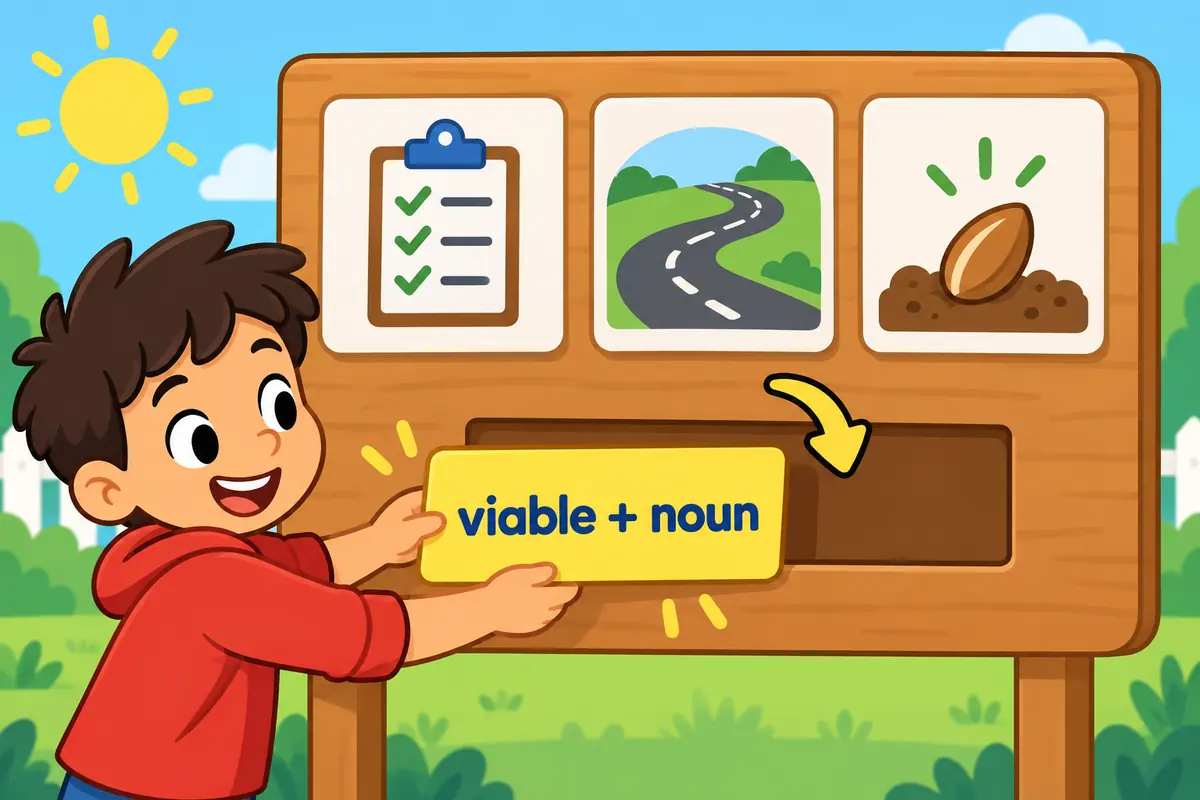
| viable + noun | They proposed a viable alternative. | The adjective judges the noun directly; the commonest pattern. |
| become / remain viable | The clinic remains viable on donations. | A change of state or continued survival. |
| make + object + viable | Better roads made the route viable. | Names whatever creates the condition for success. |
| a viable option / candidate | Rooftop solar is now a viable option. | The noun phrase that dominates business writing. |
| not viable | The scheme is not viable at this cost. | Directs the judgement at cost or timing. |
Where a project is simply possible but not yet tested over time, the bare adjective is a claim nobody has checked; the for phrase, as in viable for a small charity, is what keeps the sentence honest.
Viable in a sentence: examples across contexts
The meaning holds steady while the subject changes. Each sentence below names the test that makes the judgement concrete, from a classroom timetable to a laboratory freezer.
| Context | Example sentence | Why this works |
|---|---|---|
| Classroom | The class chose a viable topic that could be researched in one week. | Names the time limit that makes the choice realistic. |
| Workplace email | Before we commit, please confirm the plan is viable at the current headcount. | Ties viability to a specific constraint. |
| News report | Officials said the coastal road is no longer viable after the landslide. | Uses the negative form for a public decision. |
| Business plan | The forecast shows the shop becomes viable in its third year. | Gives viability a date, which investors expect. |
| Biology lab | The team stored the seeds to check which remained viable after freezing. | Applies the survival sense to living material. |
| Local government | A viable bus route needs enough passengers to cover its fuel. | States the condition instead of asserting success. |
| Conversation | Splitting the rent three ways is the only viable option I can see. | Softens a practical judgement in everyday speech. |
| Academic writing | The study asks whether small farms are viable without subsidy. | Pairs the adjective with the exact test being applied. |
| Design review | We kept the layout because it is viable on both phone and desktop. | Uses viability for technical fit rather than profit. |
A route can be viable without being profitable if the public purse covers the gap, which is why planners keep the two words apart.
Viable vs feasible
Viable and feasible both sound like approval, but they answer different questions. Feasible asks whether something can be done; viable asks whether it can keep working once it exists. Neither word describes a person’s ability, so keep capable for people.
| Attribute | viable | feasible |
|---|---|---|
| Core question | Can it survive and keep working? | Can it be done at all? |
| Time frame | Judged over time, after starting | Judged before starting |
| Typical subject | A business, route, species or plan | A project, scheme or option |
| Implies | Ongoing success or survival | Practical possibility |
| Opposite | Nonviable or unviable | Infeasible |
Verdict: choose feasible when you are deciding whether to begin, and viable when you are judging whether the thing can endure once it begins.
Word forms and grammar of viable
Viable inflects like any long adjective, and its noun carries the abstract idea of staying power. The last row shows a form learners build by mistake.
| Form | Part of speech | Example |
|---|---|---|
| viable | adjective | The plan looks viable. |
| more viable / most viable | comparative / superlative | Solar is now the more viable choice. |
| viability | noun | Nobody questioned the viability of the site. |
| viably | adverb, rare | The service cannot be run viably at this price. |
| nonviable | adjective, opposite | The lab declared the sample nonviable. |
| viable as a verb | non-standard | “We will viable the project” is wrong; write make viable. |
The noun viability is the form to reach for in headings and reports, because it turns the judgement into something a study can measure.
Common mistakes with viable
- Incorrect:
The idea is viable to do.Correct: The idea is viable. Rule: Viable is an adjective and does not take a to-infinitive the way able does. - Incorrect:
We need to viable the factory.Correct: We need to make the factory viable. Rule: Viable is never a verb; pair it with make, become or remain. - Incorrect:
It is viable that sales will rise.Correct: It is possible that sales will rise. Rule: Viable does not introduce a that-clause; use possible or likely before a clause. - Incorrect:
The weather made the picnic viable.Correct: The weather made the picnic possible. Rule: Keep viable for plans and living things that must keep working, not for one-off events. - Incorrect:
She is a very viable student.Correct: She is a very capable student. Rule: Viable rarely describes a person’s ability; capable does.
Practice using viable
Work through the six items and then read the reasoning, because the reason is what fixes the pattern in memory.
- Fill the gap: The bakery became ______ once the rent was renegotiated.
- Choose the better word: The doctor checked whether the tissue was still (viable / vivid).
- Correct the error: We will viable the scheme by spring.
- Build a sentence: use viable before a noun to describe a transport plan.
- Spot the register: which belongs in a funding proposal — the pilot route is viable, or the route sort of works?
- Rewrite with the noun: The committee proved the plan could succeed. Use viability instead.
Answers
- viable — the bakery is judged able to keep trading, which is the practical sense.
- viable — living tissue that can survive is viable; vivid describes colour or memory.
- The scheme should be made viable by spring — viable is an adjective, so a verb such as make is needed.
- Model answer: The council funded a viable tram line between the two estates.
- The pilot route is viable — a proposal needs the precise adjective, not the vague phrase sort of works.
- The committee confirmed the viability of the plan — the noun takes the definite article here.
The bottom line
Use viable in a sentence when something has to keep working or keep surviving, and name the constraint that decides it. Two nuances settle most uses: feasible asks whether a task can be done at all while viable asks whether it can continue, and only the practical sense applies to businesses. Where the question is long-term endurance rather than bare possibility, sustainable often carries the idea more precisely.
Frequently asked questions about viable
Is viable a positive word?
Viable is mildly positive, because it means something can succeed or keep going. It is not a strong compliment, though. Calling a proposal viable says it will not collapse; it does not say the proposal is clever, fair or the best available.
What is the opposite of viable?
Nonviable and unviable are the direct opposites, and both appear in business and science writing. A nonviable project cannot continue, and a nonviable seed cannot grow. In ordinary English, the plainer opposites are not workable or not sustainable, which readers understand without technical knowledge.
Can you use viable for a person?
Only rarely, and never in the way you would use capable. A viable candidate can mean someone who could actually win or serve, but a viable employee sounds odd. For a person, choose capable, employable or qualified, and keep viable for plans, methods and living things.
Does viable always mean profitable?
No. Profit is only one way of succeeding. A viable service can break even, a viable species can survive without earning anything, and a viable plan can meet a goal that is not financial. Use profitable when money is the test, and viable when continued success of any kind is the test.
Do you struggle with finding suitable solutions that are both practical and effective? You might be looking for something that is viable. The term “viable” refers to something that has the capability to work successfully, whether it’s a plan, idea, or product.
In everyday life, being able to identify viable options can significantly impact decision-making and problem-solving. Understanding what makes a solution viable can lead to more efficient and successful outcomes in various situations.
7 Examples Of Viable Used In a Sentence For Kids
- Plants need viable soil to grow big and strong.
- It is important to eat healthy food to have viable energy.
- Animals need water to stay viable and healthy.
- We should recycle to keep our environment viable.
- Reading books helps our brains stay viable and active.
- It is fun to play outside and keep our bodies viable.
- We should always be kind to others to create a viable community.
14 Sentences with Viable Examples
- Viable options for part-time jobs on campus include working at the library or student union.
- Finding a viable study group can greatly improve your understanding of course material.
- It is important to research viable internship opportunities in your field of study.
- Utilizing online resources for research can make finding viable sources much easier.
- Participating in campus events can be a viable way to meet new people and make friends.
- Setting up a viable budget will help you manage your expenses effectively as a college student.
- Joining a sports team or club can be a viable way to stay active and relieve stress.
- Creating a viable study schedule can help you stay organized and on top of your coursework.
- Taking advantage of campus resources such as the career center can lead to viable job opportunities after graduation.
- Exploring viable scholarship options can help offset the cost of tuition and books.
- Forming a viable routine that includes exercise, healthy eating, and regular sleep can improve your overall well-being as a student.
- Attending career fairs and networking events can be viable ways to connect with potential employers.
- Utilizing viable note-taking techniques like Cornell notes can enhance your understanding and retention of material.
- Utilizing viable time management strategies can help you balance academics, extracurricular activities, and personal life effectively.
How To Use Viable in Sentences?
Viable means capable of working successfully; feasible. To use Viable in a sentence, follow these steps:
-
Identify the context: Determine the situation or problem you are discussing. This will help you use Viable appropriately.
-
Choose the appropriate form: Depending on the context, decide whether the word Viable fits better as an adjective or a noun in your sentence.
-
Construction: When constructing your sentence, place Viable in a position that flows naturally and clearly conveys your message.
-
Check grammar and clarity: Ensure that the sentence makes sense and has proper grammar. Double-check the placement of Viable to confirm it fits seamlessly into the sentence.
Example sentence: “Finding a viable solution to the current economic crisis is crucial for our society’s stability.”
Practice using Viable in various sentences to become more comfortable with its usage. Pay attention to how other writers incorporate Viable in their work to gain a better understanding of its nuances.
Remember, the word Viable adds specificity and clarity to your sentences by indicating that something is workable or feasible.
Conclusion
In conclusion, the examples of sentences with the keyword “viable” showcase its versatility in describing practical and feasible solutions, options, or strategies. These sentences illustrate the concept of something being workable, capable of success, or having the potential to achieve desired outcomes. Whether discussing a viable business plan, a viable alternative, or a viable solution, the keyword helps convey the idea of something being realistic, achievable, and worth considering.
By examining these sentences, one can grasp the importance of assessing whether a plan or option is truly viable before proceeding. Understanding the implications of using the keyword “viable” ensures clear communication and effective decision-making, as it prompts consideration of practicality, feasibility, and likelihood of success in various contexts.


