
Quick answer: Wherein is a formal word meaning “in which.” It connects a noun such as case, process, or document to a clause that explains something within it. In everyday writing, in which or where is often clearer.
What does “wherein” mean?
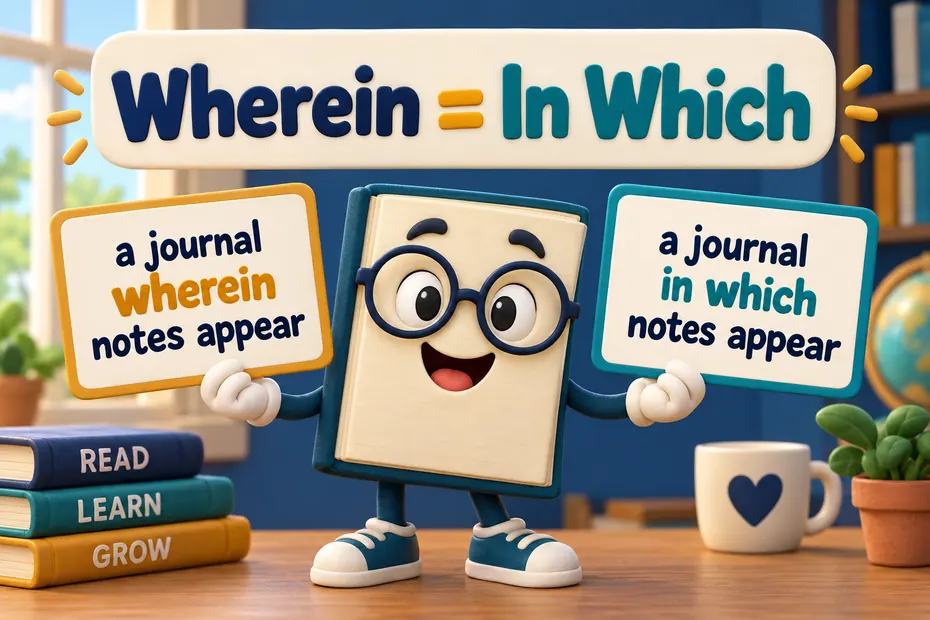
Wherein is a formal relative adverb that usually means in which. It can point to a place, period, situation, or document already mentioned: “They entered a room wherein a map covered the table.” Here, wherein means “in which a map covered the table.”
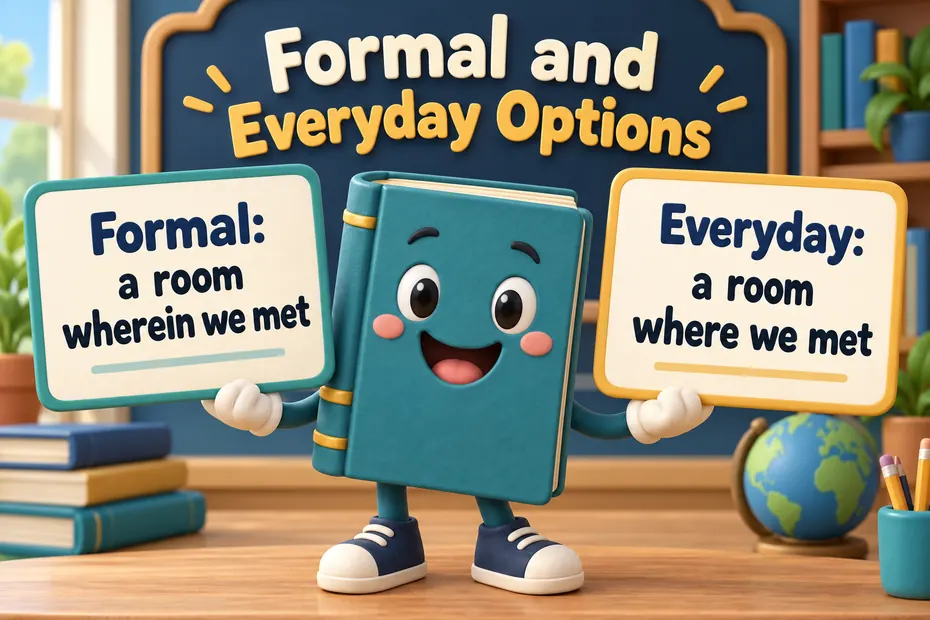
The word is common in older, literary, and legal-style writing, but can sound stiff in everyday conversation. A clearer modern sentence is often possible: “They entered a room where a map covered the table.” For abstract cases, in which may be easier to follow: “The report describes a process in which each team reviews its own work.”
Wherein in example sentences
- The archive contains a journal wherein the explorer recorded each stop.
- They designed a process wherein every request receives a second review.
- The novel imagines a city wherein music is part of daily life.
- The agreement includes a section wherein each party lists its responsibilities.
- She presented a case wherein the original rule produced an unexpected result.
- The museum opened a room wherein visitors can compare the two maps.
- The paper describes a period wherein several schools adopted the new schedule.
- They published a guide wherein the steps are arranged from simplest to most complex.
In each example, wherein introduces a clause that can be paraphrased with in which. These are original practice sentences, not quotations from the cited dictionaries.
Wherein and “where,” “in which,” or “whereas”
| Word or phrase | Typical use | Example |
|---|---|---|
| Wherein | Formal “in which”; refers back to a place, situation, or thing. | “The handbook describes a system wherein the parts work together.” |
| Where | Commonly refers to a place; it can also introduce a situation in some contexts. | “The handbook explains where the parts belong.” |
| In which | A clear alternative when the intended meaning is “within which.” | “The handbook describes a system in which the parts work together.” |
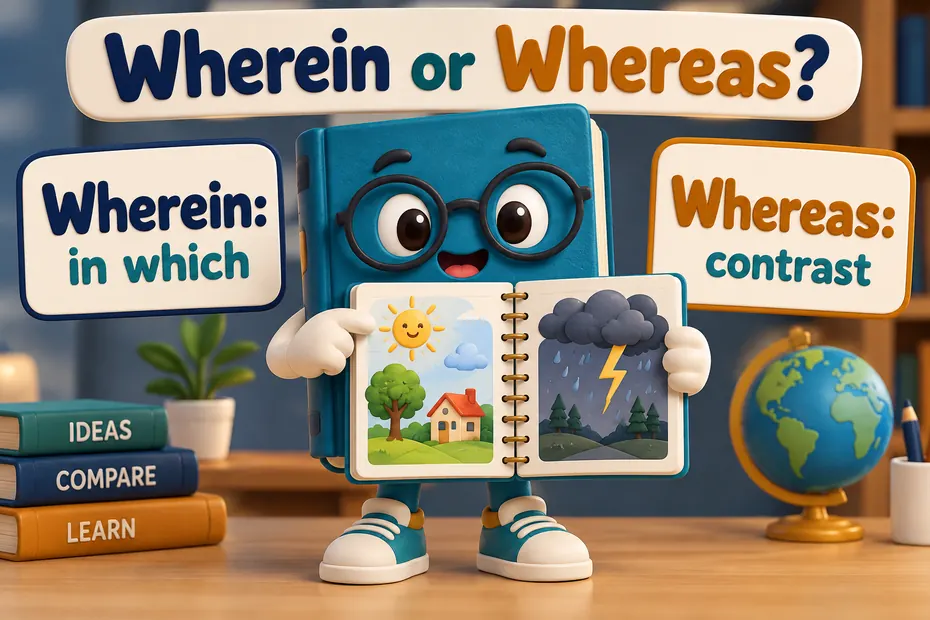
| Whereas | Introduces a contrast, often meaning “while” or “although.” | “The first system is compact, whereas the second is easier to repair.” |
Wherein and whereas are not interchangeable. Use wherein for an “in which” relationship and whereas to contrast two ideas. If readers may pause to decode a formal word, use the simpler phrase instead.
How to use “wherein” clearly
- Give it a noun to refer back to. A room, process, case, period, or document can make the relationship clear.
- Check that “in which” fits. If that paraphrase changes the sentence’s meaning, choose another construction.
- Do not confuse it with “whereas.” The latter signals a contrast, not a location or situation within which something occurs.
- Prefer plain wording when possible. “Where,” “in which,” or “during which” may be easier for a broad audience.
- Use the formal tone deliberately. “Wherein” can suit a literary or traditional style, but it may feel unnecessarily legalistic in a casual message.
What about “wherein lies the difficulty”?
Wherein can also mean “in what respect” or “in which part” in a formal question. “Wherein lies the difficulty?” asks where the difficulty consists or what makes the matter difficult. In everyday English, “What is the difficulty?” is usually more direct. This use does not need a previously stated room or document, so the noun-before-wherein pattern is a practice guide rather than a rule for every occurrence.
Frequently asked questions
What does “wherein” mean in simple terms?
It usually means “in which.” It introduces a clause about something inside or within a previously mentioned place, situation, or thing.
Is “wherein” still used?
Yes, but it is formal and less common in everyday conversation. Writers often choose where or in which for a more direct style.
Are “wherein” and “whereas” the same?
No. Wherein usually means “in which”; whereas introduces a contrast, similar to “while.”
Can I use “wherein” for a place?
Yes, in formal writing it can mean “in which” and refer to a place. In ordinary prose, where is usually simpler.
Sources and further reading
Check a current dictionary entry for wherein or wherein for its definition, register, and examples. Cambridge also records the sense “in which part,” useful for understanding formal questions. The practice examples above are original.
Looking to enhance your writing skills and add complexity to your sentences? Using the word “wherein” can elevate your writing by indicating a specific point in which something happens. This versatile word is often used to provide additional detail or clarification in a sentence.
“Wherein” is a conjunction that signals a relationship between parts of a sentence, highlighting the precise location or circumstance in which an action takes place. By incorporating “wherein” into your writing, you can create more sophisticated and precise descriptions, making your work more engaging and polished.
7 Examples Of Wherein Used In a Sentence For Kids
- Wherein do cows live?
- Have you seen the garden wherein the flowers bloom?
- The classroom wherein we study is very colorful.
- Wherein can we find the monkeys in the zoo?
- Let’s go to the park wherein we can play on the swings.
- The kitchen is the place wherein we cook our food.
- The library is a quiet place wherein we can read books.
14 Sentences with Wherein Examples
- Wherein the students are required to submit their assignments online before the deadline.
- Wherein the college library provides a quiet space for students to study and work on their assignments.
- Wherein the college cafeteria offers a variety of affordable meals and snacks for the students.
- Wherein the college organizes events and workshops to enhance the students’ skills and knowledge.
- Wherein the students have access to online resources and databases for research purposes.
- Wherein the college campus has designated areas for extracurricular activities such as sports and cultural events.
- Wherein the college offers career counseling services to help students plan their future after graduation.
- Wherein the college provides support for students with disabilities to ensure their academic success.
- Wherein the students are encouraged to participate in community service projects to give back to society.
- Wherein the college hosts guest lectures and interactive sessions with industry experts to expose students to real-world scenarios.
- Wherein the college has a strong alumni network that offers mentorship and job opportunities to current students.
- Wherein the students have the option to pursue internships and practical training to gain hands-on experience.
- Wherein the college collaborates with international universities for exchange programs and study abroad opportunities.
- Wherein the college facilitates networking events and career fairs to help students connect with potential employers.
How To Use Wherein in Sentences?
Wherein is a word that is commonly used in formal writing to introduce a clause that explains or provides more detail about something mentioned earlier in the sentence. When using wherein, it is important to ensure that the sentence is structured correctly to convey the intended meaning.
To use wherein in a sentence, follow these steps:
- Identify the main idea or point that you want to elaborate on in your sentence.
- Introduce wherein after a comma or semicolon to connect the main idea with the detailed explanation that follows.
- Ensure that the clause following wherein provides additional information or context that is relevant to the main idea.
For example:
– “She went to the store, wherein she bought groceries for the week.” (In this sentence, wherein introduces a clause that explains what the main character did at the store.)
– “The company implemented a new policy, wherein employees are required to attend training sessions.” (Here, wherein connects the policy implementation with the specific requirement for employees.)
By using wherein effectively in your writing, you can provide clarity and coherence to your sentences by linking related ideas in a structured manner. With practice, you can master the use of wherein to enhance the flow and organization of your writing.
Conclusion
In this article, we explored examples of sentences using the keyword “wherein.” This word typically introduces a clause that provides more detailed information or specific circumstances within a larger context. By incorporating “wherein” into a sentence, writers can clarify relationships, conditions, or actions that are crucial to understanding the overall meaning.
Using “wherein” can help make sentences more precise and structured, ensuring that the reader can follow the narrative or argument effectively. Whether used in legal documents, scholarly papers, or creative writing, the keyword “wherein” serves to enhance clarity and coherence by pinpointing key details or conditions within the broader context.


