Whispered in a Sentence: Meaning, Grammar, and Examples
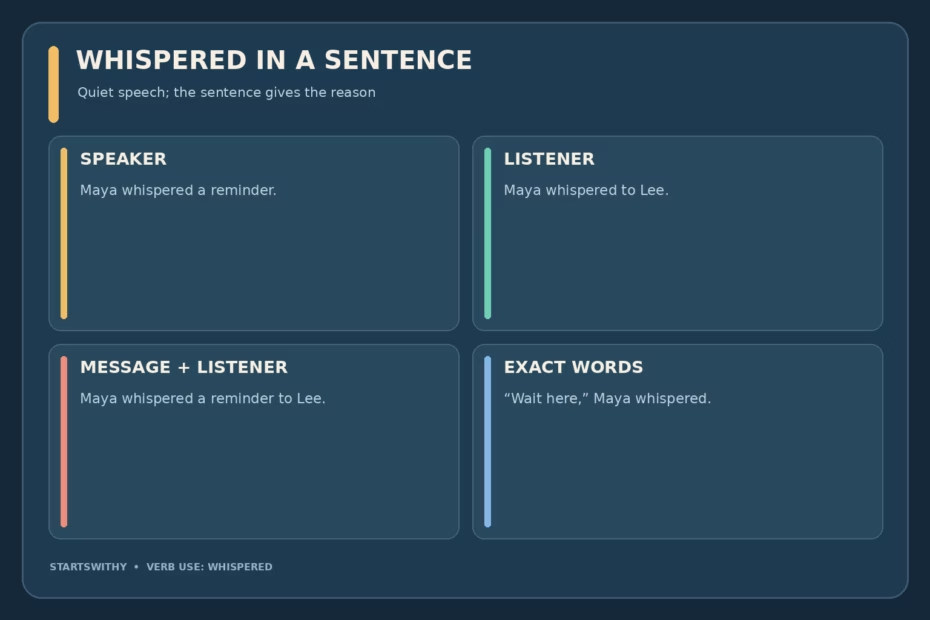
Whispered is the past-tense and past-participle form of whisper, meaning to speak or say something very quietly. Use it when the manner of speech matters: “Maya whispered a reminder to her partner.” It can describe literal quiet speech, as well as figurative sounds such as wind that seems to whisper through leaves. The word does not automatically mean a secret; context tells readers why someone is speaking quietly.
What does whispered mean?
When a person whispers, they speak in a very quiet, breath-based way so the sound does not carry far. In the sentence “Nora whispered the directions,” whispered is the main verb and describes what Nora did. Cambridge Dictionary also gives whisper as a noun for quiet speech, while Oxford Learner’s Dictionaries shows that the verb can be used with or without an object.
A whisper may be private, but secrecy is only one possible reason for it. Someone might whisper to avoid disturbing a sleeping child, to communicate in a quiet room, or to create a dramatic effect in a story. By contrast, “She spoke softly” describes low-volume speech more generally; it does not necessarily mean she whispered.
How to use whispered in a sentence
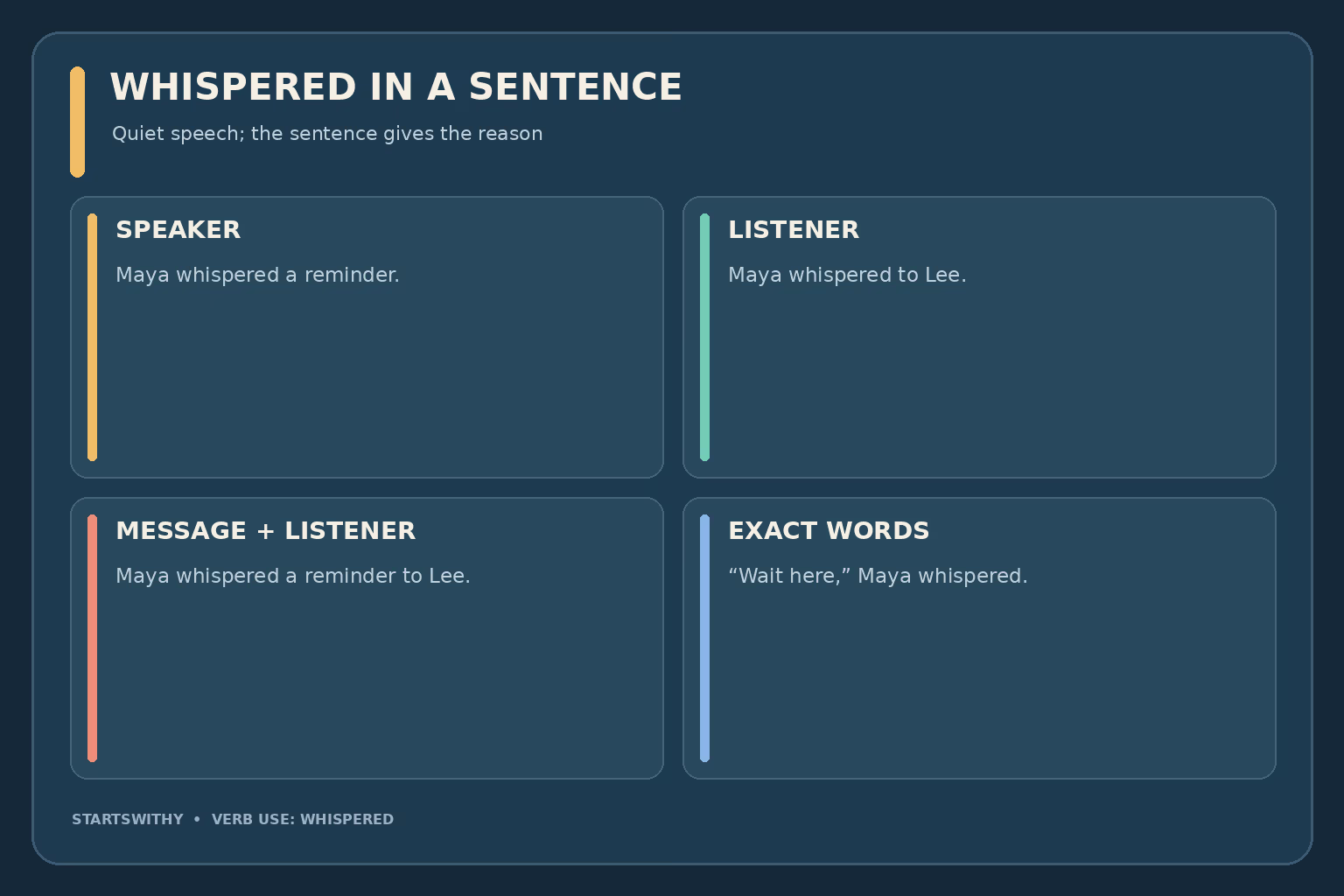
Choose the sentence pattern that matches what the speaker does. The verb can stand alone, identify a listener, or name the words or message spoken:
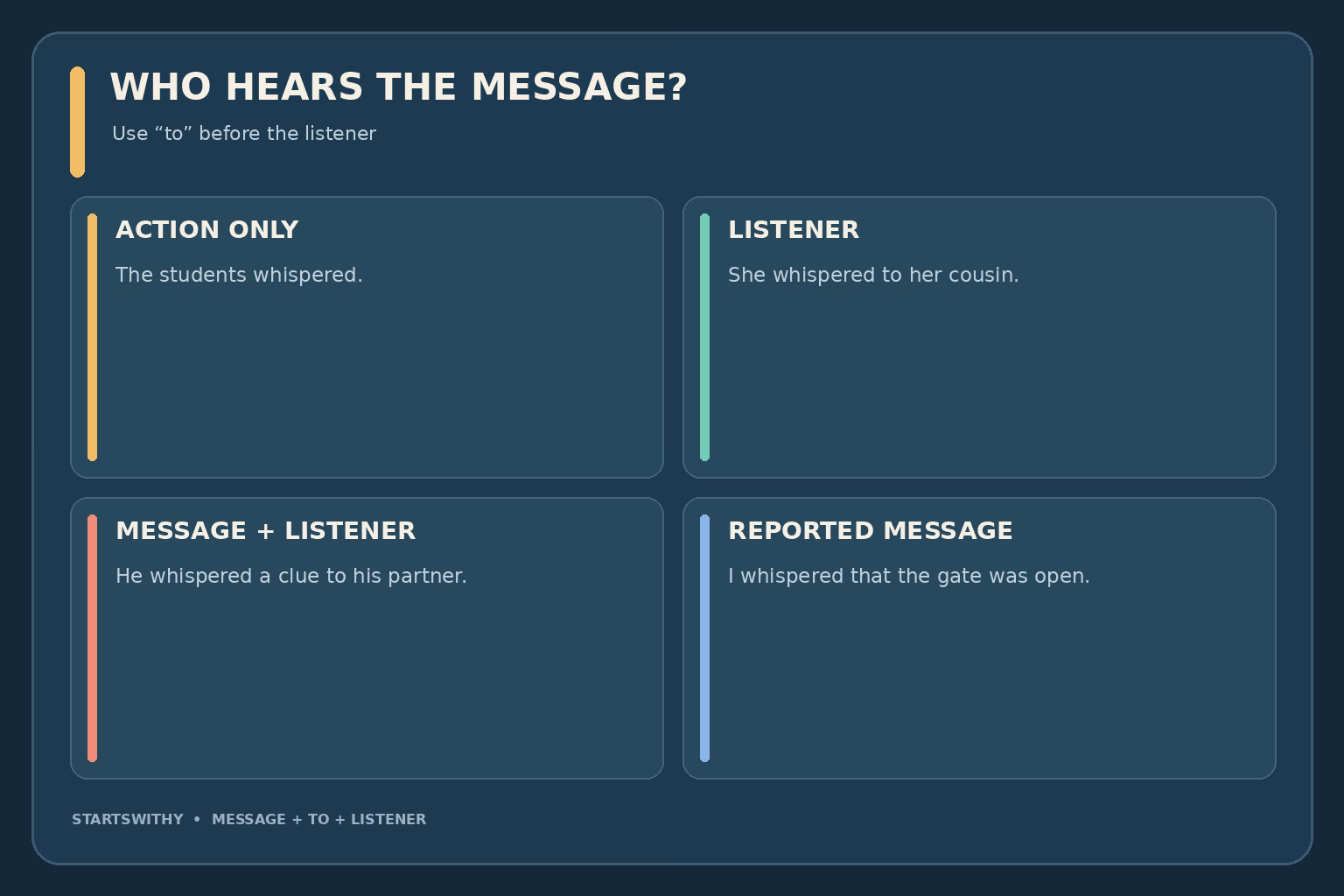
- Speaker + whispered: “The audience whispered during the pause.” The verb has no direct object.
- Speaker + whispered + to + listener: “I whispered to Eli.” The preposition to introduces the person being addressed.
- Speaker + whispered + message + to + listener: “I whispered the answer to Eli.” The message is the direct object; the listener follows to.
- Speaker + whispered + quoted words: “ ‘The door is open,’ Eli whispered.” The quotation gives the exact words.
- Speaker + whispered that + clause: “Eli whispered that the door was open.” This reports the message without quoting its exact wording.
These patterns are useful for both short example sentences and longer writing. Choose a clear subject, then decide whether readers need to know the listener, the message, or the exact words.
Whispered, whispers, and whispering
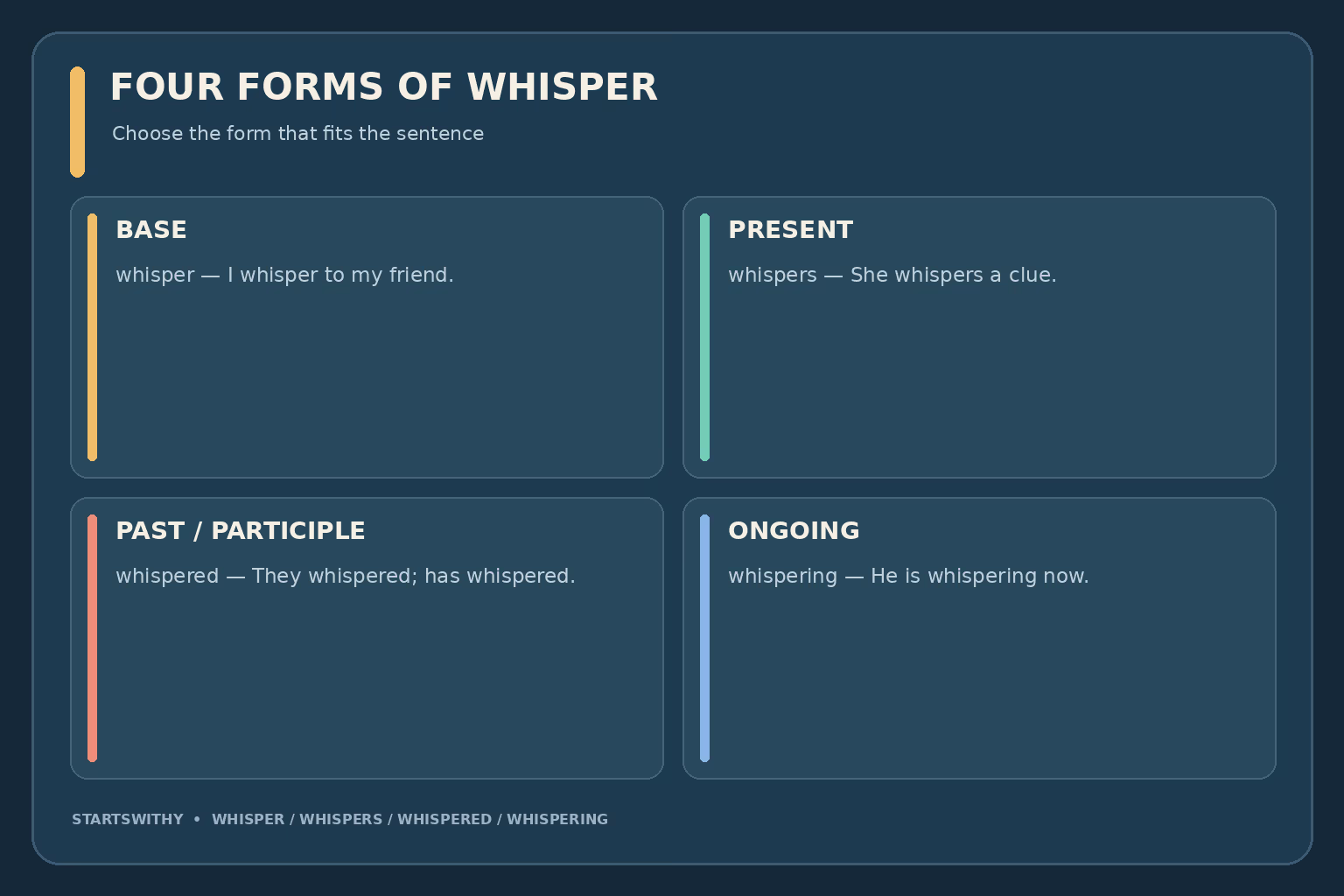
The correct form depends on the sentence’s time and structure. Use whispers for a present-tense action with a singular third-person subject (“Jon whispers”), and whisper with I, you, we, or they (“They whisper”). Use whispered for a completed past action (“Jon whispered”) and as the past participle after a helping verb (“They have whispered”). The present participle is whispering: “Jon is whispering.”
Whispered can also come before a noun: “a whispered request.” Here it modifies request, rather than serving as the sentence’s main verb. Compare “She whispered a request” (verb) with “She made a whispered request” (modifier). The spelling is whispered, with one final r before -ed.
Punctuating dialogue with whispered
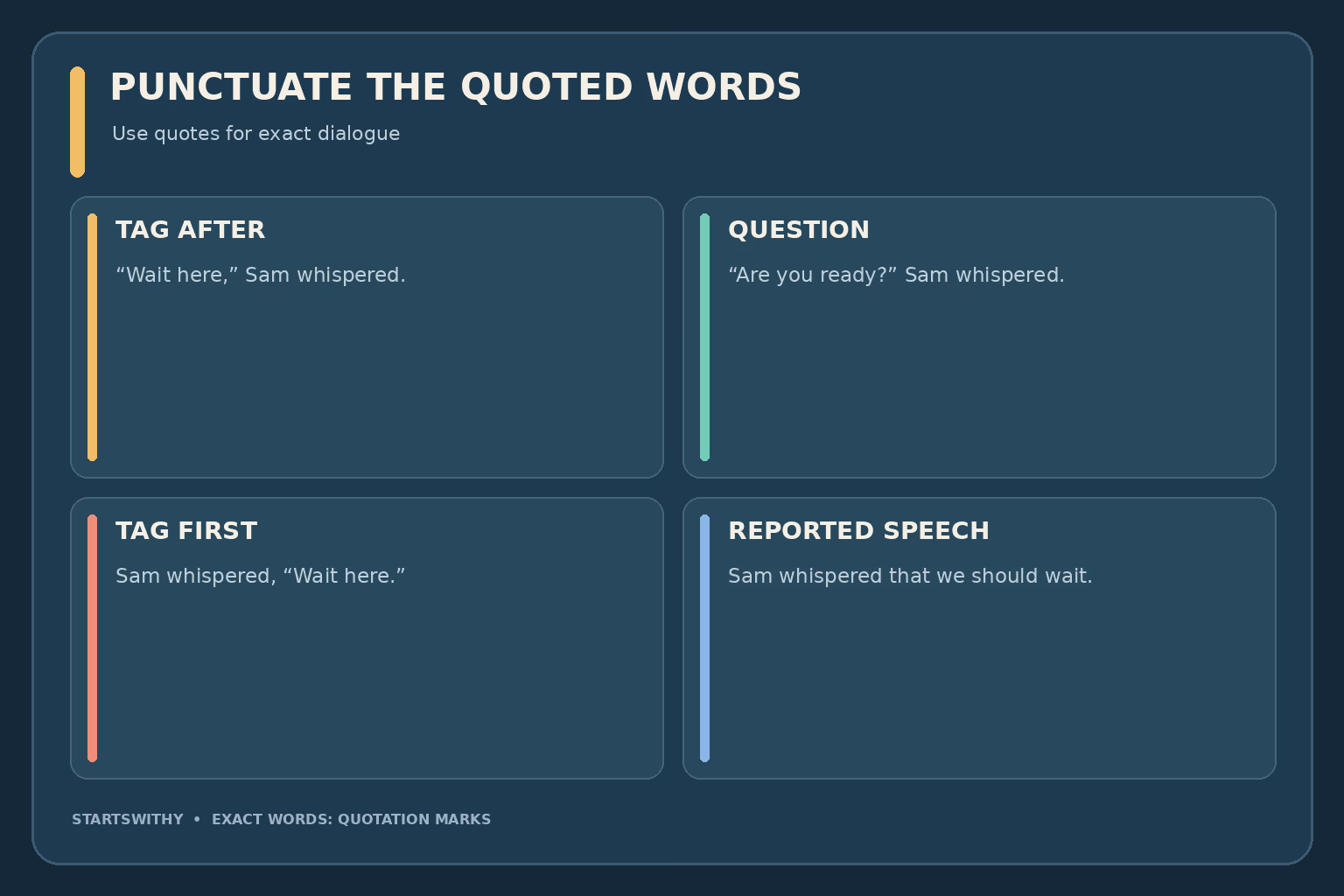
When you quote a speaker’s exact words, place the comma or question mark inside the closing quotation mark in standard American English. For example: “ ‘Wait here,’ Sam whispered.” If the quoted words form a question, write “ ‘Are you ready?’ Sam whispered.” When the speech tag comes first, use a comma before the quotation: “Sam whispered, ‘Wait here.’”
Quotation marks are appropriate when you are showing the exact dialogue; they are not required just because a sentence contains whispered. Indirect speech does not use quotation marks: “Sam whispered that the bus had arrived.” A short dialogue tag such as she whispered identifies the speaker and manner of speaking. Avoid adding an adverb that repeats the same information (“whispered quietly”) unless you need a specific contrast or emphasis.
Literal and figurative uses
Most often, a person whispers words to another person. Writers also use the verb figuratively for a very soft sound: “The breeze whispered through the grass.” The breeze is not literally forming words; the sentence compares its gentle sound to a whisper. This literary use appears in dictionaries, but in factual or technical writing a more direct verb such as rustled or moved softly may be clearer.
Likewise, a “whispered warning” may mean that someone spoke the warning quietly, while “a whisper of doubt” is figurative and means a slight trace of doubt. Notice the context and grammar: in “I whispered a warning,” whispered is a verb; in “I heard a whispered warning,” it describes the noun warning.
Common mistakes to avoid
- Using the wrong form: “Yesterday, she whispered,” not “Yesterday, she whisper.”
- Confusing the listener and message: “He whispered to his friend” names the listener; “He whispered a clue to his friend” names both clue and listener.
- Assuming every quiet statement is secret: A whisper can be practical, affectionate, urgent, theatrical, or simply quiet.
- Adding redundant wording: Because a whisper is already quiet speech, “whispered quietly” is often repetitive.
- Forgetting dialogue punctuation: When exact speech is quoted, punctuate the quoted words as dialogue; indirect reports use no quotation marks.
Quick examples with whispered
- “The librarian whispered a reminder to the visitors.”
- “ ‘The lights are still on,’ I whispered.”
- “He whispered that he would meet us outside.”
- “The children whispered while the baby slept.”
- “A whispered question reached the front row.”
- “In the poem, the pines whispered in the evening wind.”
For dictionary definitions and additional usage examples, see Cambridge Dictionary’s entry for whisper and Oxford Learner’s Dictionaries’ verb entry.

Original whispered sentence examples
The original examples and guidance are preserved below.
Whispered sentences are quiet, hushed utterances that convey secrecy or intimacy. These soft-spoken phrases are typically used in situations where one wishes to communicate discreetly or share something personal without being overheard.
Whether sharing a secret, expressing affection, or divulging confidential information, whispered sentences add an element of mystery and closeness to the spoken word. The softness of the delivery can create an atmosphere of intrigue and privacy, drawing the listener in and inviting them to lean in closer to catch every word.
7 Examples Of Whispered Used In a Sentence For Kids
- Whispered secrets are worth keeping.
- She whispered the answer to her friend.
- Whispered words can be calming.
- He whispered a joke in her ear.
- The wind whispered through the trees.
- They whispered their wishes to the stars.
- The teacher whispered instructions to the students.
14 Sentences with Whispered Examples
- Whispered conversations in the library can be disruptive to other students trying to study.
- During exams, students often whispered answers to each other to avoid getting caught.
- The professor whispered important instructions before the start of the practical experiment.
- In the crowded lecture hall, students whispered to each other to find out what was written on the board.
- He whispered a secret recipe for success to his friend before an important presentation.
- The girls whispered in excitement about the upcoming college fest.
- Students whispered rumors about the surprise guest speaker for the upcoming seminar.
- As the lights dimmed in the auditorium, the students whispered in anticipation of the cultural performance.
- She whispered words of encouragement to her nervous classmate before a class presentation.
- The seniors whispered to the juniors about the best places to hang out on campus.
- The group whispered strategies to ace the upcoming competitive exam.
- The friends whispered about their weekend plans during a dull lecture.
- Students whispered about their dream jobs while waiting for their career counseling session.
- Amidst the chaos of festival preparations, volunteers whispered urgent reminders to each other to stay organized.
How To Use Whispered in Sentences?
Whispered is a versatile verb that adds depth and emotion to your writing. To use whispered effectively in a sentence, follow these simple steps:
-
Choose the appropriate context: Whispered is used to convey a soft, secretive, or hushed tone. It is often used in situations where the speaker wants to communicate privately or discreetly.
-
Identify the subject and object: Begin your sentence with the subject, followed by the action of whispered, and then the object. For example, “She whispered a secret to her best friend.”
-
Use adverbs to enhance the meaning: Adverbs like softly, quietly, or gently can be added before whispered to indicate the manner in which the whisper is spoken. For instance, “He softly whispered words of encouragement to his nervous teammate.”
-
Pay attention to punctuation: When using whispered in a sentence, consider adding quotation marks to indicate the whispered speech. For example, “I’ll be there,” she whispered with a smile.
-
Practice for fluency: To become more comfortable using whispered in your writing, try incorporating it into various sentences to build your confidence and improve your writing skills.
By following these steps and practicing regularly, you can effectively use whispered in your writing to create a sense of intimacy, secrecy, or emotion. Experiment with different contexts and styles to find the perfect fit for your narrative.
Conclusion
In summary, sentences with whispered indicate quiet communication or expression. These hushed conversations often carry a sense of secrecy, intimacy, or urgency, as if the message is meant to be heard only by a select few. Whispered sentences can convey emotions such as fear, excitement, trust, or affection, adding depth and significance to the words being spoken.
Whether whispered out of necessity to avoid being overheard or whispered for the sake of closeness, these sentences hold a special power in their subtle delivery. The act of whispering creates a unique atmosphere, drawing listeners in and emphasizing the importance of the message being shared in a discreet and personal manner.


