
Wrap up means to finish or conclude something, or to dress warmly for cold weather. To use wrap up in a sentence, keep the object flexible: “she wrapped up the meeting early.” The phrasal verb is separable, so a pronoun must sit in the middle, as in wrap it up.
Wrap up at a glance
- Wrap up is a separable phrasal verb; its forms are wraps up, wrapped up and wrapping up.
- The main sense is to finish or conclude an activity, often a meeting, task or deal.
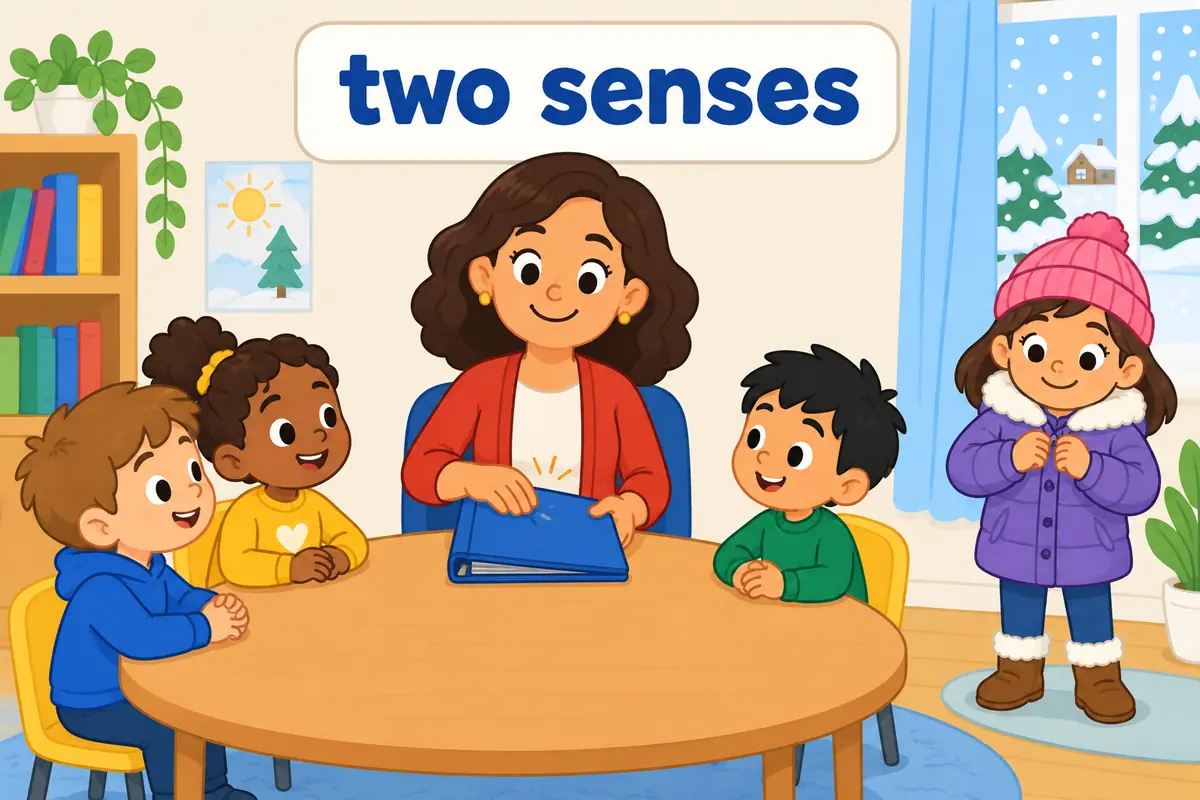
- A second sense is to dress warmly, as in the children wrapped up against the cold.
- The object may follow the particle or sit between the words, but a pronoun goes in the middle.
- The commonest error is confusing it with wind up, which can mean to finish, to end up or to tease.
What does wrap up mean?
Wrap up is a phrasal verb meaning to finish or conclude something, or to put on warm clothes. The Cambridge entry for wrap up keeps the finishing sense and the dressing sense apart, and the two behave differently: one usually takes an object, while the other stands alone.
| Sense | Plain meaning | Example sentence |
|---|---|---|
| Finish or conclude | Bring an activity to an end | We wrapped up the meeting at noon. |
| Complete a task | Finish the last details of something | She wrapped up the report before Friday. |
| Dress warmly | Put on warm clothes against the cold | The children wrapped up against the wind. |
One limitation is worth stating plainly. Wrap up is not a formal synonym for conclude in every document: a legal brief would say conclude or close rather than wrap up. It also means something different from the related verb wind up, which can mean to end up in a place or to tease somebody.
How do you use wrap up in a sentence?
The verb is transitive in the finishing sense and intransitive in the dressing sense, and that difference controls the shape of the sentence. The particle may be separated from the verb, but a pronoun must sit between the two parts.
| Pattern | Example | What it signals |
|---|---|---|
| wrap up + object | They wrapped up the discussion quickly. | Object follows the particle, the standard order. |
| wrap + object + up | They wrapped the discussion up quickly. | Split order suits a longer or more familiar object. |
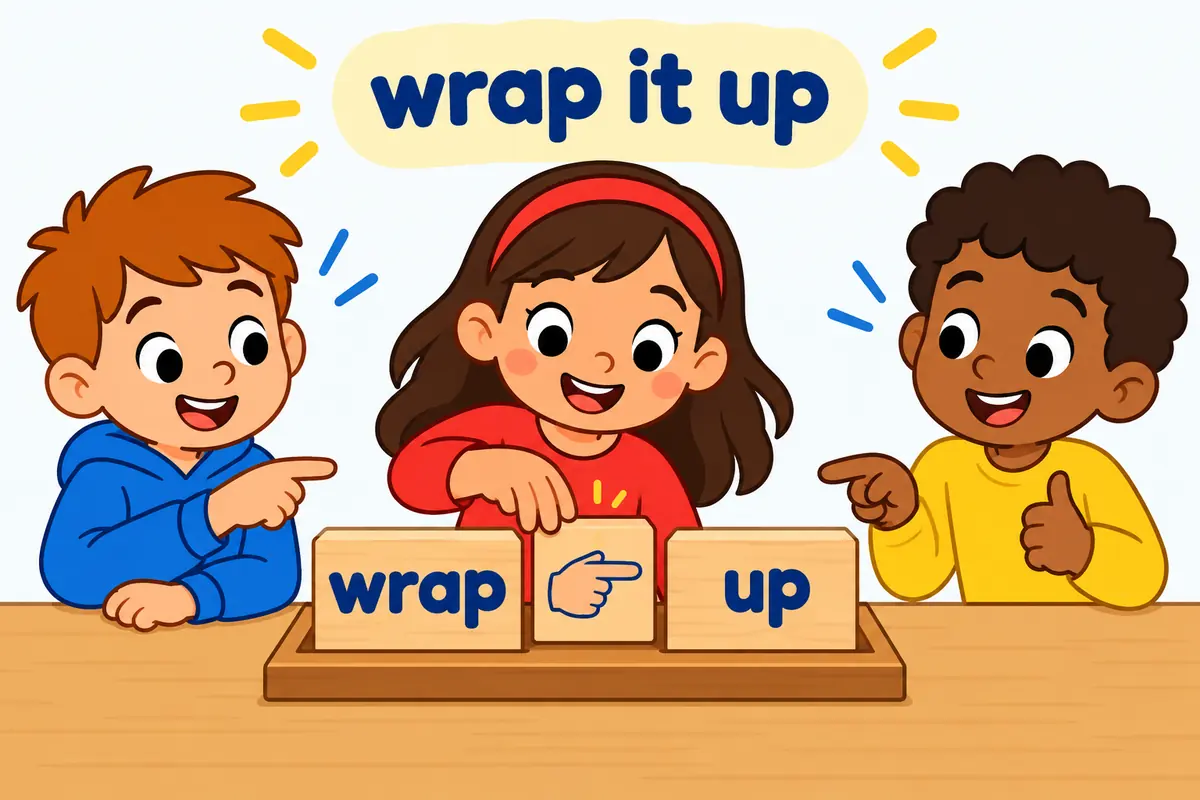
| wrap + pronoun + up | Wrap it up before lunch. | With a pronoun, only the split order is grammatical. |
| wrap up, no object | Let us wrap up for today. | Intransitive, meaning stop or finish for now. |
| wrap up + warm/against + noun | Wrap up warm before you go out. | The dressing sense, which takes no object. |
Because the particle may strand after the object, wrap up is more flexible than a fixed phrase. The one rule a learner must never break is the pronoun placement: wrap it up, never wrap up it. Where the meaning is only to bring something to a stop, conclude keeps the same sense in a stiffer register.
Wrap up in a sentence: examples across contexts
The same verb covers a chairperson closing a meeting and a family dressing for snow, so context decides the sense. The nine sentences below keep the meaning clear, and each one shows whether an object is present.
| Context | Example sentence | Why this works |
|---|---|---|
| Classroom | We wrapped up the lesson with a short quiz. | The object is the lesson and wrap up means end calmly. |
| Workplace email | Let us wrap up the review by Thursday. | The object follows the particle in a neutral request. |
| News report | Police wrapped up their inquiry after six months. | Applies the finishing sense to an official process. |
| Sports writing | They wrapped up the title with a game to spare. | Shows the verb closing a competition decisively. |
| Conversation | Wrap it up, the bus leaves in five minutes. | Uses the pronoun between verb and particle, the fixed order. |
| Family | The children wrapped up warm before the walk. | Uses the dressing sense with no object. |
| Conference | The chair wrapped the session up ten minutes early. | The split order handles a longer object smoothly. |
| Finance | The two firms wrapped up the deal on Friday. | Treats a negotiation as a task being completed. |
| Project management | We will wrap up the last tasks next week. | Names the remaining work as the object of the verb. |
Six of these rows end an activity, two finish an agreement, and one describes dressing. Where a writer needs the formal closing of a formal event, finalize the deal or complete may replace wrap up without losing the sense.
Wrap up vs wind up
Wrap up and wind up overlap in the closing sense and diverge sharply everywhere else. Wind up can mean to end up in a place or state, and in informal use it means to tease somebody, while wrap up never carries those senses.
| Attribute | wrap up | wind up |
|---|---|---|
| Core meaning | Finish or conclude something | Finish, but also end up in a state |
| Informal sense | To dress warmly | To tease somebody |
| Separability | Separable, pronoun in the middle | Separable, pronoun in the middle |
| Typical objects | meeting, task, deal, report | meeting, company, clock |
| Register | Neutral and common in business | Informal to neutral |
Verdict: choose wrap up to finish a named activity or to dress for cold weather, and wind up when the meaning is ending up somewhere or teasing. If you can replace the verb with finish, both wrap up and wind up fit, so look at the rest of the sentence before deciding.
Word forms and grammar of wrap up
The verb inflects through wrapped up, and the same two words become a hyphenated noun. A third, fixed expression, wrapped up in, has nothing to do with finishing at all.
| Form | Part of speech | Example |
|---|---|---|
| wrap up | verb, base form | We should wrap up soon. |
| wraps up | verb, third person singular | The chair wraps up the session at five. |
| wrapped up | verb, past and past participle | They wrapped up the deal last week. |
| wrapping up | verb, present participle | She is wrapping up the report. |
| wrap-up | hyphenated noun and adjective | a quick wrap-up at the end of class |
| wrapped up in | fixed idiom, absorbed by | He was wrapped up in his book. |
| wrap up it | non-standard order – avoid | write wrap it up instead |
The noun wrap-up is the summary that closes a meeting, and the page on summarize the points shows the verb that does the same job at greater length.
Common mistakes with wrap up
- Incorrect:
Please wrap up it before lunch.Correct: Please wrap it up before lunch. Rule: A pronoun object must sit between the verb and the particle. - Incorrect:
We wrapped up the agenda was full.Correct: We wrapped up a full agenda. Rule: The verb takes a noun phrase, never a that-clause. - Incorrect:
a wrap up emailCorrect: a wrap-up email. Rule: The noun and its attributive form are hyphenated. - Incorrect:
The meeting wrapped up the chair at noon.Correct: The chair wrapped up the meeting at noon. Rule: The person is the subject and the thing finished is the object. - Incorrect:
He was wrapped up to his work.Correct: He was wrapped up in his work. Rule: The idiom for being absorbed takes in, not to.
Practice using wrap up
Work through the six items, then check the reason rather than only the key.
- Fill the gap: The team will ______ the project before the holiday.
- Choose the better word: The chair (wrapped up / wound up) the meeting by thanking everyone.
- Correct the error: Please wrap up it and send it today.
- Build a sentence: use wrap up + object about finishing a report.
- Spot the register: which belongs in a formal memo – we will conclude the review on Friday, or we will wrap the review up on Friday, no rush?
- Rewrite with the noun: We held a short summary at the end. Use wrap-up instead.
Answers
- wrap up – the team is finishing the project, and the object follows the particle.
- wrapped up – the chair is closing the meeting, which is the finishing sense.
- Please wrap it up and send it today – a pronoun must go between the verb and the particle.
- Model answer: I will wrap up the report before the end of the day.
- We will conclude the review on Friday – a formal memo prefers conclude and drops the vague reassurance.
- We held a short wrap-up at the end – the noun is hyphenated.
The bottom line
Use wrap up in a sentence to finish a named activity or to describe dressing for cold weather, and choose the object order that reads most naturally. The two points that decide most sentences are these: a pronoun object must sit between the words, and the dressing sense takes no object at all. Where a stiffer register is needed, complete or conclude is the safer choice than wrap up.
Frequently asked questions about wrap up
Why must a pronoun go between wrap and up?
Wrap up is a separable phrasal verb, and pronouns always cling to the verb rather than the particle. So the correct order is wrap it up, not wrap up it. A full noun object is freer: you may say wrap up the meeting or wrap the meeting up, and both are standard.
What does wrapping up warm mean?
It means putting on warm clothes before going outside, and this sense takes no object. The phrase often adds warm or against the cold, as in wrap up warm before the walk. It has nothing to do with finishing anything, so context decides which sense is meant.
Is wrap up used in formal writing?
It appears in business and journalistic writing but sounds too casual for contracts and legal documents, where conclude or close is preferred. In a meeting note or a news report, wrap up is perfectly acceptable and widely understood by most readers.
What does wrapped up in something mean?
Wrapped up in is a fixed idiom meaning completely absorbed by something, as in he was wrapped up in his book. It is a different expression from the phrasal verb wrap up, so it never means to finish, and it always takes the preposition in rather than to.
Wrap up can be a phrasal verb meaning finish or summarize, or a hyphenated noun for a final summary or concluding part. Write “We will wrap up the meeting” but “Here is the meeting’s wrap-up.” The object’s position and hyphen help readers identify which form the sentence needs.
- Verb: wrap up means finish, summarize, or cover something.
- Noun: a wrap-up is a summary or concluding part.
- Spelling: use two words for the verb and a hyphen for the noun.
- Verb forms: wraps up, wrapped up, wrapping up.
- Register: the “finish” sense is informal and common in conversation and work settings.
What does wrap-up mean?
Wrap-up as a noun means a summarizing report or the concluding part of an activity. Merriam-Webster lists both senses. The related phrasal verb wrap up can mean to summarize or bring something to a conclusion; Cambridge and Oxford describe this completion use as informal. (Merriam-Webster: wrap-up; Cambridge Dictionary: wrap up; Oxford Learner’s Dictionaries: wrap up)
| Form | Grammar job | Example |
|---|---|---|
| wrap up | Phrasal verb: finish | “We should wrap up the call by four.” |
| wrap up | Phrasal verb: summarize | “She will wrap up the report with three findings.” |
| wrap-up | Noun: summary or ending | “The newsletter has a short wrap-up.” |
| wrap-up | Adjective before a noun | “They scheduled a wrap-up meeting.” |
When do you write wrap up or wrap-up?
Write wrap up as two words when it is the verb: “Let’s wrap up the discussion.” Write wrap-up with a hyphen when it names a thing or describes a noun: “The wrap-up was concise” or “the wrap-up report.” The hyphen signals a compound noun or modifier rather than the two-word verb.
In the verb phrase, the object can often appear between the words: “wrap the meeting up” or “wrap up the meeting.” With a pronoun, place it between them: “wrap it up.” This separable pattern is why “wrap up it” sounds wrong when it is the direct object.

What are examples of wrap up in a sentence?
Use the verb for completing a task, summarizing information, covering an object, or dressing warmly. Use the hyphenated noun for the resulting summary or final stage:
- “The host wrapped up the interview with one final question.”
- “The team will wrap up the design review before lunch.”
- “I wrapped up the mug in paper before packing it.”
- “The report’s wrap-up lists the three decisions the group made.”
- “Their final wrap-up meeting is scheduled for Friday.”
How do you write a clear wrap-up sentence?
A wrap-up sentence should close the topic by restating its main point or showing what follows from it. In a paragraph, use one sentence that connects the evidence to the claim; in a report or presentation, name the decision, result, or next step rather than repeating every detail.
For example, after comparing two schedule options, write: “Because the later start reduced missed connections, the team chose the 9 a.m. route.” This sentence summarizes the reason and decision. A wrap-up should add closure, not introduce a new major argument that belongs in the body.

Frequently asked questions about wrap-up
Is wrap up one word or two?
As a verb, wrap up is written as two words: “Let’s wrap up the meeting.” As a noun or adjective, it is usually hyphenated: “the meeting’s wrap-up” or “a wrap-up report.” The grammar role, not pronunciation, determines the spelling. When in doubt, check whether it names an action or a thing.
What does wrap up mean?
Wrap up commonly means finish an activity or summarize its main points. It can also mean cover something in material or dress warmly. The sentence tells you which meaning applies: a meeting may be wrapped up, while a parcel can be wrapped up in paper.
What is a wrap-up sentence?
A wrap-up sentence closes a paragraph, report, or presentation by restating its central point or explaining the result. It should connect the evidence to a conclusion or next step. Avoid using it to add a new major idea that the rest of the piece has not developed.
What is the plural of wrap-up?
The plural noun is wrap-ups, with the hyphen retained: “The editors prepared separate wrap-ups for each event.” The verb changes differently: wraps up for a third-person singular subject, wrapped up for the past, and wrapping up for the participle.
Have you ever struggled with knowing when to bring a presentation or a conversation to a close? To “wrap up” is to conclude something by summarizing the main points or by finishing it off in a tidy manner.
Knowing how to effectively wrap up a task or discussion is a valuable skill that can help ensure clear communication and understanding. It signals closure and gives a sense of completion to whatever you are engaged in.
7 Examples Of Wrap Up Used In a Sentence For Kids
- Wrap up your toys before bedtime.
- Let’s wrap up in our cozy blankets.
- Time to wrap up our storybook and go to sleep.
- We can wrap up our snack leftovers for later.
- It’s time to wrap up our playtime and go home.
- Don’t forget to wrap up your school supplies before leaving.
- Let’s wrap up our game and pick up our toys.
14 Sentences with Wrap Up Examples
- Don’t forget to wrap up your assignments before the deadline.
- Let’s wrap up this group project quickly so we can submit it on time.
- After the last lecture, we can all wrap up and head to the library to study.
- It’s time to wrap up this presentation and practice it before the class starts.
- Before the semester ends, we need to wrap up our research papers and presentations.
- Make sure to wrap up your study session so you can get enough rest for tomorrow’s exam.
- We should wrap up our discussion before the professor arrives for the tutorial.
- Let’s wrap up this brainstorming session and finalize our project ideas.
- It’s getting late, so let’s wrap up our study group and reconvene tomorrow.
- Before we leave for the day, let’s wrap up our conversation about internship opportunities.
- We need to wrap up our practical experiment and record our observations.
- Before the class ends, make sure to wrap up your questions about the assignment.
- Let’s wrap up our debate and come to a conclusion about the topic.
- As the semester comes to a close, we need to wrap up our preparations for the final exams.
How To Use Wrap Up in Sentences?
Wrap up is a phrase used to indicate the conclusion or completion of something. It is commonly used in both formal and informal settings to signal the end of a discussion, meeting, event, or activity.
When using Wrap up in a sentence, it is important to pay attention to the context in which it is being used. For example, “Let’s wrap up the meeting by summarizing the key points” implies that it is time to end the meeting by reviewing the main topics discussed.
To use Wrap up correctly, simply place it at the end of your sentence to signify that you are bringing something to a close.
For instance, “After the final presentation, it is time to wrap up the conference.”
It is also important to use appropriate body language and tone of voice when signaling the Wrap up of a conversation or activity. This will help ensure that your message is effectively communicated to others.
In summary, Wrap up is a versatile phrase that can be used in various situations to indicate the conclusion or completion of something. By keeping the context in mind and using appropriate cues, you can effectively incorporate this phrase into your everyday speech.
Conclusion
In conclusion, the sentences with “wrap up” serve to bring a discussion or task to a close, summarizing key points and providing a sense of completion. These sentences are essential in formal writing, presentations, and conversations as they help reinforce main ideas and leave a lasting impression on the audience or readers. By using sentences with “wrap up,” individuals can effectively tie together information, clarify complex concepts, and ensure that the intended message is clearly understood.
Overall, the ability to craft cohesive and impactful sentences with “wrap up” is a valuable skill that can enhance communication and ensure that information is delivered effectively. Whether in business meetings, academic papers, or casual discussions, mastering the art of summarizing and concluding with “wrap up” sentences can make a significant difference in how ideas are perceived and remembered.


