How do you use yesterday in a sentence?
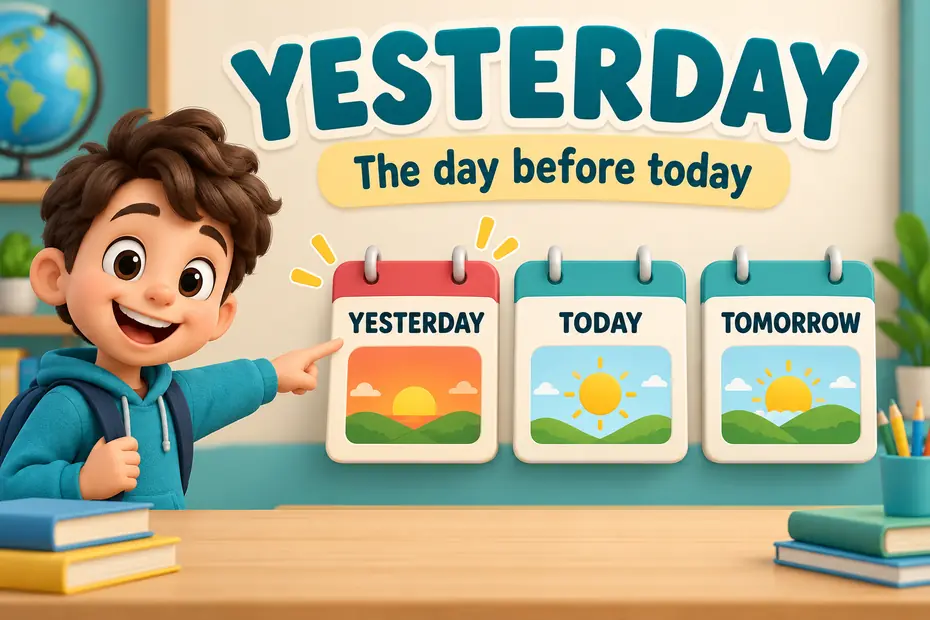
Yesterday means the day before today. Use it to say when something happened: “I finished my homework yesterday.” It can also name the day itself: “Yesterday was unusually quiet.” In everyday English, place it at the beginning or end of the clause, and usually use a past-tense verb for a completed action.
- Yesterday refers to the previous calendar day, not necessarily the last 24 hours.
- “Yesterday morning” and “yesterday evening” make the time more specific.
- Write “yesterday,” without “on,” when it directly tells when an action happened.
- Use “yesterday’s” before a noun: “yesterday’s meeting.”
- Sentence-final yesterday does not normally need a comma.
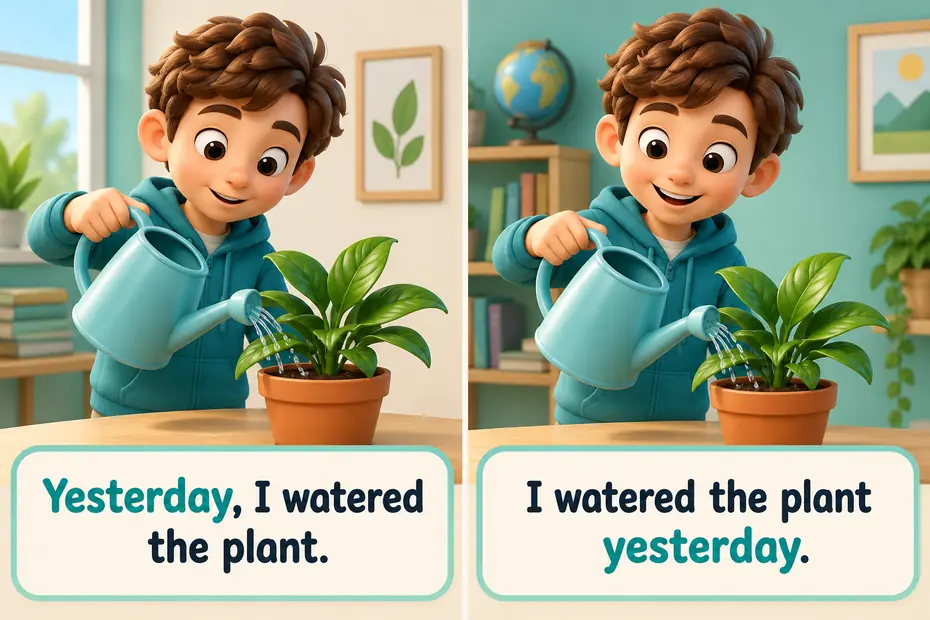
Correction to the older guidance below: yesterday does not have to start a sentence or follow a comma. “I visited the library yesterday” is an ordinary, correct sentence. Also, dictionaries recognize both adverb and noun uses; “Yesterday was busy” names the day rather than modifying an action.
Where should yesterday go?
Yesterday most naturally goes before the subject or after the main information in a short sentence. Choose the opening position when you want to establish the time first, and the ending position when the event matters most.
| Pattern | Example | Purpose |
|---|---|---|
| Yesterday + subject + past verb | Yesterday, Mina repaired her bicycle. | Sets the time before the event. |
| Subject + past verb + yesterday | Mina repaired her bicycle yesterday. | Answers when after stating the event. |
| Yesterday as the subject | Yesterday was our first rehearsal. | Names the day itself. |
| Yesterday’s + noun | Yesterday’s rehearsal lasted an hour. | Identifies something associated with that day. |
A comma after introductory yesterday is often helpful, especially before a long clause, but it is not always necessary after this short time expression. Do not insert a comma simply because yesterday comes last: “The parcel arrived yesterday” needs none. In longer sentences, place yesterday close enough to the intended action to avoid ambiguity.
Compare “Yesterday, I told Noor that the train was delayed” with “I told Noor that the train was delayed yesterday.” The first clearly dates the telling; the second can sound as though the delay happened yesterday. When both events matter, spell them out: “I told Noor today about yesterday’s delay.”

Which tense goes with yesterday?
Use the past simple for a completed action at a stated finished time: “We bought the tickets yesterday.” Use the past continuous for an action that was in progress then: “At noon yesterday, we were waiting outside the theatre.” The time word identifies the day; the verb form describes the event’s timing or development.
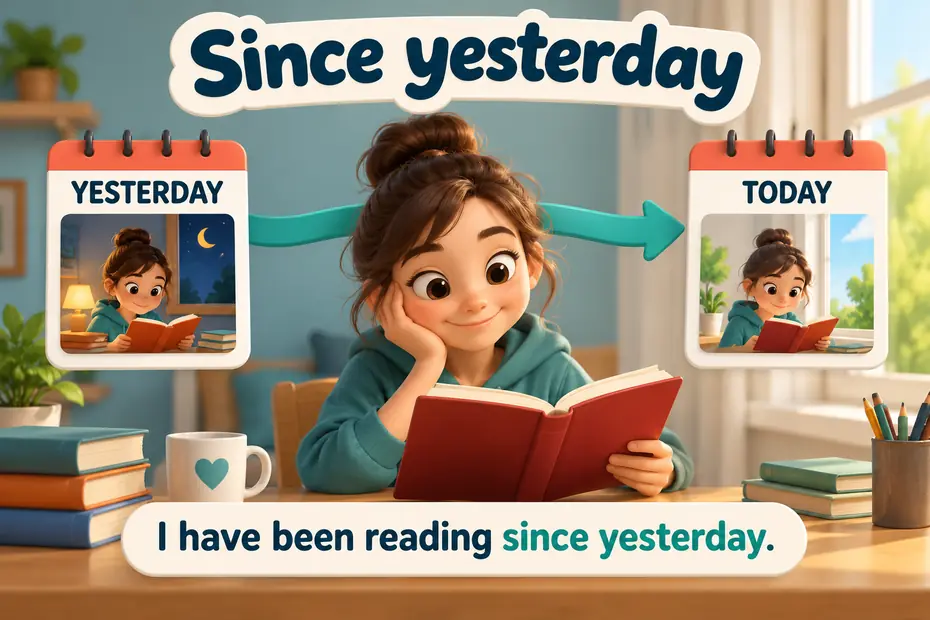
For standard learner English, change “I have bought the tickets yesterday” to “I bought the tickets yesterday.” Present perfect usually describes time extending up to now, while yesterday identifies a finished period. However, “I have been waiting since yesterday” is correct: since yesterday supplies a starting point for waiting that continues now.
Questions and negatives need the base verb after did: “Did you call yesterday?” and “I did not call yesterday.” Avoid “Did you called yesterday?” For the verb be, use “Was the shop open yesterday?” or “The shop was not open yesterday.” There is no did in those examples.
Useful yesterday sentence examples
- Yesterday, the children planted sunflower seeds.
- Our neighbour returned the ladder yesterday.
- I was reading when the lights went out yesterday.
- Did you save a copy of the file yesterday?
- The museum was closed yesterday morning.
- We did not receive your message yesterday.
- Yesterday’s lesson explained irregular verbs.
- I have felt tired since yesterday.
- By yesterday afternoon, the team had finished the display.
- Yesterday was warmer than today.
Each example answers a slightly different question: when the action happened, what was happening at a particular moment, or which day’s activity is being discussed. To build your own sentence, choose a real event, select the appropriate verb form, and add yesterday where its connection is clear. “We walked yesterday” becomes more informative as “We walked along the river yesterday afternoon.”
What does yesterday mean in a dated message?
Yesterday changes with the speaker’s reference day. If you write on October 2, yesterday means October 1; someone rereading that message on October 5 should still interpret it relative to when you wrote it. For a deadline, travel record, or message across time zones, an explicit date avoids confusion.
Write “I submitted the form on October 1” when the date must stay clear in an archive. “Yesterday” is excellent for conversation, but a saved document can outlast the reader’s knowledge of its original timing. Similarly, “the day before” is often clearer when a story has already established a past reference point: “She arrived on Tuesday. The day before, she had packed her bags.”
Frequently asked questions
Is yesterday one word?
Yes. Write yesterday as one word in ordinary English. The possessive form is yesterday’s, with an apostrophe before the s. Do not split it into “yester day.” At the beginning of a sentence, capitalize the initial letter; elsewhere it normally stays lowercase unless it is part of a title.
Can I say yesterday night?
Readers will usually understand it, but “last night” is the more natural everyday expression for the previous night. Use “yesterday evening” when you mean the earlier part of that period. “Yesterday morning” and “yesterday afternoon” are both standard ways to specify parts of the previous day.
Does yesterday always mean exactly 24 hours ago?
No. Yesterday identifies the previous calendar day in the relevant local context. If it is Friday morning, Thursday evening was yesterday even though fewer than 24 hours have passed. Say “24 hours ago” when you mean that exact elapsed duration, rather than a day on the calendar.
Can yesterday appear in a negative sentence?
Yes: “I did not attend yesterday” is correct. Negating the action does not change the time expression. Keep attend in its base form after did not, and use the same placement choices as in an affirmative sentence. “Yesterday, I did not attend” emphasizes the day first.
Sources: Cambridge Dictionary: yesterday; Cambridge English Grammar Today: past simple or present perfect. The examples above are original teaching examples.

Do you struggle with figuring out when to use the word “yesterday” in a sentence? Understanding how to properly use “yesterday” can enhance the clarity and accuracy of your communication.
“Yesterday” is an adverb that refers to the day before today. It is commonly used in sentences to indicate an action or event that occurred in the past, specifically the day immediately preceding the current day. By correctly utilizing “yesterday” in your sentences, you can convey a clear timeline of events and provide context for your audience.
7 Examples Of Yesterday Used In a Sentence For Kids
- Yesterday I ate my favorite snack.
- I played with my friends yesterday.
- Yesterday I watched a fun movie.
- I read a new book yesterday.
- Yesterday I drew a colorful picture.
- I helped my mom cook dinner yesterday.
- Yesterday I danced to my favorite song.
14 Sentences with Yesterday Examples
- Yesterday was the deadline for submitting our project proposals.
- My friend missed the bus and arrived late to the college yesterday.
- We had a great time at the college fest yesterday.
- Our professor surprised us with a pop quiz yesterday.
- I forgot to pack my lunch and had to buy food from the canteen yesterday.
- I attended an interesting webinar on coding yesterday.
- Our college team won the inter-college sports competition yesterday.
- I borrowed a book from the library yesterday.
- We had a group study session in the library yesterday.
- I had to stay back after college for a project meeting yesterday.
- I missed the deadline for submitting my assignment yesterday.
- We had a guest lecture on professional networking yesterday.
- My roommate and I cooked a delicious meal together yesterday.
- I woke up late and had to rush to college yesterday.
How To Use Yesterday in Sentences?
To use “Yesterday” in a sentence, start by identifying a past event or action that occurred the day before today. You can use “Yesterday” to refer to this specific time frame in your sentence.
Here’s an example sentence:
– “I went to the park yesterday to meet my friends.”
In this sentence, “Yesterday” is used to indicate that the action of going to the park and meeting friends took place on the day before today.
Remember to always place “Yesterday” at the beginning of a sentence or after a comma when starting with an independent clause. It helps to establish the context of the past event you are referring to.
It’s important to note that “Yesterday” should only be used to talk about events or experiences that happened in the past, specifically the day before the current day. It cannot be used to refer to events further back in the past, such as last week or last month.
Practice using “Yesterday” in simple sentences to become more comfortable incorporating it into your everyday language. This word is a useful tool for discussing past events and adding clarity to your communication.
Conclusion
In conclusion, by examining sentences with the keyword “yesterday,” we can see how this word is commonly used to refer to a specific point in the past. Whether discussing events, actions, or feelings that occurred on the previous day, “yesterday” serves as a useful temporal marker for communication. From simple statements like “I went for a walk yesterday” to more complex uses such as “She mentioned her vacation plans yesterday,” this word plays a crucial role in providing clarity and context to our conversations.
Overall, sentences containing “yesterday” help us to narrate our lives, share experiences, and track the passage of time. By incorporating this keyword into our dialogue, we can effectively convey past events, reflect on recent memories, and maintain organization within our discussions about the past.


