Adjectives for Nice: 30 Alternatives by Context
The best adjectives for nice depend on what you want to praise: call a helpful person thoughtful or considerate, an enjoyable afternoon delightful, a beautiful view lovely, and a well-made result excellent. These specific words show whether “nice” means kind, pleasant, attractive, or satisfying, giving readers a clearer picture.
- For a person’s behavior: kind, considerate, thoughtful, friendly, gracious, or generous.
- For an experience: pleasant, enjoyable, relaxing, delightful, or memorable.
- For appearance or design: lovely, attractive, charming, elegant, or appealing.
- For quality or results: excellent, impressive, useful, satisfying, or well-made.
- Choose by sense: these words overlap with nice but are not interchangeable in every sentence.
What does nice mean?
Nice has several common meanings: pleasant or enjoyable, kind or friendly, and satisfactory. Cambridge also records a formal sense meaning based on slight differences, as in “a nice distinction.” Because the adjective covers different qualities, the best replacement depends on whether you mean behavior, experience, appearance, or quality. (Cambridge Dictionary)
Adjectives for nice by context
Choose a synonym by naming the quality you want to emphasize. The examples below show useful alternatives without treating every positive adjective as a direct substitute.
| What “nice” describes | More precise adjectives | Example |
|---|---|---|
| A considerate person | kind, thoughtful, considerate, compassionate | “Our thoughtful neighbor brought soup when I was ill.” |
| A welcoming manner | friendly, warm, amiable, gracious, courteous | “The gracious host introduced every guest.” |
| An enjoyable experience | pleasant, enjoyable, delightful, relaxing, memorable, agreeable | “We had a relaxing afternoon by the lake.” |
| Appearance or design | lovely, attractive, charming, elegant, appealing, beautiful | “The charming cottage has a flower-filled porch.” |
| Food or drink | delicious, flavorful, refreshing, satisfying | “The refreshing lemonade balanced the spicy meal.” |
| A result or quality | excellent, impressive, useful, convenient, well-made | “The clear labels made this a useful guide.” |

How can you replace nice with a more specific word?
First identify the noun, then ask what makes it “nice”: kindness, comfort, beauty, flavor, or quality. “A nice coworker” could become “a considerate coworker”; “a nice room” might be “a comfortable room”; and “a nice result” could be “an excellent result.” The replacement should explain the praise, not just intensify it.
- Name the subject: person, place, food, object, experience, or outcome.
- Identify the quality: kind, comfortable, attractive, enjoyable, or high-quality.
- Choose a word that fits the noun: a person can be amiable, a meal can be delicious, and a result can be excellent.
- Check tone and strength: “pleasant” is measured, while “delightful” and “outstanding” express stronger praise.

Words that are not exact synonyms for nice
Many positive adjectives describe only one slice of “nice.” Polite refers to manners, cute usually points to an appealing appearance, and decent often means acceptable rather than especially good. Use amiable for a friendly manner, delicious for food, and excellent for outstanding quality.
Some dictionary-style lists also include words that are not positive substitutes in ordinary contexts. “Bad” is usually negative, “careless” criticizes a lack of attention, and “courtesy” is a noun rather than an adjective. Check both the meaning and part of speech before swapping a word into a sentence.
One less common formal use appears in “a nice distinction,” where nice means subtle or precise; kind, pleasant, and lovely do not fit that sense.
Frequently asked questions about adjectives for nice
What is a stronger word than nice?
The strongest replacement depends on what is being praised. Use outstanding or excellent for exceptional work, delightful for a very enjoyable event, and compassionate for unusually kind behavior. A stronger adjective should add the right meaning, not merely sound more emphatic.
What adjective means nice and kind?
Kind is the most direct adjective for someone who treats others with care. Considerate emphasizes noticing other people’s needs, while thoughtful often describes helpful actions. For a generally friendly, agreeable manner, amiable or warm may fit better in casual settings.
What is a more formal word for nice?
Pleasant is a measured alternative for an enjoyable place, visit, or experience. Agreeable sounds more formal and often describes conditions or experiences; courteous is more exact for polite behavior. Choose based on the noun instead of replacing every use of nice with one formal word.
Is nice too vague for writing?
Nice is not incorrect, but it can leave the reader unsure what quality you mean. In a thank-you note, its warmth may be enough; in a description or review, “comfortable,” “flavorful,” “considerate,” or “well-designed” gives more information and makes the praise easier to picture.
The most useful adjectives for nice name the specific quality behind the praise: kindness, enjoyment, beauty, comfort, or excellent work.
When we think of the word “nice,” we might think of it as meaning “pleasant” or “good.” But there are actually many different ways to use the adjective “nice.” Here are some examples of how you can use “nice” to describe different things.
You can use “nice” to describe someone’s personality. For example, you might say that someone is “nice” if they’re always friendly and helpful.
You can also use “nice” to describe how something looks. For example, you might say that a painting is “nice” if it’s beautiful or aesthetically pleasing.
In addition, you can use “nice” to describe how something feels. For example, you might say that a fabric is “nice” if it’s soft or smooth.
Finally, you can use “nice” to describe an experience. For example, you might say that a party was “nice” if it was fun and enjoyable.
As you can see, there are many different ways to use the adjective “nice.” Next time you want to describe something as being “nice,” think about what exactly you mean.
Adjectives For Nice
Most people are nice, but some people are nicer than others. Here are some adjectives to describe someone who is nice:
- Thoughtful – always thinking of others and doing kind things for them
- Generous – always willing to help others, even if it means making a sacrifice
- Compassionate – always caring and empathizing with others
- Honest – always telling the truth, even if it means getting into trouble
- Loyal – always sticking by your friends and family, no matter what
- Patient – always willing to listen to others and help them, even if it takes a long time
- Friendly – always approachable and happy to chat with anyone
- Humorous – always making others laugh and enjoy their company
These are just a few of the many adjectives that can be used to describe someone who is nice. So if you know someone who is nice, make sure to let them know how much you appreciate them!
A
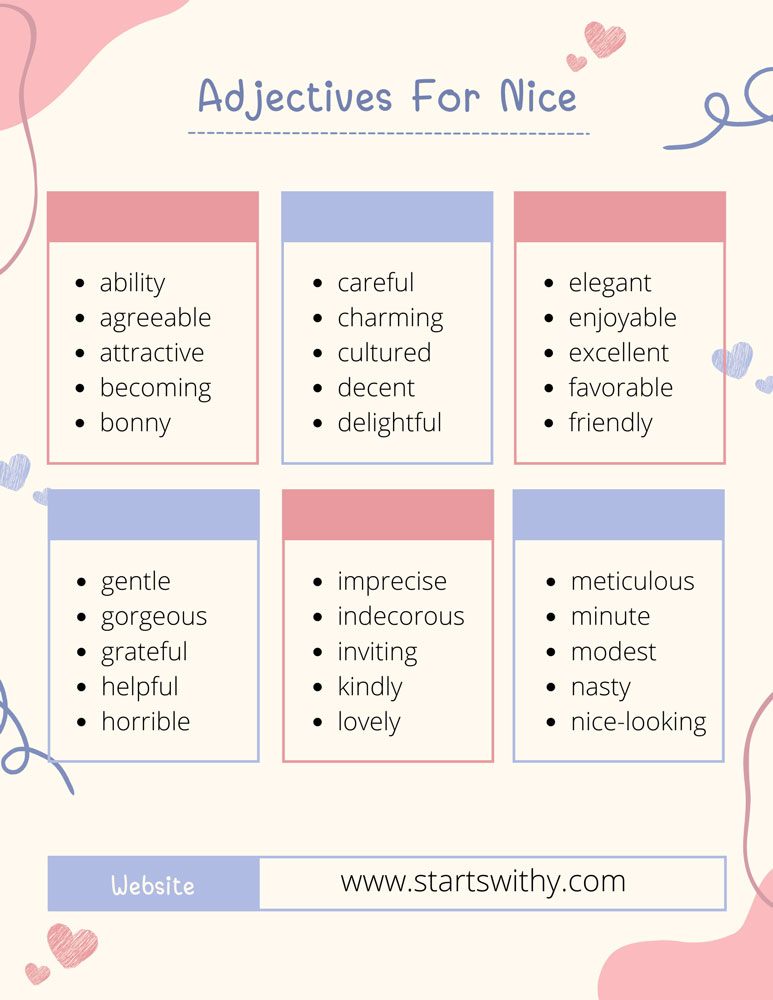
| Ability | Accept | Accurate |
| Admirable | Agreeable | Amiable |
| Appealing | Approved | Approximate |
| Attractive |
B
| Bad | Becoming | Befitting |
| Big | Bonny | Braw |
| Broad |
C
| Careful | Careless | Charming |
| Chaste | Choosy | Classy |
| Comely | Comme Il Faut | Commendable |
| Congenial | Considerate | Cool |
| Copacetic | Cordial | Correct |
| Courteous | Courtesy | Critical |
| Crude | Cultured | Cute |
D
| Dainty | De Rigueur | Decent |
| Decorous | Delicate | Delightful |
| Demure | Detailed | Difficult |
| Disagreeable | Discerning | Discriminating |
| Disordered | Distinguishing | Ducky |
E
| Elegant | Enjoyable | Exact |
| Exacting | Excellent | Exquisite |
F
| Fab | Fair | Fastidious |
| Fastidiousness | Favorable | Fine |
| Fine And Dandy | Finespun | Finical |
| Finicky | Finished | Friendly |
| Fussy |
G
| Genial | Genteel | Gentle |
| Good | Gorgeous | Gracious |
| Grateful | Gratifying |
H | I | K | L
| Hairsplitting | Helpful | High-Grade |
| Horrible | Imprecise | Indecorous |
| Ingratiating | Inviting | Kind |
| Kindly | Likable | Like |
| Lovely |
M | N | O
| Mean | Meticulous | Minute |
| Modest | Nasty | Neat |
| Nice-Looking | Nifty | Obliging |
| Okay | Overnice |
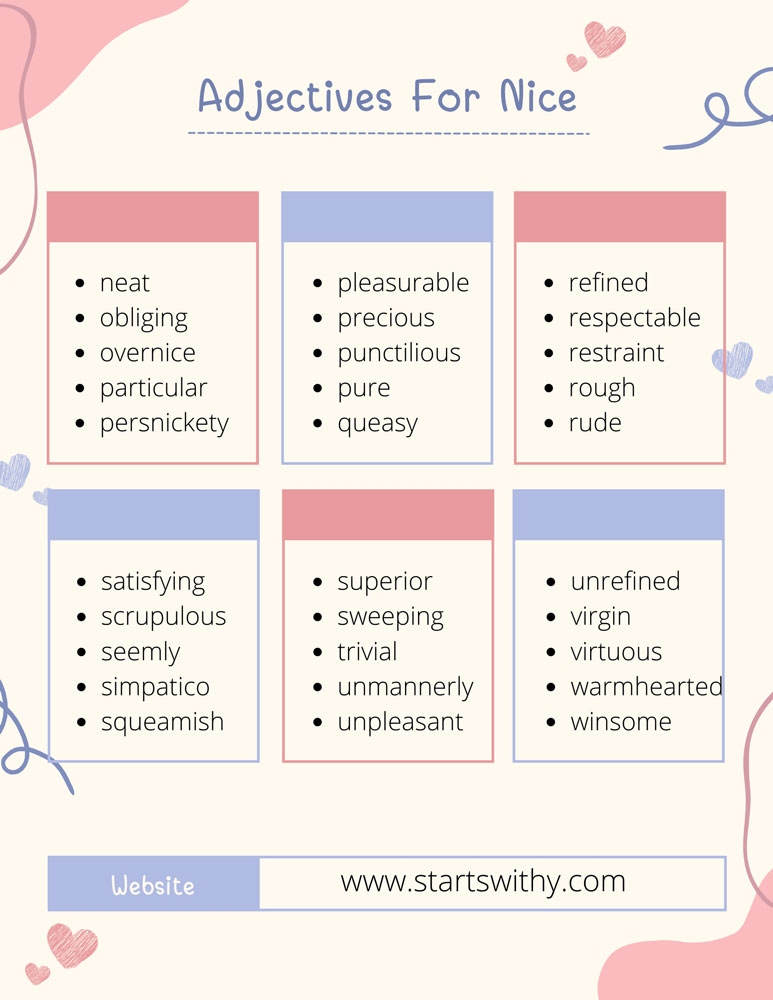
P
| Particular | Peachy | Persnickety |
| Picky | Pleasant | Pleasing |
| Pleasurable | Polite | Precious |
| Precise | Prepossessing | Prissy |
| Profligate | Proper | Punctilious |
| Pure |
Q | R
| Queasy | Refined | Repulsive |
| Respectable | Restraint | Right |
| Rough | Rude |
S
| Satisfying | Scrupulous | Seemly |
| Sex | Simpatico | Skillful |
| Snazzy | Spiffing | Squeamish |
| Subtle | Superior | Sweeping |
| Swell |
T | U | V
| Trivial | Unassuming | Unlikable |
| Unmannerly | Unpleasant | Unpresumptuous |
| Unrefined | Virgin | Virginal |
| Virtuous |
W
| Wanton | Warmhearted | Welcome |
| Well-Mannered | Winning | Winsome |
| Wonderful |
Final verdict
When it comes to finding the right words to describe someone who is nice, there are a lot of adjectives that can be used. Some of the most common adjectives used to describe someone who is nice include: kind, caring, sweet, thoughtfulness and helpful.
These are just a few of the many adjectives that can be used to describe someone who is nice. It is important to remember that everyone has their own unique way of being nice, so there is no one right way to describe someone who is nice. The most important thing is to simply choose the adjectives that best fit the person you are trying to describe.