
Meet vs. Met: Quick Answer
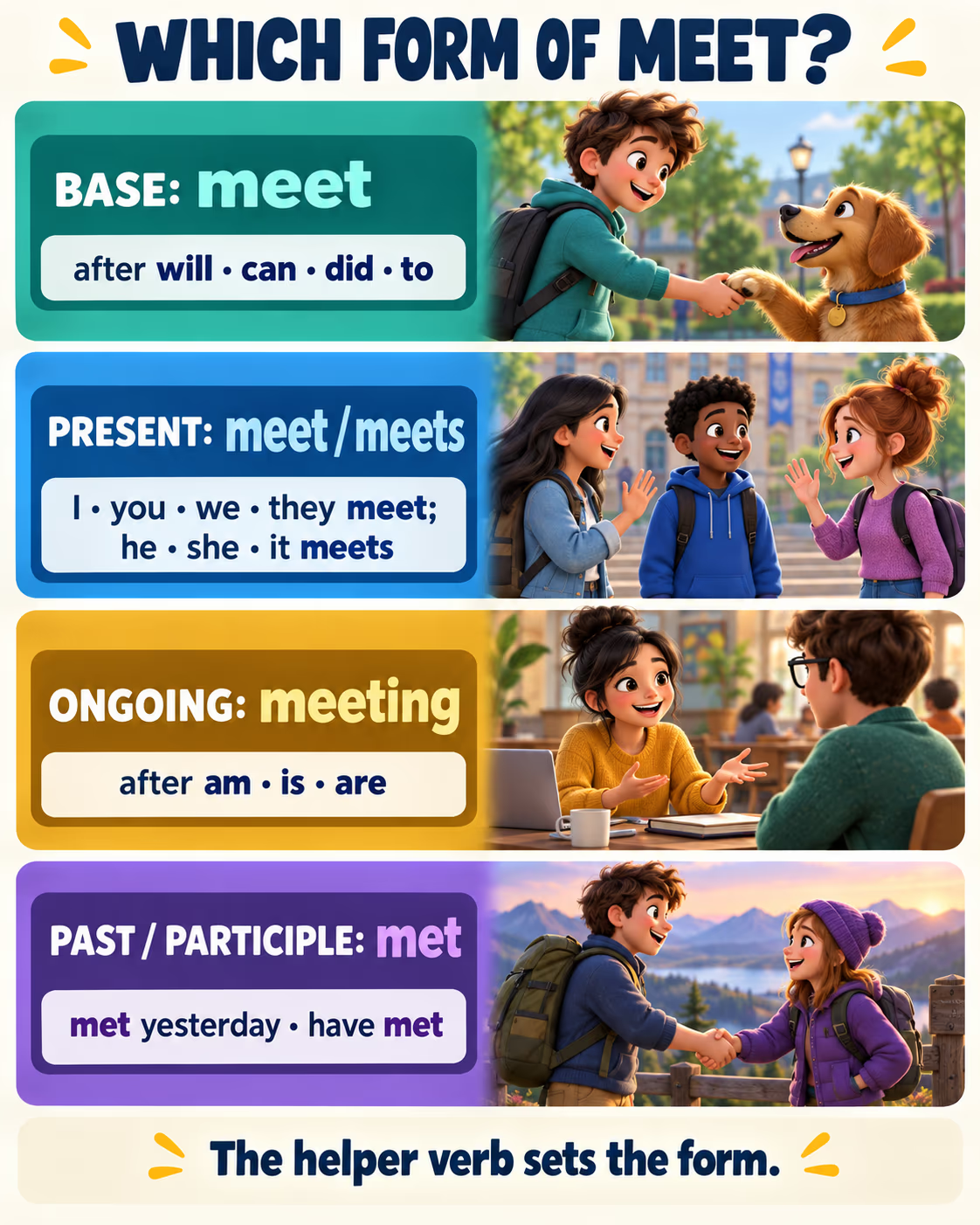
Meet is the base form and the present-simple form for I, you, we, and they; use meets with he, she, or it in the present simple. Met is both the simple past and the past participle. Meeting is the -ing form. The helper verb and sentence frame determine which one belongs.
| Form | Use | Example |
|---|---|---|
| meet | Base form after will, can, did, or to | “We will meet tomorrow.” |
| meet / meets | Present simple; subject determines the form | “They meet weekly.” / “She meets them weekly.” |
| meeting | -ing form after am, is, or are | “We are meeting at noon.” |
| met | Simple past or past participle after have, has, or had | “I met them yesterday.” / “I have met them.” |
Can “Meets” Describe a Future Event?
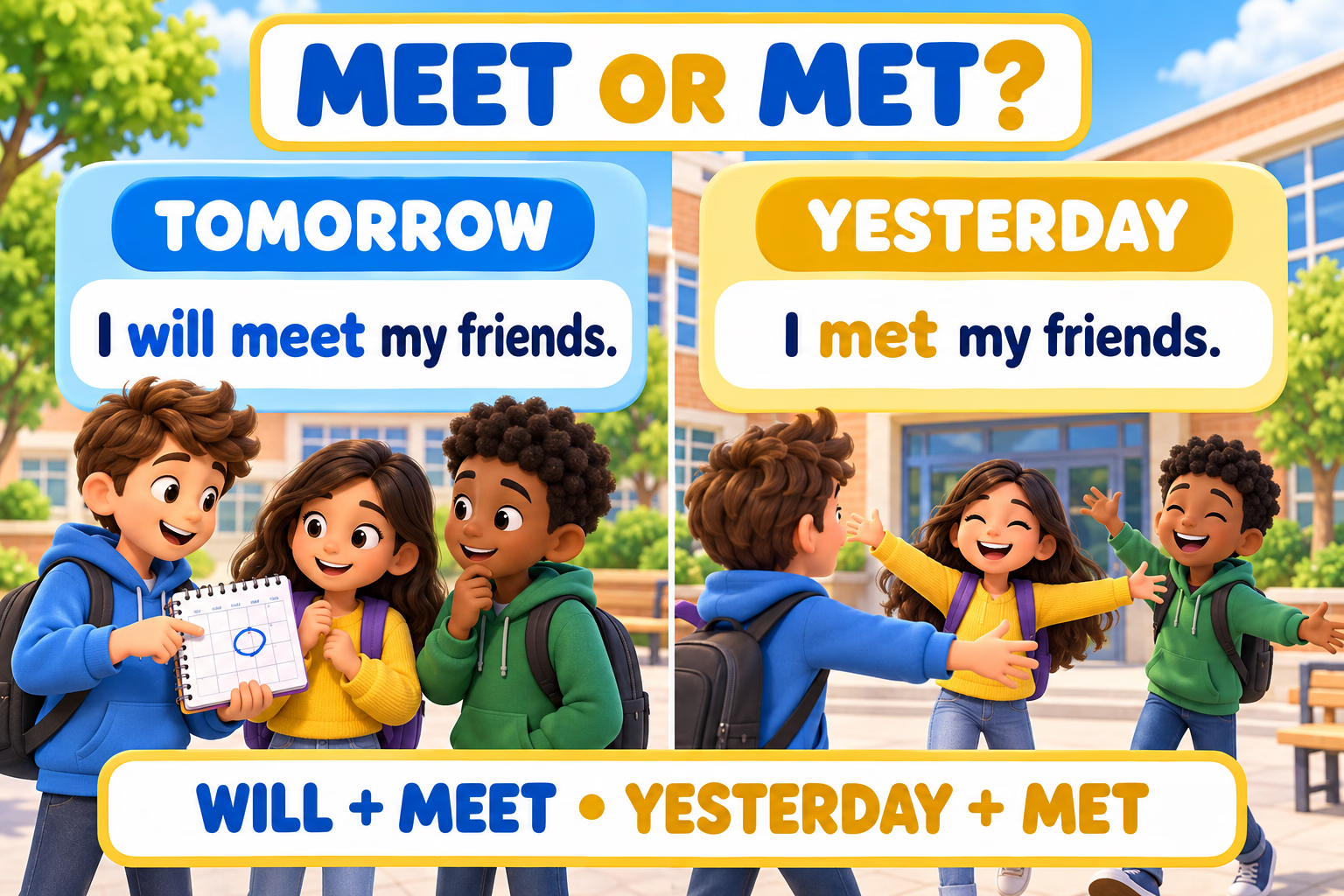
Yes, when a present-simple form describes a fixed timetable or schedule: “The committee meets on Friday.” This does not make meets a future-tense form. In “The committee will meet on Friday,” will marks future time and is followed by the base form meet. After did, use that same base form: “Did they meet?”

“Meet With” and “Meet” in Context
Meet with someone often describes a planned discussion, while meet alone can describe a scheduled gathering, an introduction, or a chance encounter. The past form is met in either construction: “We met with the committee yesterday” and “We met at the station.” Oxford also records meet with for receiving a reaction or experiencing something, as in “The proposal met with resistance.” Choose by the object and context, not by treating met and met with as mutually exclusive tenses.
Clarification to the earlier wording below: Meet is not itself a future-tense form, and meets is not categorically wrong for a future schedule. The corrected forms and examples above reflect Oxford’s verb entries and Cambridge’s guidance on fixed timetables.
Sources: Oxford Learner’s Dictionaries: meet; Oxford Learner’s Dictionaries: meet with; Cambridge Grammar Today: present simple for future schedules; Cambridge Grammar Today: will future.
As an experienced writer, I understand the importance of using the correct verb forms in writing. Today, I’ll delve into the nuances of “meet” and “met” to help you grasp their correct usage effortlessly. Understanding these distinctions is vital for precise communication.
Whether you’re discussing past actions or ongoing events, knowing when to use “meet” or “met” can significantly impact the clarity of your writing. Join me as we explore the subtle yet crucial differences between these verb forms. Let’s unravel the mysteries of “meet” and “met” together to enhance your language skills and elevate your writing prowess.
Meet or Met: Correct Usage
Understanding the proper usage of “meet” and “met” is essential for clear communication. When we talk about past actions, we use “met” as the past tense and past participle form of “meet.” For example, “Yesterday I met my colleagues for lunch” and “Last year our team met the sales targets successfully.”
It’s important to note that “met” can also be used in perfect tenses, such as “I have met many interesting people during my travels.” This form indicates that the action has already taken place.
On the other hand, “meet” is the base form used for the present simple tense and when forming the future tense with auxiliary verbs like “will” or “going to.” For instance, “I meet my colleagues every Monday” and “We will meet the new students tomorrow.”
Understanding these distinctions is crucial for using the correct tense in both writing and speaking. By recognizing when to use “meet” and “met” appropriately, we can ensure our language is precise and effectively conveys the intended message.
Meet vs. Met
Definition and Usage
Understanding the difference between “meet” and “met” is crucial for accurate communication. “Meet” is the present tense form used when describing current or future events, such as “I meet my friends at the movies.” On the other hand, “met” is the past tense form solely utilized for actions that have already occurred, like “I met Bill yesterday.” Ensuring the correct usage based on the timeline of the action is key to clarity in writing and speech.
- Present Tense (Meet): “She meets her colleagues every Monday.”
- Future Tense (Meet): “They will meet the new clients tomorrow.”
- Past Tense (Met): “They had met before the party.”
By applying these distinctions accurately, the intended message is effectively conveyed without ambiguity.
Common Mistakes with Meet and Met
Incorrect Usage in Context
Often, a common mistake arises when selecting between “meet” and “met” due to their tense differences. For instance, using “meets” in sentences that refer to future events can lead to grammatical errors. An example of this is saying, “I will meets my friends for coffee tomorrow.” The correct form in this case should be, “I will meet my friends for coffee tomorrow.” Ensuring the correct verb tense is crucial to avoid miscommunication and maintain clarity in your writing.
Tips for Proper Usage
To prevent these errors, it is essential to double-check the tense and context in which you are using “meet” or “met.” A helpful strategy is to substitute the words “encounter” or “meeting” to test which choice fits better in the sentence. Regular reading and writing practice can also aid in familiarizing yourself with the nuances of English language usage, enhancing your ability to select the right verb form. By paying attention to details and practicing consistently, you can master the proper application of “meet” and “met” in various contexts.
Conclusion
Understanding the correct usage of “meet” and “met” is crucial for effective communication. By recognizing their tense differences and practicing their application in various contexts, you can enhance your writing skills and avoid common grammatical errors. Remember to pay attention to the context of your sentence to determine the appropriate form to use. Consistent practice and exposure to different examples will help solidify your understanding of these verbs. With the right strategies in place, you can confidently apply “meet” and “met” correctly in your writing, ensuring clarity and precision in your communication.
Frequently Asked Questions
When should I use “meet” versus “met”?
Use “meet” when referring to a present or future encounter, like “Let’s meet for coffee tomorrow.” Use “met” for past encounters, such as “We met at the conference last year.”
How can I avoid confusion between “meet” and “met”?
Practice by using both words in sentences to understand their tense differences. Remember, “meet” is present/future, and “met” is past tense.
Is “met with” the same as “met”?
No, they have different meanings. “Met with” implies a meeting or discussion, like “I met with my team.” “Met” simply refers to a past encounter, as in “I met my friend for lunch.”
What does “meet in person” mean?
“Meet in person” means physically meeting someone, like having a face-to-face encounter. Example: “Let’s meet in person to discuss the project.”
Can you use “met” in a sentence?
Yes, use “met” for past tense sentences. For example, “I met a new client yesterday.”
Can you provide an example with “meet” in a sentence?
Sure, here’s an example: “I will meet you at the restaurant at 7 p.m.”


