Organizer and organiser are accepted spelling variants of the same noun: each can mean a person who arranges an event or a device that keeps things in order. Organizer is usual in US style; organiser is common in British writing, but neither spelling belongs exclusively to one country. Follow your publication’s style guide and use one form consistently.
Organizer or Organiser: Quick Guide
| Spelling | Typical pattern | Part of speech and meaning |
|---|---|---|
| organizer | Usual US spelling; also used elsewhere | Noun: a person who arranges something, or a device for keeping things in order |
| organiser | Common in British English; not limited to it | The same noun and meanings as organizer |
| organize / organise | Organize is usual in US style; organise is usual in UK style | Verb: to arrange, plan, or put something in order |
| organization / organisation | The corresponding noun spellings | Noun: the process or arrangement, or a group formed for a purpose |
Oxford lists organiser as a British English form of organizer. Cambridge labels it “UK usually” and also records British use of organizer. Those labels describe common preferences, not an absolute rule for every writer or publication. See the Oxford Learner’s Dictionary entry for organizer and Cambridge’s organizer entry.
Examples: One Noun, Two Spellings
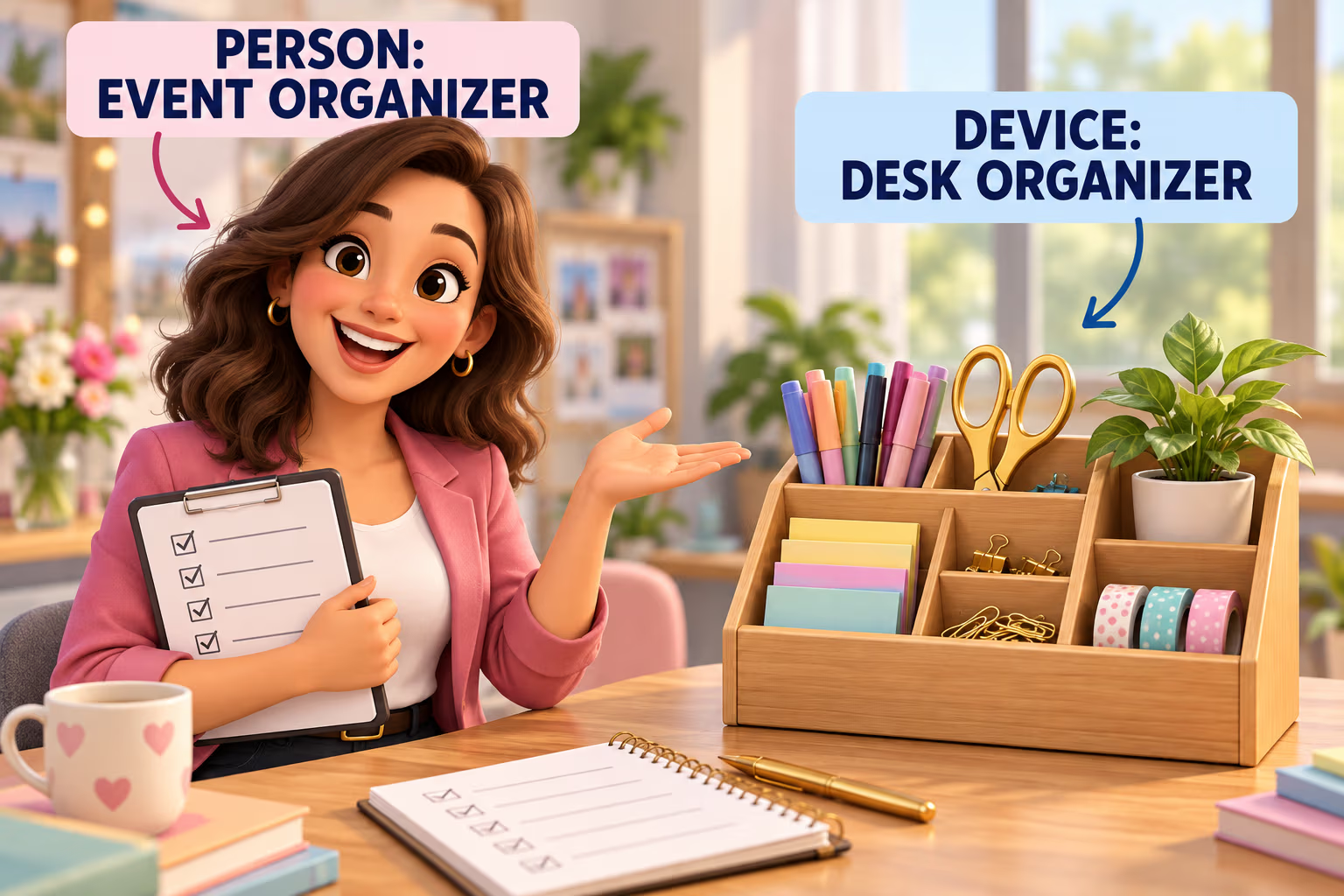
- Event: “The event organizer booked the hall.” In a publication using the other spelling: “The event organiser booked the hall.”
- Community: “A community organizer helped residents plan a neighborhood meeting.” The UK-style spelling is community organiser.
- Device: “She put the pens in a desk organizer.” Desk organiser means the same storage item.
Keep the Word Forms Straight
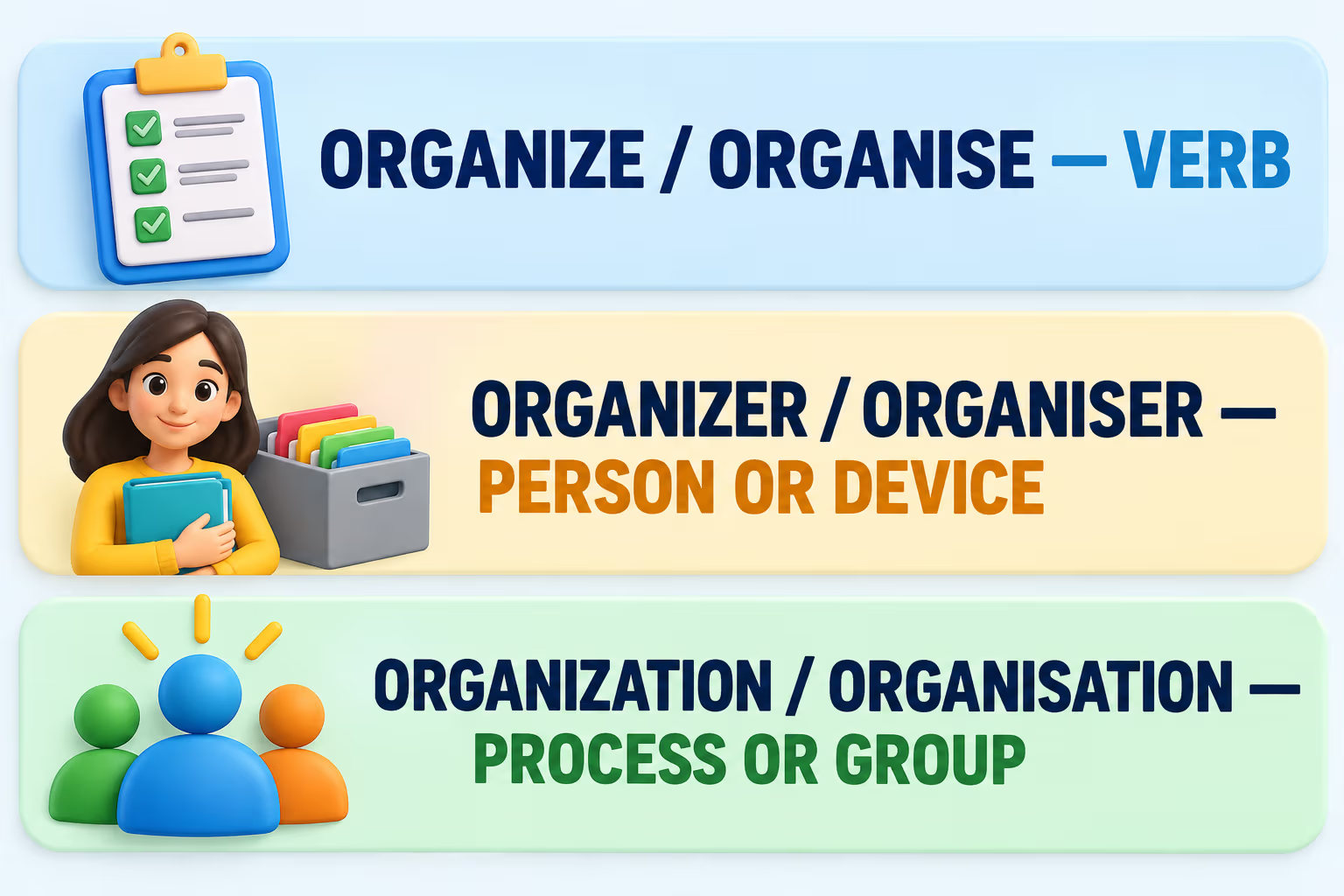
The final -er in organizer / organiser forms a noun for a person or thing that organizes. By contrast, organize / organise is a verb. Organization / organisation is a noun for the act or arrangement, or for an organized group. The spellings in each pair do not change the part of speech.
| Word family | Part of speech | Example |
|---|---|---|
| organize / organise | Verb | We will organize the meeting. / We will organise the meeting. |
| organizer / organiser | Noun: person or device | The organizer sent the schedule. / The organiser sent the schedule. |
| organization / organisation | Noun: process, arrangement, or group | The organization of the event took weeks. / The organisation of the event took weeks. |
| organized / organised | Adjective or past participle | The files are organized. / The files are organised. |
So, saying that organize is the noun is a grammar error: it is the verb. But organization is not the only related noun. Use organizer / organiser for the person or device, and organization / organisation for the process, arrangement, or group. The Cambridge entry for organize labels it a verb, while its entry for organization labels that form a noun.
How to Choose a Spelling
Use the spelling required by your publisher, employer, school, or house style. If no guide applies, choose the convention that best fits the intended readership—often organizer for US-focused writing and organiser for UK-focused writing—and keep related forms consistent: organize / organizer / organization or organise / organiser / organisation. A publication may choose a house style that differs from a reader’s local preference.
The same consistency principle applies to other regional spelling pairs such as check and cheque. The spelling choice helps signal a style convention; it does not give organizer and organiser different meanings.
Correction and context: Some original sentences below present the regional preference too categorically and can make the noun/verb family seem narrower than it is. Keep those paragraphs as part of the source article, but read them with this clarification: organizer and organiser are same-meaning nouns, organize and organise are verbs, and organization and organisation are nouns. Oxford and Cambridge both record overlapping usage rather than an exclusive country boundary.
Jump to the quick guide, the word-family table, or the additional FAQs. The original article follows unchanged; use your browser’s Find command to locate its examples or headings.
Are you confused about whether to use “organiser” or “organizer”? Let me clear up the confusion for you. These two words may look similar, but they have distinct meanings and spellings based on British or American English. Understanding when to use each term is crucial for effective communication. Let’s dive into the correct usage of “organiser” and “organizer” to ensure you’re using the right word in the right context.
In British English, “organiser” is the preferred spelling when referring to a person or tool that helps arrange things systematically. On the other hand, “organizer” is the correct spelling in American English for the same context. Knowing which spelling to use based on your audience can make a significant difference in how your message is perceived. Stay tuned as we explore examples and scenarios where “organiser” and “organizer” should be appropriately utilized to enhance your writing and communication skills.
Organisers vs Organizers: Understanding Correct Usage
Definition of Organisers and Organizers
When it comes to using organisers versus organizers, it’s essential to understand that both words refer to individuals or tools aimed at bringing order and organization to various settings. Organiser (spelled with an “s”) is the British English version, while organizer (with a “z”) is the American English variant. Despite the spelling distinction, both terms essentially serve the same purpose, focusing on arranging and coordinating activities in an orderly manner.
Regional Variations in Spelling
In the English language, differences in spelling often arise due to regional variations. The use of organisers in British English and organizers in American English exemplifies this aspect. It’s crucial to be mindful of your audience or the target readership when deciding which spelling to employ. Consistency in spelling is key to effective communication, ensuring clarity and professionalism in your writing.
Grammar Rules in American English
In American English, organizers with a “z” conform to the standard grammar rules. While both versions are correct in their respective contexts, adopting the American English spelling organizer can align with the preferred grammar norms in the United States. Understanding these nuances can enhance the overall quality and readability of your written content, catering to a broader audience and maintaining linguistic accuracy.
Examples of Correct Usage
Sentence Examples
When focusing on correct usage, it’s crucial to understand how to use “organizer” and “organiser” appropriately, depending on the regional English variant. Here are some sentence examples to illustrate the proper usage:
-
American English (organizer):
- “She was the lead organizer of the conference.”
- “He used a closet organizer to keep his clothes tidy.”
- “The event organizer was responsible for coordinating all aspects of the festival.”
-
British English (organiser):
- “The organisers successfully managed the fundraising campaign.”
- “She acted as a chief organiser for the charity event.”
- “The school organiser arranged the students’ schedules efficiently.”
Comparison with British English
In British English, “organiser” is the accepted spelling, while in American English, “organizer” is preferred. Understanding this distinction is key when composing written content tailored to a specific audience. Each variant maintains correctness within its respective linguistic framework, emphasizing the importance of regional spelling preferences in effective communication.
Tips for Proper Word Choice
Contextual Guidelines
When deciding whether to use “organizers” or “organisers,” it’s crucial to consider the context of your writing. American English favors “organizers,” while British English prefers “organisers.” To ensure clear communication with your audience, always align your spelling choice with the English variant you are targeting.
Common Mistakes to Avoid
One common error is using “organizing” and “organising” interchangeably. Remember, British English uses “organising,” and American English uses “organizing.” To steer clear of this mistake, be mindful of the spelling based on the intended audience. Another pitfall is mistakenly using “organize” as a noun. Always remember to use “organization” when referring to a structured group or entity.
Conclusion
Choosing between “organizer” and “organiser” is crucial for effective communication. It’s essential to be mindful of the spelling differences in American and British English to cater to your audience accurately. Avoid mixing up “organizing” and “organising” to maintain clarity and professionalism in your writing. Remember to use “organization” instead of “organize” when referring to a noun for better accuracy. By paying attention to these details, you can ensure your writing is precise and tailored to the intended readership.
Frequently Asked Questions
Why is it important to differentiate between “organizer” and “organiser”?
Choosing between “organizer” and “organiser” depends on the English variant you are targeting—American English (organizer) or British English (organiser). Using the correct spelling helps you connect better with your intended audience and shows attention to language details.
Can “organizing” and “organising” be used interchangeably?
No, “organizing” and “organising” are not interchangeable. “Organizing” is used in American English, while “organising” is used in British English. It’s crucial to adhere to the spelling conventions of the English variant you are writing in to maintain consistency.
Which is the preferred term: “organize” or “organization”?
“Organize” should be used as a verb, while “organization” is the preferred noun form. Using “organization” clarifies the context and ensures correct grammar usage. Remember to choose the appropriate term based on whether you are describing an action or a structured entity.
How can proper word choice impact content effectiveness?
Selecting the right words, such as “organizer” or “organiser,” enhances readability and comprehension for your target audience. Incorrect spelling may lead to confusion or alienate certain readers. Consistency in language choice demonstrates professionalism and attention to detail in your content.
What is the recommended approach for spelling differences in English?
Adhering to either American English or British English consistently throughout your content is essential. Choose one variant—whether “organizer” for American English or “organiser” for British English—and maintain that spelling throughout to ensure clear communication and connect effectively with your audience.
More Questions About Organizer and Organiser
Is “organiser” used only in the United Kingdom?
No. Organiser is common in British writing, and Cambridge marks it as the usual UK spelling, but dictionaries also list organizer in British English. Usage can vary by publication and individual preference, so “UK usually” is more accurate than “UK only.”
Does “organizer” mean something different from “organiser”?
No. Both are nouns with the same core meanings: a person or group that arranges an event, a person who plans carefully, or a device used to keep items in order. The difference is spelling convention, not meaning.
Is “organize” a noun?
No. Organize (or organise) is a verb meaning to arrange or plan. The noun for the person or device is organizer / organiser; the noun for the act, arrangement, or group is organization / organisation.
Can I use both spellings in one document?
You can quote a name or source that uses a different spelling, but ordinary prose is usually easier to follow when you choose one style and stay consistent. If you are writing for a publication, follow its guide even if that convention is not the one you use personally.


