
Pressure vs. Preasure: The Correct Spelling
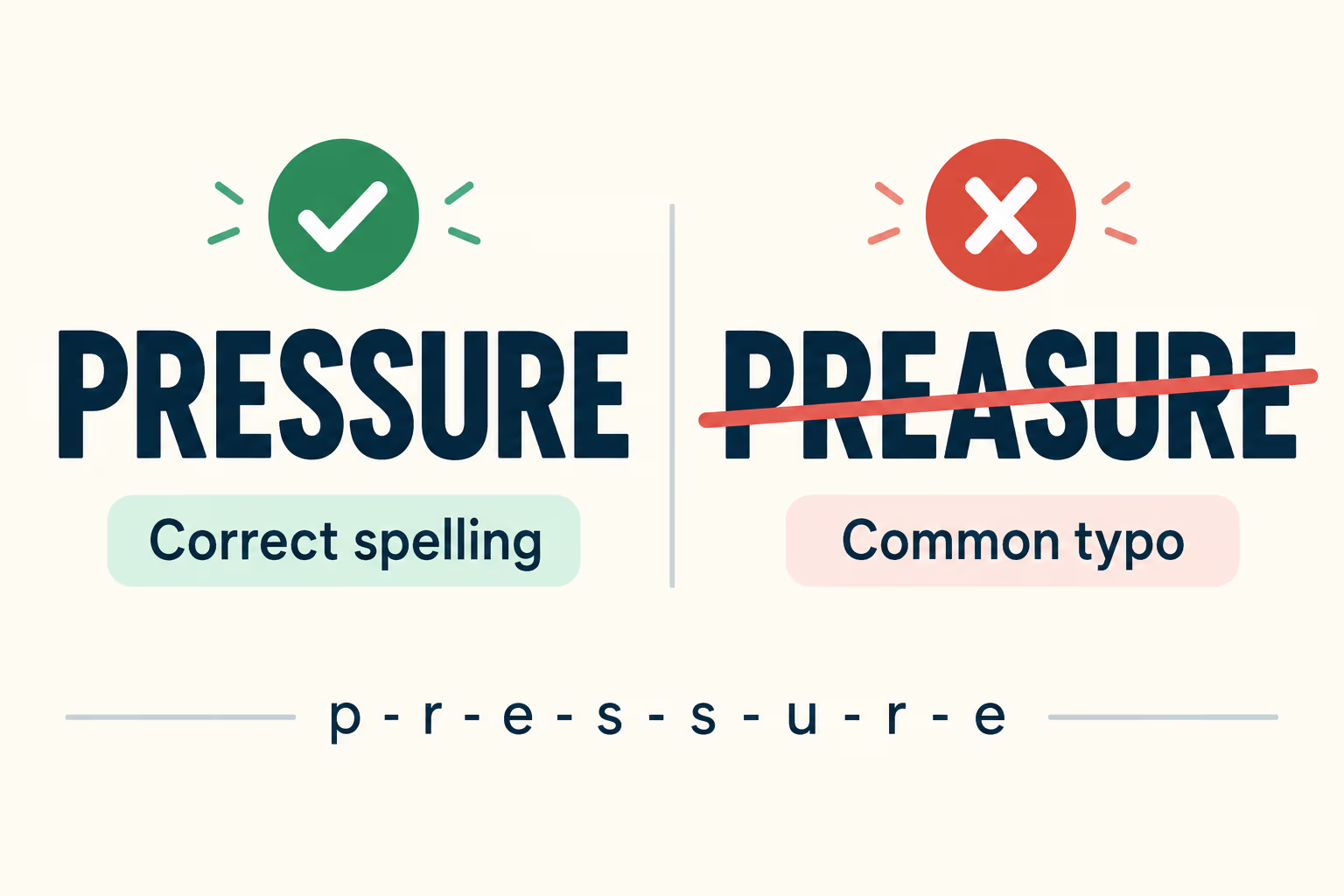
Pressure is the standard spelling. Preasure is a misspelling when you mean the noun or verb pressure. The correct word has two s letters after “pre”: p-r-e-s-s-u-r-e. Because pleasure is a familiar word with a similar sound and a different spelling, writers sometimes mix up the letter sequence. In edited English, use pressure for force, strain, influence, or the act of urging someone.
Quick check: “The deadline put me under pressure.” If you type “preasure,” replace it with pressure. The misspelling is not a standard alternative spelling; it may appear in a username, brand, quotation, or deliberate wordplay, but those special cases do not make it the ordinary English word.
What Does Pressure Mean?
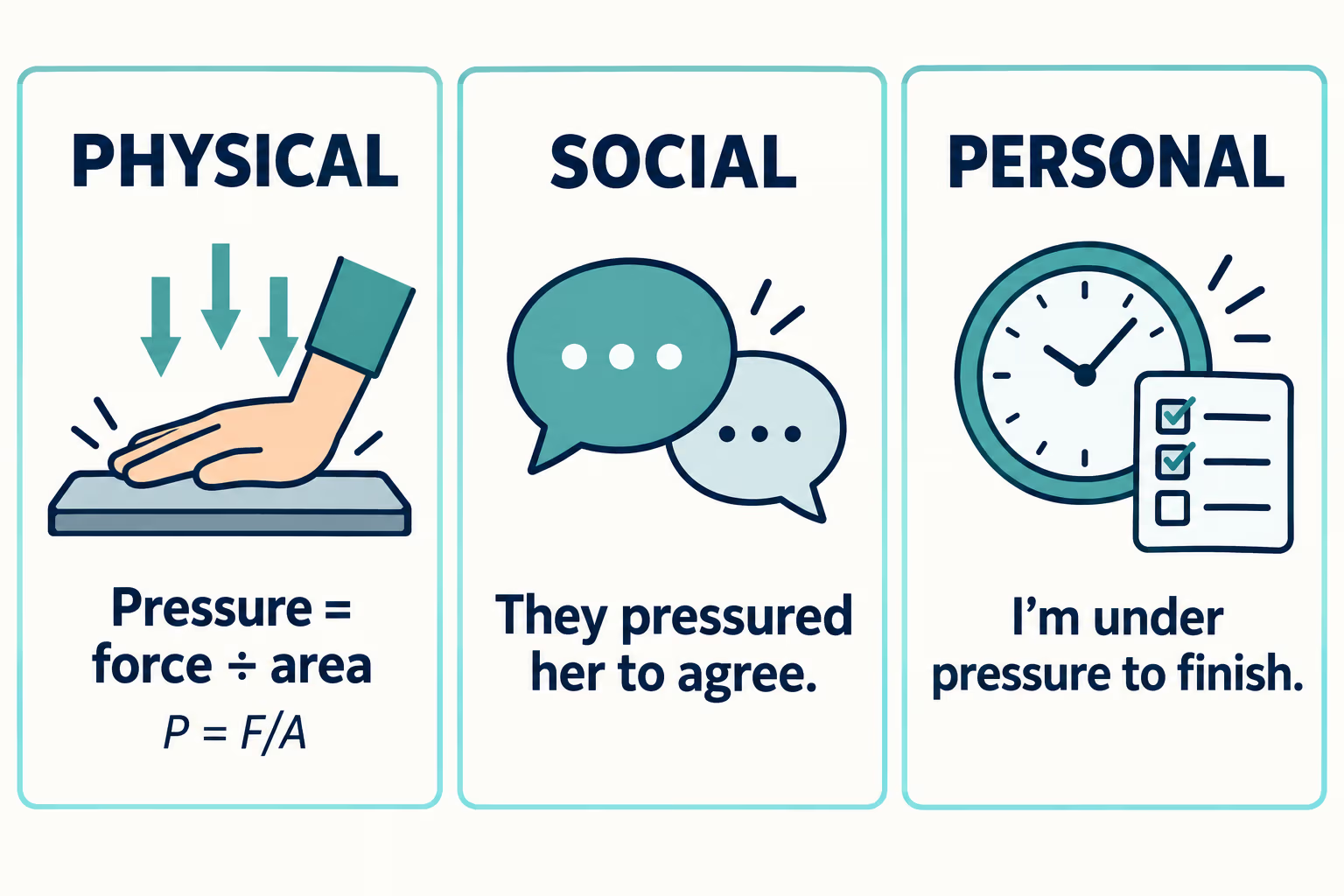
Pressure has several related meanings. It can name a physical quantity, a force applied to something, or a demanding influence. Cambridge Dictionary records both physical and influence-related senses, while Oxford’s learner dictionary also explains the worry or demands connected with a situation. Context tells you which meaning is intended.
| Meaning | What it describes | Example |
|---|---|---|
| Physical quantity | Force distributed over an area, such as pressure in a tire or gas cylinder | “Check the tire pressure before the trip.” |
| Applied force | A push or force placed on a surface or object | “Apply gentle pressure to the seal.” |
| Influence | An attempt or circumstance that urges someone toward an action | “The team felt pressure to finish early.” |
| Demand or strain | The stress associated with responsibilities, limits, or expectations | “She works well under pressure.” |
Pressure in physics
In physics, pressure describes force per unit area. The relationship is commonly written as P = F/A: pressure equals the perpendicular force divided by the area over which it acts. The SI unit is the pascal (Pa), equal to one newton per square metre. For the same force, concentrating it on a smaller area produces greater pressure; spreading it over a larger area produces less. That is why a narrow heel can press into a floor more than a broad sole under the same person’s weight.
In everyday writing, you do not need the formula each time you use the word. A sentence about tire pressure, blood pressure, water pressure, or air pressure usually concerns a measured physical condition. A sentence such as “I felt pressure to answer” uses the figurative sense instead. NIST and OpenStax describe the scientific quantity and the pascal unit; the everyday figurative sense is a separate use of the same word.
Pressure as influence or a demand
When pressure refers to influence, it often appears with words such as social, peer, political, or commercial. “Peer pressure” is influence from people in one’s age group or social circle. “Pressure from the public” identifies who is applying the influence. The word itself does not prove that the influence is unfair: the surrounding sentence supplies that judgment.
When it means a demanding situation, pressure often appears in the phrases under pressure, relieve pressure, put pressure on, and mounting pressure. For example, “A clear schedule relieved some pressure” describes reduced strain. “The manager put pressure on the team” describes an influence directed at people. These phrases are natural, but they do not all mean exactly the same thing.
How to Use Pressure in a Sentence
Choose the meaning first, then make the sentence’s context clear. These examples show the word in common settings:
- Physical measurement: “The mechanic adjusted the pressure in each tire.”
- Applied force: “Press down with steady pressure until the lid clicks.”
- Work demands: “The team completed the report under pressure.”
- Influence on a person: “Her friends pressured her to change her decision.”
- Public or commercial influence: “Customer pressure led the company to explain the change.”
- Relief from strain: “They divided the tasks to take pressure off one colleague.”
Pressure, Pressured, and Pressuring
Pressure can be a noun or a verb. As a noun, it names force or influence: “The pressure increased.” As a verb, it means to try to persuade or compel: “They pressured him to sign.” The related forms keep the same spelling pattern: pressured and pressuring. The adjective pressurized usually describes something kept at a pressure above or different from its surroundings, such as a pressurized cabin.
| Form | Use | Example |
|---|---|---|
| pressure (noun) | force, influence, or strain | “The pressure dropped overnight.” |
| pressure (verb) | urge or try to compel someone | “Do not pressure her for an immediate answer.” |
| pressured | past tense or participle | “He felt pressured to agree.” |
| pressuring | ongoing action | “They are pressuring the supplier to respond.” |
| pressurized | kept at a specified pressure | “The equipment uses a pressurized tank.” |
Why Writers Type “Preasure”
The typo can happen when a writer remembers the sound but not the letter sequence, types quickly, or carries over the spelling pattern of pleasure. The two words are not interchangeable: pressure begins with the “press” sound and relates to pressing, while pleasure names enjoyment. Spell-checkers may catch the error, but proofreading remains useful because not every tool flags every misspelling.
Try a quick memory cue: connect pressure with press. It has “press” at the start, including the double s. Then check the ending: -ure. If the sentence is about a force, a demand, or someone being urged, pressure is almost certainly the word you need.
Practice: Choose the Correct Form
Fill each blank with the correct form of pressure. Answers follow the exercise.
- The coach did not want to ______ the players into competing while injured.
- Check that the bicycle tires have enough air ______.
- Several employees said they felt ______ to work late.
- The aircraft cabin is ______ to keep conditions comfortable at altitude.
- Under time ______, she reread the instructions before submitting the form.
Answers: 1. pressure; 2. pressure; 3. pressured; 4. pressurized; 5. pressure. In every answer, the base spelling is pressure, with two s letters after “pre.”
Quick Editing Checklist
- Use pressure, not preasure, for the standard English noun and verb.
- Check whether the sentence means physical force, influence, or a demanding situation.
- Use a precise modifier when helpful: air pressure, peer pressure, or work pressure.
- Keep the related forms consistent: pressured, pressuring, and pressurized.
- Read the sentence aloud and run a spelling check, especially in headlines and repeated key phrases.
Frequently Asked Questions About Pressure
Is “preasure” ever the correct spelling?
Not as the standard spelling of the English word pressure. You may encounter “Preasure” as a proper name or intentional invention, but in ordinary prose about force, influence, or strain, write pressure.
What is the difference between pressure and force?
Force is a push or pull. In physics, pressure is force distributed over an area, so the same force can create different pressure when the area changes. In everyday speech, pressure can also mean influence or strain.
What is the plural of pressure?
Pressures is the plural. It is used when referring to several kinds or sources of influence, as in “The business faces financial and competitive pressures.” For a single physical measurement or general strain, pressure is often uncountable.
How do you spell “under pressure”?
Spell it under pressure: p-r-e-s-s-u-r-e. The phrase usually means experiencing demands or strain, though it can also refer literally to a substance held at elevated pressure.
Sources and Further Reading
- Cambridge Dictionary: pressure — physical and influence-related meanings.
- Oxford Learner’s Dictionaries: pressure — learner-friendly definitions and usage.
- NIST: pressure and the pascal — measurement context.
- OpenStax College Physics: Pressure — the relationship between force, area, and pressure.

As a seasoned writer, I delve into the nuances of language to shed light on the distinction between “preasure” and “pressure.” The proper spelling is crucial in maintaining the integrity of our written communication. While “pressure” is a well-recognized term, “preasure” is often a misspelling that can impact the credibility of your writing. Let’s explore the correct usage and significance of these terms in our daily discourse.
Understanding the difference between “preasure” and “pressure” is essential for effective communication. While “pressure” refers to the force exerted per unit area, “preasure” is not a valid word in the English language. Join me as we unravel the various contexts in which these terms are used, from physics to psychology, and discover how to navigate the intricacies of language with confidence and precision.
Understanding the Difference between “Preasure” and “Pressure”
When it comes to written communication, using the correct spelling is crucial to convey your message accurately. “Pressure” is the correct term that refers to the force per unit area, whether it’s in physics, psychology, or other fields. On the other hand, “preasure” is an incorrect spelling and is not recognized in the English language.
Understanding the distinction between these two terms is vital to maintain the credibility of your writing. While “pressure” accurately describes the force exerted by a substance per unit area, “preasure” stands as an erroneous variation that can adversely impact the clarity and professionalism of your content.
In various contexts, such as discussing physical force or psychological sensations, the proper usage of “pressure” enhances the effectiveness of communication and ensures that your message is conveyed with accuracy and authority. Remember, precision in language sets the tone for reliable and credible written discourse.
Common Mistakes with “Preasure” and “Pressure”
Spelling Errors
One of the most common mistakes in writing is using the term “preasure” instead of “pressure.” The correct spelling is pressure, which represents the force exerted by a substance per unit area. The incorrect usage of “preasure” not only leads to confusion but also impacts the credibility of the written content. It is essential to be mindful of this spelling error to ensure clarity in communication.
Contextual Misuse
Another common mistake is the contextual misuse of “preasure” in place of “pressure.” While “pressure” refers to the force exerted per unit area, “preasure” does not exist in standard English language usage. Understanding the differences between the two terms is crucial for accurate communication. By using the correct spelling, pressure, in the appropriate contexts, you can convey your message effectively and maintain professional standards in your writing.
Tips for Proper Usage
Remembering the Correct Spelling
Spelling plays a crucial role in effective communication. Remember, the correct spelling is pressure, not “preasure.” To avoid errors, always double-check before finalizing your written content. Utilize spell check tools and online resources for accuracy. Incorrect spelling can impact the credibility of your work, so paying attention to detail is key.
Knowing When to Use Each Term
Understanding the appropriate context for pressure and preasure is essential. In physics and medical fields, pressure is commonly used to describe force. However, preasure is not a recognized word. When in doubt, refer to dictionaries or consult experts to ensure you’re using the right term. By mastering the nuances between these terms, you enhance the clarity and accuracy of your writing.
Practice Exercises
Exercise 1: Fill In The Blank
I remember the feeling of intense bold pressure during my last exam. The bold pressure to excel can sometimes lead to heightened anxiety.
Exercise 2: Sentence Completion
In situations where there is a lot of bold pressure, it’s essential to stay focused and prioritize tasks. Learning to manage bold pressure effectively can greatly enhance productivity.
Conclusion
After practicing with the exercises provided in this article, you should feel more confident in using the term “pressure” correctly in your writing. Remember, mastering the distinction between “preasure” and “pressure” is essential for effective communication. Keep honing your skills and pay attention to how you use these words in various contexts to ensure clarity and precision in your language. With dedication and practice, you’ll soon find yourself using “pressure” effortlessly in your everyday communication.
Frequently Asked Questions
What is the term “pressure” referring to in the article?
The term “pressure” in the article refers to the physical force exerted on an object per unit area. It also includes intense feelings and situations that demand focus and productivity.
How can one reinforce the proper usage of the word “pressure” through practice exercises?
By engaging in practice exercises like filling in the blanks and completing sentences, readers can solidify their understanding of the correct spelling and usage of “pressure” in written communication.
What is the correct spelling of the term discussed in the article: “pressure” or “preasure”?
The correct spelling of the term is “pressure.” “Preasure” is a common misspelling and should be avoided.
How can one describe putting pressure on something using different words?
Putting pressure on something can be described as exerting stress, tension, strain, worry, anxiety, load, concern, or weight on it.
Can you provide examples illustrating how to correctly use the term “pressure” in sentences?
- She applied enough pressure to the door to open it with a kick.
- His fingers’ pressure had eased.
- The recommended treatment for such bleeding is applying firm pressure.
- The window shattered in the cockpit, causing a sudden drop in pressure.


