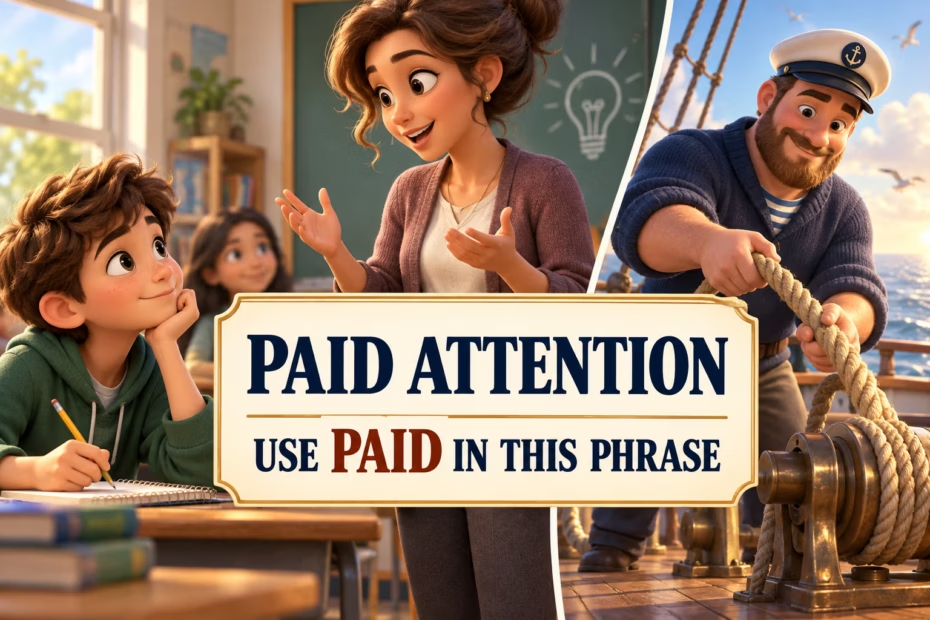
In the phrase “pay attention,” the past-tense and past-participle form is “paid attention.” “Payed” belongs to specialized nautical senses of pay: letting a rope run out or coating something with a waterproof composition. It does not fit this attention phrase, so write “I paid attention to the instructions.”
Key Facts / At a Glance
- Paid is the ordinary past simple and past participle of pay, including the collocation pay attention.
- The standard phrase is paid attention to a person, instruction, detail, or event.
- Payed is not the form for “paid attention”; it appears in two narrow maritime senses of pay.
- For a rope, Merriam-Webster gives paid and also payed for the nautical sense “slacken and allow to run out.”
- For the separate nautical sense “coat with a waterproof composition,” Merriam-Webster lists payed, also paid.
- Pay attention to is the common pattern; use focus on if you want the preposition on.

Paid vs. Payed: Form, Meaning, and Example
| Form | Meaning | Example |
|---|---|---|
| paid attention | Ordinary past or participle of pay attention; the standard form for noticing or listening carefully. | She paid attention to the safety briefing. |
| paid | Ordinary past and past participle of pay in financial, figurative, and other common senses. | We paid the invoice and paid tribute to the volunteers. |
| paid out / payed out | Nautical: let a rope or line run out. Merriam-Webster records paid and also payed for this sense. | The crew paid out the line slowly. |
| payed (also paid) | A specialized nautical verb meaning to coat something with a waterproof composition. | The workers payed the seam with a waterproof compound. |
Dictionary sources: Oxford lists paid as the past forms of pay and gives “pay attention” examples; Cambridge also identifies paid as the past simple and past participle; Merriam-Webster records “pay attention” and the limited rope/coating senses where payed can occur.
Use “Pay Attention To,” Not “Pay Attention On”
The usual pattern is pay attention to something: “Pay attention to the road,” “I paid attention to the speaker,” or “They have paid attention to every detail.” If you prefer on, change the verb phrase to focus on: “Focus on the road.” The phrases take different prepositions.
Correction to the original FAQ wording: “Payed attention is never correct” is too broad about the word payed. It is a recognized past form in specialized nautical uses, but it is not correct for the everyday phrase pay attention. Write paid attention for the sense of noticing or listening carefully.
About the earlier title: “Correct Usage of ‘Paid’ vs. ‘Payed’: Difference Explained” remains preserved in this page. The full original article follows; this sourced guide clarifies the rare nautical exceptions and the correct attention phrase.
Are you confused about whether it’s “payed attention” or “paid attention”? Let me clear up the confusion for you. Understanding the correct usage of these terms is crucial, especially in written communication. Many people mistakenly use “payed attention,” but I’m here to set the record straight.
As an expert in language and grammar, I’ll guide you through the differences between “payed attention” and “paid attention.” Knowing when to use each term can enhance the clarity and professionalism of your writing. So, let’s dive into the nuances of these phrases and ensure you’re using them correctly in your everyday communication.
Payed Attention or Paid Attention: Correct Usage
When it comes to differentiating between “payed attention” and “paid attention,” it is crucial to understand the correct usage of these terms. Paid attention is the accurate past tense form of the phrase “to pay attention.” It is widely recognized and used in everyday communication for denoting the action of focusing or listening carefully. Contrary to this, payed attention is not a standard term in general English and is largely limited to nautical contexts.
In various situations where attentiveness is key, using paid attention enhances the clarity and professionalism of your written and verbal communication. For instance, when discussing educational settings, work environments, or even personal relationships, the phrase “I paid attention” signifies an active engagement in listening or observing.
Moreover, the distinction between these terms is essential to avoid misunderstandings or misconceptions. By acknowledging the correct past tense forms—paid attention for focusing and paid off for successful outcomes—you elevate the quality and accuracy of your language usage. Embracing these nuances reinforces your linguistic precision and showcases your commitment to effective communication strategies.
Grasping the nuances between payed attention and paid attention empowers you to convey your thoughts and intentions clearly, whether in formal documents, casual conversations, or any written content. Stay mindful of these linguistic distinctions to uphold the standards of accuracy and professionalism in your language usage.
Understanding the Difference
Definition of “Payed”
In nautical terms, “payed” is a verb used to describe actions like giving slack to a rope or covering it with tar. This term is specifically related to maritime activities such as letting out slack on a line or moving away from the wind. “Payed” is not typically used outside of nautical contexts and carries a specific meaning limited to seafaring situations.
Definition of “Paid”
On the other hand, “paid” is the past tense form of the verb “pay”, commonly associated with financial transactions or compensations. In everyday language, “paid” signifies the exchange of money, goods, or services, or experiencing consequences due to actions taken. It is the correct form to use when referring to financial transactions and is widely recognized in formal and informal communication. The usage of “paid” extends beyond nautical contexts and is more versatile in various settings.
Example Sentences With “Paid Attention” For Better Understanding

Scenario #1 – 5 Example Sentences
- While studying for my exams, I paid attention to every detail in the textbook.
- I paid attention during the meeting and took notes to remember all the key points discussed.
- I paid attention to the traffic signs and safely navigated through the busy city streets.
- I paid attention to the professor’s instructions and successfully completed the assignment.
- At the seminar, I paid attention to the speaker and gained valuable insights into the topic.
Scenario #2 – 5 Example Sentences
- I paid attention to the safety briefing before embarking on the hiking trail.
- During the cooking class, I paid attention to the chef’s demonstration of the recipe.
- I paid attention to the weather forecast and decided to carry an umbrella for the day.
- I paid attention to the details in the contract before signing it to avoid any misunderstandings.
- While learning a new language, I paid attention to the pronunciation of each word.
Scenario #3 – 5 Example Sentences
- I paid attention to the nutrition labels on food products to make healthier choices.
- During the presentation, I paid attention to the speaker’s body language for cues on their confidence.
- I paid attention to the feedback received and made adjustments to improve my work.
- I paid attention to the advice given by my mentor and applied it to my career development.
- I paid attention to the news updates to stay informed about current events.
Scenario #4 – 5 Example Sentences
- I paid attention to the details in the user manual to properly assemble the furniture.
- At the workshop, I paid attention to the instructor’s techniques to enhance my skills.
- I paid attention to the ingredients list on the package to avoid allergens.
- I paid attention to the trail markers while hiking to stay on the right path.
- I paid attention to the lecture and actively participated in the class discussions.
Common Mistakes
Using “Payed” Instead of “Paid”
In writing, one of the common mistakes that often arises is the confusion between “payed” and “paid.” It’s crucial to note that “paid” is the correct past tense of the verb “pay” and is used in various contexts, such as financial transactions or settling debts. On the other hand, “payed” is a term more specifically related to nautical settings, referring to the action of sealing the deck of a ship with pitch or tar. Unless you are writing about maritime activities, “paid” is typically the word you should use in your everyday language.
Confusion in Usage
The confusion between “paid” and “payed” primarily stems from their similar pronunciation. However, the distinction lies in their meanings and contexts of application. “Paid” is commonly utilized when referring to transactions involving money or the completion of a payment. In contrast, “payed” is predominantly employed in nautical contexts, signifying the process of letting out a boat’s line or cable. It’s essential to pay attention to the specific context in which these terms are used to ensure accurate and effective communication.
Conclusion
Having delved into the nuances of “paid” and “payed,” it’s evident that the correct usage of these terms is crucial for precise communication. While “paid” is the standard past tense form of “pay” in most scenarios, “payed” finds its niche within nautical contexts, specifically in relation to ship deck maintenance. Recognizing the appropriate contexts for each term is essential for conveying information accurately. By understanding the distinctions between “paid” and “payed,” one can navigate language intricacies with confidence and clarity. Remember, using the correct term not only enhances communication but also showcases linguistic proficiency. Mastering these distinctions ensures effective communication across various domains, whether in everyday conversations or specialized fields.
Frequently Asked Questions
Is it paid attention or payed attention?
The past participle of “pay” is almost always “paid,” and “paid attention” is correct. The form “payed” is used in only one very specific sense, that is, as the past participle of “pay” when it means “to coat with a waterproof substance” (“We payed the new deck with a wood sealant”).
How do you say pay attention to details?
Overconscientious or punctilious. they are two words meaning always paying attention to details. Meticulous is also another word that works.
What is the past tense of payed attention?
Paid attention is the past tense of ‘pay attention’, a common expression that means to focus on (or take notice of) someone or something. ‘Payed attention’ is never correct. Example: ‘Paid attention’ in a sentence When the teacher talked, the children paid attention to her.
Why is paid spelled paid and not payed?
In almost all cases, the past tense and past participle of pay is paid. When used in this way, pay is considered an irregular verb because it doesn’t use the ending -ed like regular verbs do. However, the word payed is used as the past tense and past participle of pay in two very specific nautical senses.
What is the present tense of pay attention?
‘I pay attention’ is correct. The s is added at the third person at the present tense. I pay attention, you pay attention, we pay attention, they pay attention.
What Adjective Means “Careful About Details”?
If you are looking for an adjective rather than the verb phrase, meticulous means very careful and exact, while punctilious emphasizes careful attention to rules or details. Cambridge defines punctilious as very careful about behaving correctly or attending to details. Overconscientious can suggest excessive care. The original question’s “pay attention to details” is also a natural verb phrase.
Helpful references: Cambridge on punctilious and Oxford on pay attention.
Frequently Asked Questions About Paid Attention and Payed Attention
Is it paid attention or payed attention?
Use paid attention in ordinary English. Paid is the past-tense and past-participle form used in the collocation pay attention. Payed belongs to specialized nautical senses of pay, such as letting out a rope; those senses do not apply to attention.
Is payed a real word?
Yes. Merriam-Webster records payed in specialized nautical uses of pay: slackening a rope so it runs out, or coating something with a waterproof composition. In the rope sense, the dictionary also records paid. Neither spelling changes the ordinary phrase paid attention.
What does payed mean when sailors use it?
In nautical language, payed out can mean let a rope or line run out by easing it. A separate verb sense means coat something with a waterproof composition. These are specialized meanings of pay; they do not mean listen carefully or notice details.
Should I write paid attention to or paid attention on?
The usual phrase is paid attention to: “She paid attention to the instructions.” If you want the preposition on, use a different verb phrase, such as “She focused on the instructions.” In standard usage, attention takes to in this construction.
Is paid attention past tense or present perfect?
Paid can be a simple-past verb or a past participle. “I paid attention during class” is simple past; “I have paid attention to the details” uses the present perfect. In both sentences, the correct spelling is always paid, not payed.
What adjective describes someone who notices details?
Meticulous describes someone who works very carefully and precisely. Punctilious emphasizes careful attention to details or rules, often in formal behavior. Overconscientious can imply being too careful. The verb phrase remains pay attention to details; choose an adjective when you need a compact description.


