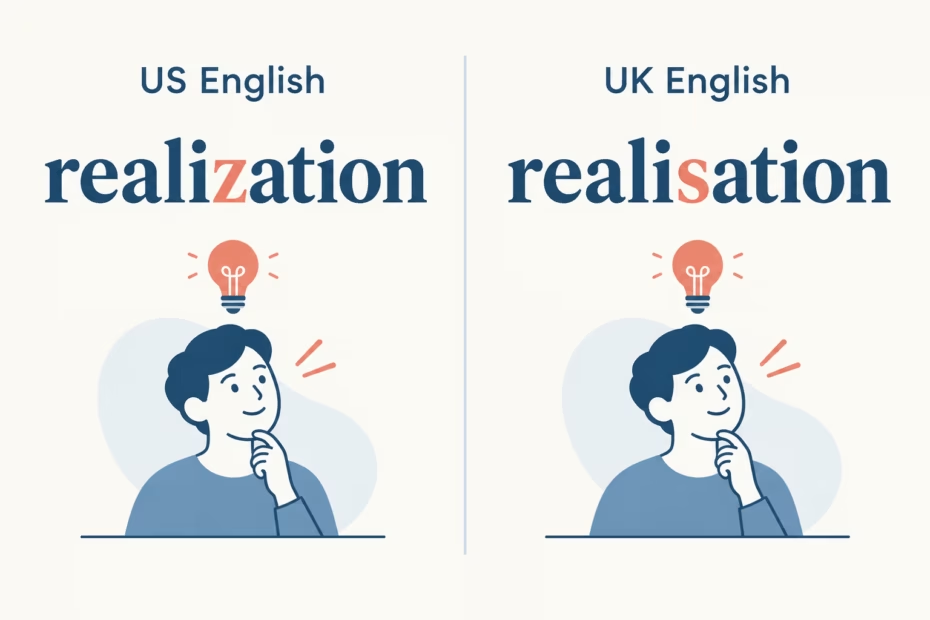

Confused about whether to use “realisation” or “realization”? As an expert in English language nuances, I’ll shed light on this spelling conundrum. In American English, “realization” is the standard spelling, while in British English, “realisation” is the norm. Let’s dive into the details to clarify which one is correct in various contexts.
Understanding the differences between “realisation” and “realization” can enhance your writing skills and prevent common spelling errors. Whether you’re crafting an academic paper or a creative piece, knowing the correct usage is crucial. Stay tuned as I unravel the intricacies of these spellings and provide examples to illustrate their proper application.
Mastering the distinction between “realisation” and “realization” is key to polished writing. Join me on this linguistic journey to grasp the nuances of these terms and elevate your language proficiency.
Realisation or Realization: Which is Correct?
When it comes to the spelling difference between “realisation” and “realization,” it’s essential to understand the nuances between British English and American English. In American English, realization is the sole correct spelling for words related to the concept of making something real or becoming aware of something. On the other hand, British English prefers realisation for the same context, deviating from American English norm.
The choice between realization and realisation boils down to the variations in spelling conventions between these two major forms of English. Acknowledging and internalizing this divergence can significantly improve one’s writing skills and enhance the overall quality of written communication. Mastery of these nuances allows for more precise and appropriate word selection to convey meaning effectively in different linguistic contexts.
For those aiming to achieve linguistic proficiency in either American or British English, awareness of such spelling differences is indispensable. Whether writing for academic, professional, or creative purposes, grasping the subtleties between realization and realisation can elevate the clarity and sophistication of one’s written expression. Thus, conscientious writers should embrace the distinct spellings and utilize them appropriately according to the linguistic conventions they aim to adhere to.
Definition and Usage Differences
British English: Realisation vs. American English: Realization
In British English, the correct spelling is realisation, whereas in American English, it is realization. These two variations represent a key spelling difference between the two language variants. It’s crucial to be mindful of this discrepancy when crafting written content for specific audiences, as consistency in spelling enhances the overall clarity and professionalism of the text. By understanding and adopting the appropriate spelling based on the linguistic context, writers can effectively communicate their intended message.
Spelling Rules and Regional Variations
American English: -ize vs. British English: -ise
In American English, the spelling convention typically uses the suffix “-ize” in words like “realize.” On the other hand, British English leans towards “-ise,” as in “realise.” Both spellings are correct within their respective linguistic contexts, but it’s essential to maintain consistency within a particular writing style.
Historical Context and Evolution of Spelling
The variance in spelling between “realisation” and “realization” reflects an intriguing linguistic history. Noah Webster, a prominent figure in American lexicography, advocated for spelling reform, contributing to the adoption of “realize” in American English with a “z”. This divergent spelling evolution showcases the dynamic nature of language and the impact of historical figures on linguistic conventions.
Acceptable Forms in Academic Writing
In academic writing, maintaining consistency and adhering to specific style guides are paramount. When it comes to the spelling of “realisation” versus “realization,” the choice can vary depending on the prescribed style. In American English, the preferred spelling is “realization,” aligning with the -ize suffix commonly used in American English vocabulary.
However, in British English and certain academic institutions following British conventions, “realisation” with an -ise ending is considered correct. This discrepancy arises from the linguistic nuances and historical influences that have shaped the English language on both sides of the Atlantic.
For academic papers or research articles intended for an audience familiar with British English norms, opting for “realisation” may be more appropriate to maintain consistency and authenticity in the written work. Conversely, if the target readership predominantly uses American English, “realization” would be the recommended spelling choice to uphold uniformity and clarity throughout the text.
It’s essential to consult the specific guidelines provided by academic institutions or publishers regarding spelling preferences to ensure adherence to the prescribed style. Whether it’s “realisation” or “realization,” the key is to follow the established conventions consistently within the academic writing context to convey professionalism and linguistic accuracy.
Conclusion
After exploring the nuances between “realization” and “realisation” in academic writing, it’s evident that both spellings are acceptable depending on the English variant being used. Consistency and adherence to specific style guides remain crucial in maintaining linguistic accuracy and professionalism. Whether opting for the “-ize” or “-ise” suffix, the key is to consider the audience’s familiarity with the chosen English style. By following prescribed spelling guidelines, writers can effectively communicate their ideas and research findings with clarity and precision. Remember, the choice between “realization” and “realisation” ultimately boils down to aligning with the preferred spelling conventions of the target readership.
Frequently Asked Questions
How should I spell “realization” in academic writing?
In American English, “realization” with the “-ize” suffix is preferred in academic writing.
What about British English spelling of “realization”?
In British English, “realisation” with the “-ise” ending is considered correct.
Which spelling should I use in my academic paper?
Choose the spelling based on your targeted audience’s familiarity with either English variant.
Why is it important to follow specific style guides for spelling?
Following prescribed spelling guidelines conveys professionalism and linguistic accuracy in academic papers and research articles.
Realisation or Realization: Quick Answer
Both spellings are correct. Realization is the usual US spelling; realisation is the usual UK spelling. A British publication may also use realization if it follows Oxford University Press style, so the best choice depends on your audience and the style guide you are following. Cambridge labels the noun “realization” and notes that the UK usually uses realisation; it gives the same UK qualification for the verb “realize.”
For everyday writing, follow the spelling used by your reader’s country or the publication’s house style. In US English, choose realization. In most UK contexts, choose realisation. If an editor, school, journal, or employer gives a style guide, follow that instruction even when it differs from the regional default.
How the Spelling Changes in the Word Family
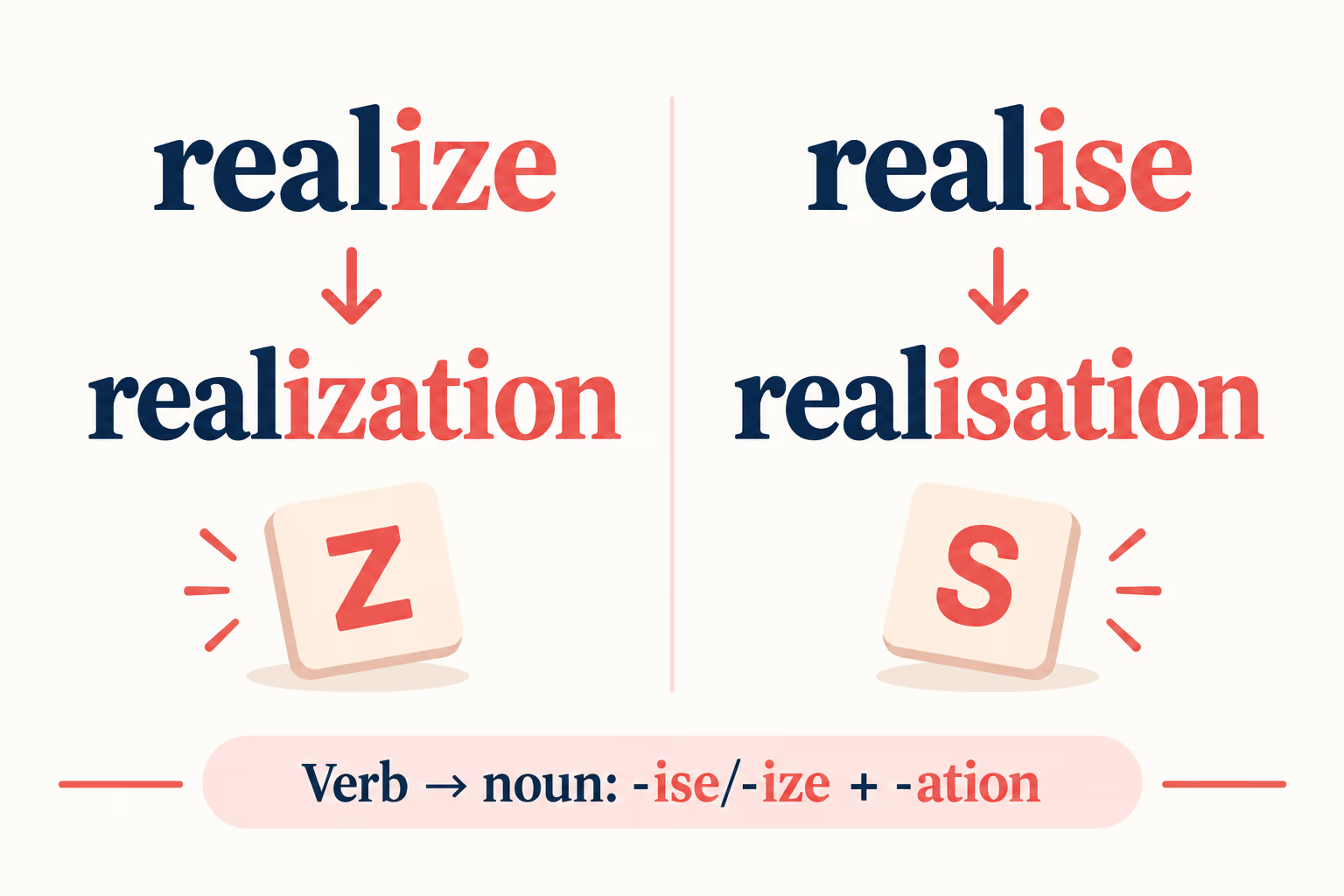
The noun follows the spelling of the related verb. The common US pair is realize and realization; the common UK pair is realise and realisation. The difference is usually the letter z or s before the ending. The same choice appears in related forms: US realized and realizing, compared with UK realised and realising.
Do not change the spelling inside a quotation, an official name, or a source title. Otherwise, use one spelling system consistently within the same document. A text can discuss both forms, but its own prose should not switch randomly between realization and realisation.
What Does “Realization” Mean?
The noun has several related meanings. In ordinary writing, it most often means either becoming aware of something or achieving something hoped for. In finance, it can also mean obtaining money by selling an asset. Cambridge lists these senses in its entry for realization; the spelling choice does not change the meaning.

- Awareness: “The realization that the train left early came too late.” Here, the noun means the point at which someone understands a fact.
- Achievement: “The new clinic was the realization of the community’s long-held plan.” Here, it means bringing an aim into reality.
- Finance: “The realization of the property’s value took several months.” In financial writing, it can refer to turning property or another asset into money.
These meanings can help you tell which sense a sentence intends. A realization that something happened usually concerns awareness; the realization of a goal concerns achievement; and the realization of assets is a technical financial use.
Which Spelling Should You Use in Formal or Academic Writing?
There is no single spelling rule for every English-language academic publication. Start with the journal’s, institution’s, or publisher’s instructions. The University of Oxford style guide says its house style uses -ise and -isation. Oxford University Press uses a different house style: its house-style guide explains that British English can use either -ise or -ize for this word family, and that OUP chooses -ize where that alternative is available. These are house-style choices, not evidence that one of the spellings is universally wrong.
If no guide is specified, match the variety of English you are using and keep the family consistent: realise, realised, realising, realisation or realize, realized, realizing, realization. In a US document, the z-spellings are standard. In UK writing, the s-spellings are the usual choice, though Oxford-style publications may prefer z-spellings. A spellchecker set to the intended language can help catch accidental mixing, but it cannot replace the publisher’s instructions.

Examples of “Realization” and “Realisation” in Sentences
- US style: “Her realization that the figures were reversed changed the report.”
- UK style: “His realisation that the key was missing delayed the meeting.”
- US style: “The scholarship helped make her goal a realization.”
- UK style: “The restoration was the realisation of a decade-long ambition.”
- Finance: “The company reported the realization of assets after the sale.” The UK may spell this realisation under its chosen house style.
The examples show that the noun keeps the same meaning across the two spellings. The difference signals a spelling convention, not a difference in grammar, pronunciation, or intended idea.
Frequently Asked Questions
Is “realisation” wrong in American English?
It is not the standard US spelling. American readers will usually expect realization, but they can recognize realisation as a variant used in other English styles.
Is “realization” accepted in British English?
Yes. It is used in Oxford University Press style and is recognized by major dictionaries; realisation remains the usual spelling in much British writing. Follow the publication’s chosen convention.
Does the spelling change the meaning?
No. Both forms can mean becoming aware of something, achieving an aim, or (in a financial context) converting assets into money. The surrounding sentence tells you which sense is intended.
How do I spell the related verb?
Use realize with realization, or realise with realisation. Keep the same pattern in forms such as realized/realised and realizing/realising.


