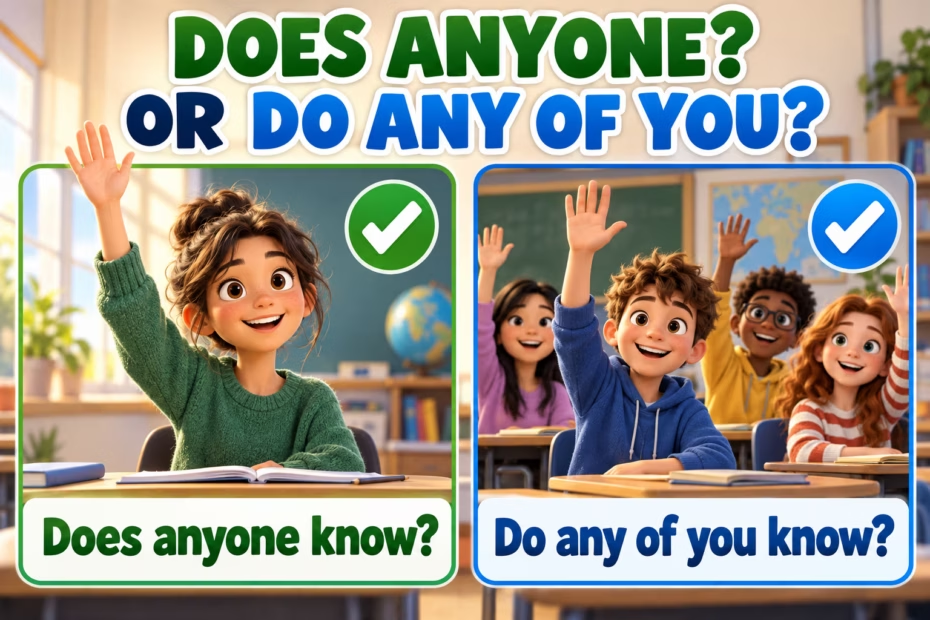
Use “does anyone” when the singular pronoun anyone is the subject of a present-simple question: “Does anyone know?” Use do with a plural subject: “Do any of you know?” “Do anyone know?” is not the standard subject–verb form. But “Do you know anyone?” is correct because you, not anyone, is the subject.
At a glance
- Anyone is an indefinite pronoun and takes a singular verb when it is the subject. (Cambridge Grammar)
- In present-simple questions, use does with a third-person singular subject and do with I, you, we, or they.
- Correct: “Does anyone have a question?” After does, use the base verb have, not has.
- For a plural group, write “Do any of you have a question?” The subject is any of you, not anyone.
- Anyone can also be an object: “Do you know anyone?” The auxiliary agrees with the subject you.
- Singular they may refer back to anyone in a later clause; this does not change the verb that agrees with anyone.
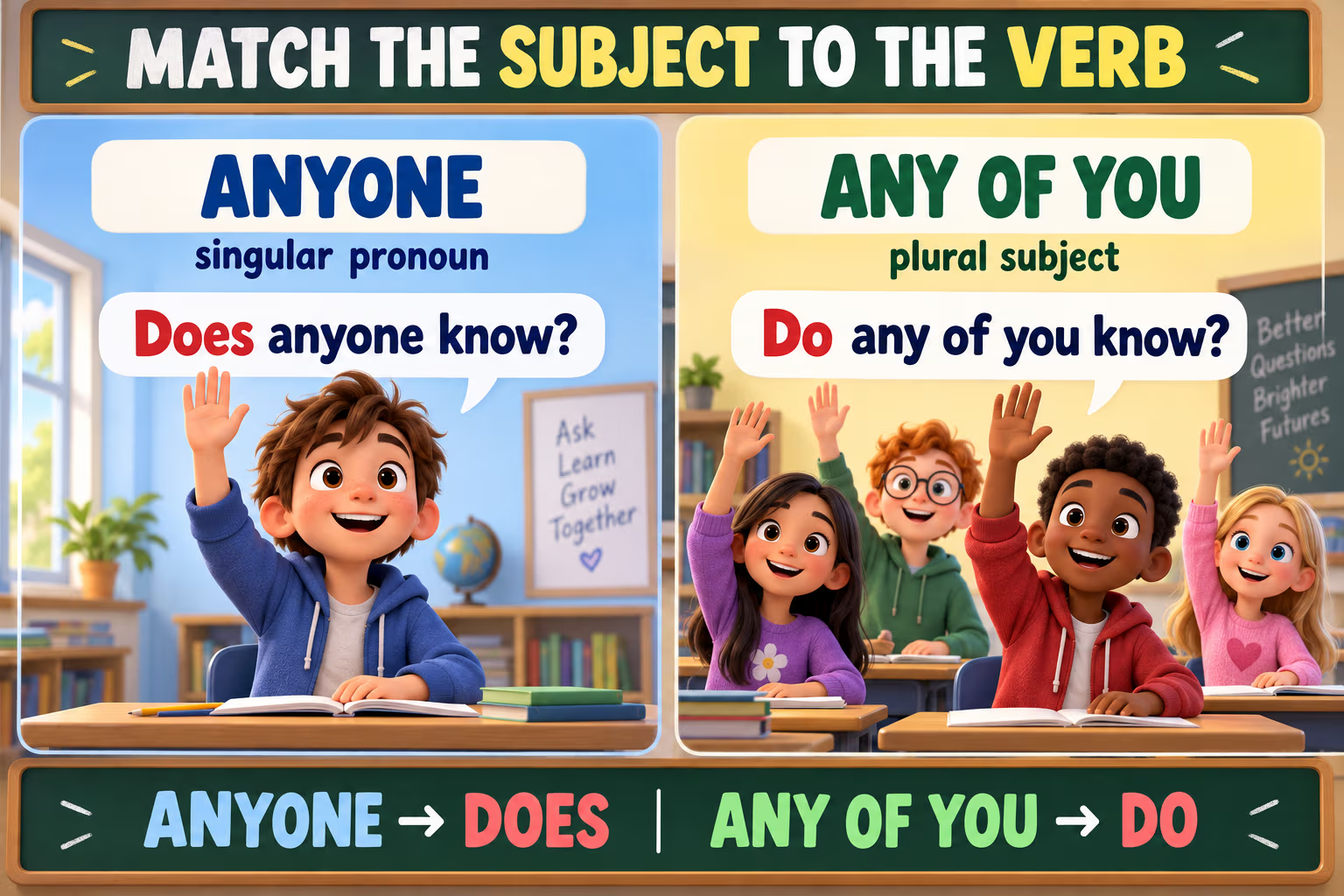
Does Anyone or Do Anyone?
The standard choice depends on which phrase is the subject. Use does anyone when anyone is the subject; use do any of you when the subject is plural. The words do and anyone can also occur in the same sentence with a different subject, as in “Do you know anyone?”
As an expert in English language nuances, I’ll delve into the common confusion between “does anyone” and “do anyone.” Understanding the correct usage can significantly enhance your communication skills. Let’s break down the grammar rules to clarify this often misunderstood topic.
Many English learners struggle with whether to use “does” or “do” when forming questions with “anyone.” I’ll provide clear explanations and examples to help you grasp the correct structure effortlessly. By the end of this article, you’ll confidently know when to use “does anyone” and when to opt for “do anyone,” ensuring your sentences are grammatically accurate and effectively convey your message.
Proper Usage of “Does Anyone” and “Do Anyone”
Understanding Subject-Verb Agreement
Precise rule: Cambridge Grammar lists anyone as an indefinite pronoun used with a singular verb. Thus, in a present-simple question, write “Does anyone need help?” For a plural group, change the subject: “Do any of the students need help?” Cambridge’s question pattern puts do or does before the subject, then uses the base form of the main verb.
When it comes to the phrases “does anyone” and “do anyone,” subject-verb agreement is key. “Does anyone” is the correct form because “anyone” is a third-person singular pronoun. This means it requires a singular verb. On the other hand, “do” is used for plural subjects. Therefore, “do anyone” is grammatically incorrect due to the mismatch in subject-verb agreement.
Differences in Singular and Plural Usage
- “Does anyone” should always be used when referring to an action or a question involving one person.
- In contrast, “do” is reserved for when the subject is in the plural form.
- Remember, “does anyone” is singular in nature, ensuring grammatical accuracy in your sentences.
- Incorrect: “Do anyone have a spare pen?”
- Correct: “Does anyone have a spare pen?”
- Incorrect: “Do anyone know how to fix this?”
- Correct: “Does anyone know how to fix this?”
- By using “does anyone,” you maintain proper subject-verb agreement in your sentences and communicate effectively.
“Does anyone” or “Do Anyone” – Sentence Comparison Table:
Correction to the table below: Its “Do anyone” column preserves nonstandard learner examples; do not copy those forms in standard subject–verb agreement. In each question, anyone is the subject, so use “Does anyone…?” If you mean a plural group, use a plural subject such as “Do any of the people here…?” “Do you know anyone?” is correct because you is the subject and anyone is the object. The original rows remain intact.
| “Does Anyone” Sentences | Meaning | “Do anyone” Sentences | Meaning |
|---|---|---|---|
| Does anyone know the answer to this question? | Asking if any individual possesses knowledge of a particular subject. | Do anyone here have a pen I can borrow? | Inquiring if any person present has a writing instrument available. |
| Does anyone else hear that strange noise? | Asking if others perceive a particular auditory sensation. | Do anyone in this group speak French fluently? | Inquiring if any member of a specified group is proficient in a language. |
| Does anyone remember where we parked the car? | Asking if someone retains a memory of a past event or location. | Do anyone have any dietary restrictions we should be aware of? | Inquiring if any person has specific dietary limitations. |
| Does anyone have a spare charger for a MacBook? | Asking if an individual possesses an additional electronic accessory. | Do anyone need a ride home after the party? | Asking if anyone requires transportation following an event. |
| Does anyone want to go see a movie tonight? | Inviting others to join in a recreational activity. | Do anyone have a background in accounting? | Inquiring if anyone possesses experience or knowledge in a particular field. |
| Does anyone know CPR? | Inquiring about knowledge of a specific life-saving technique. | Do anyone here play the guitar? | Asking if anyone present has a skill or hobby. |
| Does anyone else find this situation absurd? | Seeking agreement or shared perception about a circumstance. | Do anyone have a recommendation for a good book to read? | Asking if any person can suggest a literary work. |
| Does anyone need assistance with their luggage? | Offering help or aid to others in carrying their belongings. | Do anyone know how to fix a leaking faucet? | Inquiring if anyone has expertise in plumbing. |
| Does anyone have any objections to this proposal? | Inquiring if there are dissenting opinions or concerns. | Do anyone have a map of the hiking trails in this area? | Asking if anyone possesses navigational resources. |
| Does anyone want coffee or tea? | Offering choices for refreshments. | Do anyone have any experience with public speaking? | Inquiring about past involvement in addressing audiences. |
| Does anyone else think we should leave early? | Proposing an alternative course of action and seeking agreement. | Do anyone want to join me for a jog in the park? | Extending an invitation to engage in physical activity. |
| Does anyone have a pen I can borrow? | Requesting the temporary use of a writing instrument. | Do anyone know a good restaurant in the area? | Seeking recommendations for dining establishments. |
| Does anyone have plans for the weekend? | Asking about scheduled activities or commitments. | Do anyone have a first aid kit in their car? | Inquiring about the presence of emergency medical supplies. |
| Does anyone need directions to the conference room? | Offering guidance or assistance in finding a specific location. | Do anyone here own a pet snake? | Inquiring about pet ownership within a group. |
| Does anyone want to volunteer for this task? | Seeking individuals willing to undertake a particular responsibility. | Do anyone have a background in computer programming? | Inquiring about expertise in a technical field. |
| Does anyone know how to play the piano? | Asking about proficiency in a musical instrument. | Do anyone have any suggestions for improving office morale? | Seeking ideas for boosting workplace enthusiasm. |
| Does anyone have any questions before we conclude? | Offering an opportunity for inquiries or clarifications. | Do anyone need help with their homework? | Offering assistance with academic assignments. |
| Does anyone have any objections to rescheduling the meeting? | Seeking consensus on changing the timing of a gathering. | Do anyone know how to change a flat tire? | Inquiring about mechanical expertise. |
| Does anyone want to share their thoughts on the matter? | Inviting contributions to a discussion or conversation. | Do anyone here own a beach house? | Inquiring about property ownership within a group. |
| Does anyone need a ride to the airport tomorrow? | Offering transportation assistance for travel purposes. | Do anyone have experience with graphic design? | Inquiring about proficiency in visual communication. |
Common Mistakes to Avoid
Incorrect Usage Examples
Check the subject before correcting a sentence. “Do anyone have a pen?” needs does because anyone is its subject. “Anyone can do them,” however, can be grammatical when them refers to more than one thing; use it only when the intended object is singular. Singular they can also refer back to anyone.
When discussing the usage of “does anyone” or “do anyone,” it’s essential to avoid common mistakes that can impact the clarity and correctness of your language. Incorrect usage examples include:
- Asking “Do anyone have a pen?” instead of “Does anyone have a pen?”
- Using “Anyone can do them” instead of the correct form “Anyone can do it.”
Remember, maintaining proper subject-verb agreement is crucial when utilizing these phrases to ensure effective communication.
Grammar Sources
- Cambridge Grammar: “Anyone, anybody or anything?” — indefinite pronouns and singular verb agreement.
- Cambridge Grammar: “Present simple” — do/does forms in present-simple questions.
- Cambridge Grammar: “Do as an auxiliary verb” — question word order with do and does.
- Cambridge Grammar: “Subjects” — subject position in interrogative clauses.
Conclusion
Ensuring the correct subject-verb agreement with phrases like “does anyone” and “do anyone” is essential for clear communication in English. Remember, “does anyone” is used for singular subjects, while “do” is appropriate for plural subjects. By being mindful of this rule, you can avoid common errors and convey your message effectively. Practice using the correct form in your writing and speech to strengthen your language skills. Mastering subject-verb agreement not only enhances your communication but also boosts your overall language proficiency. Keep these tips in mind to confidently navigate the nuances of English grammar.
Frequently Asked Questions
Is anyone singular or plural?
Anyone is a singular indefinite pronoun when it is the subject of a clause, even when it refers to an unspecified person in a group. Use “Anyone is welcome” or “Does anyone know?” A later pronoun may be singular they, as in “Anyone can share their idea,” without changing the earlier verb agreement.
Should I write “does anyone have” or “do anyone have”?
In standard present-simple English, write “Does anyone have…?” because anyone is singular. The auxiliary does carries the third-person singular marking, so the main verb stays in its base form: have, not has. For example: “Does anyone have the notes from class?”
When should I use “do any of you”?
Use “do any of you” when you are asking a group whether one or more members have or do something: “Do any of you need a ride?” Here the subject is the plural phrase any of you. With the singular pronoun anyone, use does: “Does anyone need a ride?”
Can I use they after anyone?
Yes. Singular they commonly refers back to anyone when the person’s gender is unknown or irrelevant: “If anyone calls, tell them I’ll return the call.” The later pronoun does not make anyone plural, so the verb in its own clause still follows singular agreement.
Is “Do you know anyone?” grammatically correct?
Yes. In “Do you know anyone?” the subject is you, which takes do; anyone is the object of know. This differs from “Do anyone know?”, where anyone is the subject and the standard present-simple question uses does: “Does anyone know?”


