Quick answer: “That’s fine” often responds to a suggestion or choice, while “it’s fine” often describes a situation, item, or result as acceptable. Both are correct, and they can overlap. Use the phrase that clearly refers to what you mean; context and tone help listeners interpret it.
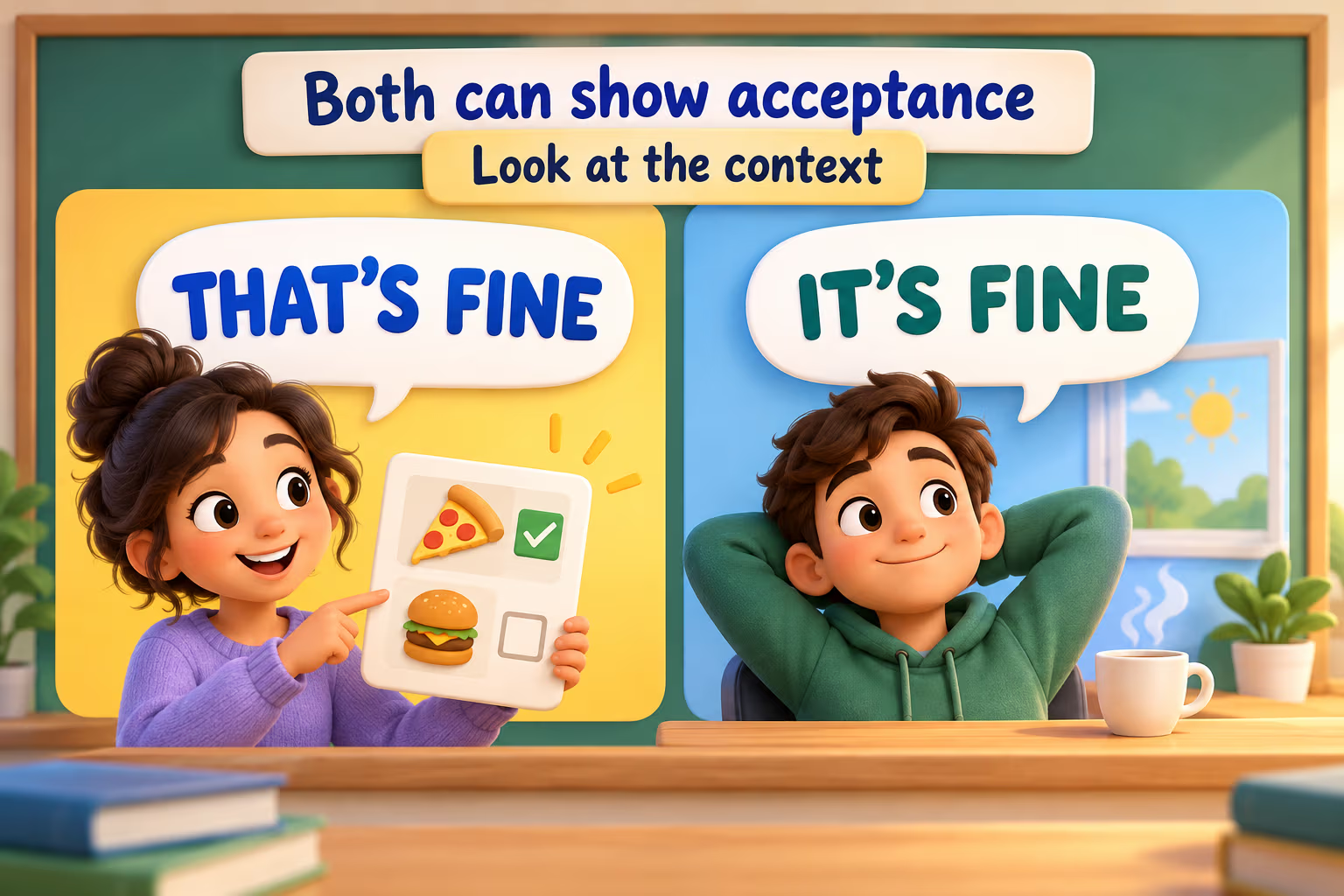
“That’s Fine” vs. “It’s Fine”: Quick Difference
Both expressions are grammatical. That’s means that is, and it’s means it is in these examples. A useful tendency is that that points to a choice, suggestion, or statement just mentioned, while it refers to a situation, condition, or thing already understood. This is a guide to reference and emphasis, not a rule that makes the meanings mutually exclusive.
| Expression | Common use | Example | What the context supplies |
|---|---|---|---|
| That’s fine | Accepting or approving a proposal or choice | “We can meet at 3.” “That’s fine with me.” | That points back to the proposed time. |
| It’s fine | Describing something as acceptable or reassuring someone about a situation | “Is the soup warm enough?” “It’s fine.” | It refers to the soup or the matter being discussed. |
| Either phrase | Showing acceptance, depending on the wording | “Could we move lunch?” “That’s fine.” / “It’s fine if we move lunch.” | The full sentence makes the reference clear. |
Cambridge Dictionary gives that’s fine by me as a response to a suggestion and also illustrates it’s fine for something that is good enough. Those are common patterns, not exclusive meanings: Cambridge’s entry for fine shows both uses.
How the Two Phrases Work
“That’s fine” usually refers back to an idea
In that’s fine, the word that commonly points to a proposal, decision, preference, or fact already in the conversation. For example: “I can send the revised file tomorrow.” “That’s fine with me.” The reply accepts the suggested timing. The phrase that’s fine by me has the same basic purpose: the speaker says the option is acceptable to them. Cambridge’s definition of “be all right/fine by someone” uses this agreement pattern.
“That” can also point to a whole situation rather than a single object: “The train is ten minutes late.” “That’s fine; I have time.” The sentence does not require a narrowly specific physical thing. It refers to the information or circumstance just mentioned.
“It’s fine” commonly describes a condition or situation
In it’s fine, it refers to something identifiable from the surrounding words or conversation: a meal, a draft, a delay, the weather, or the overall situation. “Is the soup hot enough?” “It’s fine” assesses the soup. “I’m sorry I’m late.” “It’s fine” can reassure the other person that the lateness is not a problem. The referent may be a whole event, not just an object.
English speakers can also use it’s fine by me to accept a proposal, as Cambridge’s examples show. So “accepting a proposal” does not belong exclusively to that’s fine; the sentence structure and the words after fine help identify the meaning.
“Fine” can mean acceptable, good enough, or well
The adjective fine has several related senses. It can mean satisfactory or good enough, as in “The replacement part is fine”; healthy or well, as in “I’m fine now”; or acceptable to someone, as in “That’s fine by me.” In a reply, it may communicate approval, reassurance, or only minimum acceptability. The word alone does not reveal how enthusiastic the speaker feels.
Examples: Choosing the Clearer Reply
Read the sentence before choosing. Ask whether you are accepting a named option, evaluating a condition, or reassuring someone. These examples show tendencies; another wording may work in the same context if its reference is clear.
- Accepting a suggested time: “Could we start at 9:30?” “That’s fine with me.” The reply points back to the proposed time.
- Describing an item: “Does this replacement cable work?” “It’s fine for the monitor.” The pronoun refers to the cable.
- Reassuring someone: “Sorry, I attached the wrong draft.” “It’s fine; send the corrected one when you can.” The reply addresses the situation and gives a next step.
- Accepting a changed plan: “Let’s take the earlier train.” “That’s fine.” The reply accepts the option just offered.
- Clarifying limited approval: “Is this final version ready?” “It’s usable, but it still needs a source check.” This is clearer than a bare fine when there is an important qualification.
When the answer matters, add the missing detail: “That time works for me,” “The color is acceptable,” or “I’m not upset, but please let me know next time.” Specific wording reduces the risk that a short fine will be mistaken for stronger approval than you intend.
Does Either Phrase Sound Rude or Passive-Aggressive?
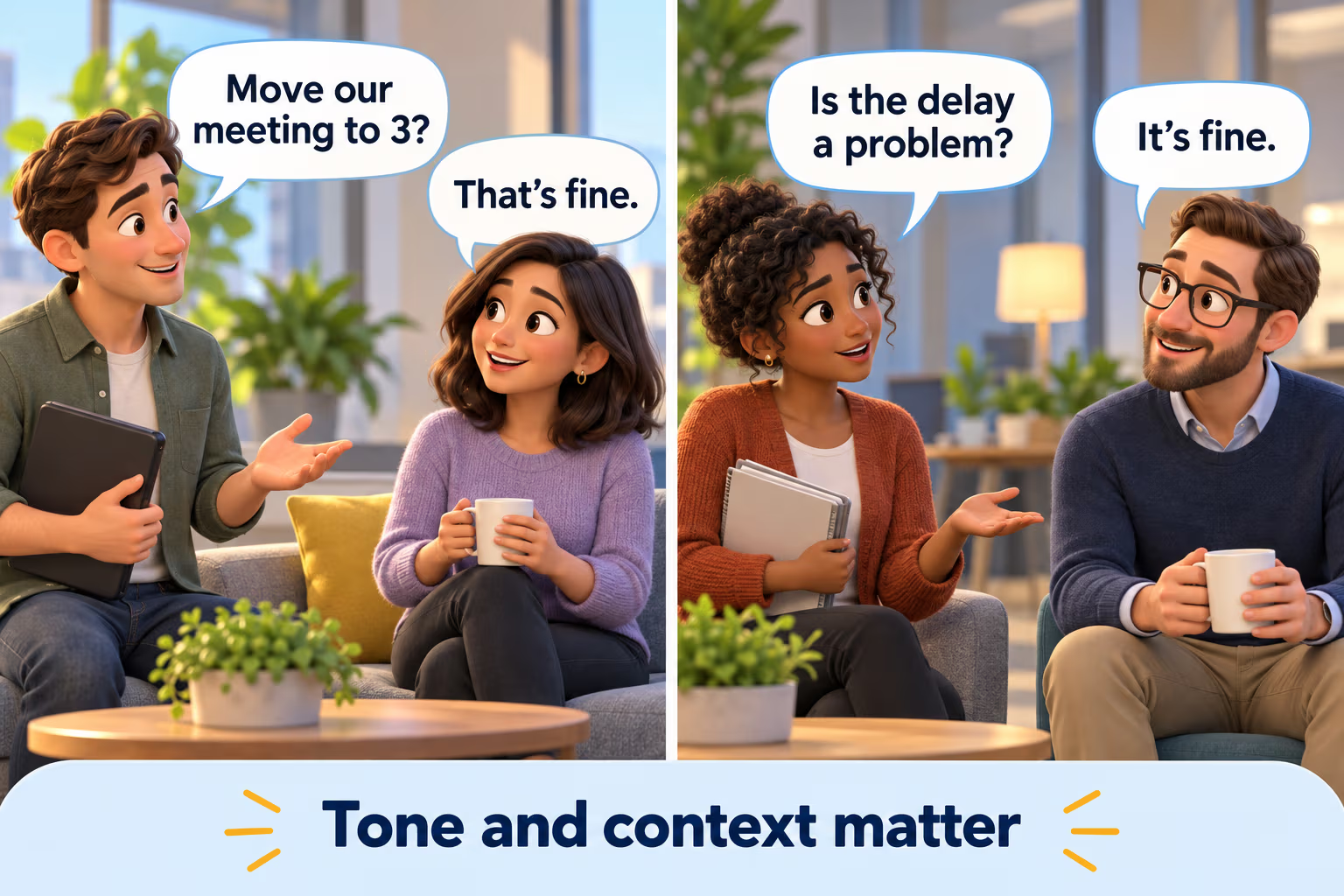
Neither expression is automatically rude or passive-aggressive. Both may be warm, neutral, or curt. Listeners use the relationship, prior exchange, timing, punctuation, and spoken delivery to interpret a short reply. A clipped “Fine.” after a disagreement may sound annoyed; “That’s fine, thanks for checking” is more explicit. The phrase itself does not prove the speaker’s hidden attitude.
In text messages, the reader cannot hear stress or pitch. If a reply could be misunderstood, add a clear signal or a concrete next step: “That works for me—thanks for asking,” “It’s okay; I’ll handle the update,” or “I’m not comfortable with that change.” Avoid relying on extra punctuation or an emoji to carry meaning that the words leave unclear. Purdue OWL explains that tone and diction should fit the audience and purpose in its guide to tone, mood, and audience.
Using “That’s Fine” and “It’s Fine” in Professional Writing
Both contractions are standard English, but a particular assignment, workplace, or publication may prefer a more formal register. Cambridge notes that contractions are common in everyday speech and informal writing and are usually avoided in formal writing. The MLA Style Center, however, says contractions are allowed in its publications and explains that suitability depends on tone, clarity, and context. The practical rule is to follow the relevant style guide and audience rather than calling contractions grammatically wrong.
For a formal decision or approval, consider replacing the vague adjective fine with the exact meaning: “The proposed date is acceptable,” “I approve the revised schedule,” or “The draft meets the stated requirements.” If the intention is friendly and conversational, “That’s fine with me” may be clearer and more natural. Purdue OWL describes formality as a scale shaped by audience and purpose in its guide to levels of formality. For apostrophe placement in contractions, see our guide to common apostrophe mistakes.
In either phrase, the apostrophe marks omitted letters: that’s is short for that is here, and it’s is short for it is. In other sentences, ’s can represent has—for example, “It’s been a long day” means “It has been a long day.” In that’s fine and it’s fine, expand the contractions to check the grammar: “That is fine” and “It is fine.”
Punctuation and Sentence Structure
Both expressions can stand as complete sentences: “That’s fine.” “It’s fine.” If a second independent thought follows, use a period or semicolon rather than joining the two clauses with only a comma: “That’s fine; we can move the meeting.” In a conversational reply, a comma plus a coordinating conjunction is also correct: “It’s fine, and I can resend the file.” Punctuation helps organize the sentence, but it cannot reliably communicate a speaker’s emotional tone by itself.
When it comes to using “that’s fine” vs. “it’s fine,” clarity is key. As an expert blogger, I’ve delved into the nuances of language to provide you with a comprehensive guide on the correct usage of these commonly confused phrases. Understanding when to use “that’s fine” and when to opt for “it’s fine” can make a significant difference in your communication.
In this article, I’ll break down the subtle distinctions between “that’s fine” and “it’s fine” to help you navigate the English language with confidence. With years of experience in crafting engaging and informative content, I’m here to shed light on the correct contexts for each phrase. Stay tuned to enhance your language skills and ensure that you’re using “that’s fine” and “it’s fine” accurately in your everyday conversations.
That’s Fine vs. It’s Fine: Correct Usage
When it comes to differentiating between “that’s fine” and “it’s fine,” clarity and context are key in effective communication. “That’s fine” is often used when referring to a specific thing or situation, emphasizing a particular object or event. On the other hand, “it’s fine” is more general, conveying an overall sense of acceptance or approval.
In practical terms, “that’s fine” might be used to indicate approval of a specific action or decision made by someone else, while “it’s fine” is commonly used to reassure others or express one’s own acceptance of a situation. Understanding these subtle nuances can help avoid misinterpretation in conversations.
Clarification: “Specific versus general” is a helpful tendency, not a strict grammar rule. That’s fine often refers to a proposal or situation just raised, and it’s fine often describes a condition or reassures someone, but the phrases can overlap. “It’s fine by me” can accept a proposal, too.
In everyday conversations, using “that’s fine” might imply that a specific action or choice is acceptable, whereas “it’s fine” can convey a broader sense of reassurance or contentment. Consider the following examples:
- “That’s fine, you can choose the movie tonight.”
- “It’s fine, we can reschedule the meeting for tomorrow.”
By being mindful of these distinctions, you can effectively navigate various social and professional interactions with clarity. Remember, the right choice between these two phrases often depends on the specifics of the situation at hand.
Understand “That’s Fine” and “It’s Fine” Usage With Examples:
Certainly! Here’s the table with 20 sentences for “That’s fine” and “It’s fine”:
| That’s fine | Meaning | It’s fine | Meaning |
|---|---|---|---|
| If you need to leave early, that’s fine with me. | That’s fine: Indicates acceptance or agreement with a situation. | If you can’t make it to the party, it’s fine. | It’s fine: Indicates reassurance or acceptance of a situation. |
| You can choose whichever option you prefer; that’s fine. | That’s fine: Indicates approval or permission for a choice. | I’m sorry for the delay, but it’s fine. | It’s fine: Indicates forgiveness or lack of concern. |
| If you don’t like spicy food, that’s fine; I can make it mild. | That’s fine: Indicates acknowledgment or accommodation of preferences. | Don’t worry about the mess; it’s fine. | It’s fine: Indicates lack of concern or problem. |
| You can arrive whenever you’re ready; that’s fine with us. | That’s fine: Indicates acceptance or flexibility regarding timing. | I accidentally broke the vase, but it’s fine. | It’s fine: Indicates reassurance or forgiveness. |
| If you prefer to work alone, that’s fine by me. | That’s fine: Indicates acceptance or agreement with a choice. | You don’t need to apologize; it’s fine. | It’s fine: Indicates forgiveness or lack of concern. |
| You forgot to bring the book? That’s fine, we can share. | That’s fine: Indicates reassurance or accommodation of a mistake. | I know you’re busy, but it’s fine; take your time. | It’s fine: Indicates reassurance or lack of urgency. |
| If you’d rather not join us, that’s fine; no pressure. | That’s fine: Indicates acceptance or acknowledgment of someone’s choice. | I spilled some coffee, but it’s fine; I’ll clean it up. | It’s fine: Indicates reassurance or acceptance of a mistake. |
| You need a few extra days to finish the project? That’s fine. | That’s fine: Indicates understanding or accommodation of time needed. | The plan changed last minute, but it’s fine; I’ll adjust. | It’s fine: Indicates adaptability or lack of frustration. |
| If you’re not feeling well, that’s fine; we can reschedule. | That’s fine: Indicates consideration or flexibility regarding health. | You forgot to include the attachment, but it’s fine; I got it. | It’s fine: Indicates reassurance or lack of inconvenience. |
| You want to take a different route? That’s fine with me. | That’s fine: Indicates acceptance or agreement with a change of plan. | I made a mistake on the report, but it’s fine; I’ll correct it. | It’s fine: Indicates reassurance or acknowledgment of a mistake. |
| You need some time to think it over? That’s fine by us. | That’s fine: Indicates patience or understanding regarding decision-making. | The restaurant got our order wrong, but it’s fine; we’ll eat it. | It’s fine: Indicates acceptance or lack of complaint. |
| You can’t make it to the meeting? That’s fine; we’ll catch you up later. | That’s fine: Indicates accommodation or assurance regarding attendance. | The printer isn’t working, but it’s fine; I’ll try to fix it. | It’s fine: Indicates reassurance or willingness to resolve an issue. |
| If you prefer a different color, that’s fine; we have other options. | That’s fine: Indicates flexibility or accommodation of preferences. | I know you’re upset, but it’s fine; we’ll figure it out together. | It’s fine: Indicates reassurance or support during difficulties. |
| If you’re not comfortable with the plan, that’s fine; we can adjust. | That’s fine: Indicates acknowledgment or acceptance of concerns. | I forgot to bring the tickets, but it’s fine; I’ll go back for them. | It’s fine: Indicates reassurance or willingness to correct a mistake. |
| If you’d rather not discuss it now, that’s fine; we can talk later. | That’s fine: Indicates respect or consideration for someone’s timing. | You’re running late, but it’s fine; we can wait for you. | It’s fine: Indicates patience or lack of urgency. |
Understanding the Difference
Usage of “That’s Fine”
When it comes to using “That’s fine,” it’s important to understand that this phrase is commonly used to express agreement or acceptance in modern American English. One can appropriately respond with “That’s fine” in situations such as giving permission, agreeing with a suggestion, or accepting an apology.
However, it is crucial to note that “That’s fine” can sometimes be delivered sarcastically or in a passive-aggressive manner. The tone of voice and context play a significant role in determining the true meaning behind the usage of this phrase.
Usage of “It’s Fine”
On the other hand, “It’s fine” is often used to convey that everything is acceptable or satisfactory. For instance, if a delivery arrives with minor damages, saying “It’s fine” indicates that the situation is alright, and there’s no cause for concern.
Similarly, in response to an apology, using “It’s fine” signifies that one is no longer upset or bothered. It’s essential to distinguish the context in which “It’s fine” is used to ensure effective communication and avoid misunderstandings. Remember, the choice between “That’s fine” and “It’s fine” depends on the specific scenario and the message you aim to communicate.
Common Mistakes to Avoid
Confusion with “That’s” and “It’s”
Many people often confuse “that’s” and “it’s” in their usage. The key difference lies in understanding when to use each one correctly. “That’s” is a contraction of “that is” or “that has,” while “it’s” is a contraction of “it is” or “it has.” To avoid confusion, remember that “that’s” is used when referring to something specific, whereas “it’s” is used when talking about a non-specific, general situation.
Usage note: Describing that as specific and it as non-specific is too absolute. Both pronouns rely on context, and both expressions can accept a choice or reassure someone. Pick the phrase whose reference is clearest in the full sentence; there is no rule that one must be used only for a specific thing.
Incorrect Usage in Formal Writing
In formal writing, it’s important to be mindful of using “that’s” and “it’s” appropriately. “That’s” is considered more informal and conversational, so it should be avoided in formal settings. Instead, opt for “that is” or “it is” to maintain a professional tone. Using contractions like “it’s” can also be seen as too casual in formal writing, so it’s advisable to spell out the words fully for a more polished and refined style.
Formality clarification: Contractions are not inherently incorrect in formal writing. Some assignments and house styles ask writers to avoid them, while other professional styles permit them when they suit the audience and do not reduce clarity. Follow the requested style guide; use that is or it is when that guide calls for the full forms.
Conclusion
Understanding the nuances between “that’s fine” and “it’s fine” is crucial for effective communication. By recognizing the specific versus general contexts in which these phrases are used, one can convey their message accurately. Avoiding common mistakes and maintaining a professional tone in formal writing is essential. Remember, clarity is key when choosing between “that is” and “it is” to ensure the intended meaning is conveyed. Mastering the correct usage of these expressions enhances communication skills and fosters clear and concise interactions.
Frequently Asked Questions
Are “that’s fine” and “it’s fine” both grammatically correct?
Yes. In these phrases, “that’s” expands to “that is,” and “it’s” expands to “it is.” Both can be followed by the adjective “fine.” Choose according to what the pronoun refers to and what you want to say; neither expression is a spelling mistake or a grammatical error.
Is “that’s fine” more polite than “it’s fine”?
Not by itself. Either phrase can sound friendly, neutral, or abrupt depending on the exchange, delivery, and relationship. “That’s fine with me” often makes acceptance explicit, while “It’s fine, thanks” can reassure someone. If politeness matters, state your response and intention directly instead of relying on the phrase alone.
Can “it’s fine” be used to accept a suggestion?
Yes. “It’s fine by me” can mean that a proposal is acceptable to the speaker. Although “That’s fine” is a common reply to a suggestion, the meanings are not exclusive. Cambridge Dictionary includes “if it’s fine by him” as an example of accepting a plan, so the surrounding words matter.
Should I avoid contractions in formal writing?
Check the instructions for your assignment, employer, or publication. Some formal contexts favor full forms, but contractions are not automatically ungrammatical or unsuitable in every professional text. The MLA Style Center permits them in its publications when they fit the tone and remain clear; other style requirements may be stricter.
How can I make “fine” sound less ambiguous in a message?
Add the detail the other person needs: “That time works for me,” “The new version looks good,” or “I’m not upset, but please send the file today.” A short phrase can be interpreted in several ways, especially in text. A specific reason, boundary, or next step makes your meaning easier to understand.


