Curious about when to use “all is” or “all are” in a sentence? Let’s dive into the nuances of subject-verb agreement with the versatile word “all.” Understanding this distinction can make a significant impact on your writing clarity and accuracy.
Navigating the usage of “all is” and “all are” may seem tricky at first glance, but fear not – I’ve got you covered. Whether you’re a grammar enthusiast or just looking to enhance your writing skills, grasping this concept is key to effective communication. Let’s explore how to wield “all” with precision and finesse in your sentences.
Quick correction before you read: “All the book is on the shelf” is not standard English. Say “The whole book is on the shelf” or “All of the book is on the shelf.” Use all with a plural count noun (“all the books”) or an uncountable noun (“all the water”); then choose are or is to match that noun. When all means “everything” by itself, it normally takes a singular verb: “All is well.”
The Difference Between “All is” and “All are”
Understanding Subject-Verb Agreement
When it comes to using “all is” or “all are” correctly, understanding subject-verb agreement is key. In English grammar, the basic rule is that a subject and verb must match in number. If the subject is singular, the verb must be singular as well. So, when you use “all,” consider whether you are referring to a singular entity or a plural group.
Singular vs. Plural Nouns
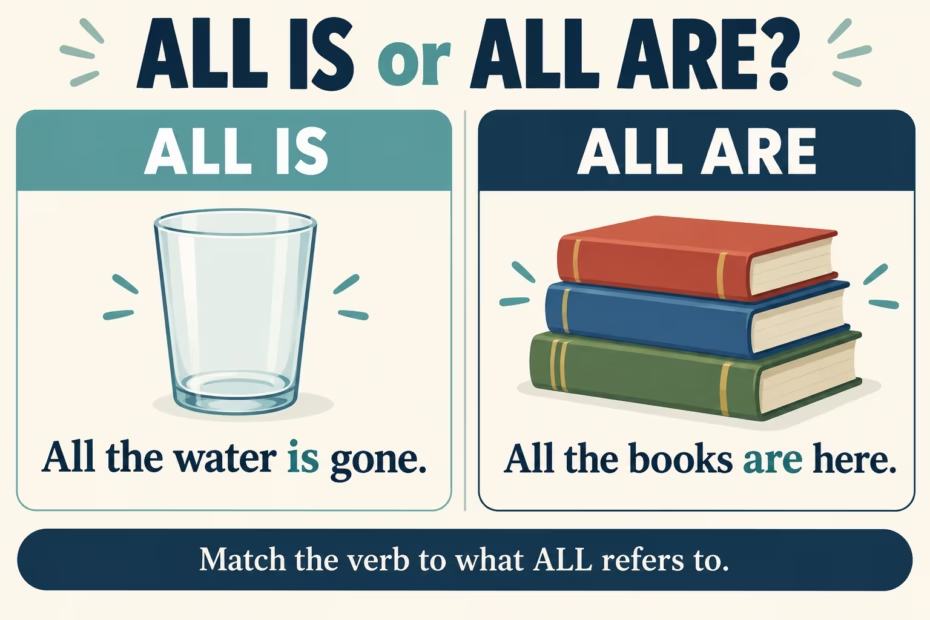
• Singular Nouns: When referring to a single entity, use “all is.” For example: “All the water is gone.” Here, “water” is singular, so it pairs with the singular verb “is.”
• Plural Nouns: If you are talking about multiple entities, go with “all are.” For instance: “All the books are on the shelf.” In this case, “books” is plural, so it matches with the plural verb “are.”
Remember, the distinction between “all is” and “all are” lies in whether the noun following “all” is singular or plural. Mastering this aspect of subject-verb agreement will enhance the clarity and correctness of your writing.
“All is” vs “All Are” – Understand With Example Sentences:
| All is | Meaning | All are | Meaning |
|---|---|---|---|
| All is fair in love and war. | Anything goes in matters of love and conflict. | All are invited to join the book club. | Everyone is welcome to participate in the book club. |
| All is well that ends well. | Everything turns out fine if the outcome is positive. | All are accounted for in the attendance list. | Everyone’s presence is recorded on the attendance list. |
| All is forgiven; let’s move on. | Everything is pardoned, and it’s time to progress. | All are required to complete the assignment by Friday. | Everyone is expected to finish the assignment by Friday. |
| All is quiet on the western front. | Everything is calm or peaceful in that area. | All are necessary components of a balanced diet. | Every component is essential for a balanced diet. |
| All is lost if we don’t act quickly. | Everything will be lost if action is not taken promptly. | All are encouraged to bring a dish to the potluck dinner. | Everyone is encouraged to contribute a dish to the potluck dinner. |
| All is not as it seems at first glance. | Things are not exactly what they appear to be initially. | All are responsible for their own actions. | Everyone is accountable for their actions. |
| All is revealed in due time. | Everything will be disclosed at the appropriate time. | All are eligible to vote in the upcoming election. | Everyone is qualified to vote in the upcoming election. |
| All is calm after the storm. | Everything is peaceful or calm following a period of turmoil. | All are expected to adhere to the dress code. | Everyone is expected to follow the dress code. |
| All is quiet on the home front. | Everything is peaceful or calm within the household. | All are invited to participate in the charity fundraiser. | Everyone is invited to take part in the charity fundraiser. |
| All is revealed in the final chapter of the book. | Everything is disclosed or explained in the last chapter. | All are welcome to express their opinions freely. | Everyone is encouraged to voice their opinions freely. |
| All is silent in the dark of the night. | Everything is quiet during the darkness of the night. | All are required to complete the safety training course. | Everyone is obligated to finish the safety training course. |
| All is accounted for in the financial report. | Everything is included and documented in the report. | All are encouraged to attend the community meeting. | Everyone is encouraged to attend the community meeting. |
| All is revealed during the climactic scene of the movie. | Everything becomes clear in the most intense scene. | All are present and ready for the team meeting. | Everyone is here and prepared for the team meeting. |
| All is silent in the cemetery at night. | Everything is quiet within the cemetery during nighttime. | All are expected to contribute to the group project. | Everyone is anticipated to contribute to the group project. |
| All is calm on the surface, but there’s tension underneath. | Everything appears peaceful, but there are underlying issues. | All are included in the employee benefits package. | Everyone is covered by the employee benefits package. |
| All is set for the grand opening ceremony tomorrow. | Everything is ready for the grand opening ceremony tomorrow. | All are invited to attend the farewell party. | Everyone is invited to come to the farewell party. |
| All is revealed in the final moments of the play. | Everything is disclosed or explained in the concluding scenes. | All are encouraged to voice their concerns at the town hall. | Everyone is encouraged to express their concerns at the town hall. |
| All is quiet in the library during study hours. | Everything is silent within the library during designated times. | All are expected to complete the online training module. | Everyone is expected to finish the online training module. |
| All is revealed in the last episode of the TV series. | Everything becomes clear in the final episode of the TV series. | All are welcome to use the shared workspace. | Everyone is welcome to utilize the shared workspace. |
| All is well in the household since the new nanny arrived. | Everything is going smoothly since the new nanny started. | All are required to submit their proposals by noon. | Everyone is obligated to submit their proposals by noon. |
The above table will help you understand if “all are correct” or “all is correct” based on situation.
Examples of Correct Usage
“All is” with Singular Nouns
When using “all is,” it’s essential to match it with singular nouns. For instance, if I want to describe a singular noun like “book,” I can construct a sentence like, “All the book is on the shelf.” Here, the singular noun “book” aligns with the singular verb “is.” This ensures proper subject-verb agreement.
“All are” with Plural Nouns
On the other hand, when dealing with plural nouns, it’s appropriate to employ “all are.” For example, suppose I’m referring to a plural noun like “flowers.” In that case, I could say, “All the flowers are blooming beautifully.” Here, the plural noun “flowers” pairs correctly with the plural verb “are,” maintaining grammatical accuracy.
How to use “all is” and “all are” properly?
“All is” and “all are” are both phrases used in English to describe states of being or conditions, but they are used in slightly different contexts.
- All is:
- All are:
It’s important to note that “all” itself is often treated as a singular pronoun in some contexts and as a plural pronoun in others. Therefore, whether to use “all is” or “all are” depends on whether “all” is being treated as singular or plural in the specific context of the sentence.
All Is or All Are? The Fast Rule
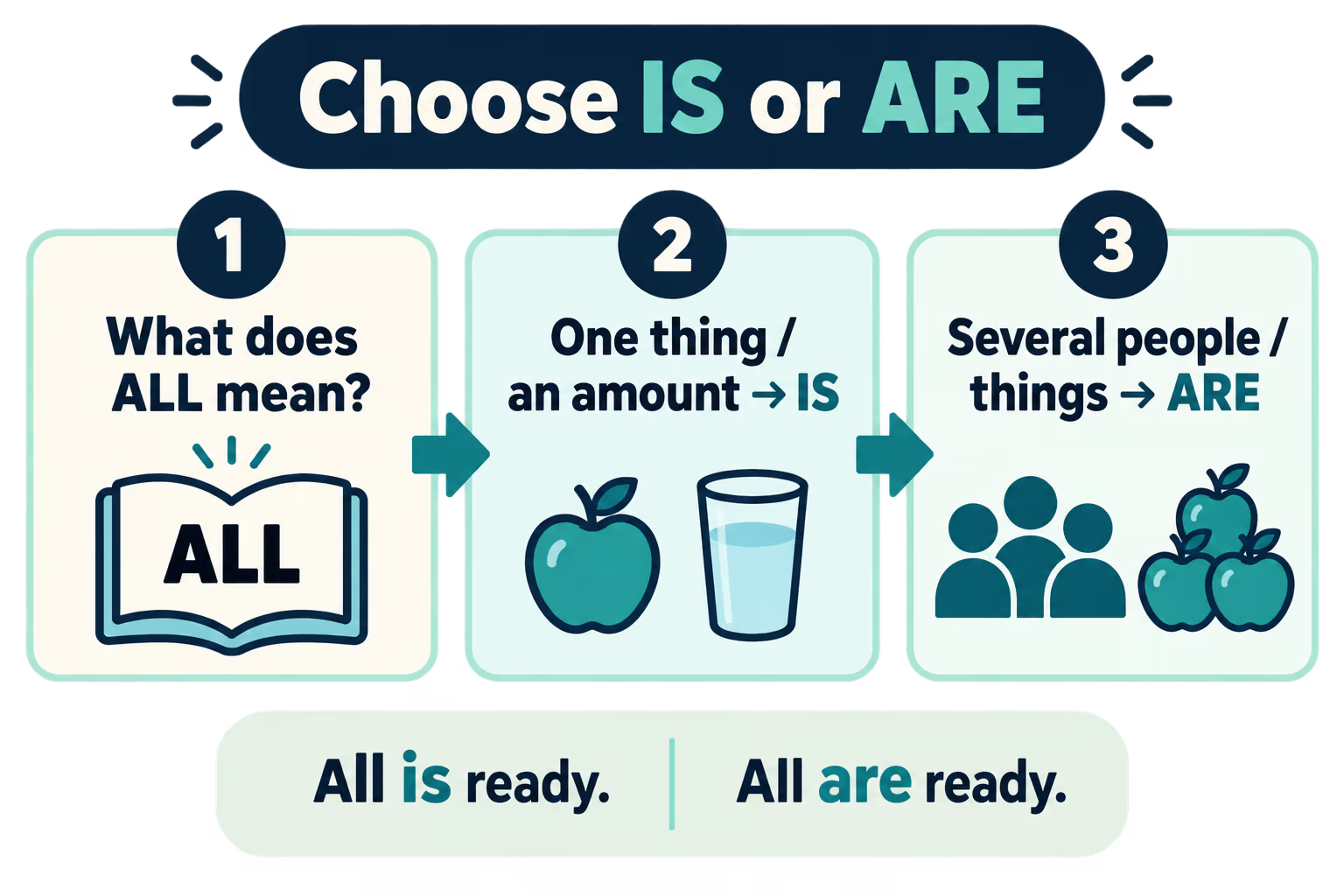
Choose the verb by identifying what all refers to. With a singular or uncountable noun, use is; with a plural noun or plural pronoun, use are. When all stands alone and means “everything,” use is. This matches the general subject–verb agreement rule: the verb agrees with the subject’s number, not with a nearby word. Purdue OWL gives the same principle for sentences such as “All of the books … are in that box.”
| What “all” refers to | Verb | Example |
|---|---|---|
| One whole thing | is | All of the cake is gone. |
| An uncountable amount | is | All the information is useful. |
| Several countable things | are | All the files are saved. |
| Several people or plural pronouns | are | All of them are ready. |
| “Everything” (all used alone) | is | All is well. |
How to Choose the Correct Verb
- Find the subject. In “All of the letters are here,” the subject is the phrase “all of the letters.”
- Ask what “all” covers. Is it one whole amount, or a set of separate items or people?
- Check the noun or pronoun. A singular or uncountable noun takes is; a plural noun or pronoun takes are.
- Ignore intervening phrases. “All of the letters in the envelope are signed.” The verb agrees with “letters,” not the singular noun “envelope.”
Examples With Countable and Uncountable Nouns
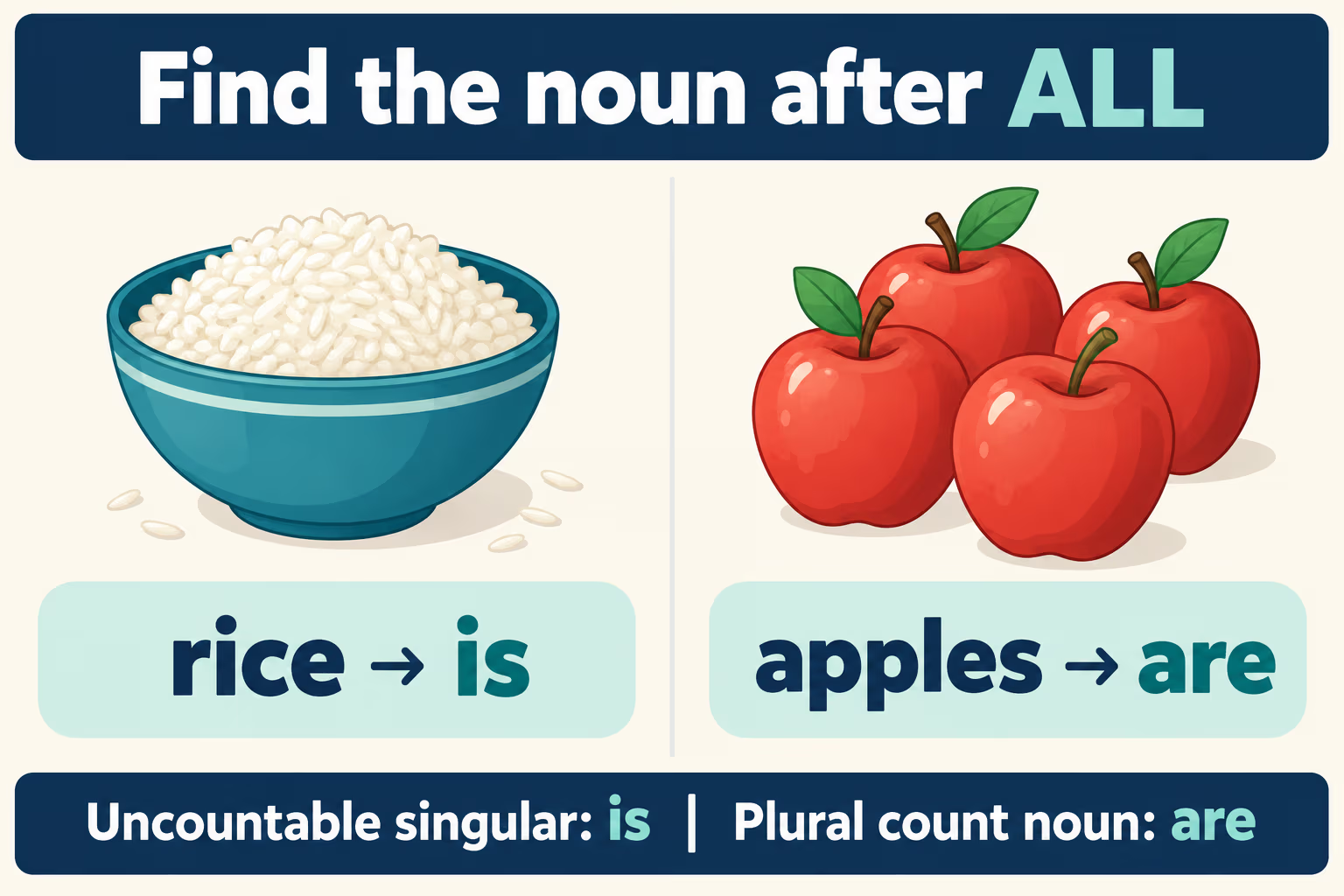
Countable nouns have singular and plural forms: apple/apples, book/books, and idea/ideas. In a sentence with all, the plural form normally takes are: “All the apples are ripe,” “All the books are on the table,” and “All the ideas are worth discussing.”
Uncountable nouns name things treated as a mass rather than as separate units, such as water, furniture, equipment, and information. They normally take is: “All the water is cold,” “All the furniture is new,” and “All the information is accurate.” To count portions, add a countable unit: “All three bottles of water are cold.” Here, bottles is plural, so the verb is are.
All Is vs. All Are With “Of”
The phrase all of does not determine the verb by itself. Look at the noun or pronoun after it:
- All of the soup is in the pot. (soup is uncountable.)
- All of the plates are clean. (plates is plural.)
- All of us are invited. (us refers to multiple people.)
- All of it is ready. (it is singular.)
With a determiner such as the, my, or these, of is often optional: “all the books” and “all of the books” are both correct. Cambridge Dictionary’s grammar guidance likewise distinguishes all with plural and uncountable nouns from every with singular nouns.
When “All” Means “Everything”
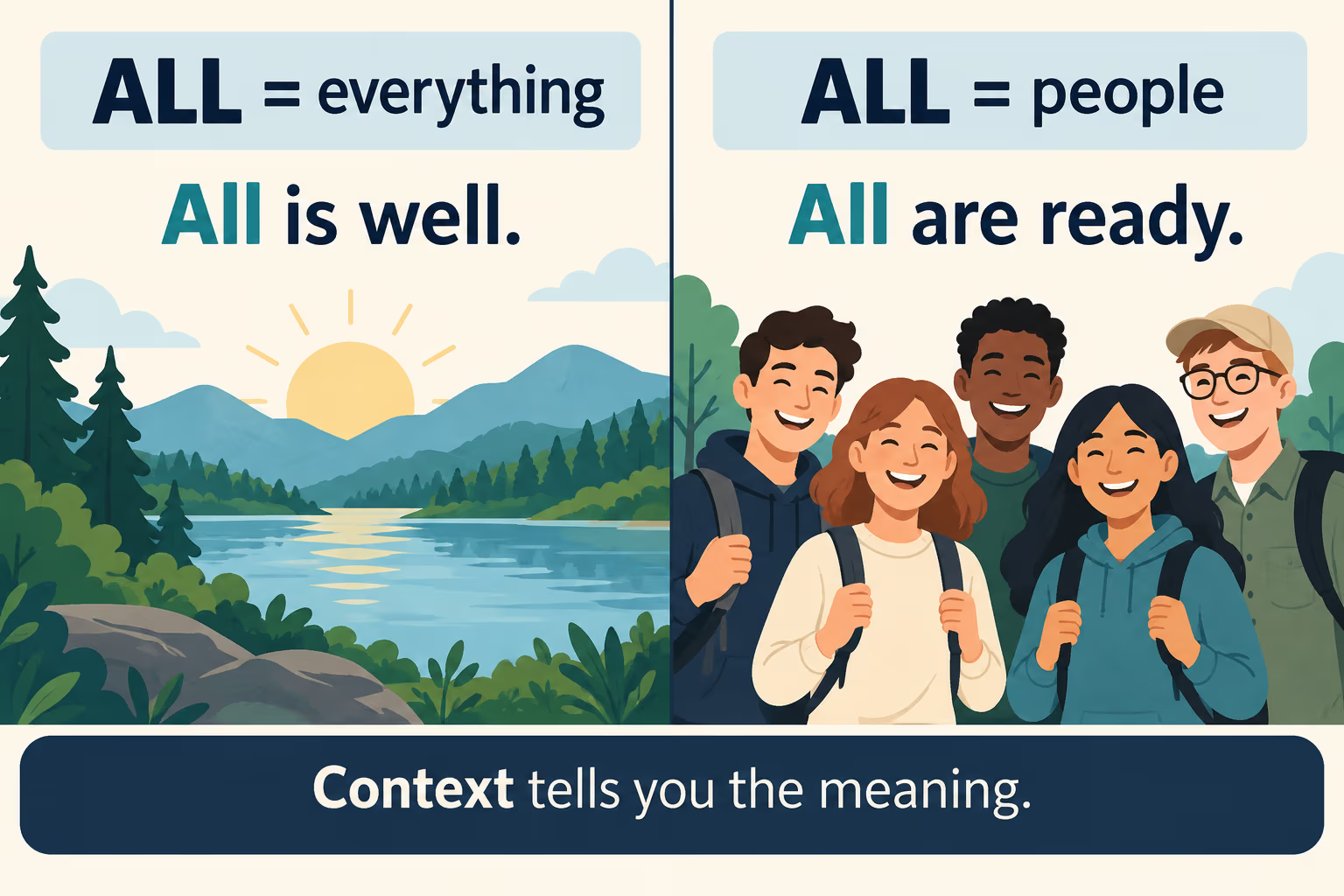
Sometimes all stands alone as an indefinite pronoun and means “everything” or “the only thing.” In this use it is treated as singular: “All is quiet,” “All is forgiven,” and “All that matters is your safety.” The verb remains singular even when a plural noun appears later in the sentence: “All that remains is to review the final draft.”
If all means several people or things, use a plural verb: “All are welcome,” “All are accounted for,” and “All are responsible for their own work.” The surrounding context tells the reader whether all means everything as a whole or all members of a group.
Common Mistakes to Avoid
- Do not put “all” before a singular count noun by itself. “All the book is here” is not the intended standard form. Write “the whole book is here” or “all of the book is here.” “All the books are here” is correct.
- Do not let the nearest noun trick you. In “All of the water in the bottles is cold,” the subject is the uncountable noun water; bottles is inside a modifying phrase. Conversely, “All of the bottles of water are cold” has plural bottles as its head noun.
- Do not confuse “all” with “every.” Use “all the students are” or “every student is.” Avoid “every students” and “all student” when you mean the full group.
- Do not automatically use “are” because several people are implied. “All is well” is correct when all means “everything”; “all are well” refers to a group of people and emphasizes each person.
Frequently Asked Questions
Is “all is” correct?
Yes. Use all is when all refers to one whole thing, an uncountable amount, or “everything”: “All the milk is gone,” “All of the work is finished,” and “All is well.”
Is “all are” correct?
Yes. Use all are for plural count nouns and plural pronouns: “All the guests are here” and “All of them are ready.”
Should I write “all of the people is” or “all of the people are”?
Write “all of the people are.” People is plural, so it takes are. You can also write “all the people are.”
Is “all of the information are” correct?
No. Information is uncountable in standard English, so write “all of the information is.” For separate facts, you can say “all the facts are.”
What is the difference between “all is ready” and “all are ready”?
“All is ready” means everything is ready. “All are ready” means all the people or things in a group are ready. Name the group if context is unclear: “All the guests are ready.”
Sources and Further Reading
- Cambridge Dictionary, “All or every?” — how all pairs with plural and uncountable nouns.
- Cambridge Dictionary, “All” — uses and placement of all in English.
- Purdue OWL, “Making Subjects and Verbs Agree” — subject–verb agreement, including “all of the books … are.”
Conclusion
Understanding the correct usage of “all is” and “all are” is crucial for maintaining proper subject-verb agreement in writing. By using “all is” with singular nouns and “all are” with plural nouns, we ensure grammatical accuracy in our sentences.
This distinction may seem subtle, but it plays a significant role in enhancing the clarity and coherence of our writing. Remembering to apply these rules correctly will help you communicate your ideas effectively and showcase your mastery of English grammar. Keep practicing and refining your skills to become more confident in using these expressions accurately in your writing.


