
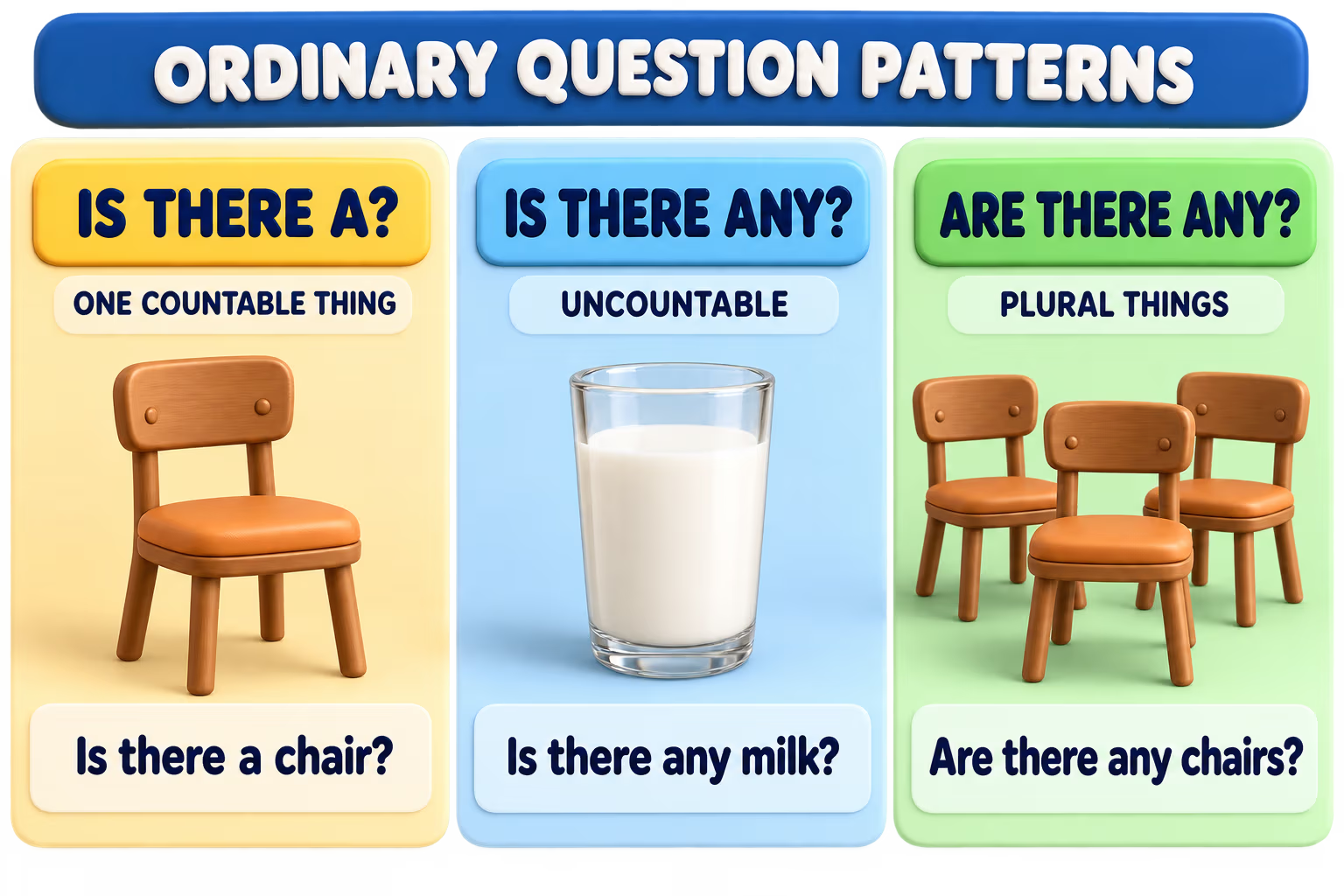
Use “Is there a” before one singular countable noun (“Is there a chair?”), “Is there any” in neutral questions about uncountable nouns (“Is there any milk?”), and “Are there any” before plural countable nouns (“Are there any chairs?”). The verb matches the noun after there; singular count nouns usually use a/an, while any has other special uses.
At a Glance
- Use is there a/an to ask about one singular countable item.
- Use is there any with an uncountable noun in a neutral availability question.
- Use are there any with plural countable nouns in open existence questions.
- The noun after there controls is or are; any does not control agreement.
- Singular any can have the separate meaning “no matter which,” as in “Any chair will do.”
How Do You Choose the Right Form?
Match the verb and determiner to the noun you mean: use is for one singular countable noun or an uncountable noun, and are for a plural countable noun. In neutral questions about one countable item, use a or an; use any for uncountable or plural nouns.
| Question pattern | Noun type | Example | Agreement |
|---|---|---|---|
| Is there a/an …? | One singular countable noun | Is there a chair? | Singular is |
| Is there any …? | Uncountable noun | Is there any milk? | Singular is |
| Are there any …? | Plural countable noun | Are there any chairs? | Plural are |
When Can Any Come Before a Singular Noun?
Singular any is possible when it means “no matter which,” as in “Any chair will do.” That strong choice meaning differs from a neutral question asking whether at least one particular chair exists, where “Is there a chair?” is clearer. Cambridge Grammar distinguishes strong and weak uses of any; its ordinary quantity use is not generally paired with singular countable nouns.
How Do Short Answers Match the Question?
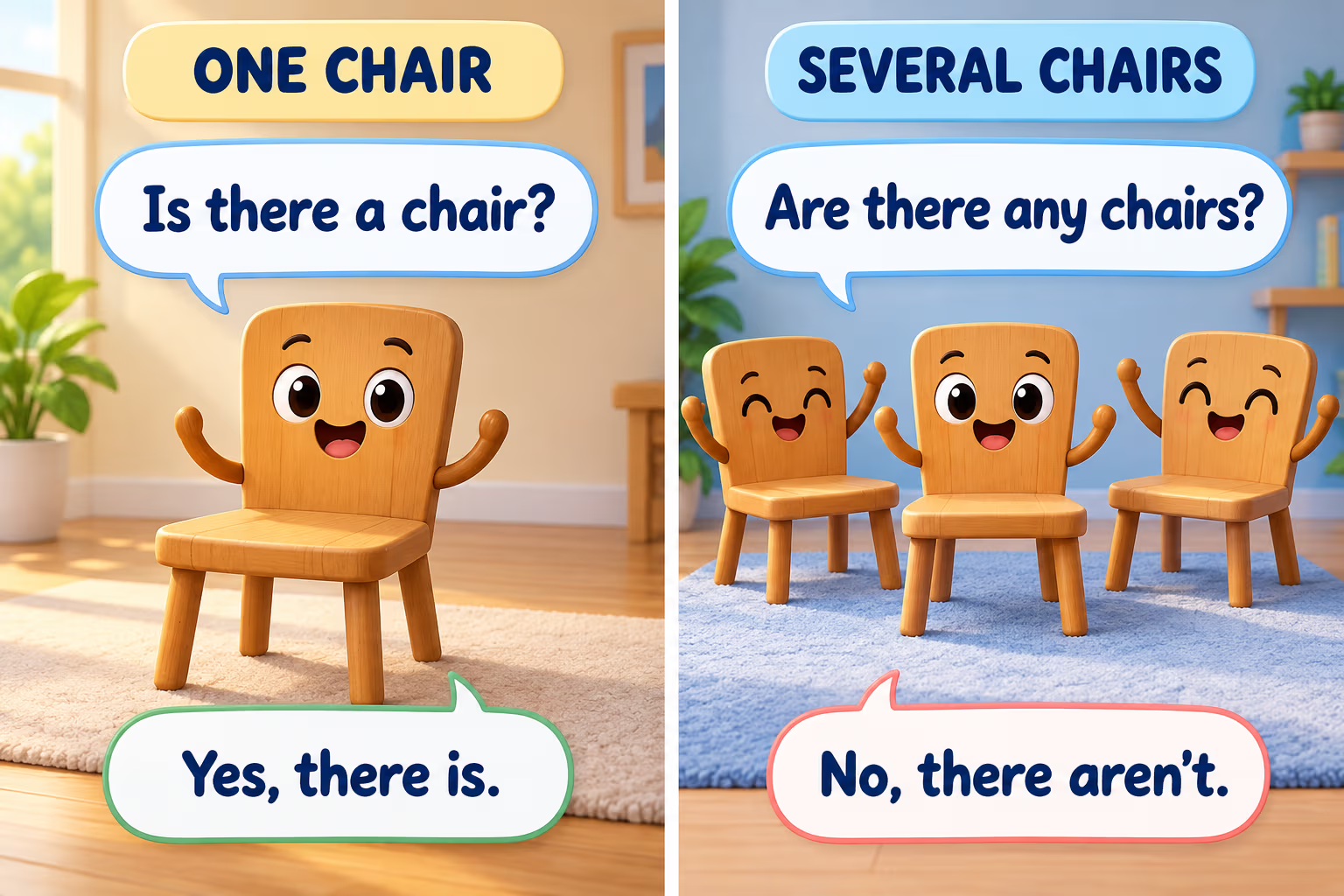
Repeat the singular or plural verb in the short answer: “Is there a chair?” takes “Yes, there is” or “No, there isn’t”; “Are there any chairs?” takes “Yes, there are” or “No, there aren’t.” The British Council’s guide to there is and there are gives the same agreement pattern.
For another subject–verb agreement example, see our guide to “Does anyone” or “Do anyone?”.
Curious about the correct usage of “is there a,” “is there any,” and “are there any”? Let me guide you through the nuances of these common phrases. Whether you’re unsure about singular or plural nouns, I’ve got you covered with clear explanations to help you navigate your sentences like a pro.
Understanding when to use “is there a” for singular nouns and “are there any” for plural nouns is key to crafting precise and effective sentences. Dive into this article to master the art of asking questions with confidence.
With examples and a breakdown of usage scenarios, you’ll soon be able to effortlessly choose between “is there a,” “is there any,” and “are there any” in your everyday conversations. Let’s unravel the mystery behind these common phrases together.
Understanding the Difference
Is There A
When using “Is there a,” it is crucial to remember to ask about the existence of a singular noun in a specific location. This phrase is suitable for inquiries where the focus is on a single, countable object. For example, “Is there a pen on the table?” directs attention to the presence of one pen in a particular spot. By utilizing “Is there a” correctly, you can effectively pinpoint the singular item you are referring to.
Is There Any
On the other hand, “Is there any” is employed to ascertain the presence of either a singular countable noun or an uncountable one. This construction allows for flexibility, accommodating both quantifiable and non-quantifiable entities. For instance, “Is there any milk in the fridge?” addresses the availability of an uncountable substance, while “Is there any book in the library?” refers to a singular, countable item. Through the use of “Is there any,” you can inquire about a varied range of objects, regardless of their quantifiability.
Are There Any
Lastly, “Are there any” is reserved for situations involving plural countable nouns. By employing this phrase, you can effectively inquire about the presence of multiple countable items in a specific location. For instance, “Are there any apples in the basket?” examines the existence of multiple individual apples in a designated area. Utilize “Are there any” when seeking information about the presence of plural, countable objects, thereby achieving clarity and precision in your questions.
Examples of Usage
“Is There A” in Questions
When using “Is there a” in questions, it is essential to remember that this phrase is geared towards inquiring about the existence of singular countable nouns. For instance, one might ask, “Is there a pen on the table?” or “Is there a cat in the garden?” The focus here is on singular items or objects that can be counted individually.
“Is There A” Sentences:
- Is there a doctor in the house? We need medical assistance immediately.
- Is there a gas station nearby? My car’s running on empty.
- Is there a way to access this document without a password?
- Is there a supermarket around here? I need to grab some groceries.
- Is there a library on campus where I can study quietly?
- Is there a solution to this problem that doesn’t involve drastic measures?
- Is there a shortcut to reach the airport in time for my flight?
- Is there a manager available? I’d like to speak to someone in charge.
- Is there a hotel with vacancies for tonight?
- Is there a vegan option on the menu? I don’t eat meat.
- Is there a pharmacy nearby where I can fill this prescription?
- Is there a train that goes directly to downtown from here?
- Is there a meeting scheduled for today? I haven’t seen any notifications.
- Is there a gym in the vicinity where I can work out?
- Is there a tech support hotline I can call for assistance with my computer?
- Is there a problem with the internet connection? I can’t seem to access any websites.
- Is there a post office in town where I can mail this package?
- Is there a good restaurant that serves local cuisine in this area?
- Is there a lost and found department where I can inquire about my missing items?
- Is there a parking spot available near the entrance? I have difficulty walking long distances.
“Is There Any” in Questions
On the other hand, “Is there any” broadens the scope to include singular and uncountable nouns. This phrase is suitable for questions like “Is there any milk in the fridge?” or “Is there any sugar in the bowl?” It allows for a wider range of possibilities beyond just singular countable items when seeking information about the presence of something.
“Is There Any” Sentences:
- Is there any milk left in the fridge? I want to make a cup of tea.
- Is there any available seating in the restaurant? We didn’t make a reservation.
- Is there any chance of rain tomorrow? I need to plan my outdoor activities.
- Is there any information on the schedule for the event? I want to know the timings.
- Is there any Wi-Fi connection in this area? I need to check my emails.
- Is there any solution to this problem that doesn’t involve spending a lot of money?
- Is there any way to expedite the delivery of my package? It’s urgent.
- Is there any interest in joining the book club? We’re looking for new members.
- Is there any possibility of extending the deadline for the project? We need more time.
- Is there any available parking space near the office? I don’t want to be late.
- Is there any specific dress code for the party tonight? I want to dress appropriately.
- Is there any concern about the safety of this neighborhood? I’m new here.
- Is there any noise ordinance in this area? It’s quite loud at night.
- Is there any food left in the pantry? I’m feeling hungry.
- Is there any way to track the status of my online order? I haven’t received any updates.
- Is there any interest in organizing a charity event? It’s for a good cause.
- Is there any particular reason for the delay in the project? We need to address it.
- Is there any damage to the car after the accident? We should inspect it.
- Is there any way to improve the efficiency of our workflow? We’re falling behind.
- Is there any chance of rescheduling the meeting? I have a conflicting appointment.
“Are There Any” in Questions
Lastly, “Are there any” is specifically designed for plural nouns in questions. When using this phrase, one would inquire about the presence of multiple items or objects. Examples include “Are there any cars in the parking lot?” or “Are there any apples in the basket?” This term is ideal for scenarios where you are looking for more than one of something.
“Are There Any” Sentences:
- Are there any apples left in the basket? I want to make a fruit salad.
- Are there any available seats on the next flight to New York? I need to book a ticket.
- Are there any volunteers willing to help with the community cleanup? We need assistance.
- Are there any concerns about the safety of the new playground equipment? We should address them.
- Are there any hotels with vacancies for tonight? I didn’t make a reservation.
- Are there any questions about the instructions I just provided? I’m happy to clarify.
- Are there any updates on the progress of the construction project? We need to stay informed.
- Are there any vegetarian options on the menu? My friend doesn’t eat meat.
- Are there any issues with the website’s functionality? Users have reported some problems.
- Are there any available rental properties in the neighborhood? I’m looking to move.
- Are there any risks associated with the new investment strategy? We should evaluate them.
- Are there any discounts available for bulk purchases? We’re buying in large quantities.
- Are there any objections to the proposed changes to the company policy? We value your feedback.
- Are there any special requirements for attending the conference? I want to be prepared.
- Are there any side effects associated with this medication? I’m considering taking it.
- Are there any open positions at your company? I’m looking for employment opportunities.
- Are there any available appointments with the dentist this week? I need to schedule a check-up.
- Are there any conflicts of interest that need to be addressed before proceeding? Transparency is key.
- Are there any issues with the plumbing in the building? We’ve noticed some leaks.
- Are there any concerns about the impact of the new policy on employee morale? We should discuss them.
Common Mistakes to Avoid
Incorrect Usage of Is There A, Is There Any, Are There Any
Using these phrases incorrectly can lead to confusion in communication. One of the common mistakes to avoid is using “is there a” when asking about uncountable nouns. For instance, saying “Is there a water in the bottle” is incorrect because “water” is an uncountable noun. The correct way to phrase this question would be “Is there any water in the bottle.”
Another error is not using “are there any” with plural nouns. For example, asking “Is there any apples in the basket” is incorrect. Since “apples” is a plural noun, the proper way to ask this question would be “Are there any apples in the basket.”
It’s crucial to remember the specific usage of each phrase to ensure clarity and accuracy in your questions.
Not Using Any with Plural Nouns
Another mistake to avoid is forgetting to use “any” when referring to plural nouns. When asking about the existence of multiple items, always remember to include “any” in your questions. This error commonly occurs when asking questions about the presence of more than one item but failing to use “any” appropriately.
By recognizing and rectifying these mistakes, you can enhance your proficiency in using “is there a,” “is there any,” and “are there any” effectively in English grammar.
Conclusion
Mastering the correct usage of “Is there a,” “Is there any,” and “Are there any” is crucial for effective communication. By understanding the nuances of these phrases and avoiding common mistakes, you can enhance your proficiency in English grammar. Remember to use “Is there a” with singular countable nouns, “Is there any” with uncountable nouns, and “Are there any” with plural nouns. Including “any” when referring to plural nouns is key to ensuring clarity and precision in your questions. With practice and attention to detail, you can confidently navigate these structures and convey your thoughts accurately. Keep honing your language skills to communicate more effectively in both spoken and written English.
Clarifications for the Examples Above
About “Is there any book?” For a neutral question meaning “Does at least one book exist?”, “Is there a book?” is the usual choice. “Any” before a singular count noun is possible with a choice meaning (“Any book will do”) or in a marked context; it should not be presented as the routine equivalent of a.
About “a water.” When water means the liquid, it is uncountable: ask “Is there any water?” or count a container, as in “Is there a glass of water?” Cambridge labels water uncountable in its ordinary liquid sense.
About “always use any” with plural nouns. Any is common in open availability questions (“Are there any chairs?”), but it is not required with every plural noun: “Are there three chairs?” is also correct. The British Council explains any with plural countable nouns and uncountable nouns, alongside other question forms.
Frequently Asked Questions
Is “Is there any” correct with a singular noun?
In a neutral question asking whether an ordinary countable item exists, “Is there a/an …?” is the clearest standard choice: “Is there a chair?” Weak any normally goes with uncountable or plural count nouns. Singular any works in the separate sense “no matter which,” as in “Any chair will do.”
Should I use “is there” or “are there” before any?
Look at the noun after any, not at any itself. Use “Is there any water?” for an uncountable noun and “Are there any chairs?” for a plural countable noun. Any does not decide singular or plural agreement; the following noun does.
Can “some” replace “any” in questions?
Yes. Any is common in neutral availability questions, while some is natural in offers, requests, and questions where the speaker expects or hopes for yes: “Would you like some tea?” and “Could I have some water?” Choose the determiner for the conversational purpose, not simply because the sentence is a question.
How do you answer an “Is there any” question?
Match the short answer to the noun: “Is there any milk?” takes “Yes, there is” or “No, there isn’t.” Milk is uncountable in this sense, so the verb is singular. For a plural noun, answer “Are there any chairs?” with “Yes, there are” or “No, there aren’t.”
Is “Is there a water?” correct?
When water means the liquid, use “Is there any water?” because the noun is uncountable. To count a quantity, name its container or measure: “Is there a glass of water?” or “Are there two bottles of water?” Cambridge marks the ordinary liquid sense of water as uncountable.


