
“In bed” describes the familiar resting or sleeping place, whether someone is awake or asleep; “on the bed” places a person or object on the mattress or covers. In ordinary sentences, “on bed” usually needs a determiner: write “on the bed,” “on a bed,” or “on my bed.”
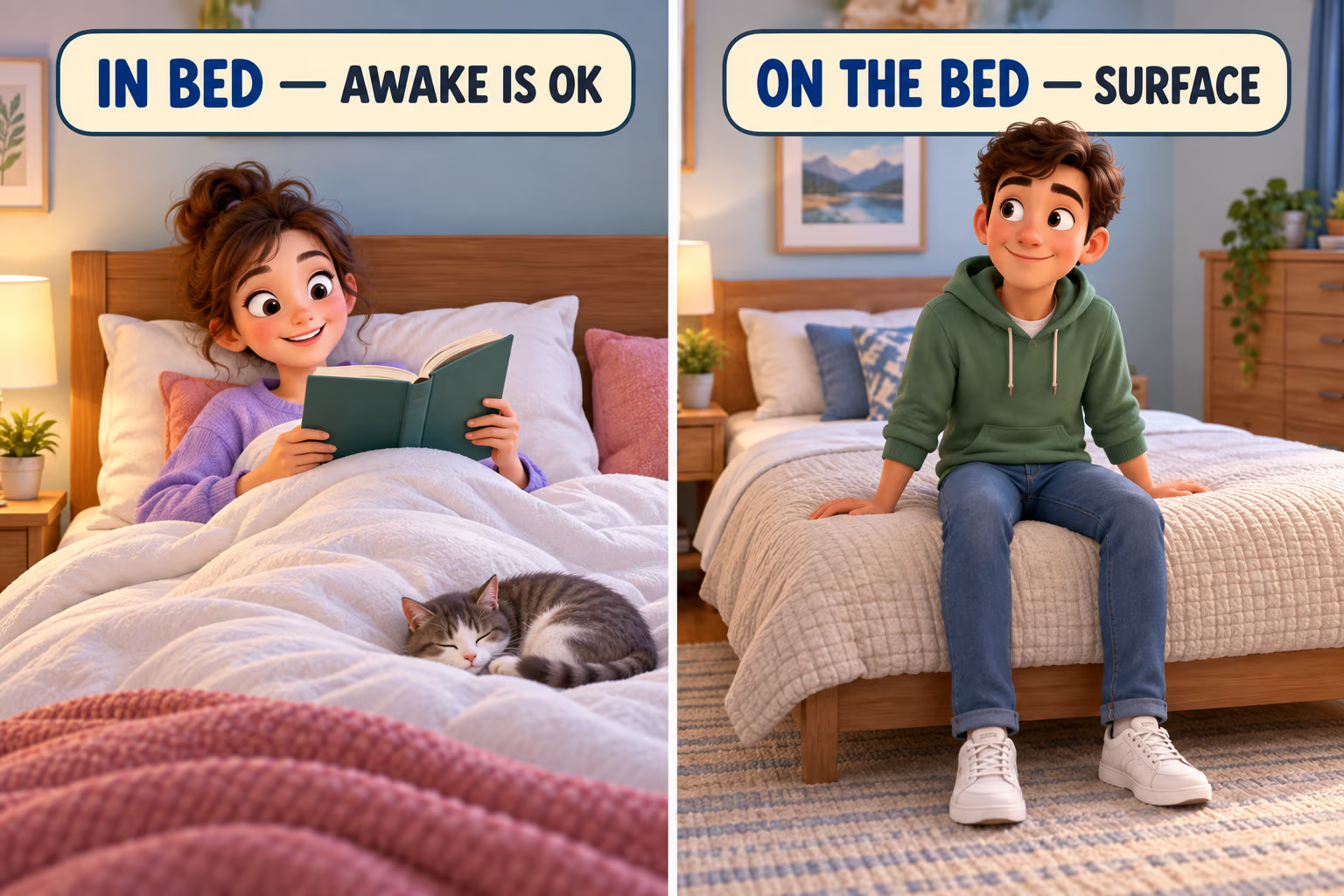
In Bed or On the Bed? Quick Answer
- Use in bed for the customary place or state of resting: “I read in bed before sleep.”
- Use on the bed for a literal position on its surface: “The book is on the bed.”
- Use an article or possessive with ordinary surface examples: on a bed, on the bed, or on my bed.
- In the bed can mean within or among the bedding of a particular bed; context decides whether that wording is useful.
When it comes to discussing the position of a bed in relation to a person, the choice between “on bed” and “in bed” can sometimes be a bit confusing. In this article, I’ll delve into the nuances of these phrases and clarify when to use each one. Whether you’re describing someone sleeping peacefully under the covers or sitting on top of the bed while getting ready for the day, understanding the distinction between “on bed” and “in bed” is crucial for clear communication.
We often use “in bed” to talk about activities related to sleeping, like drifting off to dreamland or enjoying a lazy morning. On the other hand, “on bed” is commonly used for activities such as sitting, reading a book, or placing objects on the bed. By exploring the grammatical differences and practical applications of these phrases, we can enhance our language skills and express ourselves more effectively.
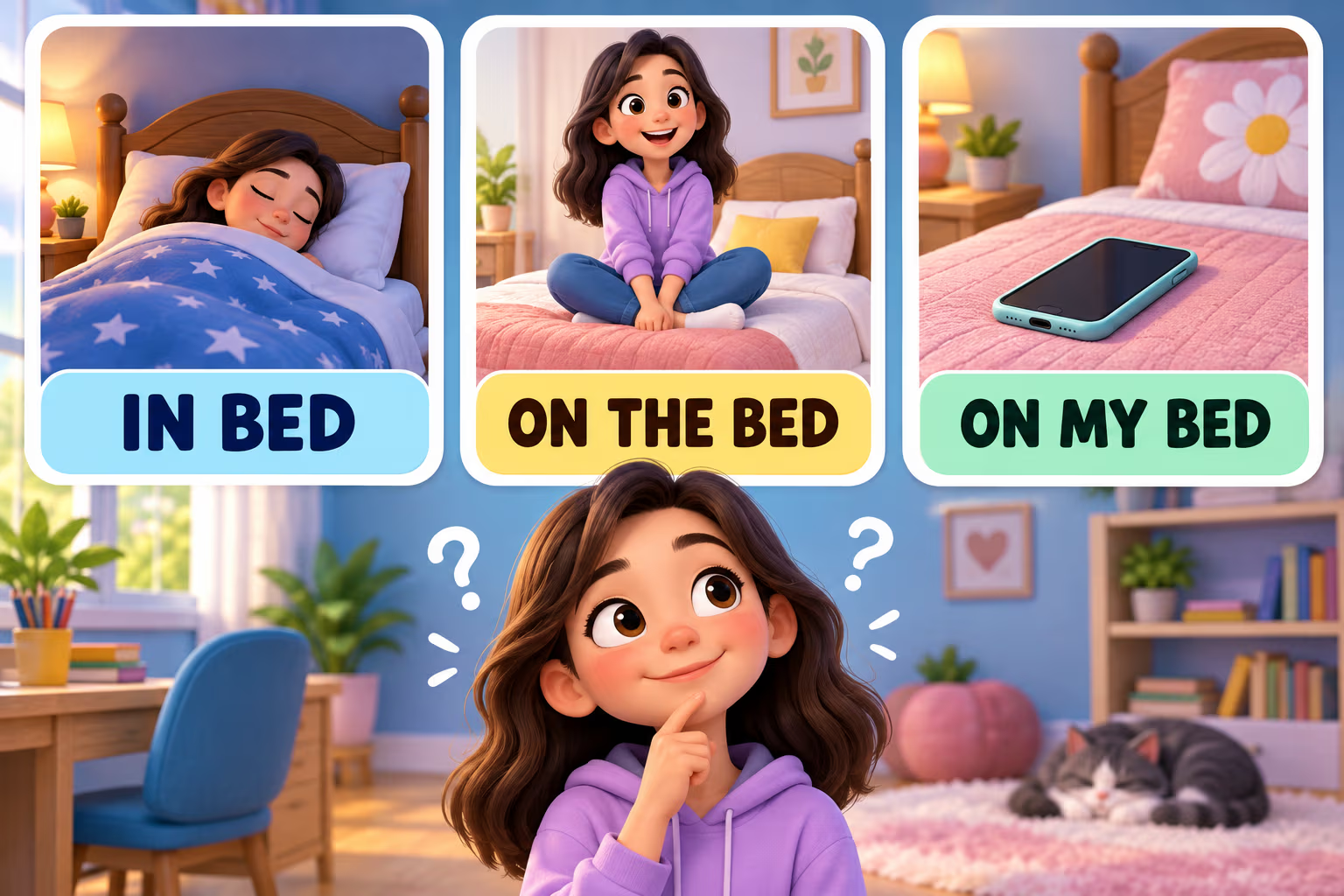
The distinction is about how the speaker frames the bed, not simply whether someone is sleeping. This visual compares an idiomatic resting phrase with literal surface descriptions; the article below explains when the article the or a possessive such as my is needed.
On Bed or In Bed: Where to Use What
Understanding the Difference
When it comes to using “on bed” or “in bed,” the key lies in understanding the nuances of each phrase. “In bed” typically describes being physically underneath the covers of a bed, often associated with sleeping activities. On the other hand, “on bed” refers to being physically on top of the bed, whether sitting, lying down, or placing objects on it. The distinction stems from the prepositions used, with “in” indicating inside and “on” indicating physical contact with something.
Common Usage of “On Bed” and “In Bed”
In everyday language, “in bed” is commonly used to denote sleeping activities like “I fell asleep in bed” or “I spend the whole day in bed.” Conversely, “on bed” is more often used to describe non-sleeping activities such as “I sat on the bed while putting on my shoes” or “I read a book on the bed.” Moreover, “on bed” can also refer to objects resting on the bed, like “I left my phone on the bed.”
Examples of Correct Usage
To illustrate further, here are a few examples of using “on bed” and “in bed” correctly:
- “I slept in bed last night.” (Correct – referring to being under the covers)
- “I placed my bag on the bed.” (Correct – indicating the bag is physically on top of the bed)
- “She enjoys reading in bed.” (Correct – describing an activity related to being under the covers)
- “The cat jumped on the bed.” (Correct – showing the physical action of the cat being on top of the bed)
Remember, using the appropriate phrase enhances clarity and ensures effective communication where on bed and in bed are concerned.
When to Use “On Bed”
Situations and Contexts
I always turn to “on bed” when describing scenarios that involve physical contact with the bed or when things are resting on top of it. Here are some common situations and contexts where “on bed” is the appropriate choice:
- Sitting on the Bed: Whether it’s putting on shoes, reading a book, or just relaxing, if you are physically seated or lying down on the bed’s surface, it’s “on bed.”
- Objects Resting on the Bed: If you mention items like a phone, laptop, or clothes that are placed on top of the bed, the correct preposition is “on.”
- Engaging in Non-Sleep-Related Activities: Any activity that doesn’t involve sleeping but occurs while physically on the bed falls under “on bed.”
Remember, “on bed” emphasizes physical contact and placement on the bed’s surface, making it crucial for clear communication.
When to Use “In Bed”
Situations and Contexts
I always opt for using “in bed” when describing activities directly related to sleeping. It’s the go-to phrase when you want to convey that you are physically located under the covers of a bed, cozy and ready to catch some Z’s. Whether it’s drifting off to dreamland or lazing around on a lazy Sunday morning, “in bed” perfectly captures that snug feeling of being tucked in and relaxed.
Clarifying Position
In written or verbal communication, clarity is key. So, whenever I’m discussing someone’s sleeping habits or routines, I make sure to use “in bed” to avoid any confusion. This phrase not only ensures that the listener or reader understands the precise position but also paints a picture of leisure and comfort associated with resting or sleeping. Whether it’s a quick nap or a full night’s sleep, “in bed” conveys that sense of being cocooned in blankets and pillows, enjoying a moment of peace and relaxation.
What Is the Difference Between “In Bed” and “On the Bed”?
In bed treats the bed as a place for resting, sleeping, or spending time there; on the bed describes a position on the physical surface. Oxford Learner’s Dictionary illustrates on the bed as being on top of the covers and in bed as the familiar resting position under covers. These are useful defaults, not a rule that a person must be asleep for in bed.
| Phrase | What it emphasizes | Natural example |
|---|---|---|
| in bed | The customary place or state of rest; the person may be awake | She read in bed for twenty minutes. |
| on the bed | A person or thing on a particular bed’s surface | She sat on the bed to tie her shoes. |
| on a bed | A surface position on any one, not-yet-identified bed | The guest placed her suitcase on a bed. |
| on my bed | A surface position on the speaker’s bed | My clean laundry is on my bed. |
| in the bed | Inside or among the bedding of a particular bed | The kitten was hiding in the bed under the blanket. |
English uses on for surface location and in for an enclosed or treated-as-contained place, as the British Council’s preposition guide explains. The bed contrast also includes an idiomatic use: in bed can describe the activity or state associated with the furniture, much like go to bed, stay in bed, and breakfast in bed.
Why Is “On Bed” Usually Incomplete?
In a normal sentence about bedroom furniture, use a determiner before singular bed after on. Choose the for a bed both people can identify, a for any one bed, or a possessive/demonstrative such as my, this, or that: “The cat is on the bed,” “A jacket is on a bed,” and “Your keys are on my bed.” Cambridge’s guide to a, an, and the explains article use with nouns; the no-article phrase in bed is a conventional expression, not a general rule for on.
The no-article pattern in in bed is a conventional expression for using the bed as a resting place. It is not a general rule that bed never needs an article. Compare go to bed with sit on the bed and buy a bed. A fixed compound such as bed rest is a separate construction; it does not make “I sat on bed” a standard surface-location sentence.
Short headings, inventory labels, or notes sometimes omit function words, so a label such as “phone on bed” can occur as compressed shorthand. In complete, edited prose, restore the determiner. This is especially helpful for English learners because leaving it out can make an otherwise clear sentence sound translated or unfinished.
Does “In Bed” Mean Someone Is Asleep?
No. In bed can refer to someone resting or spending time in bed while awake: “I answered a few emails in bed,” or “He had breakfast in bed.” Cambridge’s bed entry gives breakfast in bed as a natural example. If the point is only where someone is physically positioned, on the bed is more literal and specific.
Likewise, in bed does not require a person to be tightly tucked under blankets. The expression can describe someone who has gone to bed, is resting there, or has not yet got up. Use extra detail when the exact physical position matters: “She was under the duvet,” “She was sitting on top of the covers,” or “She was beside the bed.”
When Should You Say “In the Bed”?
In the bed points more directly to a particular bed as a physical container or location, often because the sentence describes an object or something among the bedding. “The remote fell in the bed between the pillows” is possible when it ended up among the covers. “The baby is in the bed” can identify which location the baby occupies. In contrast, “the baby is in bed” presents bed as the customary resting place.
The distinction is one of emphasis, not an absolute boundary: context can make a specific bed clear even without the, and speakers may choose in the bed for contrast or clarity. If the object is plainly on top, use on the bed; if it is under the covers or among bedding, in the bed may describe its location more precisely.
How Can You Choose the Right Bed Phrase?
Choose the phrase by deciding whether the sentence names a resting situation, a surface, or a location among the bedding. This three-step check works for most everyday examples:
- If you mean the familiar activity or state of resting there, use in bed: “The child stayed in bed with a book.”
- If you mean something supported by the mattress or covers, use on plus a determiner: “The book is on the bed.”
- If you mean something within the bedding of an identified bed, use in the bed when that detail matters: “The phone slipped in the bed under the blanket.”
For a nearby position, choose beside the bed or at the bedside, not on the bed. For a location in the room, write in the bedroom. The preposition changes with the relationship being described, so replacing every phrase with a simple “inside versus on top” rule can lead to awkward examples.
Should You Write “Lie in Bed” or “Lay in Bed”?
For present-time reclining, write lie in bed; the past tense of this verb is lay. The separate verb lay means “put or place” and takes an object. Cambridge explains the difference in its guide to lie or lay:
| Meaning | Present | Past |
|---|---|---|
| Recline (no direct object) | I lie in bed when I feel ill. | I lay in bed yesterday. |
| Put something down (takes an object) | I lay the book on the bed. | I laid the book on the bed. |
The quick test is to ask whether someone is reclining or placing an item. “She lay on the bed and read” uses the past of lie; “She laid her book on the bed” uses the past of lay. For more examples, see our guide to sentences with “lie down.”
Common Sentence Examples
| Intended meaning | Use | Example |
|---|---|---|
| Resting place | in bed | I was in bed by ten, but I was still reading. |
| Surface of a known bed | on the bed | Please leave the folded towels on the bed. |
| Any bed, not yet specified | on a bed | The visitor set her bag on a bed in the guest room. |
| Owner’s bed | on my bed | My glasses are on my bed somewhere. |
| Among the covers | in the bed | The cat burrowed in the bed beneath the quilt. |
| Beside the furniture | by the bed | A glass of water was waiting by the bed. |
For a broader refresher on location words such as in, on, and at, read our guide to prepositions of place. Keep the complete phrase together as you proofread: the preposition, noun, and determiner jointly express the relationship.
Table to Understand The Situation Better
Usage note before the preserved table: many entries below use bare on bed in ordinary sentences. That wording is generally not standard when referring to one piece of bedroom furniture; use on the bed, on a bed, or on my bed. Oxford Learner’s Dictionary models on the bed for the top of the covers and in bed for the customary resting place. The source table is retained unchanged, so read its surface examples with the missing determiner supplied. Its short glosses for in bed are also simplified: the phrase does not always mean that an object is literally inside the mattress or that a person is asleep.
| On Bed | In Bed | Meaning (On Bed) | Meaning (In Bed) |
|---|---|---|---|
| She’s lying on bed | She’s lying in bed | She’s in a horizontal position | She’s resting or sleeping in bed |
| He’s reading on bed | He’s reading in bed | He’s reading while situated on bed | He’s reading while comfortably in bed |
| The cat is sleeping on bed | The cat is sleeping in bed | The cat is resting or napping | The cat is resting or sleeping in bed |
| I left my phone on bed | I left my phone in bed | The phone is placed on the bed | The phone is placed inside the bed |
| She’s sitting on bed | She’s sitting in bed | She’s seated on the bed | She’s seated comfortably in bed |
| The book is resting on bed | The book is resting in bed | The book is placed on the bed | The book is placed comfortably in bed |
| He’s eating on bed | He’s eating in bed | He’s consuming food while on bed | He’s consuming food comfortably in bed |
| I found my keys on bed | I found my keys in bed | The keys were discovered on the bed | The keys were found within the bed |
| She’s working on bed | She’s working in bed | She’s doing work while on bed | She’s doing work comfortably in bed |
| The kids are playing on bed | The kids are playing in bed | The kids are engaged in play on bed | The kids are playing comfortably in bed |
| I placed the clothes on bed | I placed the clothes in bed | The clothes are situated on the bed | The clothes are placed within the bed |
| He’s lying on bed | He’s lying in bed | He’s in a horizontal position | He’s resting or sleeping in bed |
| The laptop is sitting on bed | The laptop is sitting in bed | The laptop is placed on the bed | The laptop is placed comfortably in bed |
| She’s writing on bed | She’s writing in bed | She’s writing while on bed | She’s writing comfortably in bed |
| I left the bag on bed | I left the bag in bed | The bag is placed on the bed | The bag is placed within the bed |
| The dog is resting on bed | The dog is resting in bed | The dog is relaxing or napping | The dog is relaxing or sleeping in bed |
| He’s sleeping on bed | He’s sleeping in bed | He’s resting or napping | He’s sleeping comfortably in bed |
| She’s stretching on bed | She’s stretching in bed | She’s stretching while on bed | She’s stretching comfortably in bed |
| I found the remote on bed | I found the remote in bed | The remote was discovered on the bed | The remote was found within the bed |
| The cat is sitting on bed | The cat is sitting in bed | The cat is seated on the bed | The cat is seated comfortably in bed |
| He’s working on bed | He’s working in bed | He’s doing work while on bed | He’s doing work comfortably in bed |
| I left my glasses on bed | I left my glasses in bed | The glasses are placed on the bed | The glasses are placed within the bed |
| She’s meditating on bed | She’s meditating in bed | She’s meditating while on bed | She’s meditating comfortably in bed |
| The toys are scattered on bed | The toys are scattered in bed | The toys are spread out on the bed | The toys are spread out within the bed |
| He’s daydreaming on bed | He’s daydreaming in bed | He’s lost in thought while on bed | He’s lost in thought comfortably in bed |
| I placed the pillow on bed | I placed the pillow in bed | The pillow is situated on the bed | The pillow is placed within the bed |
| She’s relaxing on bed | She’s relaxing in bed | She’s relaxing while on bed | She’s relaxing comfortably in bed |
| The laptop is charging on bed | The laptop is charging in bed | The laptop is being charged on bed | The laptop is being charged in bed |
| He’s snacking on bed | He’s snacking in bed | He’s eating a snack while on bed | He’s eating a snack comfortably in bed |
| I left my shoes on bed | I left my shoes in bed | The shoes are placed on the bed | The shoes are placed within the bed |
| She’s listening to music on bed | She’s listening to music in bed | She’s enjoying music while on bed | She’s enjoying music comfortably in bed |
| The cat is purring on bed | The cat is purring in bed | The cat is making a purring sound | The cat is making a purring sound in bed |
| He’s scrolling on bed | He’s scrolling in bed | He’s using a device while on bed | He’s using a device comfortably in bed |
| I left my headphones on bed | I left my headphones in bed | The headphones are placed on the bed | The headphones are placed within the bed |
| She’s painting on bed | She’s painting in bed | She’s painting while on bed | She’s painting comfortably in bed |
| The dog is playing on bed | The dog is playing in bed | The dog is engaged in play on bed | The dog is playing comfortably in bed |
| He’s snoring on bed | He’s snoring in bed | He’s making snoring sounds | He’s making snoring sounds in bed |
| I found the keys on bed | I found the keys in bed | The keys were discovered on the bed | The keys were found within the bed |
Conclusion
Understanding the nuanced difference between “on bed” and “in bed” is crucial for precise communication. While “on bed” refers to being physically positioned on top of the bed surface, “in bed” conveys a sense of coziness and readiness for sleep. By using “in bed” when describing sleeping activities, you can effectively convey a feeling of comfort and relaxation associated with rest. Choosing the correct preposition ensures clarity in your communication, whether you’re discussing a quick nap or a full night’s sleep. Remember, the choice between “on bed” and “in bed” can significantly impact the message you wish to convey.
Frequently Asked Questions
Should I say in bed or on bed?
Use “in (the) bed” when someone is under the bed’s covers, implying they are sleeping or lying down.
How do you say I am in my bed?
Saying “I am in bed” means you are under the covers, while using “on the bed” implies you are not under the covers.
Do we lie on bed or in bed?
The correct phrase is “lying in bed” when you are lying down, possibly under covers. Use articles like “a, the, that, this” with “on bed.”
What does it mean to lay in bed?
“Lay in bed” implies placing oneself under the covers in a resting or sleeping position.
Why do we say in bed instead of on bed?
Using “in bed” describes a state of resting or sleeping, whereas “on bed” only indicates a physical location without implying an activity.
Frequently Asked Questions About “In Bed” and “On the Bed”
Is “on bed” ever correct?
In ordinary full sentences about bedroom furniture, use a determiner: “on the bed,” “on a bed,” or “on my bed.” Bare “on bed” may appear in a compact label, headline, or special compound such as “bed rest,” but those uses do not make it the standard phrase for a person or object on a mattress.
Can someone be “in bed” but awake?
Yes. “In bed” describes the customary place or situation of resting, not a guarantee that someone is asleep. A person can read, eat breakfast, talk, or watch a film in bed. Add a physical detail such as “under the covers” or “sitting on top of the covers” when the exact position matters.
Should I say “the phone is in bed” or “on the bed”?
Say “the phone is on the bed” when it is resting on top of the mattress or covers. “The phone is in the bed” can work if it is among or beneath the bedding and the particular bed is clear. “The phone is in bed” is less precise because that phrase often describes a person’s resting situation.
Why do we say “go to bed” without “the”?
“Go to bed” is a conventional expression in which bed means the customary place or activity of sleeping. It is different from naming a particular piece of furniture: “I bought a bed,” “I sat on the bed,” and “I made the bed” all use a determiner because they refer to the object or its covers.
Is it “I lay in bed” or “I laid in bed” yesterday?
In standard edited English, “I lay in bed yesterday” is the past tense of “lie,” meaning recline; that verb has no direct object. “I laid the book on the bed” uses “lay” to mean place and takes “the book” as its object. Cambridge lists the forms as lie–lay–lain and lay–laid–laid.


