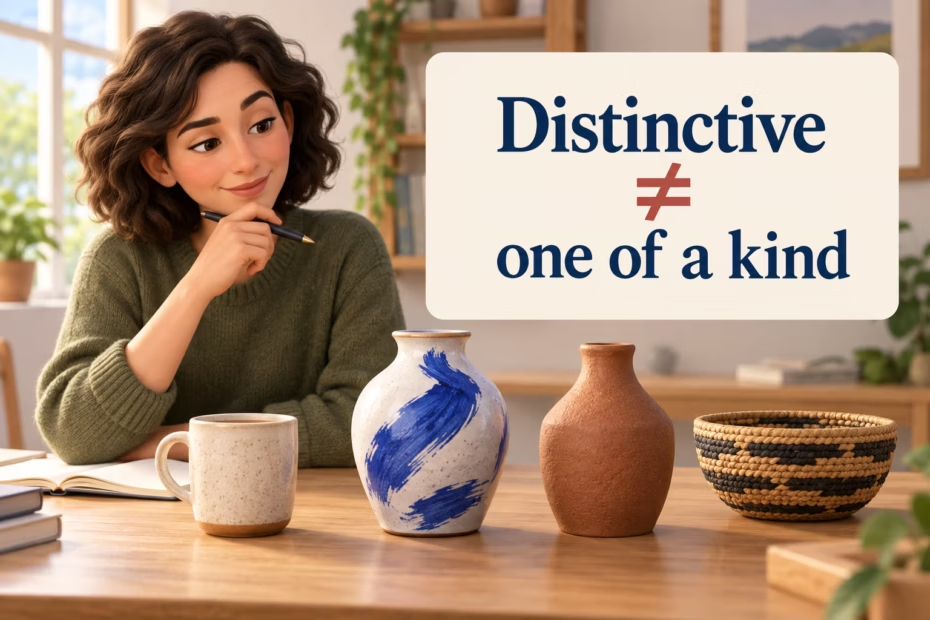
Choose an adjective for the exact quality you mean: uncommon says something is not often seen; distinctive points to a recognizable feature; original says a work or idea is newly conceived or not copied; and one-of-a-kind makes the strongest claim, that no other example of its type exists. These words overlap, but they are not interchangeable.

Uncommon, distinctive, original, or one-of-a-kind?
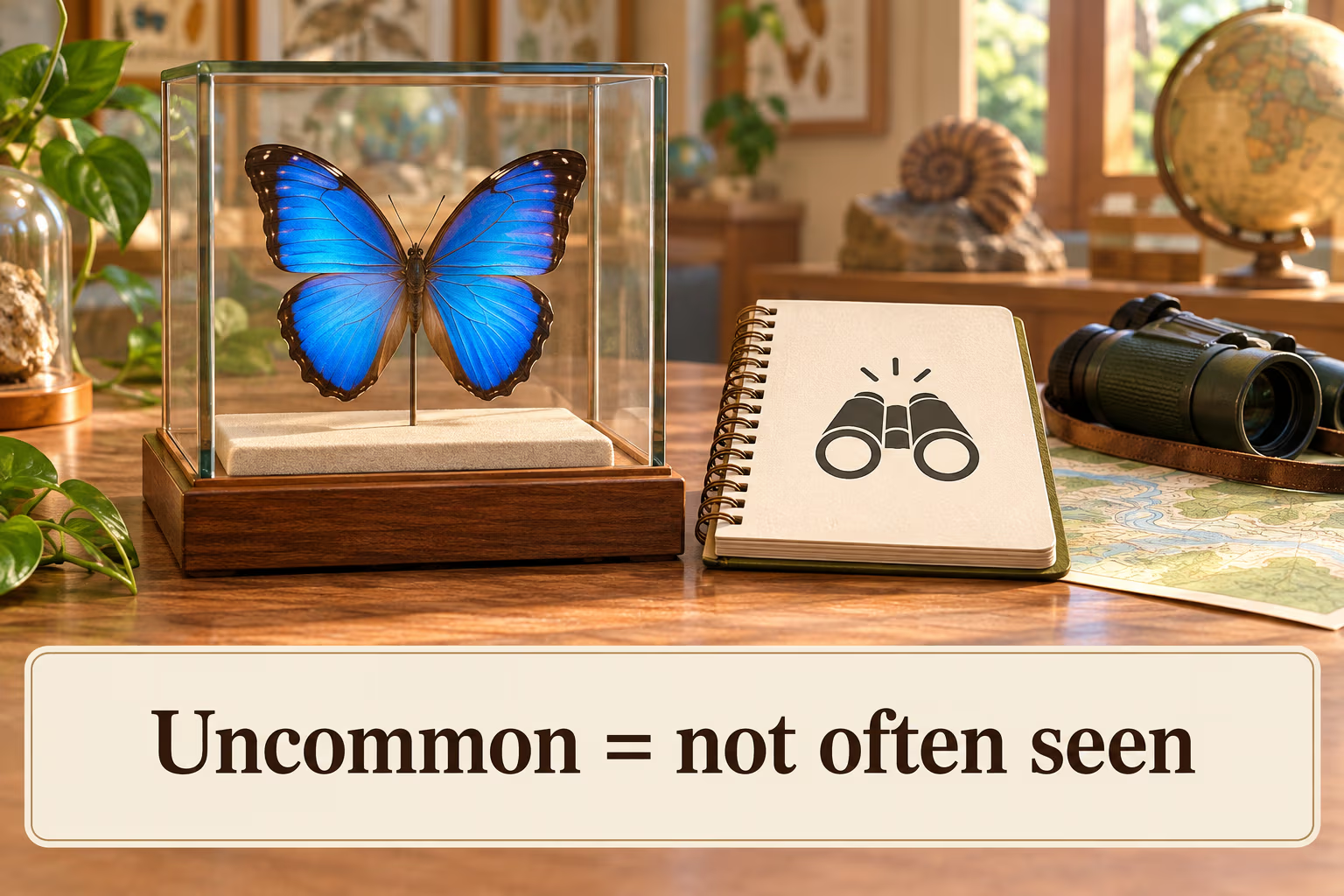
Use uncommon for low frequency: “That bird is uncommon in this region” means it is not often seen there, not that it is the only one. Use distinctive when a specific feature makes something easy to recognize: “The vase has a distinctive blue brushstroke.” Use original for an idea or work that is newly conceived or not copied: “The designer presented an original chair concept.” Reserve one-of-a-kind for a defensible claim that there is only one of that type, such as a documented, individually made artwork.
| Word | What it emphasizes | Example |
|---|---|---|
| Uncommon | How often something occurs | “This pattern is uncommon in the collection.” |
| Distinctive | A recognizable difference | “The vase’s blue brushstroke is distinctive.” |
| Original | New conception or not a copy | “The team proposed an original layout.” |
| One-of-a-kind | Only one of its type | “The archive holds a one-of-a-kind prototype.” |
Dictionary entries make these distinctions clear: uncommon concerns frequency, distinctive describes a recognizable difference, original can mean a work is not a copy, and one of a kind refers to the only person or thing of a particular type.

The A–Z directory below preserves the source list, but its entries are not all direct synonyms or adjectives: for example, leader and learner are nouns, while words such as rare and distinctive express different ideas. Check the part of speech and fit the word to the sentence.
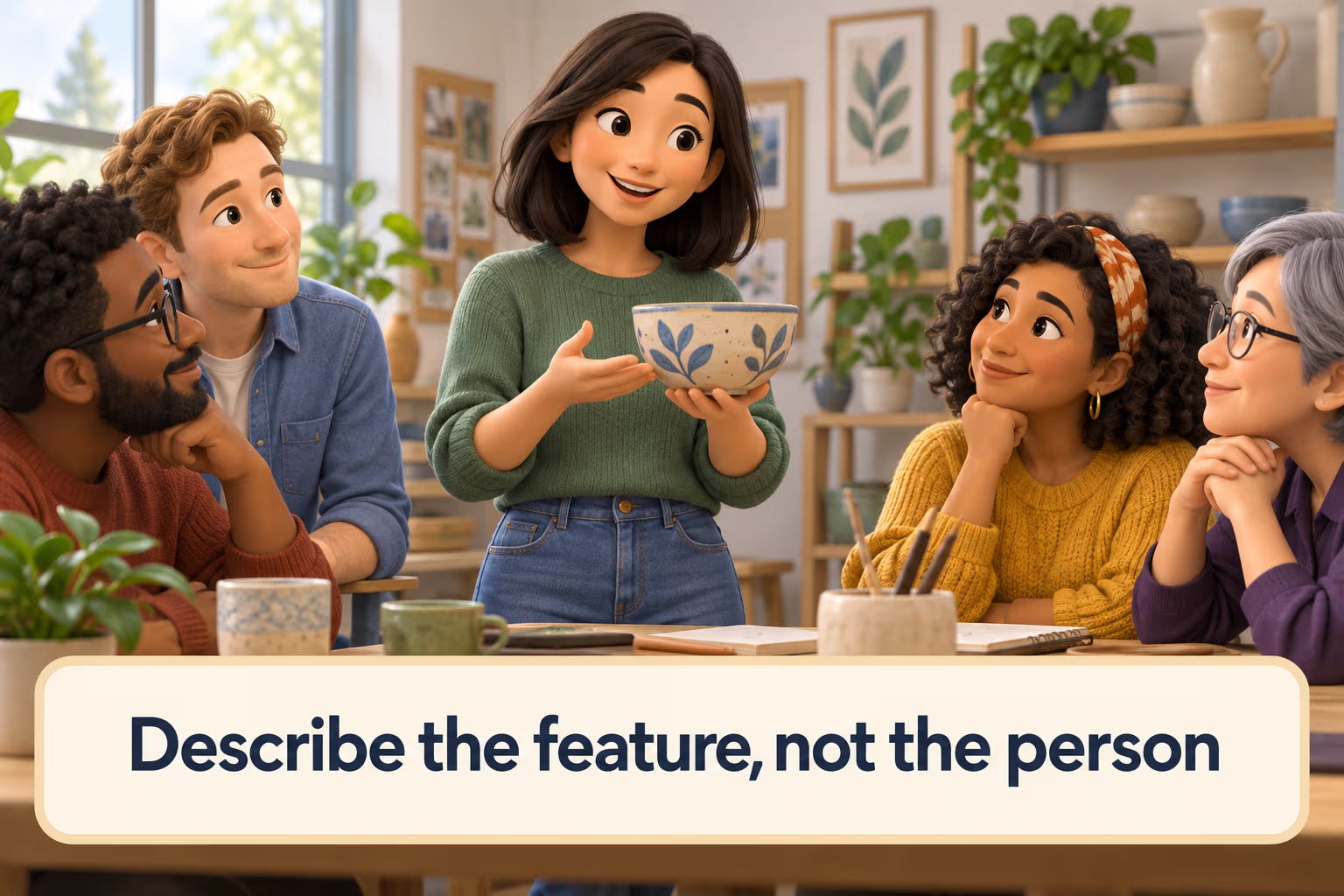
Describe a feature rather than ranking a person
When writing about people, these adjectives express a viewpoint or a comparison; they do not measure anyone’s worth. Name an observable choice, action, or feature and give the context. For example, “Her presentation used a distinctive map-based opening” identifies a specific feature, while a broad label such as “She is uniquely superior” makes an unsupported ranking. A person’s style may be distinctive to a reader without being objectively better than someone else’s.
Sense matters: Unique can mean the only example of its type; in broader use it can also mean very unusual or special. One of a kind has a literal “only one” sense and a looser “very unusual” use. Rare and uncommon describe low frequency; distinctive describes a recognizable difference; different requires a comparison; and special adds an evaluation. These related words are not interchangeable. For unusualness, contrasts can include common, usual, or ordinary; for an original creative work, a contextual contrast can be imitative or unoriginal. For literal uniqueness, “not the only example” is often clearer than a single antonym. Cambridge Dictionary and Merriam-Webster document both literal and broader uses.
An unusual experience is not necessarily memorable, and a memorable one is not necessarily unique. The preserved statements that unique experiences are never forgotten are personal generalizations, not part of the definition. Likewise, “one in a million,” “cannot be replaced,” and “deserves to be celebrated” are figurative or evaluative claims about people, not objective tests of worth. For a literal one-of-a-kind claim, identify evidence that only one example of that type exists; an individually made item alone does not establish that no similar item exists. A new idea may be original in context without proving that no one has ever had a similar idea.
When we encounter something unique, we are often awestruck by its beauty or intrigued by its rarity. This is because uniqueness is not a quality that we see very often in the world. In a sea of mass-produced items, a unique object stands out like a beacon.
We may use the word unique to describe physical objects, but it can also be applied to people, experiences, and even ideas. A person who is one-of-a-kind is someone who cannot be replaced or duplicated. They are one in a million.
Experiences that are unique are often those that we will never forget. They are the moments that stay with us long after they have ended.
Ideas can also be unique. A unique idea is one that is fresh and new, that has never been thought of before. It is an inventive solution to a problem.
When something is unique, it is special and deserves to be celebrated. We should take the time to appreciate the unique things in our lives, for they are the things that make life worth living.
Adjectives For Unique
When it comes to describing someone or something as unique, there are a variety of adjectives that can be used. Whether you want to describe someone as one-of-a-kind, special, or simply different, there’s an adjective out there that will fit your needs.
Here are some of the most common adjectives used to describe uniqueness:
- One-of-a-kind
This adjective is used to describe someone or something that is unlike anything else. If you’re looking for a way to describe someone as unique, this is probably the adjective you’re looking for.
- Special
This adjective is often used to describe people, but it can also be used to describe objects or events. When used to describe someone, it usually means that they are important or loved.
- Different
This adjective simply means that something is not the same as something else. It’s a good way to describe someone or something as unique without attaching a positive or negative connotation.
- Rare
This adjective is often used to describe objects, but it can also be used to describe people. If you’re looking for a way to describe someone as unique, this is a good option.
- Unusual
This adjective describes something that is not typical or expected. If you’re looking for a way to describe someone or something as unique, this is a good option.
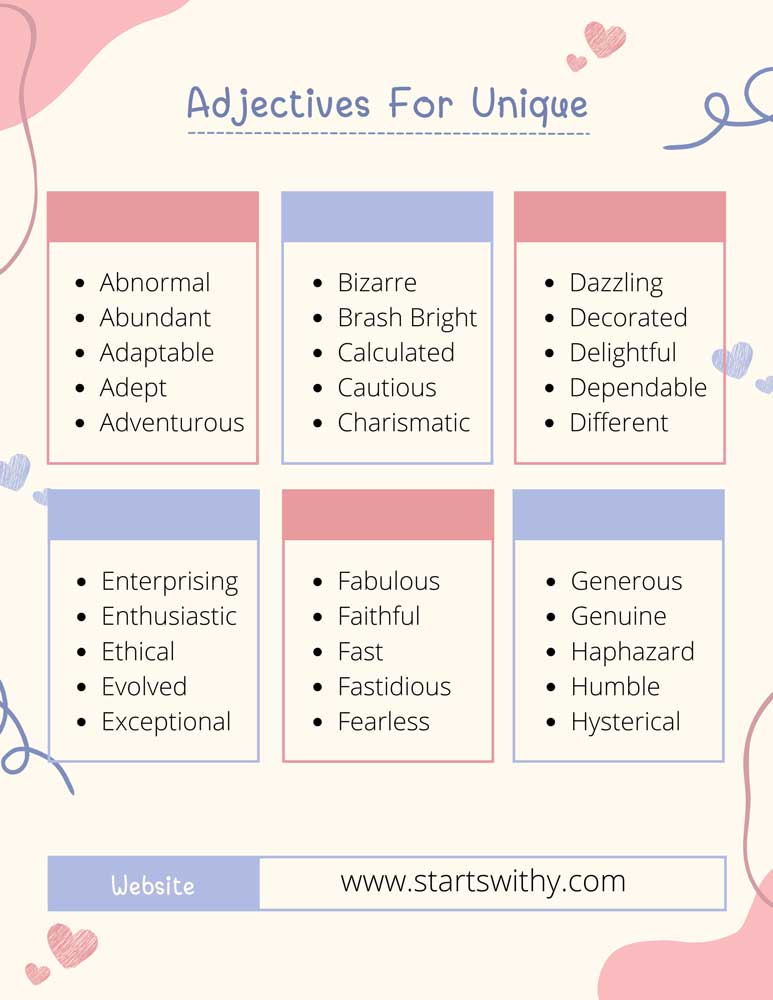
A
| Abnormal | Abundant | Accomplished |
| Adaptable | Adept | Adventurous |
| Agile | Alluring | Altruistic |
| Ambitious | Amiable | Analytical |
| Approachable | Articulate | Artistic |
| Arty | Assertive | Astute |
| Atypical | Authentic |
B | C
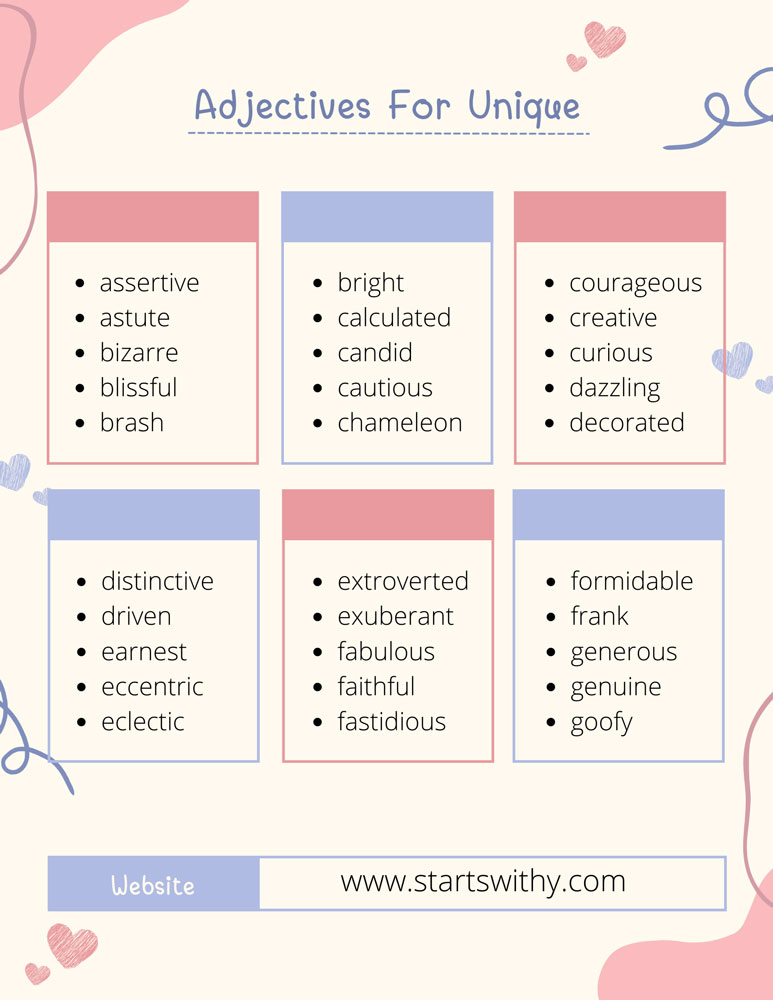
| Bizarre | Blissful | Bold |
| Brash | Bright | Calculated |
| Candid | Cautious | Chameleon |
| Charismatic | Cheery | Collaborative |
| Committed | Compassionate | Competitive |
| Complicated | Confident | Controversial |
| Cool | Courageous | Creative |
| Curious |
D
| Dazzling | Decorated | Delightful |
| Dependable | Different | Diligent |
| Diplomatic | Discerning | Disciplined |
| Discrete | Distinctive | Driven |
| Dutiful | Dynamic |
E
| Earnest | Eccentric | Eclectic |
| Effusive | Eloquent | Empathetic |
| Enchanting | Engaged | Enterprising |
| Enthusiastic | Entrepreneurial | Erotic |
| Ethical | Evolved | Exceptional |
| Exclusive | Exotic | Extraordinary |
| Extroverted | Exuberant |
F
| Fabulous | Faithful | Fast |
| Fastidious | Fearless | Flamboyant |
| Flawless | Focused | Formidable |
| Frank | Funny |
G | H
| Generous | Genuine | Goofy |
| Gregarious | Haphazard | Hard |
| Humble | Hysterical |
I
| Idealistic | Illustrated | Imaginative |
| Incomparable | Incorruptible | Independent |
| Individual | Industrious | Initiator |
| Innovative | Innovator | Insightful |
| Inspired | Inspiring | Intense |
| Interesting | Introverted | Intuitive |
| Inventive | Irregular |
J | K | L
| Jovial | Joyous | Judicious |
| Keen | Knowledgeable | Kooky |
| Leader | Learner | Level-Headed |
| Lighthearted | Lithe | Logical |
| Lone | Loud | Loving |
| Loyal | Luminous |
M
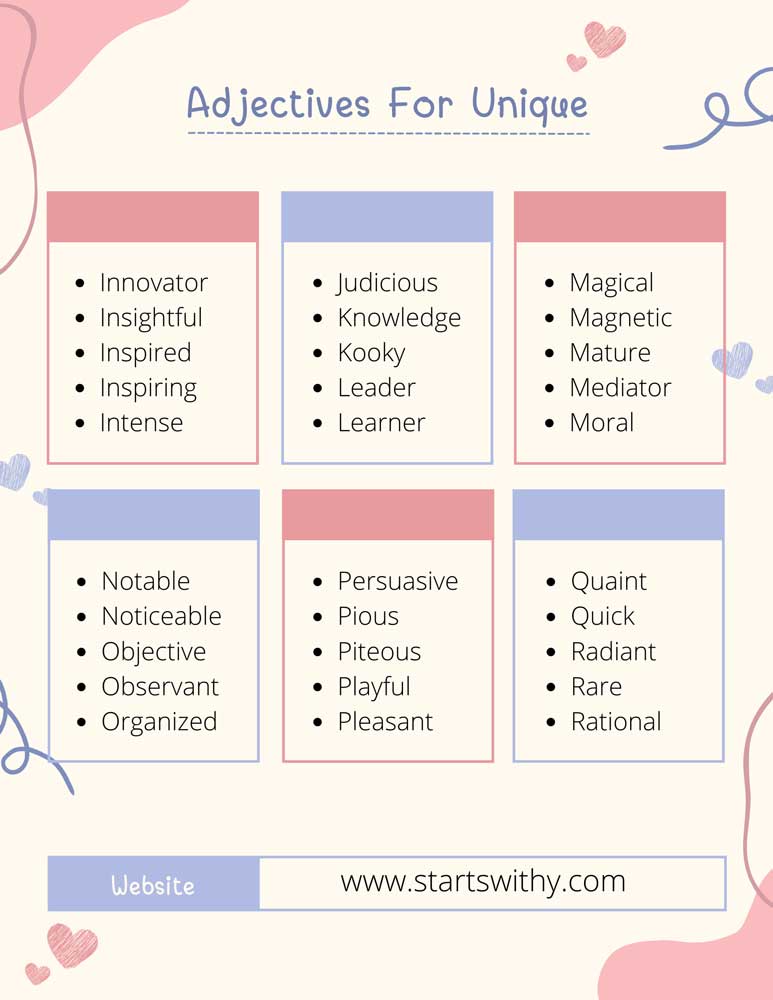
| Magical | Magnanimous | Magnetic |
| Mature | Mediator | Methodical |
| Meticulous | Moral | Motivated |
N | O
| Nonchalant | Nonconformist | Notable |
| Noticeable | Objective | Observant |
| Oddball | One | One And Only |
| Onliest | Only | Open |
| Optimistic | Orderly | Organized |
| Ostentatious | Outlandish |
P
| Partial | Particular | Passionate |
| Patient | Perceptive | Persevering |
| Persistent | Persuasive | Pious |
| Piteous | Playful | Pleasant |
| Polarising | Polite | Political |
| Popular | Positive | Powerful |
| Practical | Precise | Principled |
| Proactive | Productive | Prudent |
Q | R
| Quaint | Quick | Quirky |
| Radiant | Rare | Rational |
| Realistic | Reasonable | Reckless |
| Reflective | Reliable | Remarkable |
| Renegade | Resilient | Resourceful |
| Respected | Respectful | Responsive |
| Revered |
S
| Serene | Shameless | Sharp |
| Shrewd | Sincere | Single |
| Skilled | Snowflake | Sociable |
| Solid | Solitary | Solo |
| Sophisticated | Special | Spontaneous |
| Spritely | Stable | Steady |
| Stellar | Strategic | Striking |
| Strong | Student | Stunning |
| Stupefying | Stupendous | Subjective |
| Subtle | Successful | Sui Generis |
| Sympathetic | Systematic |
T
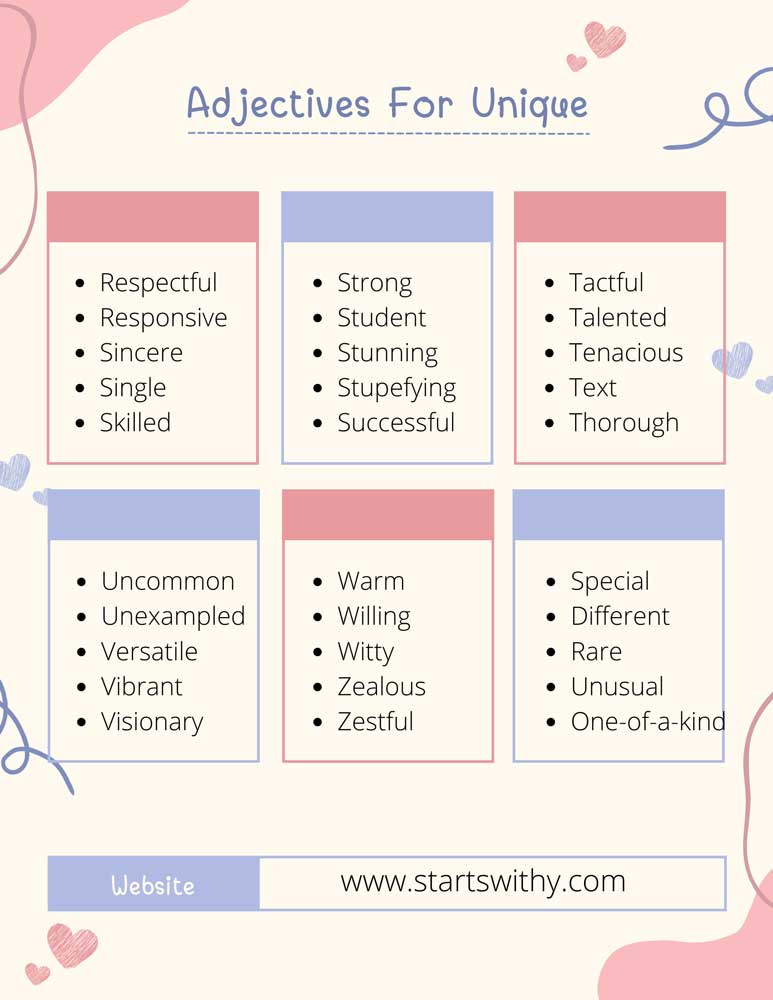
| Tactful | Talented | Tenacious |
| Text | Thorough | Thoughtful |
| Tolerant | Traditional | Tranquil |
| Twisted |
U | V | W | Z
| Uncommon | Unexampled | Versatile |
| Vibrant | Visionary | Vivacious |
| Warm | Willing | Witty |
| Zealous | Zestful |
Final verdict
In conclusion, when we want to emphasize the special qualities of something, we can describe it as unique. This word should be used sparingly, however, as overusing it can make our writing seem contrived or insincere. With that in mind, here are a few adjectives that can be used to describe something as unique: one-of-a-kind, rare, special, unusual, extraordinary, incomparable, unparalleled.