
Adjectives for a Strong Person: Words and Examples
“Strong” is an adjective whose meaning changes with the noun it describes: a strong person has physical power, a strong argument is persuasive, and a strong smell is noticeable. When looking for adjectives for a strong person, choose a precise word—such as sturdy, resilient, or courageous—that names the kind of strength you mean.
Key facts at a glance
- Strong is already an adjective; related adjectives make its meaning more specific.
- Sturdy suggests physical robustness; resilient suggests recovery after difficulty.
- Courageous describes acting despite fear; resolute describes firm determination.
- A strong argument is persuasive, while a strong smell is noticeable.
- Choose synonyms by sense instead of treating every word as interchangeable.
How do you choose adjectives for “strong”?
First decide what kind of strength you mean. A person may be physically powerful, emotionally resilient, mentally focused, or morally courageous. For an argument, persuasive or well-supported is more precise; for a smell, pungent or intense names the sensory effect.
Strong itself is already an adjective. Searchers looking for “adjectives for strong” usually want words that describe a strong person or a particular kind of strength. The Cambridge Dictionary separates senses such as physical power, durability, persuasive arguments, noticeable smells, and firm opinions, so matching the word to its noun prevents awkward substitutions.
Adjectives for physical strength
Use physical descriptors for a person’s build, lifting ability, or stamina—not as a judgment about character. Muscular refers to developed muscles; sturdy suggests solid build or reliable construction; powerful highlights force; and athletic points to physical fitness or skill.
| Adjective | Meaning | Example |
|---|---|---|
| muscular | Having clearly developed muscles | The muscular climber reached the ledge. |
| sturdy | Solidly built or able to withstand use | A sturdy runner carried the team’s gear. |
| powerful | Able to exert substantial force | The powerful rower pulled through the final stretch. |
| athletic | Fit or skilled in physical activity | The athletic goalkeeper moved quickly across the field. |

Adjectives for emotional and mental strength
- Resilient: able to recover or adapt after difficulty.
- Tenacious: persistent in pursuing a goal or holding a position.
- Resolute: firmly determined, especially when a choice is difficult.
- Courageous: willing to act despite fear or risk.
- Steadfast: remaining loyal or committed over time.
- Self-disciplined: able to guide one’s actions toward a goal.
These words overlap, but they are not exact synonyms. A resilient person rebounds from setbacks; a tenacious person keeps pursuing a goal; a courageous person faces fear. Name the action or situation that supports the adjective instead of calling every determined person “tough.”
Adjectives for a strong argument or influence
When strong describes reasoning, use persuasive, cogent, or well-supported. A compelling case holds attention and persuades; a credible source is believable; and a forceful statement is emphatic. These words describe the argument’s evidence, logic, or delivery, not a person’s muscles.
Examples of precise strength adjectives
- The resilient student returned to practice after a disappointing audition.
- A courageous neighbor called for help when the trail became unsafe.
- The tenacious researcher checked each result before presenting the report.
- Her resolute answer ended the debate about the deadline.
- The sturdy volunteer carried the folded tables into the hall.
- Two well-supported arguments helped the committee compare the options.
- The pungent scent of pine filled the workshop.
- The steadfast team continued meeting through a difficult season.

Words that are not synonyms for “strong”
A large thesaurus list may include words that describe a different trait or even the opposite. Feeble, frail, and fragile usually describe weakness or vulnerability, not strength. Continue is a verb, and words such as alcoholic or emaciated do not mean “strong.” Check the definition and example before adding a word to a synonym list.
Frequently asked questions about strength adjectives
What is a stronger word than “strong” for a person?
Choose by context. Powerful can emphasize force, muscular describes developed muscles, resilient emphasizes recovery, and tenacious emphasizes persistence. No single synonym works in every sentence. Replace strong with the word that best matches the person’s action or trait. The best choice depends on the situation.
What adjective describes someone who recovers from hardship?
Resilient describes someone able to recover, adapt, or continue after difficulty. It differs from courageous, which focuses on facing fear, and tenacious, which focuses on persistence. A sentence can name the event that shows resilience so the adjective has clear evidence.
Are “feeble” and “frail” adjectives for strong?
They are adjectives, but they usually describe weakness, delicacy, or vulnerability rather than strength. A source list may include them as contrasts, but they are not synonyms for strong. Use sturdy, robust, or powerful for physical strength, depending on the intended meaning.
What adjective describes a strong argument?
Persuasive, cogent, and well-supported can describe an argument with effective reasoning or evidence. Forceful emphasizes emphatic delivery, which does not guarantee the argument is sound. Choose the word that describes the logic, support, or tone you actually mean. Evidence matters more than volume.
Choosing a precise strength adjective
Use physical words for force or build, emotional words for persistence and recovery, and reasoning words for evidence and persuasion. A precise adjective explains what makes a person, argument, or sensation “strong” instead of relying on a broad label.
How to read the earlier word list
The earlier page includes some useful strength words but also mixes different parts of speech, unrelated descriptions, and contrasts. For example, feeble and fragile usually point away from strength, while continue is a verb rather than an adjective. Treat it as a broad vocabulary list, then check each word against the meaning needed in your sentence.
When you want to describe someone as physically strong, there are a lot of different adjectives that you can use. Some of these adjectives might describe the person’s muscles, while others might describe how the person uses their strength. It’s up to you to decide which adjective is best for the person you are describing. Adjective choices can also depend on whether you are describing someone in a positive or negative light.
Here are some adjectives for strong that you can use to describe someone:
- Muscular
- Powerful
- Brawny
- Burly
- Husky
- Strapping
- Beefy
- Hefty
- Sinewy
- Tough
- Rugged
- Resilient
- Determined
- Disciplined
- Single-minded
- Forceful
- Assertive
- Aggressive
- Domineering
- Overbearing
- Tyrannical
- Oppressive
Adjectives For Strong
When you need a word to describe someone who is strong, there are many adjectives that can be used. For example, if you want to describe someone who is physically strong, you could use adjectives like “brawny,” “burly,” “husky,” “powerful,” “stocky,” or “sturdy.” If you want to describe someone who is mentally or emotionally strong, you could use adjectives like “courageous,” “fearless,” “resilient,” “tenacious,” or “unwavering.”
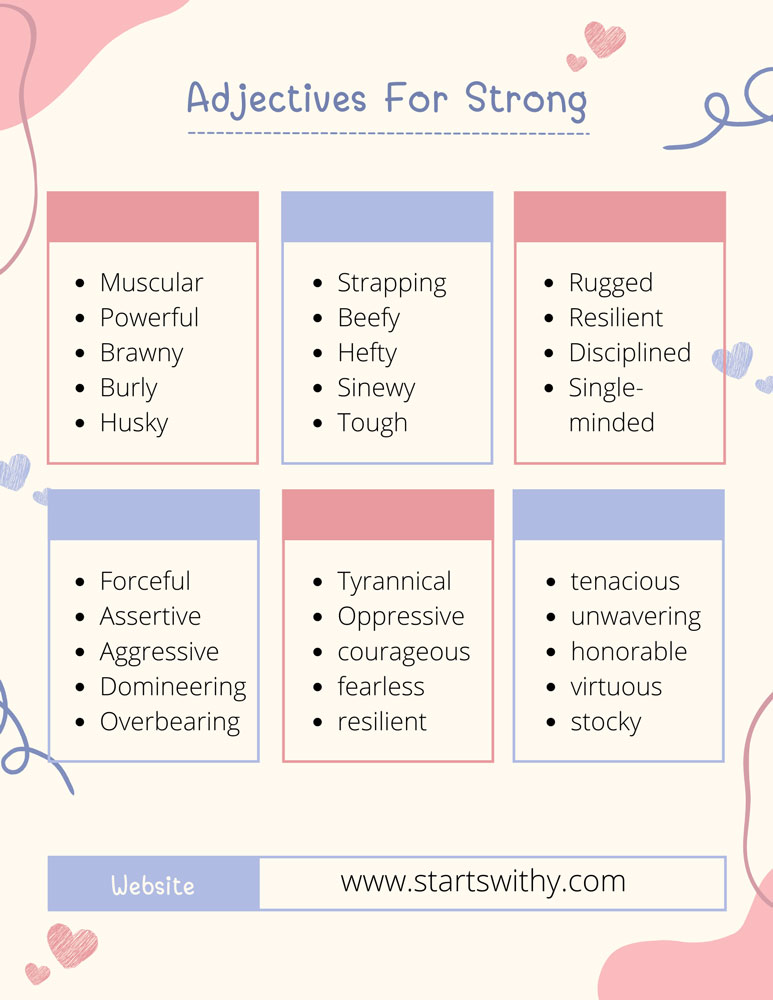
And if you want to describe someone who is morally strong, you could use adjectives like “honorable,” “just,” “upstanding,” or “virtuous.” No matter what kind of strength you need to describe, there’s an adjective for it! Adjectives are a great way to make your writing more interesting and to ensure that your readers understand exactly what you mean. It’s always a good idea to have a few strong adjectives in your toolbox, so you can use them when the situation calls for it.
A | B
| Able | Able-Bodied | Active |
| Acute | Adept | Agreeable |
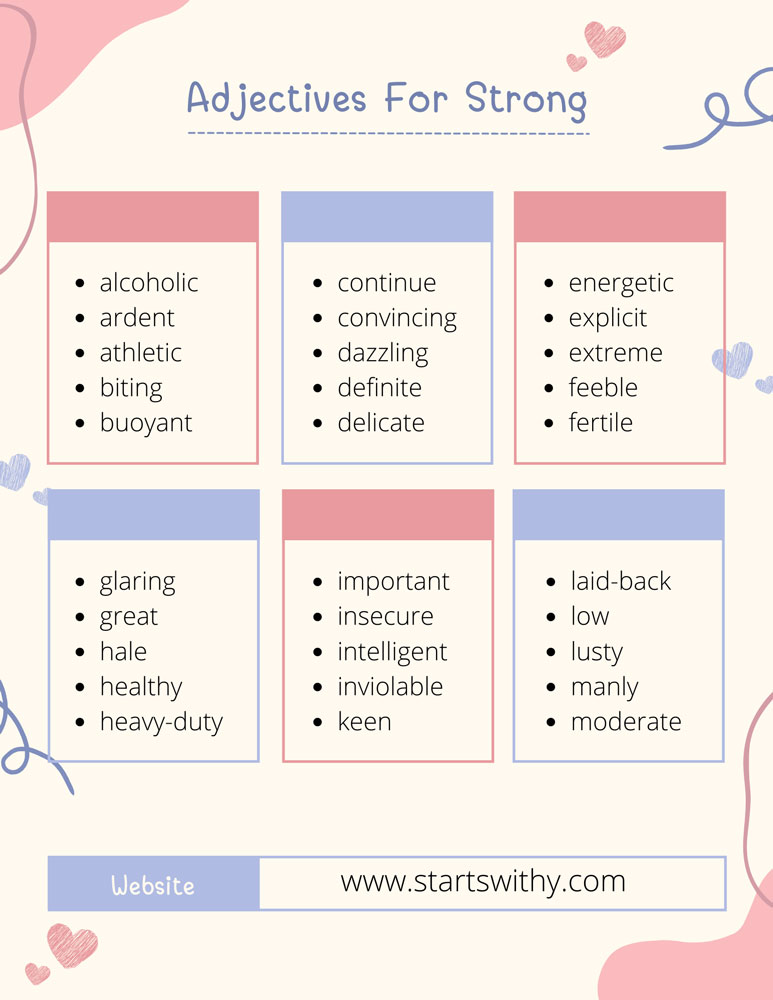
| Alcoholic | Ardent | Athletic |
| Big | Biting | Bold |
| Brawny | Buoyant | Burly |
C
| Capable | Clear | Clear-Headed |
| Cogent | Complacent | Concentrated |
| Conclusive | Continue | Convincing |
| Courageous |
D
| Dazzling | Deep | Definite |
| Delicate | Determined | Difficult |
| Distinct | Doughty | Drastic |
| Durable | Dynamic | Dynamical |
E
| Eager | Easy-Going | Effective |
| Emaciated | Emphatic | Enduring |
| Energetic | Explicit | Extreme |
F
| Faint | Fast | Feeble |
| Fertile | Fierce | Firm |
| Fit | Fixed | Forceful |
| Forcible | Formidable | Forthright |
| Fortified | Fragile | Frail |
| Frangible | Furious |
G | H
| Glaring | Great | Hale |
| Hard | Hard As Nails | Hard-Hitting |
| Hardy | Healthy | Hearty |
| Heavy | Heavy-Duty | Heroic |
| High | High-Powered | Hot |
| Husky |
I
| Impetuous | Important | Impregnable |
| In Fine Feather | Indistinct | Inebriating |
| Infirm | Influential | Ingestion |
| Insecure | Intelligent | Intense |
| Intoxicating | Intoxicative | Invincible |
| Inviolable | Irresistible | Irresolute |
K | L | M | O
| Keen | Laid-Back | Low |
| Lusty | Manly | Marked |
| Mighty | Mild | Moderate |
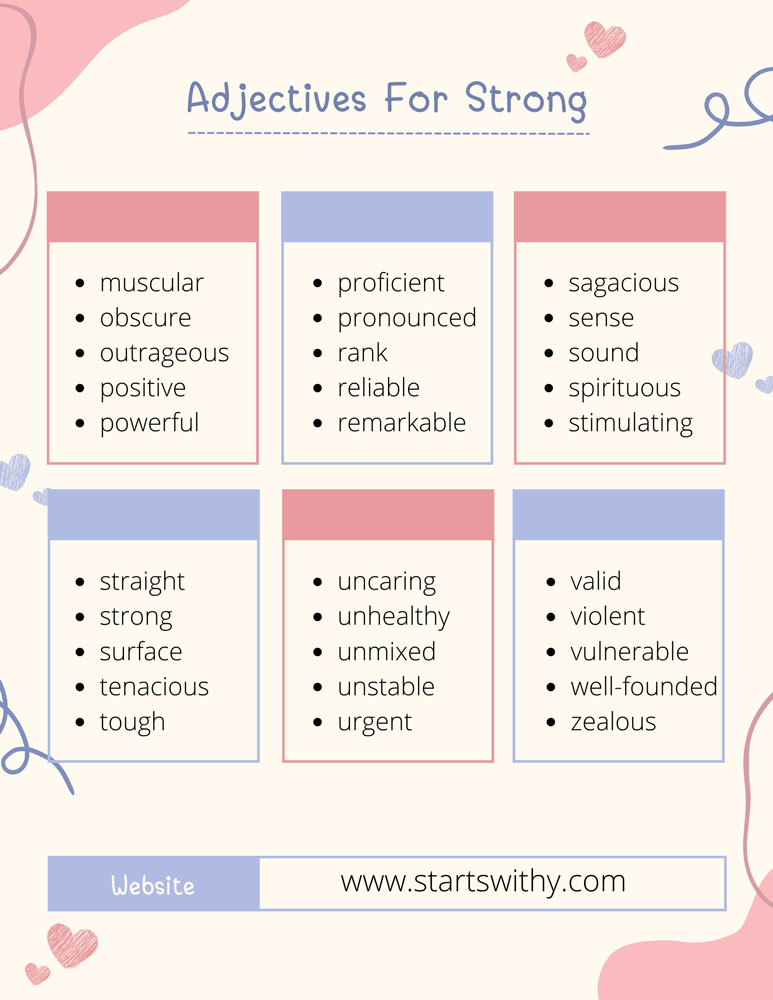
| Muscular | Obscure | Obvious |
| Outrageous | Overpowering |
P
| Pale | Perceptive | Persuasive |
| Piquant | Positive | Potent |
| Powerful | Proficient | Profound |
| Pronounced | Puissant | Pungent |
| Puny |
R
| Racy | Rank | Reinforced |
| Reliable | Remarkable | Resilient |
| Resolute | Resonant | Rich |
| Robust | Rugged |
S
| Safe | Sagacious | Secure |
| Sense | Sharp | Sinewy |
| Skilled | Soft | Solid |
| Sound | Spicy | Spiked |
| Spirituous | Stable | Stalwart |
| Stanch | Stark | Staunch |
| Steadfast | Steady | Stiff |
| Stimulating | Stout | Straight |
| Strapping | Strenuous | Strict |
| Strong | Sturdy | Substantial |
| Sure | Surface |
T | U
| Tart | Tenacious | Tottering |
| Tough | Unassailable | Unattackable |
| Uncaring | Undiluted | Unhealthy |
| Unimpaired | Unmistakable | Unmixed |
| Unshakable | Unstable | Unwavering |
| Unyielding | Urgent |
V
| Vague | Valid | Vehement |
| Vigorous | Violent | Virile |
| Vivid | Vulnerable |
W | Z
| Warm | Weak | Well-Built |
| Well-Established | Well-Founded | Well-Made |
| Wiry | Zealous |
When it comes to describing strength, the English language offers a wide array of powerful adjectives that can perfectly capture the essence of this quality. In this article, I’ll be exploring some of the most impactful adjectives for strong, providing you with a comprehensive list of words that can truly convey the robustness and resilience of a person, object, or situation.
From “mighty” to “sturdy” and “formidable” to “indomitable,” the English language offers an abundance of descriptive words that can vividly paint a picture of strength. Whether you’re writing a compelling essay, crafting an engaging story, or simply looking to expand your vocabulary, these adjectives will undoubtedly add depth and intensity to your writing. So, let’s dive in and explore the world of adjectives for strong, accompanied by examples that showcase their usage in context.
In this article, I’ll be your guide as we navigate through the realm of words that encapsulate strength. So, without further ado, let’s embark on this linguistic journey and discover the perfect adjectives to describe strength.
How to Describe strong? – Different Scenarios
When it comes to describing strength, the English language offers a variety of adjectives that can be used in different scenarios. Let’s explore some common scenarios and the adjectives that best capture the essence of strength.
1. Physical Strength
When describing physical strength, we can use adjectives that convey power, endurance, and muscle. Here are a few examples:
- Mighty: The weightlifter effortlessly lifted the barbell with their mighty arms.
- Brawny: The brawny construction worker single-handedly carried the heavy load.
- Sturdy: The sturdy oak tree withstood the powerful winds of the storm.
- Tough: The tough athlete completed the grueling marathon without breaking a sweat.
2. Emotional Strength
Emotional strength refers to the ability to handle challenges and maintain resilience. Here are some adjectives that capture this inner strength:
- Resilient: Despite facing setbacks, she remained resilient and never gave up.
- Courageous: The courageous soldier faced danger with unwavering bravery.
- Tenacious: The tenacious entrepreneur persevered through countless obstacles to achieve success.
- Steely: With a steely determination, she overcame her fears and pursued her dreams.
3. Mental Strength
When it comes to describing mental strength, we can use adjectives that highlight intelligence, focus, and fortitude. Consider these examples:
- Sharp: The sharp detective quickly solved the complex case.
- Determined: The determined student studied tirelessly to achieve top grades.
- Resolute: With a resolute mindset, he pushed past self-doubt and achieved his goals.
- Confident: The confident speaker captivated the audience with their compelling words.
Remember, using these adjectives in your writing can add depth and intensity. By choosing the right words to describe strength in different scenarios, you can paint a vivid picture and engage your readers.
Read: 1050+ Adjective Words To Describe a Picture or Photo
Stay tuned for more examples and explore the rich world of adjectives that encapsulate strength.
Describing Words for strong in English
Describing Words for Strong in English
When it comes to describing strength, there are a variety of adjectives that can be used to add depth and intensity to your writing. In this section, I’ll share with you some examples of describing words for strong in English. You can use these adjectives to enhance your storytelling or to teach young children about words that convey strength.
- Powerful: A powerful person or thing possesses great strength or force. For example, “He swung the bat with a powerful force, hitting the ball out of the park.”
- Mighty: To describe something as mighty is to emphasize its strength and power. For instance, “The mighty lion roared loudly, asserting its dominance in the wild.”
- Sturdy: When something is sturdy, it is strong and can withstand pressure or wear. For instance, “The sturdy oak tree weathered the storm without losing a single branch.”
- Resilient: Resilient individuals have the ability to recover quickly from difficult situations or setbacks. For example, “Despite facing numerous challenges, she remained resilient and never gave up.”
- Indomitable: This adjective is used to describe someone who is unconquerable or cannot be defeated. For example, “Her indomitable spirit inspired others to keep pushing forward.”
- Tenacious: To describe someone as tenacious means that they are determined and persistent. For instance, “He displayed a tenacious spirit, never giving up on his dreams.”
- Invincible: Invincible refers to someone or something that is unable to be defeated. For example, “The superhero felt invincible as he protected the city from danger.”
Remember, these describing words can be used in various contexts to evoke the sense of strength. Incorporating them into your writing or teaching can help create a vivid and engaging experience for your audience or students.
In the next section, I’ll provide more examples of adjectives for strong in different situations, such as physical strength, emotional strength, and mental strength. Stay tuned for more examples to expand your vocabulary and express strength more effectively.
Adjectives for strong
Positive Adjectives for Strong with 12 Example Sentences
When we think of strength, positive adjectives come to mind. These adjectives describe the empowering qualities of strength. Here are some examples:
| Adjective | Example Sentence |
|---|---|
| Powerful | I am powerful enough to achieve my goals. |
| Mighty | The superhero lifted the car with mighty strength. |
| Sturdy | The sturdy bridge withstood the weight of heavy traffic. |
| Resilient | Despite the setbacks, she remained resilient. |
| Indomitable | My determination is indomitable, I won’t give up. |
| Tenacious | With tenacious effort, he overcame every challenge. |
| Invincible | The champion displayed invincible strength in the match. |
Read: 2800+ Adjectives That Start With U
These positive adjectives, when used in your writing, can bring depth and power to your descriptions.
Negative Adjectives for Strong with 5 Example Sentences
While strength is often associated with positivity, there are negative adjectives that describe a different aspect of strength. Here are some examples:
| Adjective | Example Sentence |
|---|---|
| Overbearing | His overbearing personality intimidated others. |
| Dominating | The dominating force controlled the situation. |
| Brutal | The dictator ruled with brutal strength. |
| Intimidating | His intimidating presence made others uneasy. |
| Oppressive | The oppressive regime exerted its strength on the people. |
These negative adjectives indicate a forceful or overwhelming display of strength. Using them in your writing can create contrast or emphasize certain aspects.
By incorporating a variety of positive and negative adjectives for strong, you can create a nuanced portrayal of strength. Whether you are describing physical, emotional, or mental strength, these adjectives can add depth and impact to your writing.
Synonyms and Antonyms with Example Sentences
Synonyms for strong
When it comes to describing strength, there are several synonyms that can be used to add variety and depth to your writing. Here are some examples of synonyms for “strong” along with their definitions:
| Synonym | Definition |
|---|---|
| Powerful | Having great strength, influence, or control |
| Mighty | Possessing great strength, often in a physical sense |
| Sturdy | Resilient and able to withstand physical force or pressure |
| Resilient | Able to recover quickly from difficulties or challenges |
| Indomitable | Unyielding in the face of adversity or hardship |
| Tenacious | Persistent and determined, unwilling to give up |
| Invincible | Impossible to defeat or overcome |
Using these synonyms can help paint a more nuanced picture of strength, whether it is physical, emotional, or mental. Here are some example sentences to illustrate the use of these synonyms:
- The powerful wind gusts knocked down trees and caused damage to houses.
- Despite his small size, the boxer proved to be mighty in the ring, delivering knockout punches.
- The sturdy bridge withstood the weight of heavy traffic without any signs of strain.
- After facing numerous setbacks, she showed her resilient spirit and bounced back stronger than ever.
- The team’s indomitable spirit propelled them to victory, even against seemingly insurmountable odds.
- He was praised for his tenacious dedication to his work, never giving up on finding a solution.
- The superhero was believed to be invincible, as nothing seemed capable of defeating him.
Read: Descriptive Words for Autism: Examples & Usage
Antonyms for strong
On the other hand, if you wish to convey a sense of weakness or lack of strength, there are also several antonyms for “strong” that you can use. Here are some examples:
| Antonym | Definition |
|---|---|
| Fragile | Easily broken or damaged |
| Weak | Lacking in strength, not having much physical power |
| Vulnerable | Susceptible to harm or attack |
| Feeble | Lacking strength or unable to exert force |
| Frail | Delicate and easily damaged |
| Powerless | Without ability or influence |
| Dependent | Reliant on someone or something |
Including these antonyms in your writing can help create contrast and provide a more well-rounded description. Here are some example sentences to demonstrate the use of these antonyms:
- Be careful with the dishes, as they are fragile and can break easily.
- The injured athlete’s legs felt weak and shaky after the intense race.
- The team’s defense was vulnerable to quick counterattacks, leading to several goals by the opposing team.
- The elderly woman’s feeble voice could barely be heard over the noise in the crowded room.
- Handle the glass decorations with care, as they are frail and can easily crack.
- She felt powerless in the face of overwhelming circumstances, unsure of what to do next.
- The child was dependent on his parents for his basic needs.
By incorporating a variety of synonyms and antonyms for “strong,” you can enhance your writing and provide a more nuanced portrayal of strength.
In this article, I have explored a range of adjectives that can be used to describe strength. By incorporating synonyms and antonyms for “strong” such as powerful, mighty, sturdy, resilient, indomitable, tenacious, invincible, fragile, weak, vulnerable, feeble, frail, powerless, and dependent, writers can enhance their descriptions and create a more vivid portrayal of strength.
By using a variety of adjectives, we can capture the different aspects of strength, whether it be physical, emotional, or mental. These adjectives provide depth and nuance to our descriptions, allowing us to paint a more well-rounded picture of strength in our writing.
Remember, the key to effective writing is to use language that engages the reader and conveys our ideas clearly and convincingly. By incorporating these adjectives into our writing, we can create powerful and impactful descriptions that resonate with our audience.
So, the next time you want to describe strength, consider using these adjectives to add depth and variety to your writing. By doing so, you’ll be able to convey the true essence of strength and captivate your readers with your words.
Final verdict
When it comes to describing someone who is strong, there are a lot of different adjectives that can be used. Some of the most common adjectives used to describe someone who is strong include brave, determined, and fearless.
However, there are many other adjectives that can also be used to describe someone who is strong. Some of these other adjectives include: confident, independent, powerful, and self-assured. No matter what adjectives you use to describe someone who is strong, one thing is for sure, and that is that they are a force to be reckoned with.


