
Leaches vs leeches: the quick answer
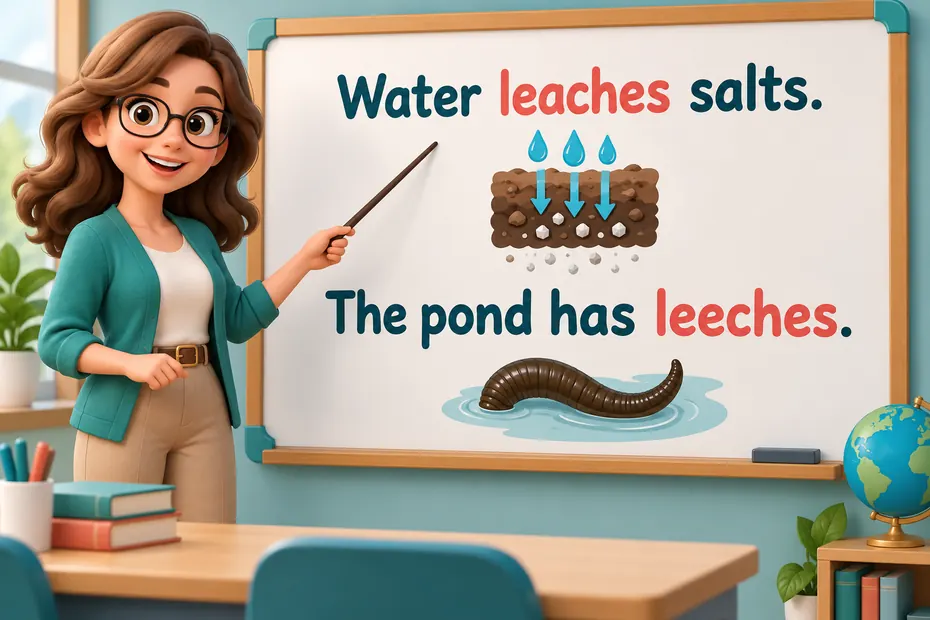
Leaches usually describes a substance being dissolved or carried out by a liquid passing through material: Water leaches salts from the soil. Leeches usually names the worms: The pond contains leeches. However, leech is also a verb, and leach has a specialist sail-edge noun sense. Meaning and grammar work together to identify the spelling.
Corrections to the older examples below: leaches does not simply mean devices used to drain a garden. The sentence “She used leaches to drain the excess water” is not a useful repair of the mistake. Also, not every leech feeds on blood, and leaching is more specific than removing any liquid. The guide here explains those distinctions and avoids treating broad medical examples as treatment advice.

Key facts and a comparison table
| Spelling | Common job | Meaning cue | Example |
|---|---|---|---|
| Leaches | Present-tense verb | Dissolving or carrying material out | The water leaches soluble salts. |
| Leeches | Plural noun | Worms or figurative exploiters | We observed leeches in the pond. |
| Leeches | Present-tense verb | Attaching to or draining someone | He leeches off his friends. |
Merriam-Webster’s leach entry associates the verb with dissolution and removal through a percolating liquid. Its leech entry includes both animal and figurative senses, along with the verb. The familiar contrast is useful, but “leaches is always a verb, leeches is always a noun” is too absolute.

How leaches works in a sentence
Leaches is the form used with a singular subject in the present tense: Water leaches, the process leaches, or the material leaches. With a plural subject, use leach: The samples leach salts. The past tense is leached, and the participle used for an ongoing action is leaching.
The verb can describe removal from material or movement out of it. Compare The liquid leaches soluble material from the sample with The soluble material leaches out of the sample. The first names the liquid performing the action; the second emphasizes the material leaving. Both constructions are clearer than a sentence vaguely claiming that something “drains.”
- The water leaches salts from the sample. Leaches is a verb with a singular subject.
- Salts leach out of the sample. The plural subject takes leach.
- The experiment measured leaching. Leaching names the process.
How leeches works as a noun and a verb
As an animal noun, leeches is the plural of leech. You can write one leech, two leeches, or several leeches. They are annelid worms, but defining the whole group simply as bloodsuckers leaves out carnivorous forms. For a general vocabulary example, observing leeches in a pond avoids assuming what a particular species eats.
As a figurative noun, leech can criticize a person who takes advantage of others. For example, The fictional character calls the freeloaders leeches explains the intended insult without presenting it as a neutral description. Use that sense carefully because it expresses a judgment about a person.
The verb also has a figurative use. He leeches off his friends describes exploiting their resources or support. In that construction, leeches is not a plural noun: he is the subject, and leeches is the action. The tense changes to leeched for the past and leeching for an ongoing action.
Why drainage alone is not a good test
Water flowing away from a garden is drainage, but the movement alone does not establish leaching. To illustrate leaching, name the dissolved material being carried from the soil or sample. For example, Water leaches salts from the soil provides that missing information. Simply substituting leaches for leeches in the original drainage example does not solve its meaning or grammar problem.
The same care helps with environmental examples. Say what moves, where it moves from, and where it goes. Avoid broad claims about unspecified “toxins,” plants, or reactions when the sentence is only intended to teach spelling. A small, precise sample example is easier to understand and makes fewer assumptions.
A specialist exception: the edge of a sail
Leech also names an edge of a sail, and leach is a less common spelling of that nautical noun. In that particular context, leaches can be a plural noun. If you are editing a boating text, consult its glossary or preferred terminology before changing the spelling. This exception does not make leaches the ordinary spelling for worms.
For an easy memory aid, connect the A in leaches with water carrying material away and the double E in leeches with the creature. Then check the actual sentence. The mnemonic helps with the common meanings, while context handles figurative verbs and specialist vocabulary.
Frequently asked questions
Are leaches and leeches pronounced alike?
In their familiar uses, yes. Their spelling and meaning distinguish them.
What is the plural of the worm leech?
Leeches. Write The pond contained several leeches.
Is leeches always a noun?
No. It can be a verb, as in He leeches off others.
Does leaches mean draining water?
It usually involves dissolving or carrying material out through a liquid. Ordinary water drainage alone is a different description.
Do all leeches suck blood?
No. The dictionary definition includes carnivorous forms as well as bloodsucking forms.
Are you confused about the correct usage of “leaches” and “leeches”? Don’t worry, I’ve got you covered. In this text, I’ll investigate into the differences between these two commonly misused words and provide you with the tools to use them appropriately.
Leaches, spelled with an “a,” refers to the act of draining or extracting, while leeches, spelled with an “e,” are blood-sucking worms. Understanding the distinction is crucial to avoid embarrassing mistakes in your writing.
So, whether you’re a writer, a student, or someone who simply wants to improve their language skills, this article will equip you with the knowledge to confidently navigate the tricky world of “leaches” and “leeches.” Let’s immerse and put an end to the confusion once and for all.
Key Takeaways
- “Leaches” and “leeches” are commonly confused words with distinct meanings.
- “Leaches” refers to the process of draining or extracting substances from a solid material.
- “Leeches” are blood-sucking worms that attach themselves to the skin of animals and feed on their blood.
- To use these words correctly, remember to use “leaches” when referencing extraction or drainage and “leeches” when referring to the blood-sucking creatures.
- Avoid common mistakes such as confusing the definitions, incorrect usage in sentences, and ignoring context.
- Understanding the correct usage of these words is essential for clarity and precision in writing.
The Difference Between Leaches and Leeches
When it comes to the words “leaches” and “leeches,” it’s important to understand the difference between them to use them correctly in your writing. Let me explain the definitions of each word so that you can confidently distinguish between them.
Leaches, derived from the verb “to leach,” refers to a process of draining or extracting substances, typically liquids, from a solid material. It involves the removal of certain elements or chemicals through a process of percolation or filtration. For example, you might hear someone say, “The rainwater leaches out the toxins from the soil.”
On the other hand, leeches are blood-sucking worms that are typically found in freshwater environments. These creatures attach themselves to the skin of animals, including humans, and feed on their blood. They have been used in traditional medicine and certain medical procedures. An example sentence using “leeches” could be, “They used leeches to improve blood circulation in the patient’s leg.”
So, the key difference between leaches and leeches is that “leaches” refers to the action of draining or extracting, while “leeches” are the blood-sucking worms.
By understanding this difference, you can avoid using the wrong word in your writing and maintain clarity. Let’s move on to some examples to solidify your understanding.
Understanding the Correct Usage
As a writer, it is crucial to understand the difference between similar words to ensure clarity and precision in your writing. In this section, I will explain the correct usage of “leaches” and “leeches” to help you avoid any confusion.
Definition of “leaches” and “leeches”:
- “Leaches” is a verb that refers to draining or extracting substances, typically liquids, from a solid material. It involves the removal or separation of elements or chemicals from a solid substance.
- On the other hand, “leeches” are small, blood-sucking creatures that attach themselves to the skin of animals, including humans. They feed on their host’s blood, causing the skin to swell.
Difference between “leaches” and “leeches”:
The key distinction between these two words lies in their meanings and usage:
- Use of “leaches”:
- “Leaches” is a verb that describes the process of extracting or draining substances. Here are a few examples:
- The soil leaches nutrients as water seeps through it.
- The rainwater leaches toxins from the polluted air.
- Use of “leeches”:
- “Leeches” are living organisms. They are blood-sucking worms that attach themselves to the skin of animals, typically to feed on their blood. Here are some examples:
- The doctor applied leeches to remove excess blood from the patient’s wound.
- Some people still believe in the therapeutic benefits of leeches for certain medical conditions.
Correct usage guidelines:
To ensure accurate usage, consider the following guidelines:
- Use “leaches” when referring to the process of extracting or draining substances from a solid material.
- Use “leeches” when referring to the blood-sucking creatures that attach themselves to animals.
By understanding these distinctions, you can confidently use “leaches” and “leeches” in your writing without any confusion. Maintaining clarity in your language is essential, especially when communicating complex ideas or information.
Remember, precision and accuracy in word choice contribute to effective communication. So, always double-check your usage to convey the intended meaning accurately.
Common Mistakes to Avoid
As writers, we often encounter words that sound or look similar, but have completely different meanings. Understanding the distinction between these words is crucial for effective communication. In this section, I’ll highlight some common mistakes to avoid when using “leaches” and “leeches” in your writing.
Mistake #1: Confusing the Definitions
One of the main mistakes people make when using “leaches” and “leeches” is confusing their definitions. Let’s take a closer look at the correct meanings of these words to clarify any confusion:
- “Leaches”: This word is a verb that refers to draining or extracting substances, typically from a solid material. For example, you might say, “The soil leaches nutrients over time.”
- “Leeches”: On the other hand, “leeches” are blood-sucking worms that attach themselves to the skin of animals to feed on their blood. They are parasitic creatures commonly found in freshwater environments.
Mistake #2: Incorrect Usage in Sentences
Another mistake people make is incorrectly using “leaches” or “leeches” in sentences. Here are a few examples to illustrate this:
- Incorrect: “She used leeches to drain the excess water from the garden.”
Correct: “She used leaches to drain the excess water from the garden.” - Incorrect: “The doctor suggested using leaches to treat the patient’s ailment.”
Correct: “The doctor suggested using leeches to treat the patient’s ailment.”
Focusing to the correct usage of these words, you can avoid confusion and maintain clarity in your writing.
Mistake #3: Ignoring Context
Context plays a crucial role in determining whether to use “leaches” or “leeches” in your writing. Consider the following examples:
- “The heavy rainfall caused the soil to leach excessive amounts of nutrients.”
- “The hiker discovered leeches on his legs after wading through the swamp.”
By understanding the specific context in which these words are used, you can ensure their appropriate usage in your writing.
Examples of Correct Usage
Now that we have established the difference between “leaches” and “leeches,” let’s explore some examples of their correct usage. These examples will further solidify your understanding and help you confidently incorporate these words into your writing.
Correct usage of “leaches”:
- The soil’s acidity leaches nutrients from the plants, affecting their growth.
- The rainwater gradually leaches out the toxins from the contaminated soil.
- The chemical reaction caused the metal to leach valuable minerals.
- The doctor used leeches to remove excess blood from the wound.
- The leeches attach themselves to the skin and feed on the host’s blood.
- The old practice of bloodletting involved the use of leeches to balance the body’s humors.
As you can see from these examples, “leaches” is used to describe the process of extracting or draining substances from a material, whether it’s nutrients from the soil or minerals from a solid. On the other hand, “leeches” refers to the blood-sucking worms that attach themselves to animals and humans to feed on their blood.
Understanding the correct usage of these words is crucial in maintaining clarity and precision in your writing. By using them appropriately, you can effectively convey your intended meaning to your readers.
Keep in mind that context plays a significant role in determining which word to use. When in doubt, consult a reliable source or reference material to ensure accuracy. By consistently using these words correctly, you can enhance your language skills and avoid common mistakes. Remember, practice makes perfect!
Conclusion
Understanding the differences between “leaches” and “leeches” is crucial for effective communication. By grasping their distinct meanings and usage, you can confidently incorporate these words into your writing without confusion.
“Leaches” refers to the extraction or draining of substances from a solid material. On the other hand, “leeches” are blood-sucking worms that attach themselves to animals’ skin. It’s important to note that context plays a significant role in determining the appropriate usage of these words.
Throughout this article, we have provided detailed explanations and examples to help you navigate the correct usage of “leaches” and “leeches.” By avoiding common mistakes, such as confusing their definitions or misusing them in sentences, you can maintain clarity in your writing.
Whether you are a writer, student, or someone looking to enhance their language skills, mastering the distinctions between “leaches” and “leeches” will elevate the quality of your work. So, remember to use “leaches” when referring to the removal of elements from a solid material and “leeches” when discussing blood-sucking worms.
By following these guidelines, you can confidently wield these words to convey your thoughts accurately and effectively.
Frequently Asked Questions
Q: What is the difference between “leaches” and “leeches”?
A: “Leaches” refers to draining or extracting substances, while “leeches” are blood-sucking worms.
Q: Who can benefit from understanding the difference between “leaches” and “leeches”?
A: Writers, students, and anyone looking to improve their language skills can benefit from understanding the difference between “leaches” and “leeches”.
Q: How can I use “leaches” correctly in a sentence?
A: Use “leaches” when referring to the removal of elements or chemicals from a solid material. For example, “The soil leaches nutrients during heavy rainfall.”
Q: What is the correct usage of “leeches” in a sentence?
A: Use “leeches” when referring to creatures that attach themselves to the skin of animals and feed on their blood. For example, “The doctor used leeches to treat the patient’s condition.”
Q: What mistakes should I avoid when using “leaches” and “leeches”?
A: Avoid confusing the definitions of “leaches” and “leeches” and using them incorrectly in sentences. Pay attention to the context to determine the appropriate usage.


