
Dies vs Dyes: Meanings, Grammar and Examples
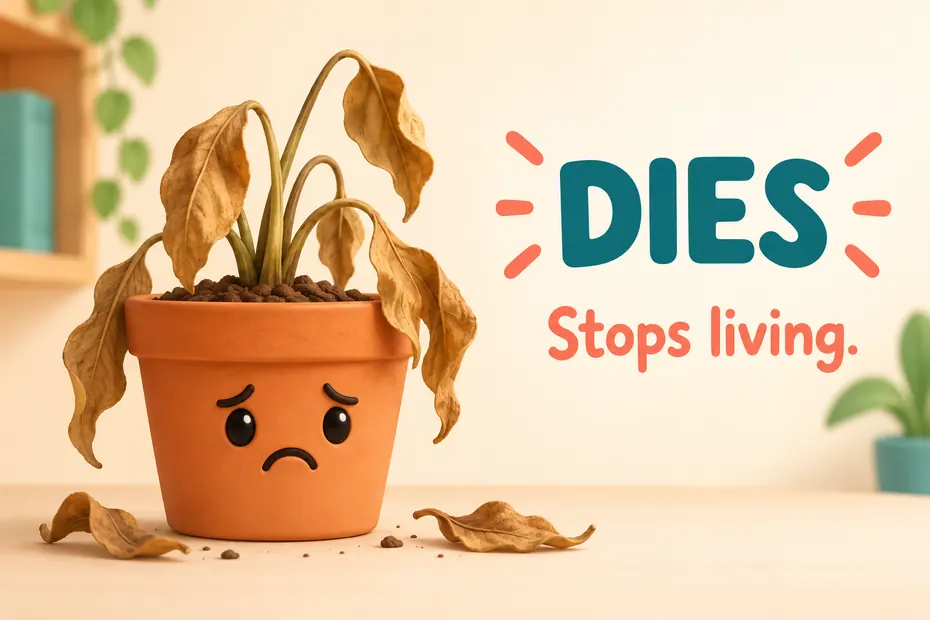
Dies can be the present-tense verb form of die: “The plant dies.” It can also be the plural of a shaping or stamping tool called a die. Dyes can be the plural of a coloring substance, or the present-tense verb form of dye: “She dyes the fabric.” Both words ordinarily sound the same, rhyming with eyes.
Correction to the retained article: the proposed long-vowel versus short-vowel pronunciation difference is incorrect. Dyes is not exclusively a noun; its own example “She dyes her hair” uses a verb. Dies is not exclusively a verb either. Also, dying is not a medical definition based simply on stopping breathing, and dyes do not all produce permanently unchanging color.
Key Facts and Comparison Table
| Word | Role | Meaning | Example |
|---|---|---|---|
| Dies | Verb | Stops living or functioning; fades or ends | The battery dies quickly. |
| Dies | Plural noun | Tools that shape, stamp or cut | The craft shop stocks cutting dies. |
| Dyes | Plural noun | Coloring substances | These dyes produce different shades. |
| Dyes | Verb | Colors with dye | She dyes the cloth blue. |
Dies as a Verb
Use dies with a third-person singular subject in the simple present: “The plant dies without enough water.” The subject plant is singular, so the verb has the ending -s. Compare “The plants die.” These sentences illustrate agreement; they do not provide gardening advice about a particular species.
Die can also describe ceasing to function or fading away. “The engine dies at the junction” describes an engine stopping. “The noise dies down” describes a reduction. “The tradition dies out” describes disappearance. Merriam-Webster records these broader senses in its die entry.
For past tense, use died: “The battery died yesterday.” For the -ing form, use dying: “The battery is dying.” The spelling changes from ie to y. “The battery dies yesterday” mixes a simple-present form with past timing unless a special narrative context explains it.
When writing about a person’s death, choose wording appropriate to the situation and rely on established facts. This article explains language, not criteria for determining death. The earlier phrase “ceasing to live or breathe” is too loose to serve as a medical definition.

Dyes as a Noun or Verb
A dye is a coloring substance; several are dyes. “The box contains three fabric dyes” counts products or substances. In “The workshop uses dyes,” the subject is workshop, the verb is uses, and dyes is the plural noun receiving the action.
In “The artist dyes the fabric,” dyes is the verb. The artist performs the coloring. Merriam-Webster’s dye entry includes both noun and verb meanings. Compare “The artist uses dyes” with “The artist dyes cloth”: the same spelling has different grammatical jobs.
The normal verb forms are dye, dyes, dyed, and dyeing. Dyeing keeps the e, distinguishing it from dying. “The fabric is dyeing unevenly” concerns coloring; “the plant is dying” concerns loss of life.
Do not assume every dye is suitable for every material or use. The noun tells you that something colors; it does not establish permanence, wash resistance, suitability for skin or food, or a particular method of application. In a language example, “fabric dyes” identifies the intended context without making unsupported product claims.

Dies as Tools, and Die vs Dice
A die can be a tool for shaping, stamping or cutting material, and the ordinary plural for that tool sense is dies. “The factory replaced the worn dies” concerns equipment. “The designer stored several cutting dies” also uses a plural noun. Neither sentence says anything stopped living.
For the familiar spotted gaming cube, die is the singular and dice is the traditional plural. “The game uses two dice” has a different meaning from “The workshop uses two dies.” Identify which kind of die you mean before selecting the plural.
Choose by Meaning, Then Check Grammar
- For coloring, choose the dye family: dye, dyes, dyed, dyeing.
- For stopping living or functioning, choose the die family: die, dies, died, dying.
- For shaping or stamping tools, choose the noun die and plural dies.
- Check whether the sentence needs a plural noun or a verb agreeing with its subject.
Practice: “The craft worker ___ cloth using several ___.” Both blanks take dyes, first as a verb and then as a noun. “The workshop stores metal ___” takes dies. “When its charge runs out, the device ___” also takes dies, now as a verb.
Frequently Asked Questions
Are dies and dyes pronounced differently?
No. Their ordinary pronunciation is the same, rhyming with eyes.
Is dyes always a plural noun?
No. “She dyes cloth” uses dyes as a present-tense verb. “She buys dyes” uses a plural noun.
Is dies always about death?
No. It can describe stopping or fading, and it can be the plural noun for shaping or stamping tools.
Is it dying or dyeing fabric?
Dyeing fabric describes coloring it. Dying belongs to the verb die.
What is the plural of a gaming die?
The traditional plural is dice. The tool sense normally takes dies.
Earlier Article, Preserved for Reference
The original text follows. Use the updated guide for shared pronunciation, both noun and verb uses, and the dyeing versus dying spelling distinction.
Have you ever found yourself confused between “dies” and “dyes”? I know I have! In this text, I’ll guide you through the proper usage of these two words, so you can confidently express yourself without any mix-ups. Whether you’re a writer, a student, or simply someone who wants to improve their language skills, understanding the difference between “dies” and “dyes” is essential. So, let’s immerse and unravel the mystery behind these commonly confused words. By the end of this article, you’ll be equipped with the knowledge to use “dies” and “dyes” appropriately, leaving no room for uncertainty.
Key Takeaways
- “Dies” is a verb that refers to the act of ceasing to live or breathe, while “dyes” is a noun that refers to substances used for coloring or staining.
- The pronunciation of “dies” is /daɪz/, with a long “i” sound, while “dyes” is pronounced as /dʌɪz/, with a short “i” sound.
- “Dies” and “dyes” have different parts of speech, meanings, and contexts, so it’s crucial to use them appropriately.
- Use “dies” when referring to the end of a person’s life or the extinguishing of a flame.
- Use “dyes” when referring to substances used for coloring or staining, such as in textiles, art, cosmetics, or even hair coloring.
- Pay attention to the surrounding words and context to ensure accurate usage of “dies” and “dyes” in your writing and conversations.
Understanding the Difference between “Dies” and “Dyes”
As a writer and language enthusiast, I often come across words that can be easily confused due to their similar spellings or pronunciations. One such pair of words that frequently causes confusion is “dies” and “dyes.” In this section, I’ll clarify the difference between these two words and provide you with a solid understanding of how to use them correctly in your writing.
Let’s start with the definition of each word:
- Dies: This word is primarily a verb and is the present tense form of the verb “to die.” It refers to the act of ceasing to live or breathe. For example, “The old man dies peacefully in his sleep.”
- Dyes: On the other hand, “dyes” is a noun that refers to substances used to color or stain something. Dyes are often used in textiles, art, and even hair coloring. For instance, “She dyes her hair blonde every few months.”
Now that we have a clear understanding of what each word means, let’s investigate deeper into the difference between “dies” and “dyes”:
- The first and most obvious difference lies in their parts of speech. “Dies” is a verb, while “dyes” is a noun.
- Another distinction is their pronunciation. “Dies” is pronounced as /daɪz/, with a long “i” sound, while “dyes” is pronounced as /dʌɪz/, with a short “i” sound.
- Also, their meanings couldn’t be more different. “Dies” relates to the end of life, while “dyes” refers to coloring or staining.
To further emphasize the difference, let’s take a look at some examples:
- “He dies a hero’s death in the battle.”
- “She dyes the fabric with vibrant colors.”
As you can see, the context in which these words are used determines their meaning and helps avoid any confusion.
When to Use “Dies”
One of the common sources of confusion in the English language is the distinction between the words “dies” and “dyes.” In this section, I will focus on clarifying the proper usage of “dies.”
Definition of “Dies”
First, let’s understand the definition of the word “dies.” As a verb, “dies” refers to the act of ceasing to live or breathe. It is often used to describe the end of a person’s life or the extinguishing of a flame.
Difference Between “Dies” and “Dyes”
It’s important to note the difference between “dies” and “dyes” as they are often confused due to their similar spellings. While “dies” is a verb associated with death, “dyes” is a noun that refers to substances used for coloring or staining.
How to Use “Dies” Correctly
Here are a few examples that illustrate the correct usage of “dies”:
- “I was deeply saddened when my grandfather died last year.”
- “The candle dies out slowly as the wax melts away.”
- “After a long battle with illness, she finally died peacefully in her sleep.”
Remember, “dies” is used in the context of someone or something ceasing to live or breathe. It is not used when referring to coloring or staining substances.
Conclusion
Understanding the proper usage of “dies” is crucial to avoid confusion with other words like “dyes.” By recognizing that “dies” is a verb associated with death, you can use it accurately in your writing and conversations.
Examples of Correct Usage of “Dies”
As we have discussed earlier, the word “dies” is a verb that describes the end of a person’s life or the extinguishing of a flame. To further illustrate the correct usage of “dies,” let’s look at some examples:
- Example 1: “My grandmother died peacefully in her sleep last night.” Here, “died” is used to express the end of someone’s life.
- Example 2: “The candle slowly died out, leaving the room in darkness.” In this sentence, “died out” is used to describe the extinguishing of a flame.
- Example 3: “The city mourned the death of a beloved leader.” Here, “death” is a noun related to the end of someone’s life, and “mourned” indicates the emotion felt by the city.
- Example 4: “The fire will die down if you don’t add more logs.” This sentence uses “die down” to describe the gradual reduction or weakening of the fire.
Understanding the correct usage of “dies” is crucial to avoid confusion with other words like “dyes.” By using it appropriately, you can convey the intended meaning accurately in your writing or conversations.
Remember, context is essential in determining whether “dies” is being used to describe the end of a life or the extinguishing of a flame. Pay attention to the sentence structure, surrounding words, and the overall message you want to convey to ensure clarity and precision in your communication.
Now that we have examined the proper usage of “dies,” let’s investigate into the definition and examples of the word “dyes” in the next section. Understanding the differences between these two words will further enhance your language skills and prevent any misunderstandings in the future. Keep reading to expand your knowledge and usage of these commonly confused words.
When to Use “Dyes”
Now that we have a clear understanding of the verb “dies,” let’s shift our focus to the noun “dyes” and explore when and how to use it appropriately.
Definition of “dyes”
“Dyes” refers to substances used for coloring or staining. They are commonly used in various industries, such as textiles, art, and cosmetics, to add color to different materials. These substances can be natural or synthetic, and they possess the ability to penetrate and permanently change the color of the material they are applied to.
Difference between “dies” and “dyes”
It’s important to note the distinction between “dies” and “dyes.” While “dies” is a verb that pertains to the act of ceasing to live or breathe, “dyes” is a noun used to describe coloring substances. So, when talking about the end of a person’s life or the extinguishing of a flame, we use “dies.” On the other hand, when referring to coloring or staining agents, we use “dyes.”
Examples of correct usage
Here are a few examples to illustrate the correct usage of “dyes” in different contexts:
- “I used vibrant fabric dyes to create a tie-dye pattern on my t-shirt.”
- “The artist experimented with different dyes to achieve a wide range of colors in their painting.”
- “The cosmetic industry uses various natural and synthetic dyes to add color to lipsticks and eyeshadows.”
By using “dyes” accurately, we can effectively convey our intended meanings and prevent any confusion or misunderstanding. Understanding the context in which “dyes” is used is essential for clear and effective communication.
In the next section, we will investigate into more details about the verb “dies” and explore its usage with examples. Stay tuned to enhance your language skills and prevent further misunderstandings.
Examples of Correct Usage of “Dyes”
As I mentioned earlier, “dyes” is a noun that describes substances used for coloring or staining. Understanding the proper usage of “dyes” is crucial to avoid confusion with other words like “dies.” Let’s explore some examples to illustrate its correct usage:
- Textile Dyes: One common application of “dyes” is in the textile industry. Clothing manufacturers use various dyes to add vibrant hues to fabrics. For instance, a fashion designer might choose to dye a dress blue or dye a shirt red to create eye-catching garments.
- Hair Dyes: Another popular use of “dyes” is in the area of personal grooming. Many people choose to dye their hair for aesthetic purposes. For example, someone might decide to dye their hair blonde, brown, or even experiment with bold and unconventional colors like pink or purple.
- Food Dyes: “Dyes” are also employed in the food industry to enhance the visual appeal of certain products. Have you ever noticed the bright colors of candies, cakes, or beverages? These items often contain food dyes that give them their striking appearance. Food manufacturers carefully select the appropriate dyes to create visually appealing and appetizing products.
- Artistic Dyes: Artists and craftsmen frequently use dyes to add color and creativity to their creations. From paintings to pottery, dyes play a fundamental role in bringing artistic visions to life. Artists may opt for natural dyes or synthetic ones, depending on their desired effects and the medium they are working with.
- Wood Dyes: Even the world of woodworking benefits from the use of “dyes.” Woodworkers use specific dyes to stain wood, giving it a desired color or shade. This process allows them to achieve various finishes, such as dark mahogany or light oak.
Remember, the examples provided above showcase proper usage of “dyes” as a noun. Context is essential when using this word, so make sure to pay attention to the surrounding words and the specific domain being discussed.
Next, we’ll investigate into the definition and examples of the word “dies” to further enhance our language skills and prevent misunderstandings.
Conclusion
Understanding the difference between “dies” and “dyes” is crucial to avoid confusion and ensure accurate communication. Throughout this article, we have explored the distinct meanings and usage of these two words.
“Dies” is a verb that describes the act of ceasing to live or breathe, while “dyes” is a noun that refers to substances used for coloring or staining. These words differ not only in their meanings but also in their parts of speech, pronunciation, and context.
By providing examples from various industries such as textiles, hair grooming, food, art, and woodworking, we have highlighted the correct usage of “dyes” in different contexts. This knowledge enables us to express ourselves accurately and prevents misunderstandings.
To conclude, mastering the appropriate usage of “dyes” is essential for clear and effective communication. By understanding the distinctions between “dies” and “dyes,” we can confidently navigate conversations and written content without any confusion.
Frequently Asked Questions
Q: What is the difference between “dies” and “dyes”?
A: “Dies” is a verb that means ceasing to live or breathe, while “dyes” is a noun that refers to substances used for coloring or staining.
Q: How are “dies” and “dyes” pronounced?
A: “Dies” is pronounced as /dʌɪz/ and “dyes” is pronounced as /daɪz/.
Q: Can you provide examples to illustrate the correct usage of “dies” and “dyes”?
A: Sure! Example of “dies”: “The old man dies peacefully in his sleep.” Example of “dyes”: “She used natural dyes to color the fabric.”
Q: Why is it important to understand the difference between “dies” and “dyes”?
A: Understanding the difference helps to avoid confusion and the incorrect usage of these words, thus improving language skills and preventing misunderstandings.


