Raining vs Reigning vs Reining: Which Word Fits?
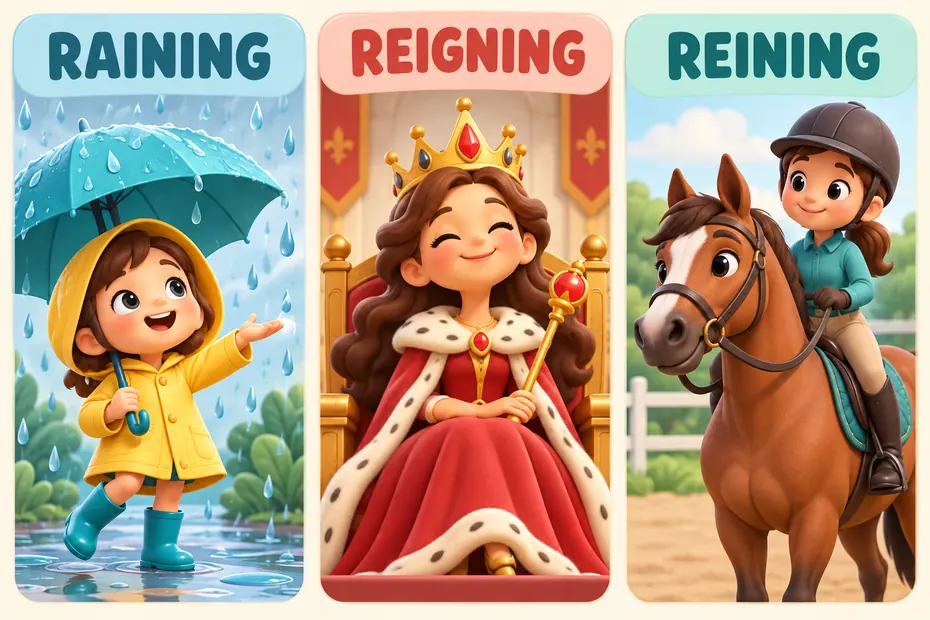
Raining means rain is falling, or something is falling abundantly like rain. Reigning means ruling, holding a title, or prevailing. Reining means guiding with reins or restraining something, especially in reining in. All three normally sound alike. Choose by meaning: weather, rule, or restraint.
Correction to the retained article: its statement that Queen Elizabeth II “is the reigning monarch” is historical rather than current. Its named sports champions also need a date and tournament context. Use the timeless examples below for spelling practice. Reining is not limited to horses, and reigning does not automatically mean exercising unrestricted political power.
Key Facts and Comparison Table
| Form | Base verb | Useful meaning test | Example |
|---|---|---|---|
| Raining | Rain | Falling in drops or abundance | It is raining outside. |
| Reigning | Reign | Ruling or currently holding a title | The reigning champion returned. |
| Reining | Rein | Guiding or holding back | We are reining in costs. |
The base words have noun uses as well: rain is precipitation, a reign is a period of rule, and a rein is a strap used to guide a horse. Adding -ing gives the forms compared here. Their identical ordinary pronunciation makes them homophones; hearing the word alone does not determine its spelling.
Raining: Weather and Figurative Abundance
Use raining in “It has been raining since dawn” or “We waited because it was raining.” The subject it commonly introduces a weather statement. The word can also describe other things falling or arriving abundantly. Merriam-Webster records both literal and extended verb senses in its rain entry.
- “Confetti was raining onto the stage.” The confetti falls like rain.
- “After the announcement, questions came raining in.” Questions arrive in great numbers.
- “It is raining cats and dogs.” This familiar idiom describes heavy rain; animals are not literally falling.
A useful edit is to replace the word with falling. If that preserves the intended image, raining may fit. Do not change “Compliments were raining down” to reigning simply because compliments express admiration. The sentence describes abundance, not authority.

Reigning: Rule, Titles and Prevailing Conditions
A reigning monarch holds the royal position, and a reigning champion currently holds a championship title. In “The queen was reigning when the bridge opened,” the verb places her period of rule in the past. This spelling is supported by the authority and prevailing senses in Merriam-Webster’s reign entry.
“The reigning champion lost the final” is coherent: the competitor entered as the titleholder and then lost. It does not mean the champion could never be defeated. In factual reporting, specify the competition and date rather than treating a named athlete as permanently reigning.
Reign can also be figurative: “Silence reigned in the hall” means silence prevailed. Calling someone a “reigning figure” in an industry is evaluative language; it is not a formal job title. For plain business prose, “leading researcher” or “dominant supplier” may state the intended relationship more precisely.

Reining In: Restraint Beyond Horse Riding
Reins give this spelling its memory hook. “The rider was reining in the horse” concerns guidance or restraint. Figuratively, “The team is reining in spending” means reducing or controlling spending. The Merriam-Webster rein entry includes both horse guidance and restraint.
Use rein in, not reign in, when you mean hold back. The manager may have authority, but “reining in overtime” describes a particular act of restriction. Conversely, “The monarch is reigning” concerns the royal position rather than horse equipment.
Related expressions include free rein for freedom of action and take the reins for taking control. The horse image remains useful even when the topic is an office project. “Give the designer free rein” allows creative freedom; “rein in the design budget” limits expenditure.
Try the Meaning Test
- “It was ___ while the parade passed.” Answer: raining, because the sentence describes weather.
- “The ___ champion signed the trophy.” Answer: reigning, because a title is held.
- “They are ___ in unnecessary travel.” Answer: reining, because travel is being restricted.
- “Suggestions were ___ down after the talk.” Answer: raining, because the image is abundant arrival.
When proofreading, identify what is happening before looking at the letters. A crown suggests reign; straps suggest rein; drops suggest rain. For a difficult sentence, rewrite it with ruling, restraining, or falling and then restore the matching word.
Frequently Asked Questions
Is it reining in or reigning in spending?
Reining in spending is correct for controlling or reducing it. Think of drawing in reins to restrain movement.
Is a reigning champion always currently winning?
No. The phrase identifies the titleholder at the relevant time. It does not predict the outcome of the next contest.
Can raining describe something other than water?
Yes. Figurative examples include raining confetti, questions, or compliments. The image is falling or arriving abundantly.
Are the three words pronounced differently?
In ordinary English they are homophones. Their meanings and written forms distinguish them.
Does every use of reining involve a horse?
No. Figurative reining in can describe controlling costs, impulses, growth, or other activity.
Earlier Article, Preserved for Reference
The original text follows. Treat its named titleholder examples as undated historical examples and use the distinctions above when editing present-day writing.
Key Takeaways
- Raining refers to the natural occurrence of water droplets falling from the sky.
- Reigning is used to describe a person’s rule or dominance over a particular domain.
- Reining refers to the act of guiding or controlling movement, particularly in the context of horses, using reins.
- These words are often confused due to their similar pronunciation, but their meanings and contexts are distinct.
- Understanding their differences will assist in using the right word in the right context, avoiding confusion or miscommunication.
- Proper usage of these words is essential for effective communication, ensuring the correct meaning is conveyed.
The Difference Between Raining, Reigning, and Reining
One of the most common language mistakes occurs when confusing similar-sounding words that have completely different meanings. To help you navigate through this linguistic maze, let’s investigate into the difference between raining, reigning, and reining – three words that often cause confusion due to their similar pronunciation but distinct definitions.
Raining
When we talk about “raining,” we’re referring to how water falls from the sky in the form of droplets. It is a natural phenomenon that occurs when water vapor condenses in the atmosphere and falls back to Earth. Raining is not something humans can control; it is simply a natural occurrence dictated by the weather patterns.
Reigning
On the other hand, when we talk about “reigning,” we are referring to a person’s rule or dominance over a particular domain. It is used to describe a period when a ruler holds power or control. The word “reigning” is typically associated with kings, queens, or other authoritative figures who hold sovereign power and influence over a kingdom or a region.
Reining
Finally, “reining” refers to the act of guiding or controlling movement, particularly in the context of horses. It involves the use of reins, which are straps or ropes attached to the bit of a horse’s bridle. By using these reins, a rider can control the direction, speed, and behavior of the horse. Reining is an essential skill in equestrianism and is crucial for maintaining control and synchronization between the rider and the horse.
To summarize:
- Raining: Natural occurrence of water droplets falling from the sky.
- Reigning: The rule or dominance of a person over a specific domain.
- Reining: Controlling the movement of a horse using reins.
These words are often confused due to their similar pronunciation, but their meanings and contexts are distinct. Understanding their differences will assist you in using the right word in the right context, avoiding any confusion or unintentional miscommunication.
Now that we have clarified the difference between raining, reigning, and reining, let’s explore some examples to solidify our understanding and ensure their appropriate usage in future conversations and written texts.
Examples of Incorrect Usage
One of the common mistakes that people make is incorrectly using the words “raining,” “reigning,” and “reining.” Let’s take a look at some examples of incorrect usage to better understand how to properly use these words.
Incorrect Usage Example 1: Misusing “Raining”
Incorrect: “The queen is raining over the kingdom with her wise decisions.”
Explanation: In this example, “raining” is used incorrectly instead of “reigning.” The word “raining” refers to the natural occurrence of water droplets falling from the sky. It does not express someone’s rule or dominance over a specific domain.
Incorrect Usage Example 2: Confusing “Reigning” and “Reining”
Incorrect: “The cowboy is reigning in the wild stallion.”
Explanation: In this example, “reigning” is used incorrectly instead of “reining.” The correct word to use here is “reining,” which refers to the act of controlling the movement of a horse using reins. “Reigning,” on the other hand, refers to a person’s rule or dominance in a particular area.
Incorrect: “The monarch is reining over the kingdom with authority.”
Explanation: In this example, “reining” is used incorrectly instead of “reigning.” While both words sound similar, they have different meanings. “Reigning” refers to a person’s rule or dominance, while “reining” is about controlling a horse using reins.
Incorrect Usage Example 3: Mixing it Up
Incorrect: “It’s reigning cats and dogs outside.”
Explanation: In this example, “reigning” is used incorrectly instead of “raining.” The phrase “raining cats and dogs” is a common idiom that means it’s raining heavily. Using “reigning” here is incorrect because it does not convey the intended meaning.
Understanding the proper usage of these words is essential to effective communication. By avoiding these common mistakes, you can be confident in using “raining,” “reigning,” and “reining” correctly in different contexts.
Understanding the Definition of Raining
When it comes to the words “raining,” “reigning,” and “reining,” it’s crucial to understand their distinct meanings. In this section, I’ll investigate into the definition of “raining” and provide examples to help clarify its usage.
So, what is the meaning of “raining”? In simple terms, it refers to the natural occurrence of water droplets falling from the sky. It’s a phenomenon that we experience often and can happen in various forms – a light drizzle, a heavy downpour, or even a gentle sprinkle. It’s a beautiful sight to behold, and it plays a vital role in maintaining the Earth’s natural balance.
To better understand the concept, let’s consider a few examples:
- “It’s raining outside, so don’t forget your umbrella.” – In this sentence, “raining” is used to describe the current weather condition, indicating that water droplets are falling from the sky.
- “After days of scorching heat, it finally started raining, providing much-needed relief.” – Here, “raining” signifies the long-awaited arrival of rain after a prolonged period of hot weather.
- “The weather forecast predicts heavy rain tonight, so it’s best to stay indoors.” – In this example, “raining” foreshadows the anticipated occurrence of a significant amount of rain during the night.
Understanding the proper usage of “raining” is essential for effective communication. By using this word correctly, you can accurately describe the weather conditions and convey your message to others.
Proper Usage of the Word Raining
When it comes to the word “raining,” it’s important to understand its proper usage to communicate effectively. Allow me to shed some light on this topic.
What is the difference between “raining,” “reigning,” and “reining”? While these words may sound similar, they have distinct meanings and applications. In this section, we’ll focus on the proper usage of “raining.”
The word “raining” refers to the natural occurrence of water droplets falling from the sky in various forms. It encompasses everything from a light drizzle to a heavy downpour. Rain is a fundamental part of our weather system and plays a crucial role in sustaining life on Earth.
When using the word “raining,” it’s important to note that it is typically used as a verb in the present participle form. This means that it is often used in phrases like “it is raining” or “it’s raining.” This form indicates that the action of rain falling from the sky is currently occurring.
Here are some examples to illustrate the proper usage of the word “raining”:
- “I’m glad I brought my umbrella today. It’s raining quite heavily outside.”
- “The weather forecast predicted that it would be raining all day.”
- “We decided to cancel the picnic because it started raining.”
It’s crucial to use the word “raining” accurately to avoid any misunderstanding or confusion. Choosing the appropriate word in a sentence can significantly impact the clarity and effectiveness of your communication.
Remember, “raining” is specifically used to describe the act of water droplets falling from the sky. Don’t confuse it with “reigning,” which refers to holding power or control over something, or “reining,” which refers to controlling or guiding something, typically in the context of horses.
So, the next time you want to talk about the weather or describe the rain, make sure to use the word “raining” correctly in your sentences. It’s an essential skill for effective communication and will help you express yourself with clarity and precision.
- “Raining” refers to the natural occurrence of water droplets falling from the sky.
- It is typically used as a verb in the present participle form.
- Use phrases like “it is raining” or “it’s raining” to
The Meaning of Reigning
Reigning may sound similar to raining, but its meaning is entirely different. Let me shed some light on what actually “reigning” means.
Reigning is a verb that refers to the exercise of supreme power or control. It is typically used to describe a situation where someone holds authority, rules, or governs over a specific domain. Unlike raining, which is a natural occurrence involving water, reigning involves the exercise of power, influence, or dominance in a certain context.
In a broader sense, reigning can be applied to various situations and contexts. For example, we often use this term when talking about a reigning monarch or a reigning champion in sports. The key characteristic of this term is the concept of having dominion or being in control.
To provide a clearer picture, here are some examples of how reigning is used in different contexts:
- The queen has been reigning for over five decades, making her one of the longest-reigning monarchs in history.
- After their victory, the team is now reigning as the champions of the league for the third consecutive year.
- The CEO is known for his innovative ideas and strategic thinking, which is why he is currently reigning over the tech industry.
Understanding the distinction between raining and reigning is crucial for effective communication. Using the right word in the right context ensures clarity and avoids any confusion or misunderstandings. So, next time when you come across these words, remember, raining refers to water falling from the sky, while reigning denotes the exercise of power or control.
In the next section, we will explore the meaning of reining and how it differs from both raining and reigning. Stay tuned!
Examples of Correct Usage of the Word Reigning
As I mentioned earlier, understanding the proper usage of “reigning” is crucial for effective communication. Let’s explore some examples to illustrate how this word is used correctly:
- In politics, when a monarch or a sovereign exercises supreme power and control over a country, they are referred to as a reigning monarch. For instance, Queen Elizabeth II is the reigning monarch of the United Kingdom.
- In the area of sports, a reigning champion is the individual or team that currently holds the title and is considered the best in their respective field. For example, Novak Djokovic is the reigning champion of men’s singles tennis at Wimbledon.
- Another instance is when we talk about a reigning heavyweight boxing champion, such as Muhammad Ali in his prime.
- We can also use “reigning” to describe someone who holds a position of power or influence in a particular field. For instance, Elon Musk can be considered a reigning figure in the tech industry due to his success with companies like SpaceX and Tesla.
By using “reigning” correctly in these contexts, we can convey the specific idea of someone holding supreme power or being at the top of their game.
Remember, using the word “reigning” accurately helps to avoid confusion and ensures clear communication. So, the next time you want to describe someone in a position of power or dominance, make sure to use the word “reigning” appropriately.
Clearing Up the Confusion about Reining
When it comes to understanding the difference between “raining,” “reigning,” and “reining,” it’s essential to have a firm grasp of their individual meanings and usage. In this section, I will investigate into the specific definition of “reining” and provide examples to help clear up any confusion.
To begin with, “reining” is a verb and it refers to the action of controlling or directing something, particularly a horse. It is often used in the context of horseback riding, where the reins are used to guide and control the horse’s movements. Here are a few examples to illustrate its usage:
- In equestrian competitions, riders must have excellent skills in reining in their horses to execute precise movements and maneuvers.
- The trainer spent hours reining in the young horse, teaching it the proper techniques and commands.
- I gradually learned how to effectively use the reins, gaining control and reining in my spirited horse.
As you can see, “reining” is a word that is most commonly associated with horseback riding. It conveys the idea of controlling or directing movement, whether in a competition or during training. It is essential to use “reining” correctly to avoid confusion and ensure clear communication.
Understanding the specific meaning of “reining” is crucial, as it helps differentiate it from the similarly spelled words “raining” and “reigning.” While “raining” refers to water falling from the sky and “reigning” relates to exercising supreme power or control, “reining” focuses on the act of guiding and controlling a horse.
By familiarizing yourself with the proper usage of “reining,” you can avoid common mistakes and effectively communicate your ideas. So, remember to use “reining” when talking about controlling or directing a horse, and reserve “raining” for precipitation and “reigning” for those in positions of power or control.
Now that we have clarified the meaning of “reining,” let’s move on to the next section where we will explore examples and proper usage of the word “reigning” in various contexts.
How to Use Reining Correctly
As we continue exploring the differences between “raining,” “reigning,” and “reining,” it’s important to understand the proper usage of each word. In this section, I’ll investigate into how to use “reining” correctly, so you can effectively communicate your ideas.
When we talk about “reining,” we’re referring to the action of controlling or directing something, particularly a horse. Picture a skilled equestrian guiding their horse through intricate movements with finesse and precision. That’s what “reining” is all about.
Here are a few key points to keep in mind when using “reining”:
- Definition of “reining”: “Reining” is a verb that describes the act of guiding and controlling a horse’s movements. It’s commonly associated with horseback riding.
- Differentiating “reining” from “raining” and “reigning”: While “reining” deals with controlling a horse, “raining” refers to water falling from the sky, and “reigning” indicates the exercise of supreme power or control.
- Examples of correct usage: Let me provide you with some examples to illustrate the proper usage of “reining”:
- The expert rider skillfully reins in the horse, demonstrating complete control over its movements.
- Sarah has been reining horses for years and is considered one of the top riders in her discipline.
- The trainer focused on reining in the horse’s wild behavior, helping it become more manageable and obedient.
By understanding and using “reining” appropriately, you can avoid common mistakes and effectively convey your thoughts. It’s crucial to differentiate it from “raining” and “reigning” to ensure clear communication.
Now that we’ve explored the correct usage of “reining,” let’s continue our journey to uncover the nuances of “reigning” and its various applications.
Conclusion
To conclude, understanding the difference between “raining,” “reigning,” and “reining” is crucial for effective communication. By using these words appropriately, we can avoid confusion and ensure clear and concise expression.
“Raining” refers to the fall of water droplets from the sky, while “reigning” is used to describe the exercise of supreme power or control. On the other hand, “reining” is a verb that specifically pertains to controlling or directing something, particularly a horse.
By familiarizing ourselves with the correct usage of these words, we can avoid common mistakes and convey our ideas accurately. Whether discussing weather conditions, the rule of a monarch, or the act of guiding a horse, using the right word will enhance our communication.
So, let’s remember to use “raining” when talking about precipitation, “reigning” when referring to supreme power or control, and “reining” when discussing the control or direction of something, especially a horse. This understanding will undoubtedly improve our writing and ensure effective communication in various contexts.
Frequently Asked Questions
Q: What is the article about?
A: The article explains the difference between “raining,” “reigning,” and “reining,” focusing on the proper usage of “raining.”
Q: What does “reigning” mean?
A: “Reigning” refers to the exercise of supreme power or control, such as a reigning monarch or a reigning champion in sports.
Q: How should “reigning” be used?
A: “Reigning” should be used to describe a person or entity that holds supreme power, dominance, or a position of influence in a particular field.
Q: What is “reining”?
A: “Reining” is a verb that means controlling or directing something, especially a horse. It is commonly associated with horseback riding.
Q: How can “reining” be distinguished from “raining” and “reigning”?
A: Understanding the specific meaning of “reining” is crucial to differentiate it from “raining” (precipitation) and “reigning” (supreme power or control).
Q: Why is it important to use these words accurately?
A: Using these words accurately ensures clear communication and avoids confusion in written and spoken language.


