
Quick Answer: Bused vs. Bussed vs. Bust
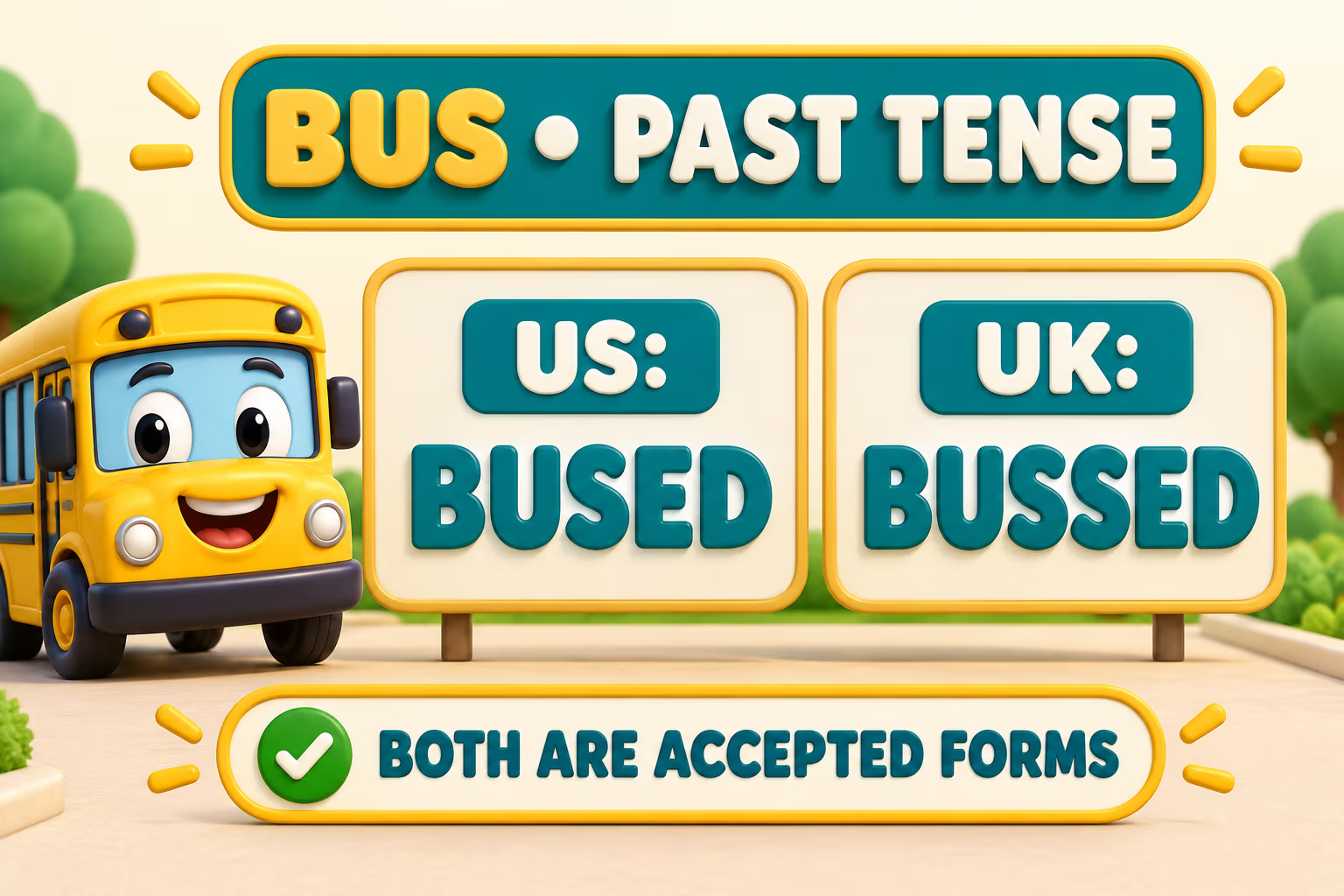
Quick answer: For the transportation verb, both “bused” and “bussed” are accepted past-tense and past-participle spellings. Cambridge maps “bused” mainly to U.S. usage and “bussed” mainly to U.K. usage, while Merriam-Webster lists both. “Bust” is a separate word: its verb can mean break, and its noun can mean a sculpture or the upper torso.
Bused, Bussed, and Bust at a Glance
- Bused and bussed are both accepted past-tense and past-participle forms of the transportation verb bus.
- Cambridge associates bused with U.S. usage and bussed with mainly U.K. usage; check the variety and house style you are writing for.
- Bussed does not have a special dictionary meaning limited to organized group trips or formal events.
- Bust is a separate word; Merriam-Webster lists busted and bust as past forms of its verb meaning break or smash.
- As a noun, bust can mean a sculpture of the upper body or the upper torso; it is not the usual noun for a broken object.
How Do Dictionaries Distinguish the Three Words?
For bus travel, bused and bussed have the same grammatical job and meaning: each is a past-tense or past-participle form of bus. Merriam-Webster lists “bused also bussed”; Cambridge’s Learner’s Dictionary entry pairs U.S. bused with mainly U.K. bussed. The spelling difference does not create a separate group-transport meaning.
| Form | Dictionary-supported use | Practical choice |
|---|---|---|
| bused | Past or past participle of bus: travel or transport by bus. | Common U.S. form in Cambridge; use it for U.S. house style. |
| bussed | Also a past or past participle of the transportation verb bus. | Cambridge associates it mainly with U.K. usage; it is not restricted to group events. |
| bust | A separate word. Its verb can mean break or smash; its noun can mean an upper-body sculpture or torso. | Choose it only when that separate meaning fits, not as the past of bus. |
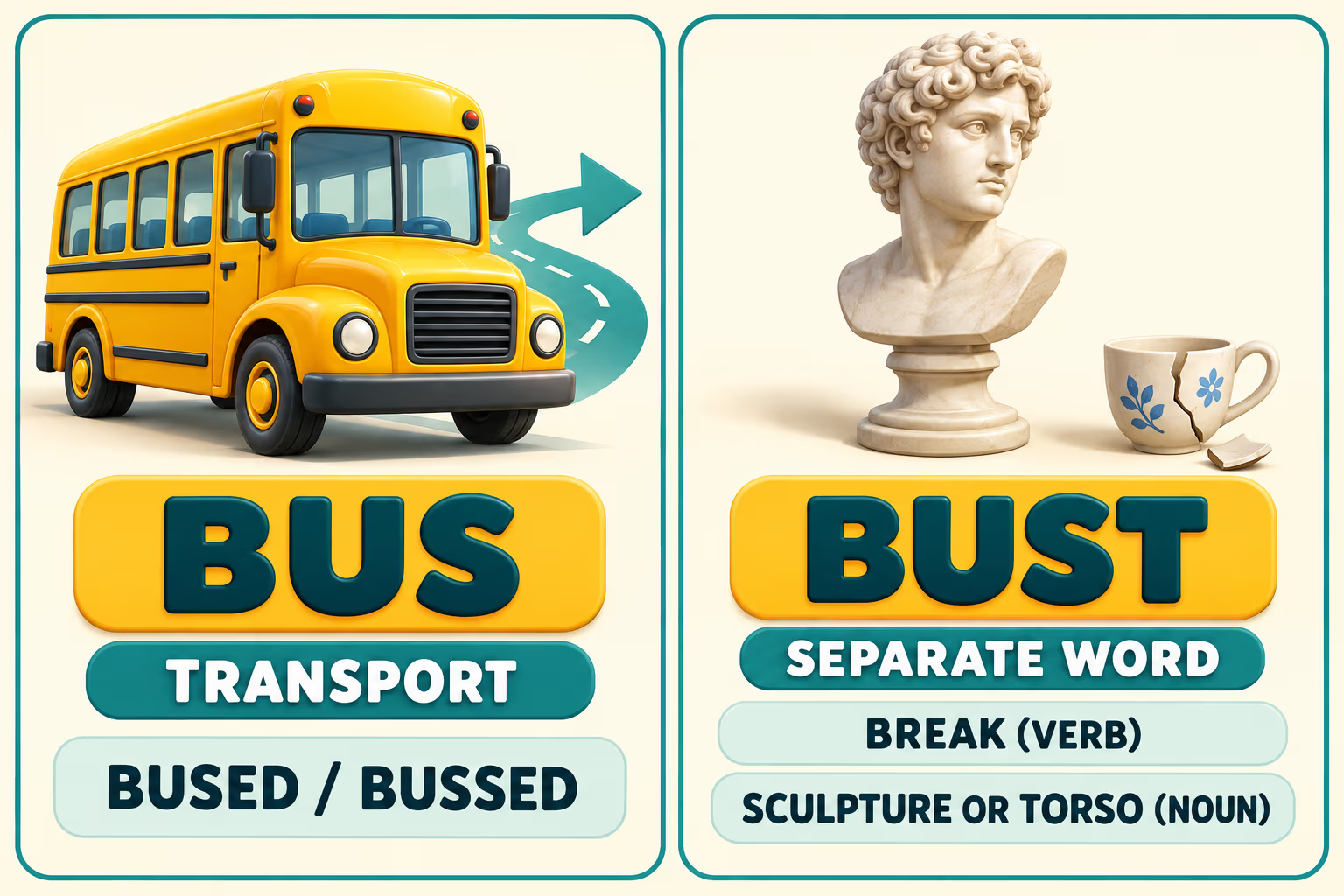
Oxford Learner’s Dictionaries also lists both bused and bussed as past-tense and past-participle forms. Merriam-Webster’s bust entry lists the verb forms busted and bust and defines a separate noun sense for a sculpture of the upper body. These entries clarify why a broken object may be described as “busted” or “broken,” while a “bust” is typically the sculpture or torso itself.
Does “Bussed” Mean Group Transportation Only?
No. “Bussed” is an accepted past form of bus, but its meaning is not limited to transporting an organized group for a special event. Cambridge’s bussed entry defines it as the past simple and past participle of bus and gives examples involving travel to different areas, hotels, and schools. Merriam-Webster likewise gives bused and bussed as variants of the same transportation verb.
Which Spelling Should I Use in My Writing?
Match your audience and editorial style. For U.S. English, Cambridge labels bused as the past-tense and past-participle form, while its learner entry associates bussed mainly with U.K. usage. For U.K.-oriented writing, bussed is a familiar choice. When a publisher or organization has a style guide, follow that guide; otherwise, choose one form and keep it consistent in a single piece.
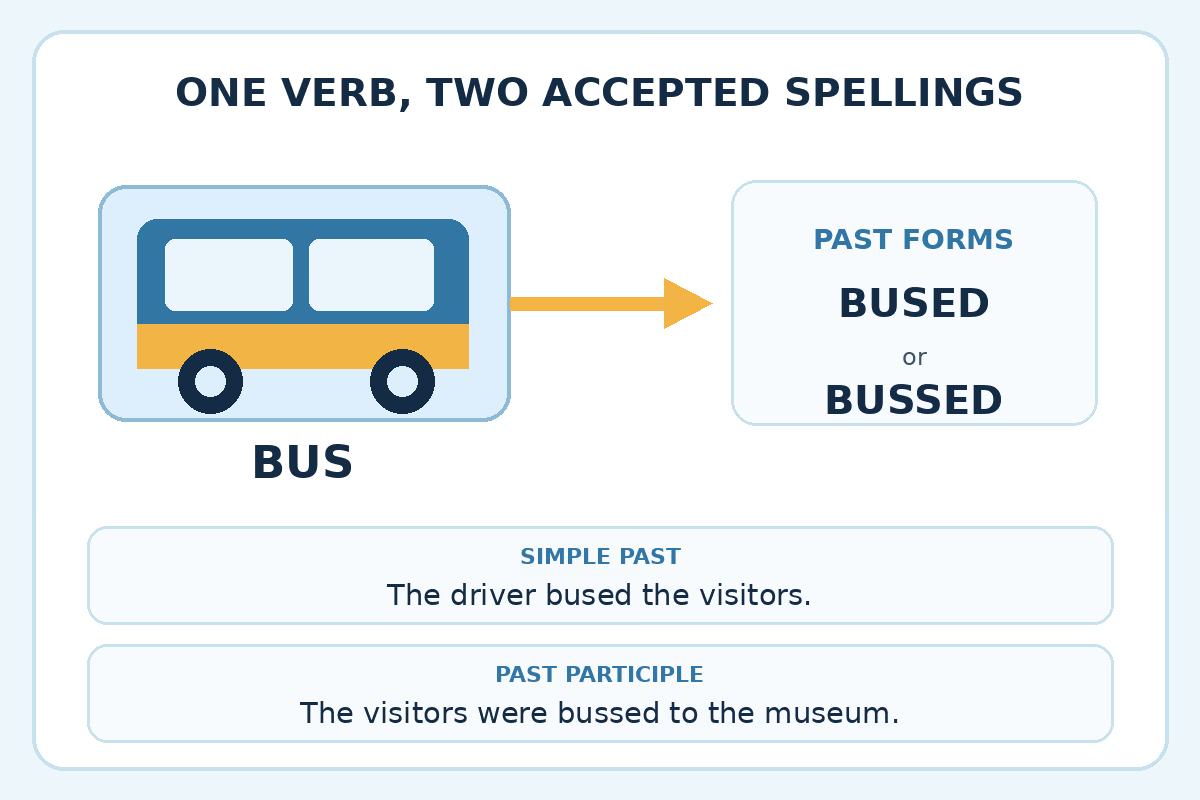
Illustrative examples: “The district bused the visitors to the gallery” uses the single-s spelling; “The school bussed the pupils to the museum” uses the double-s spelling. Both sentences describe transportation by bus. By contrast, “The museum displayed a marble bust” uses the noun for a sculpture.
For another spelling comparison involving single and doubled consonants, see gased vs. gassed vs. gast.
Key Takeaways
- “Bused” is the correct past tense and past participle form of the verb “bus” and is the most commonly used term in Standard English.
- “Bussed” is a less commonly used alternative form of “bused” and is generally used in informal or spoken language.
- “Bust” is a different word altogether with a meaning unrelated to transportation, referring to breaking or smashing something or a failure or collapse of something.
- While “bused” and “bussed” have similar meanings, “bussed” is often used when referring to organized group transportation or specific events.
- Both “bused” and “bussed” are correct forms, but it is important to maintain consistency in your writing by choosing one form and sticking to it.
- “Bust” primarily refers to breaking or damaging something, a failure or collapse, or a person’s chest or upper body. It is not the correct past tense or past participle form of the verb “bus.”
What Does “Bused” Mean?
To understand the meaning of “bused,” it’s important to look at its definition and how it differs from similar words like “bussed” and “bust.”
The term “bused” is the past tense and past participle form of the verb “bus.” It means to transport people, usually in a large vehicle like a bus, from one place to another. So when we say “I bused to work every day,” it means that I used a bus as a means of transportation to get to work.
Let’s clarify the difference between “bused,” “bussed,” and “bust” to avoid any confusion:
- The word “bused” (with one “s”) is the correct past tense and past participle form of the verb “bus.” It is the most commonly used and accepted term in Standard English.
- On the other hand, “bussed” (with two “s”) is a less commonly used alternative form of “bused.” While it is not incorrect, it is less widely recognized and used in formal writing or in the context of public transportation.
- Finally, “bust” (with a “t”) is a completely different word that has a different meaning altogether. It can refer to the act of breaking or smashing something or being caught by the police in a raid. For example, “The police busted the drug smuggling operation.”
Summarizing, the main difference between “bused,” “bussed,” and “bust” lies in their meanings and grammatical usage. While “bused” is the standard past tense and past participle form of the verb “bus,” “bussed” is a less common alternative. And “bust” is a different word altogether, with a separate meaning unrelated to transportation.
What Does “Bussed” Mean?
When it comes to the usage of “bussed,” many people often confuse it with “bused.” But, these two words have slight differences in their meanings and grammatical usage.
The past tense and past participle form of the verb “bus” is “bused”. It is used to describe the act of transporting people using a bus. For example, “I bused to work every day last week.” Here, “bused” indicates the action of using a bus as a means of transportation.
On the other hand, “bussed” is a less commonly used alternative form of “bused.” It also refers to the act of transporting people using a bus, but it can have a slightly different connotation. The term “bussed” is often used when referring to a group of people being transported together or when describing a specific event. For instance, “The school bussed the students to the museum for a field trip.” In this case, “bussed” emphasizes the organized transportation of a group of students for a specific purpose.
It’s important to note that the usage of “bussed” is not as widespread as “bused.” In everyday language, “bused” is more commonly used to convey the idea of using a bus for transportation.
Summarizing, “bused” is the standard past tense and past participle form of the verb “bus,” used to indicate the act of transporting people using a bus. “Bussed” is a less commonly used alternative that can denote organized group transportation or specific events. Both words have similar meanings but differ in their connotations and frequency of use.
So, next time you’re talking about using a bus for transportation, remember to use “bused” as the correct form.
What Does “Bust” Mean?
“Bust” is a word that can have multiple meanings depending on the context in which it is used. Here, we’ll explore the most common definition of “bust” and how it differs from the words “bused” and “bussed.”
The primary definition of “bust” is to break or smash something, often with a sudden or forceful action. It can also be used to describe a failure or collapse of something, such as a business or a plan. Also, “bust” can refer to a sculpture or depiction of a person’s head, shoulders, and upper chest.
It is important to note that “bust” is not the correct past tense or past participle form of the verb “bus.” Instead, the correct forms are “bused” and “bussed” depending on the preferred usage. While “bust” and “bused” might seem similar in terms of their pronunciation, they have different meanings and applications.
Summarizing, the primary definition of “bust” is to break or smash something, while “bused” and “bussed” are used in relation to transportation using a bus. Understanding the differences between these words is crucial for accurately expressing ideas and avoiding confusion in your writing.
Next, we will explore the definition and usage of “bused” in more detail. Keep reading to enhance your understanding of these commonly confused words.
When to Use “Bused”
As an expert in the English language, I’d like to clarify the appropriate usage of the word “bused” in your writing. Understanding the differences between “bused,” “bussed,” and “bust” is crucial for accurately expressing your ideas and avoiding confusion.
So, when should you use “bused”? Let me break it down for you:
Definition of “Bused”
The word “bus” is commonly used as a noun to refer to a large vehicle used for public transportation. But, it can also be used as a verb, meaning to transport someone or something by bus.
When “bus” is used in the past tense or as a past participle, the correct form is either “bused” or “bussed.” The choice between the two depends on your preferred usage or regional differences.
Difference Between “Bused” and “Bussed”
Although “bused” and “bussed” both represent the past tense and past participle forms of “bus,” there is no significant difference in meaning between the two. It boils down to personal preference or regional variations. Some writers may use “bused” more frequently, while others may opt for “bussed.”
Please note that both “bused” and “bussed” are widely accepted and recognized as correct forms. But, consistency within your writing is key, so choose one form and stick to it throughout your piece.
Examples of “Bused” in a Sentence
To provide you with a better understanding, here are a few examples of how you can use “bused” in your writing:
- The students were bused to the museum for their field trip.
- The company bused its employees to the conference venue.
- We bused ourselves to the beach to enjoy the sunny weather.
Remember, whether you use “bused” or “bussed,” make sure you maintain consistency in your article or essay to avoid confusing your readers.
When to Use “Bussed”
When it comes to the usage of the word “bussed,” there are a few key considerations to keep in mind. Let’s jump into what “bussed” is, its definition, and when it is appropriate to use it.
Definition of “Bussed”
“Bussed” is the past tense and past participle form of the verb “bus.” The word “bus” refers to the act of transporting people or goods by bus. In the context of transportation, “bussed” indicates that someone or something was transported by bus in the past.
Difference Between “Bussed” and “Bused”
The main difference between “bussed” and “bused” lies in their usage and formality. While both forms are considered correct, “bused” is generally preferred in most formal writing and publications, while “bussed” is more commonly used in informal or spoken language.
When to Use “Bussed”
There are a few instances when it is appropriate to use “bussed” in your writing:
- Informal Conversations: In casual conversations or informal writing, such as personal emails or text messages, using “bussed” is perfectly acceptable. It adds a conversational tone to your language and is less formal than “bused.”
- Dialogue in Fiction: When writing dialogue in fiction or creative pieces, using “bussed” can help create a natural, authentic, and relatable conversation between characters.
- Regional Variations: Depending on the region or dialect, “bussed” may be more commonly used than “bused.” If you are writing for an audience from a specific region where “bussed” is the norm, using it can help you connect with your readers effectively.
Remember, consistency is crucial when choosing between “bussed” and “bused.” Stick to one form throughout your writing to avoid confusing your readers.
To conclude, “bussed” is a valid form of the verb “bus,” and it can be used in informal conversations, dialogue in fiction, and in regions where it is the preferred form. Understanding when to use “bussed” versus “bused” allows you to adapt your language appropriately based on the context and level of formality required.
For more examples and a comprehensive understanding of the usage of “bused” and “bussed,” continue reading the next section.
When to Use “Bust”
As we continue our exploration of the commonly confused words “bused,” “bussed,” and “bust,” let’s now turn our attention to the usage of “bust.”
What is “Bust”?
The word “bust” is a noun that has several meanings. Let’s take a closer look at some of its definitions:
- A broken or damaged object: When something is “bust,” it means that it has been broken or damaged. For example, “I accidentally dropped the vase, and now it’s bust.”
- A failure or a collapse: In informal language, “bust” can be used to describe a failure or a collapse of a plan, venture, or relationship. For instance, “The concert was a bust; hardly anyone showed up.”
- A person’s chest or upper body: In slang, “bust” can refer to a person’s chest or upper body. This usage is often seen in expressions such as “bust a move” or “bust your gut.”
When to Use “Bust”
Now that we know the definitions of “bust,” let’s see when it is appropriate to use it in a sentence:
- Use “bust” when referring to a broken or damaged object. For example: “I dropped my phone, and now the screen is completely bust.”
- Use “bust” to describe a failure or a collapse of a plan, venture, or relationship. Example: “Our business partnership went bust after just a few months.”
- Use “bust” in slang expressions to refer to a person’s chest or upper body. Example: “He’s been hitting the gym and has really built up his bust.”
Remember, “bust” is primarily used as a noun, but it can also be used as a verb in certain contexts. But, the verb form is less common and often refers to actions such as breaking or damaging something.
Conclusion
Now that we have explored the appropriate usage of “bused,” “bussed,” and “bust,” it is clear that consistency is key when using these words in writing. “Bused” is the correct past tense and past participle form of the verb “bus,” while “bussed” is a variation that is more commonly used in informal or spoken language. It is important to choose one form and stick with it throughout a piece of writing to avoid confusing readers.
Also, we have learned that “bust” has multiple meanings as a noun, including a broken object, a failure, or a person’s chest or upper body. It can also be used as a verb in certain situations. Understanding the appropriate context for using “bust” is crucial in conveying our intended meaning accurately.
By following these guidelines and being consistent in our usage, we can ensure that our writing is clear and effective. For more examples and a comprehensive understanding of the usage of “bused,” “bussed,” and “bust,” I invite you to continue reading.
Frequently Asked Questions
Q: What is the correct past tense and past participle form of the verb “bus”?
A: The correct past tense and past participle form of the verb “bus” is “bused.”
Q: When should I use “bused” or “bussed” in my writing?
A: The choice between “bused” and “bussed” depends on personal preference or regional variations. However, it is important to be consistent in using either “bused” or “bussed” throughout your writing to avoid confusion.
Q: What is the definition of “bussed”?
A: “Bussed” is more commonly used in informal or spoken language, such as casual conversations, personal emails, and text messages. It can also be used in dialogue in fiction to create a natural conversation between characters. Additionally, “bussed” may be more commonly used in certain regions or dialects.
Q: What does the word “bust” mean?
A: “Bust” can be a noun with multiple meanings, including a broken or damaged object, a failure or collapse, and a person’s chest or upper body. It can also be used as a verb in certain situations.
Q: Why is consistency important when using “bused,” “bussed,” and “bust”?
A: Consistency is important in using “bused,” “bussed,” and “bust” to maintain clarity and avoid confusing readers. It is recommended to choose one form and use it consistently throughout your writing. For more examples and a comprehensive understanding of their usage, continue reading the article.
Are “bused” and “bussed” both correct?
Yes. Both are accepted past-tense and past-participle spellings of the transportation verb bus. Merriam-Webster lists bused as a variant of bussed, while Cambridge associates bused with U.S. usage and bussed mainly with U.K. usage. Follow your audience’s variety or publication style guide, then stay consistent.
Does “bussed” always describe a group trip?
No. Bussed means transported by bus when it is the past form of the verb bus, whether the sentence describes one person or many. The spelling does not itself signal a field trip, special event, or organized group. Cambridge’s examples use bussed in several ordinary transport contexts.
Can “bust” be the past tense of “bus”?
No. Bust is a separate word from bus. Merriam-Webster gives busted and bust as past forms of the verb meaning break or smash, while bust as a noun can mean a sculpture of the upper body or the torso. For transportation by bus, use bused or bussed.
What is the difference between a “bust” and a broken object?
A bust most often names a sculpture showing a person’s head and upper body, or the upper torso itself. Bust can also be a verb meaning break or smash, and it has other noun senses such as a failure. For an object that no longer works, broken or busted is usually clearer.


