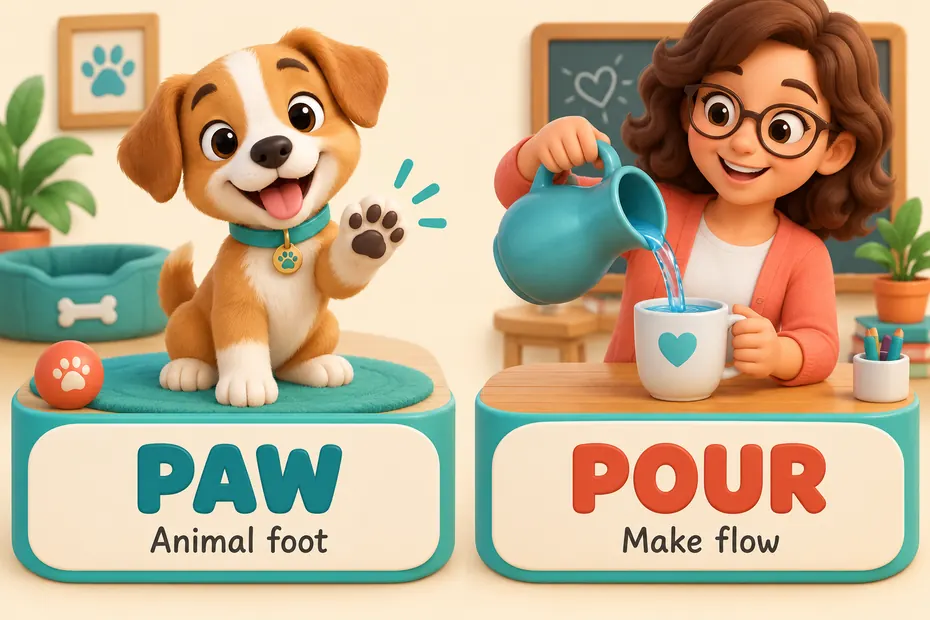
Paw vs pour: the answer and the “povs” clarification
Paw names an animal’s foot and can also be a verb; pour describes making something flow or flowing freely. A cat raises a paw, paws at a toy and watches you pour water into a bowl. Paws is the regular plural of paw. The garbled spelling “povs” in the older title does not establish which word was intended.
Correction to the retained discussion below: it is too confident to say that every occurrence of povs is a misspelling of paws. In a discussion of viewpoints, POV is the abbreviation for point of view, and POVs can be a plural form. In a sentence about animal feet, paws is appropriate. Inspect the context instead of automatically replacing all similar letters. Also, paw is not only a noun and pour is not restricted to liquids.
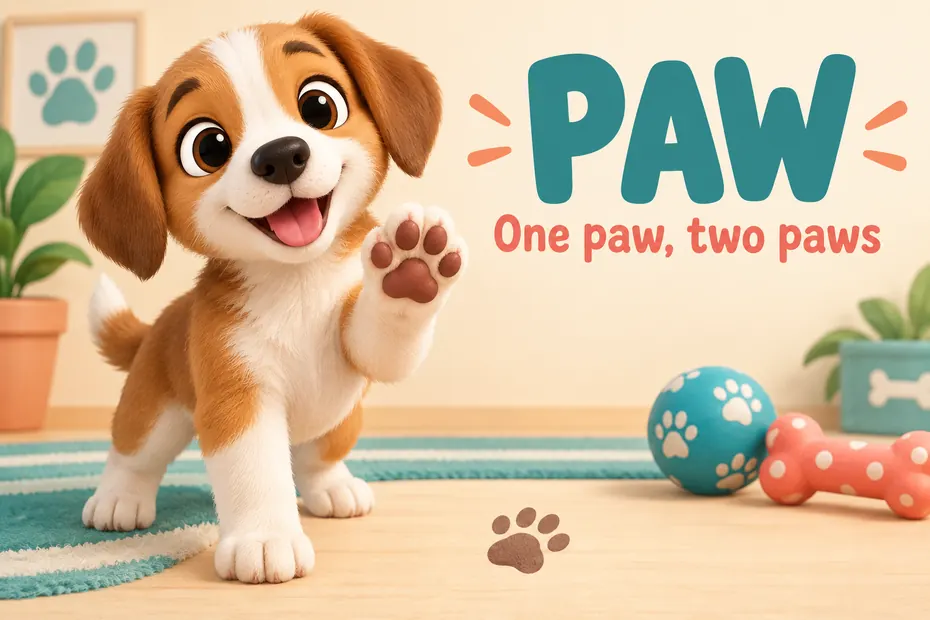
Key facts and a comparison table
| Form | Meaning or role | Fresh example |
|---|---|---|
| Paw | One animal foot | The puppy placed one paw on the mat. |
| Paws | Plural noun | Her muddy paws left little prints. |
| Paw; paws | Verb | The cat paws at the ribbon. |
| Pour | Make flow | Please pour water into the glass. |
| Poured; pouring | Verb forms | Rain was pouring onto the roof. |
| POV | Point of view | The story changes POV between chapters. |
Merriam-Webster’s entries support the noun and verb uses of paw, the varied meanings of pour, and POV as point of view. These verified entries provide useful distinctions without inventing a definition for the damaged spelling in this page’s older text.

Use paw and paws for the animal context
“The dog lifted its paw” refers to one foot. “The dog cleaned its paws” refers to more than one. The plural adds s without an apostrophe. For possession, the apostrophe belongs to the owner: “the dog’s paw” for one dog’s foot and “the dogs’ paws” for the feet of several dogs.
As a verb, paw describes touching, striking or searching roughly. “The kitten pawed at the hanging string” is a past action. “He pawed through the box of old receipts” describes a rough search rather than an animal foot. The object and setting tell readers which sense is intended.
Keep verb agreement separate from plural meaning. In “The cat paws at the door,” paws is a singular-subject verb. In “The cat’s paws are muddy,” paws is a plural noun. An s ending alone is therefore not enough to identify the grammatical job. Find the subject and the action before deciding how to explain the sentence.
Use pour for a flowing action
“Pour the juice into the glass” specifies both the action and destination. “Pour the sauce over the vegetables” gives a surface rather than a container. The prepositions into and over help readers understand the movement, while pour supplies the verb.
Pour can also describe things other than literal liquid: people may pour out of a theater, and messages may pour in after an announcement. In each example, the writer pictures a continuing stream or large influx. Do not reject those figurative uses simply because the sentence contains no water.
For heavy rain, “It is pouring” is a complete everyday sentence. For your own action, include the subject or use an instruction: “I am pouring the tea” or “Pour the tea.” Paw cannot replace pour in those sentences merely because the two words may sound similar in some accents.

How to resolve a doubtful “povs” spelling
- Read the entire sentence, not only the unfamiliar letters.
- If it describes animal feet, test paws and check singular or plural agreement.
- If it discusses narrators or viewpoints, check whether POV or POVs was intended.
- If it describes a flowing action, test pour, pours, poured or pouring.
- When the context remains unclear, consult the original source rather than guessing a replacement.
For example, “The puppy’s povs were wet” gives an animal clue and a plural verb, so paws is a sensible correction. “The two narrators offer different POVs” concerns perspectives and should not be changed to paws. These are newly written examples, not evidence of what the older damaged title originally meant.
Frequently asked questions
Is the plural of paw paws?
Yes. Write one paw and two paws. An ordinary plural does not need an apostrophe.
Can paw be a verb?
Yes. A cat can paw at a toy, and a person can paw through a box. The context identifies the touching or searching action.
Does pour always concern liquid?
No. It can describe a stream of people, messages or other things figuratively. The flowing image supplies the connection.
Does POVs mean animal feet?
No when it is the plural of POV, point of view. In writing about animals, the usual intended word for their feet is paws.
Are paw and pour always pronounced alike?
No. Pronunciation varies by accent, especially whether the r in pour is pronounced. Choose the spelling from meaning rather than assuming a universal sound match.
Have you ever found yourself confused about when to use “paw,” “povs,” or “pour”? Don’t worry, you’re not alone. In this text, I’ll guide you through the proper usage of these commonly confused words, helping you avoid embarrassing mistakes. Whether you’re a native English speaker or learning the language as a second language, understanding the differences between “paw,” “povs,” and “pour” is essential for effective communication. So, let’s immerse and unravel the mysteries behind these words, ensuring you use them appropriately in your everyday conversations and writing. Get ready to enhance your language skills and gain confidence in expressing yourself accurately.
Key Takeaways
- Understanding the proper usage of “paw,” “povs,” and “pour” is crucial for effective communication.
- “Paw” refers to an animal’s foot, specifically the limbs of animals like dogs, cats, bears, and lions.
- “Povs” is a misspelling of “paws” and is not a recognized word in English, so it should be avoided.
- “Pour” is a verb that means to cause a fluid to flow in a steady stream, often used to describe actions like pouring a liquid or rainfall.
- Confusing “paw” with “povs” or “pour” can lead to misunderstandings, so it’s important to use the correct term in the appropriate context.
- Being aware of these distinctions and avoiding common mistakes will enhance your language skills and improve your communication.
When to Use “Paw”
When it comes to the words “paw,” “povs,” and “pour,” understanding their proper usage is crucial for clear communication. Let’s start by focusing on the word “paw” and when to use it correctly.
Definition of “Paw”: The word “paw” refers to the foot or the lower part of the leg of an animal. It is commonly used to describe the limbs of animals such as dogs, cats, bears, and lions.
Difference between “Paw” and “Povs” and “Pour”: It’s important to note that “paw” is a specific term that specifically relates to the animal kingdom. On the other hand, “povs” and “pour” have different meanings altogether.
Examples of “Paw”: To help clarify, here are a few examples of how to use “paw” in a sentence:
- My dog loves to chase its own tail, and it often scratches me with its paws.
- The lion extended its massive paw toward the trainer, sniffing curiously.
- Her cat likes to playfully bat at toys with its soft paws.
Remember, when discussing animals and referring to their feet or legs, “paw” is the appropriate term to use. Don’t confuse it with “povs” or “pour,” which have different meanings and usage.
Moving forward in this text, we will explore the correct usage of “povs” and “pour” to ensure you have a complete understanding of these commonly confused words.
When to Use “Povs”
As I mentioned earlier in this text, one of the commonly confused words is “povs.” Now, let’s jump into understanding when to use this word correctly.
Definition of “Povs”
“Povs” is actually not a word in proper English usage. It is a misspelling of “paws,” which refers to the feet of an animal. The correct spelling is crucial in understanding and effectively communicating your message.
Difference Between “Paw” and “Povs”
To clarify the distinction between “paw” and “povs,” let me provide a quick summary:
- “Paw” is the correct spelling and refers to the foot of an animal.
- “Povs” is an incorrect spelling and is not a recognized word in English.
It is important to be aware of the correct terminology when referring to an animal’s feet.
Examples of Correct Usage
To further illustrate the proper usage of “paw,” here are a few examples:
- My dog loves to shake paws with visitors.
- The cat used its paws to play with the toy mouse.
- Be careful not to step on the puppy’s delicate paws.
Remember, when discussing an animal’s feet, always use the word “paw” instead of “povs.”
Conclusion
By now, you should have a solid understanding of when to use “paw” correctly. It is essential to use the correct spelling to accurately convey your message about an animal’s foot. Avoid using the incorrect spelling “povs,” as it is not a recognized word in English. Let’s move on to exploring the correct usage of “pour” in the next section.
When to Use “Pour”
When it comes to the usage of the word “pour,” there are a few key things to keep in mind. Let’s explore the proper contexts in which to use this word:
Definition of “Pour”: “Pour” is a verb that typically means to cause a fluid to flow in a steady stream. It implies the action of transferring or dispensing a liquid substance.
Difference between “Pour” and “Paw”: It’s important to note that “pour” and “paw” are completely different words with different meanings. While “pour” refers to the act of transferring liquid, “paw” refers to an animal’s foot.
Here are some situations where you would use the word “pour”:
- To describe the action of pouring a liquid: Whether it’s pouring a glass of water, pouring milk into a bowl of cereal, or pouring coffee into a cup, the word “pour” is the correct choice.
- To describe rainfall: When rainwater is coming down heavily, you can say that it is pouring rain. This conveys the idea of a significant amount of water falling from the sky.
- To describe pouring liquid into a container: If you are pouring juice into a jug, filling up a water bottle, or transferring liquid from one container to another, you would use the word “pour.”
It’s important to use “pour” correctly to accurately convey your message. Confusing it with “paw” or other words can lead to misunderstandings or misinterpretations.
By understanding the appropriate usage of “pour,” you can effectively communicate your ideas and avoid confusion. Using the correct word in the right context is essential for clear and precise communication.
In the next section, we will investigate into the differences between “paw” and “pour” to further enhance your understanding of their usage.
Common Mistakes to Avoid
When it comes to the usage of words, paw, povs, and pour, there are several common mistakes that people make. Understanding these mistakes can help you avoid confusion and effectively convey your message. Let’s take a closer look at some of these common errors:
Confusing “paw” with “povs”
One common mistake is the confusion between the words paw and povs. Remember, povs is actually a misspelling of paws and is not a recognized word in English. To accurately refer to an animal’s feet, always use the correct spelling – paw.
Examples:
- “The dog gently placed its paw on my hand.”
- “I could feel the cat’s soft paws as it walked across my lap.”
Misusing “pour”
Another mistake often made is the improper usage of the word pour. To avoid misunderstandings, it’s important to use this verb correctly. Pour means to cause a fluid to flow in a steady stream.
Examples:
- “She poured a cup of coffee for herself.”
- “The rain poured down, drenching us in seconds.”
Remember, pour is used when you’re describing actions like pouring a liquid, rainfall, or pouring liquid into a container.
Understanding the Differences
To further enhance your understanding of the differences between paw and pour, it’s crucial to note that they belong to completely different categories. Paw is a noun used to refer to an animal’s foot, while pour is a verb used to describe an action involving liquids.
By avoiding these common mistakes, you can ensure that you’re using the correct word in the right context. Remember, accuracy and clarity are key when communicating in English.
Keep reading to explore more examples and gain a deeper understanding of the usage and nuances of these words.
Tips for Using “Paw,” “Povs,” and “Pour” Correctly
As an expert blogger, I’m here to provide you with some valuable tips on how to use “paw,” “povs,” and “pour” correctly. Understanding and using these words accurately will help you communicate more effectively in English. So, let’s immerse!
Clear Definitions and Differences
To start off, let’s clarify the definitions of these words and highlight their differences:
- “Paw”: This noun refers to an animal’s foot or, more specifically, to the soft pads and claws on a mammal’s foot. For example, when you see a cat gently pawing at a toy, it’s using its paws.
- “Povs”: Now, “povs” is actually a misspelling of “paws” and is not a recognized word in English. So, avoid using “povs” and always opt for “paws” instead to accurately convey the message about an animal’s foot.
- “Pour”: Moving on to the verb “pour,” it means to cause a fluid to flow in a steady stream. This word is commonly used when describing actions like pouring a liquid, rainfall, or pouring a liquid into a container.
Common Mistakes to Avoid
Now that we have a clear understanding of the definitions, let’s look at some common mistakes to avoid when using these words:
- Confusing “paw” with “povs”: Remember, “povs” is not a recognized word, so always use “paw” to refer to an animal’s foot. For example, it’s correct to say, “The dog’s paws left muddy footprints on the floor.”
- Misusing “pour”: Be mindful of using “pour” correctly. It’s important to accurately describe the act of causing a fluid to flow in a steady stream. For instance, you would say, “She poured the tea into the cup” or “The rain poured down all day.”
- “The cat gently tapped my hand with her paw.”
- “I accidentally poured milk all over the kitchen counter.”
- “The heavy
Conclusion
By understanding the proper usage of “paw,” “povs,” and “pour,” you can communicate more effectively and avoid common mistakes. Remember, “paw” refers to an animal’s foot, while “povs” is simply a misspelling of “paws” and should be avoided. On the other hand, “pour” is a verb that describes the action of causing a fluid to flow in a steady stream.
Accuracy and clarity are key when using these words. Confusing “paw” with “povs” can lead to misunderstandings, so it’s important to use the correct term. Also, misusing “pour” can result in unclear or confusing communication.
By following these tips, you can confidently use “paw,” “povs,” and “pour” in your writing, ensuring that your message is clear and accurate. So next time you’re discussing an animal’s foot or describing the act of pouring a liquid, remember to use these words appropriately.
Frequently Asked Questions
Q: What is the meaning of “paw”?
A: “Paw” refers to an animal’s foot, including the soft pads and claws.
Q: What does “povs” mean?
A: “Povs” is a misspelling of “paws” and should be avoided.
Q: What does “pour” mean?
A: “Pour” is a verb that means to cause a fluid to flow in a steady stream.
Q: What mistakes should be avoided when using these words?
A: Common mistakes include confusing “paw” with “povs” and misusing “pour.” It’s important to be accurate and clear when using these words.


