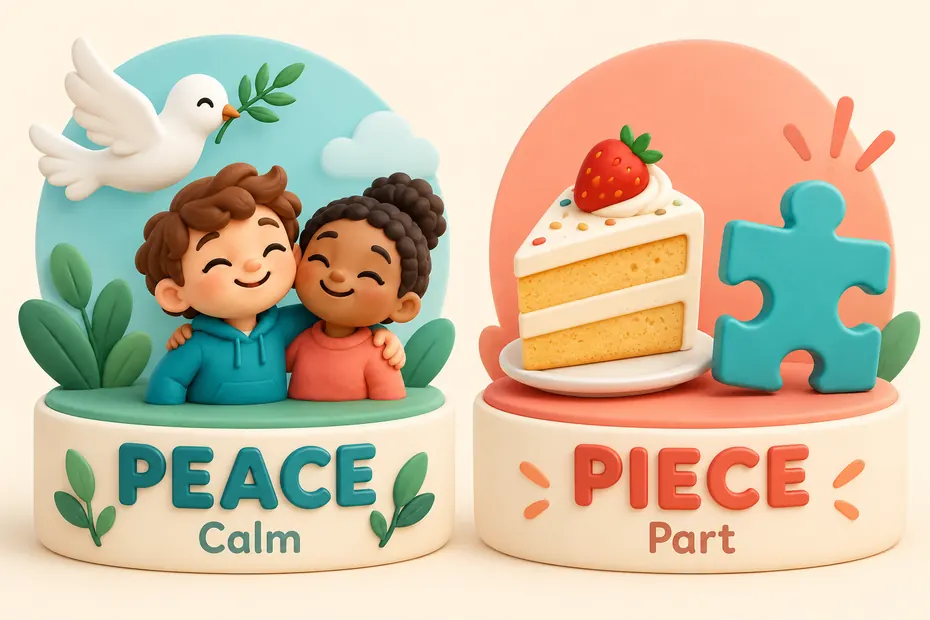
Peace vs piece: choose calm or a part
Peace means calm, harmony or freedom from conflict; piece means a part, an item or a work. You can ask for peace and quiet, eat a piece of toast, admire a musical piece or piece together a puzzle. The words have the same ordinary pronunciation, so the intended meaning decides the spelling.
Corrections to the retained discussion below: peace is usually uncountable in everyday expressions, but “a negotiated peace” is valid, so saying it can never take an indefinite article is too absolute. The suggested verbs “peace yourself” and “peace my mind” are unsuitable models for ordinary modern writing. Use “calm yourself” or “put my mind at ease.” Also, “a piece of heaven” can be a perfectly valid figurative phrase for a delightful place or experience.

Key facts and a comparison table
| Meaning or expression | Correct spelling | Example |
|---|---|---|
| Calm; absence of conflict | Peace | The cousins finally made peace. |
| A portion or individual item | Piece | Each child received a piece of fruit. |
| A creative work | Piece | The pianist performed a new piece. |
| Join parts or assemble information | Piece | We pieced together the torn map. |
| Reassurance | Peace of mind | A spare key gave her peace of mind. |
| Express an opinion | Say your piece | Everyone had a chance to say their piece. |
- Peace and piece are homophones, but they have different meanings.
- A piece can be a whole individual item, not only a broken fragment.
- The plural of piece is pieces; the verb forms include pieced and piecing.
- In ordinary instructions, choose make peace, keep the peace or calm down rather than inventing a verb use.
The meanings and usage distinctions are supported by Merriam-Webster’s entries for peace and piece. The peace entry labels its verb sense obsolete; that is why the older everyday verb examples should not be copied.

A piece is not always a broken part
“A piece of furniture” can be a complete chair, table or wardrobe. The chair does not have to be broken off a larger object. Likewise, “a piece of music” can name an entire composition. The useful question is whether the sentence identifies a portion, a distinct item or a work, rather than whether you can physically divide the object.
Piece also helps count things normally treated as uncountable. We say “two pieces of advice” rather than “two advices.” For a learner writing a school report, the same pattern works with “three pieces of information.” The number belongs to pieces; the following noun keeps its ordinary form.
With physical portions, choose language that helps readers picture the quantity. A piece of cake might be a large wedge or a small bite. If size matters, write “a small piece,” “a thin slice” or a measured amount. Correct spelling alone does not tell someone how much food to serve.
Peace of mind and a piece of your mind
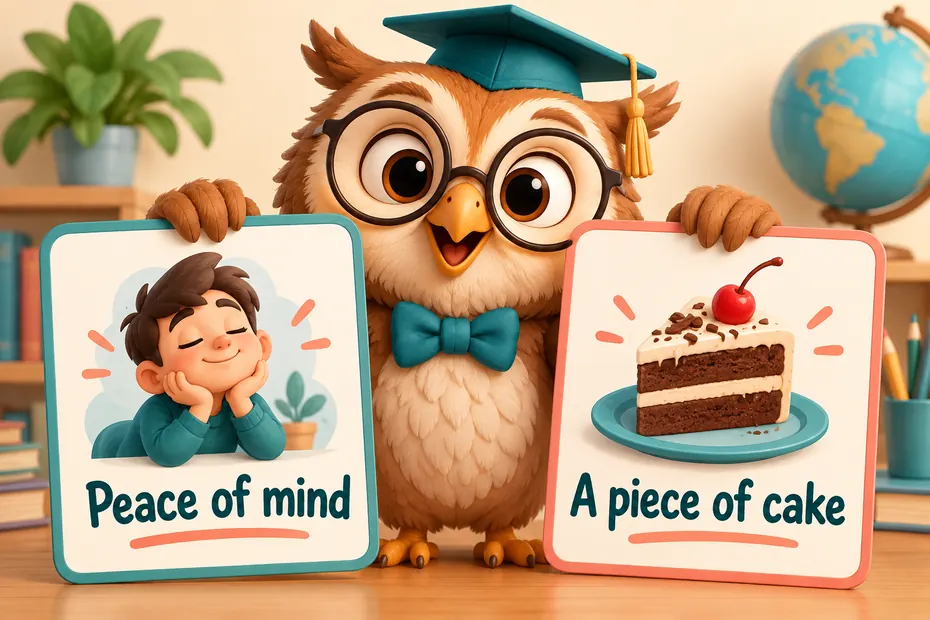
These familiar expressions explain why automatic spell-check often misses the problem. “The confirmation email gave me peace of mind” refers to reassurance. “She gave him a piece of her mind” describes expressing a strong opinion, commonly in anger. Replacing one spelling with the other changes the phrase’s meaning.
“Say your piece” means to present what you want to say. “Hold your peace” means to remain silent. A meeting chair might invite each person to say their piece, then ask everyone to listen quietly. Think of piece as the speaker’s contribution and peace as the quiet that lets others hear it.
In “piece together,” parts may be physical or informational. You can piece together a model from components or piece together an account from several witnesses’ descriptions. “Peace together” does not express that assembling action. For reconciliation, write “make peace with one another.”
A quick proofreading exercise
Complete these sentences: “Please leave the reader in ___.” “One ___ of the model is missing.” “The composer revised her latest ___.” “The neighbors made ___ after the argument.” The answers are peace, piece, piece and peace. The decisive cues are quiet, a part, a creative work and reconciliation.
When editing your own sentence, underline the nearby noun or verb. Cake, puzzle, furniture and together often point toward piece. Quiet, treaty, reconciliation and mind in the reassurance expression often point toward peace. Read the complete phrase before choosing, because “a piece of your mind” is the important exception to that final cue.
Frequently asked questions
Is it peace of cake or piece of cake?
Piece of cake is correct for a portion of cake. It also forms the familiar expression for something easy: “The final puzzle was a piece of cake.”
Can peace take the article a?
Yes in suitable contexts, such as “a lasting peace” or “a negotiated peace.” For everyday calm, it is usually uncountable: “I need some peace.”
Is a piece of heaven wrong?
No. It can describe a delightful place or experience figuratively. Decide whether the sentence means a wonderful portion or place, rather than treating the phrase as an automatic error.
Can piece be a verb?
Yes. “We pieced the evidence together” describes assembling parts or information. Keep the verb spelling piece, with pieced for the past tense.
What is the best memory aid?
Connect peace with peaceful and piece with a puzzle piece. Both cues give the spelling a familiar meaning instead of relying on sound.
Key Takeaways
- “Peace” refers to a state of harmony, tranquility, or absence of conflict.
- “Piece” refers to a part or portion of something larger.
- “Peace” is primarily used as a noun, while “piece” can be both a noun and a verb.
- “Peace” is an uncountable noun, while “piece” is a countable noun.
- “Peace” generally refers to a broad concept, while “piece” is more specific and refers to a distinct part or unit.
- Pay attention to the context to determine whether to use “peace” or “piece” in your writing.
Understanding the Difference
One common mistake that students often make is confusing the words “peace” and “piece”. While they may sound similar, they have very different meanings and usage in the English language. In this section, I’ll explain the key differences between these two words to help you use them correctly.
Definition of Peace and Piece
Let’s start by understanding what each word means:
- Peace: It refers to a state of harmony, tranquility, or absence of conflict. It can be used to describe both inner calm and societal harmony. For example, “I find peace in nature” or “The country is finally at peace after years of war.”
- Piece: On the other hand, “piece” refers to a part or a portion of something larger. It can be used to describe a physical object or an abstract concept. For instance, “I need a piece of cake” or “He wrote a beautiful piece of music.”
Differences in Usage and Context
Now that we have the definitions clear, let’s explore the differences in how these words are used:
- Grammatical Usage: “Peace” is primarily used as a noun, while “piece” can be both a noun and a verb. It’s important to pay attention to the context to determine which one to use.
- Countable vs. Uncountable: “Peace” is an uncountable noun, meaning it cannot be pluralized or used with an indefinite article (“a” or “an”). On the other hand, “piece” is countable, so it can be used in the plural form and with articles.
- Specific vs. General: “Peace” generally refers to a broad concept, while “piece” is more specific and refers to a distinct part or unit. It helps to think about whether you’re talking about a whole or a part of something when choosing between the words.
Examples of Peace and Piece in Context
To solidify your understanding, let’s look at a few examples that illustrate the correct usage of “peace” and “piece”:
- “After the long argument, they finally made peace with each other.” (referring to the resolution of a conflict)
- “She found a peaceful spot in the park to relax and read a book.” (describing a serene or calm environment)
Peace: Definition and Usage
To begin with, let’s jump into the definition and usage of the word “peace.” It’s essential to understand the meaning of this word to use it correctly.
Peace, in its simplest form, refers to a state of harmony or absence of conflict. It embodies tranquility, calmness, and serenity. When we talk about peace, we are referring to a condition where there is no war, violence, or disturbance.
In terms of usage, the word “peace” can be used in various contexts. Here are a few examples:
- Peace as a noun: When used as a noun, “peace” refers to the state or condition of peace. For example, “It’s important to work towards global peace” or “We should strive for inner peace in our lives.”
- Peace as a verb: In some cases, “peace” can also be used as a verb, meaning to bring about or establish peace. An example would be, “The diplomats are trying to peace the two countries’ conflicts.”
- Peace in idiomatic expressions: “Peace” is often used in idiomatic expressions, such as “make peace,” “keep the peace,” or “peace of mind.” These phrases convey a deeper meaning related to peaceful relationships or a state of mental calmness.
Summarizing, the word “peace” signifies a state of harmony, absence of conflict, and tranquility. It can be used as both a noun and a verb, and is also found in various idiomatic expressions. Understanding the different contexts where this word is used will help us communicate effectively and accurately.
Now that we’ve established the definition and usage of “peace,” let’s explore the distinction between “peace” and “piece” in the next section.
Piece: Definition and Usage
When it comes to the word “piece,” it has a distinct meaning and usage that sets it apart from “peace.” Let’s investigate deeper into the definition and usage of “piece.”
Definition:
- The word “piece” refers to a part or portion of something larger. It can be a physical object or an abstract concept.
- It is important to understand that “piece” is primarily a noun and is commonly used in this form.
Usage:
- “Piece” is often used to refer to a part of something whole, such as a puzzle piece, a piece of cake, or a piece of advice.
- It can also be used to indicate a portion or a section of an object, like a piece of clothing or a piece of furniture.
- Also, “piece” can be used to describe a work of art, literature, or music, indicating a creation or composition.
- It is worth noting that “piece” can also have specific meanings in various contexts, such as a news article or a musical composition.
Understanding the definition and proper usage of “piece” is essential when using it in both written and spoken English. Correct usage of this word enables effective communication and prevents confusion.
In the next section, we will explore the distinction between “peace” and “piece” further, focusing on their grammatical differences and countability.
Common Mistakes and Confusions
One common mistake that many English learners make is confusing the words “peace” and “piece.” Although the two words may sound similar, they have completely different meanings and should be used in different contexts. Let’s take a closer look at some of the common mistakes and confusions that arise between these words.
Difference Between Peace and Piece
“Peace” refers to a state of harmony or absence of conflict. It represents tranquility, calmness, and the absence of violence or war. It can also be used to describe a state of inner peace or a peaceful resolution to a conflict. For example, you might say, “I find peace in nature,” or “They signed a peace treaty to end the war.”
On the other hand, “piece” refers to a part or portion of something larger. It can be a physical fragment, a section of a whole, or an individual item. For example, you could say, “She cut a piece of cake for each guest,” or “He wrote a beautiful piece of music.”
Common Usage Mistakes
Here are some common mistakes that people make when using “peace” and “piece”:
- Using “peace” instead of “piece”: This mistake often occurs when someone means to refer to a specific portion of something but uses “peace” instead. For example, saying “I want a peace of pie” instead of “I want a piece of pie.”
- Using “piece” instead of “peace”: This confusion arises when the speaker intends to talk about a state of harmony or a resolution but mistakenly uses “piece.” For instance, saying “Let’s make a piece treaty” instead of “Let’s make a peace treaty.”
- Confusing similar spellings: Some confusion arises from the fact that “peace” and “piece” have similar spellings. This can lead to typos or incorrect usage of the words. It’s important to double-check and ensure the correct word is used in context.
Understanding the Differences
To avoid making these mistakes, it’s crucial to understand the differences in meaning and usage between “peace” and “piece.” Knowing when to use each word correctly will contribute to effective communication and prevent confusion.
Tips for Using “Peace” and “Piece” Correctly
As a writer and language enthusiast, I understand the confusion that can arise when using similar words like “peace” and “piece” in English. These words may sound alike, but they have distinct meanings and usages. To help you effectively communicate and avoid common mistakes, here are some tips for using “peace” and “piece” correctly:
- Understand the Difference:
- “Peace” refers to a state of harmony, tranquility, or absence of conflict.
- “Piece” is a noun that refers to a part or portion of something larger.
- Pay Attention to Grammatical Usage:
- “Peace” can be used as both a noun and a verb. For example:
- Noun: “She found inner peace after years of meditation.”
- Verb: “I am striving to peace my mind and find calm amidst the chaos.”
- “Piece”, on the other hand, is primarily used as a noun. It can also function as a verb when it means to make or repair something by joining separate parts.
- Countability:
- “Peace” is an uncountable noun, so it does not have a plural form.
- “Piece” is a countable noun, so it can be used in both singular and plural forms. For example:
- Singular: “Can I have a piece of cake?”
- Plural: “She bought three pieces of art.”
- Specificity:
- “Peace” is a broad and abstract concept, while “piece” denotes something more tangible and specific. For example:
- Abstract: “We strive for world peace.”
- Specific: “He assembled the puzzle piece by piece.”
- Context Matters:
- Consider the context in which you are using the words. Ask yourself if you are referring to a state of harmony or a part of something larger. This will help determine whether to use “peace” or “piece” in your sentence.
Remember, effective communication relies on using the right words in the right context. By understanding the difference and following these tips, you’ll be well-equipped to use “peace” and “piece” correctly in your writing. Keep practicing and exploring the nuances of the English language to enhance your language skills.
Conclusion
Understanding the difference between “peace” and “piece” is essential for effective communication in the English language. Throughout this article, we have explored the nuances in meaning and usage of these two words.
We have learned that “peace” refers to a state of harmony or absence of conflict, while “piece” refers to a part or portion of something larger. Focusing to grammatical usage, countability, and specificity, we can ensure accurate and clear communication.
Mistakes and confusion often arise between these two words, but by following the tips provided, we can avoid these errors. It is important to be mindful of the context in which these words are used and to understand their various applications.
By mastering the correct usage of “peace” and “piece,” we can enhance our language skills and effectively express ourselves in both spoken and written communication.
Remember, “peace” and “piece” may sound similar, but they have distinct meanings and uses. So, let’s embrace the power of language and use these words appropriately to convey our thoughts and ideas with precision.
Frequently Asked Questions
Q: What is the difference between “peace” and “piece”?
A: “Peace” refers to a state of harmony or absence of conflict, while “piece” refers to a part or portion of something larger.
Q: How are “peace” and “piece” used differently?
A: “Peace” can be used as both a noun and a verb, often found in idiomatic expressions. “Piece” primarily functions as a noun and describes a part or portion of something larger.
Q: Can you provide examples of using “peace” and “piece” correctly?
A: Sure! “I hope for peace in the world.” (noun) “Please peace yourself with a cup of tea.” (verb) “I only have a piece of the cake left.” (noun)
Q: What are some common mistakes or confusions with these words?
A: Examples of incorrect usage include saying “I want a peace of cake” or “I found a piece of heaven.” Understanding the correct meanings and contexts can prevent these mistakes.
Q: Any tips for using “peace” and “piece” correctly?
A: Understand the difference, pay attention to grammatical usage, consider countability, be specific, and understand the context. Following these tips will enhance your language skills.


