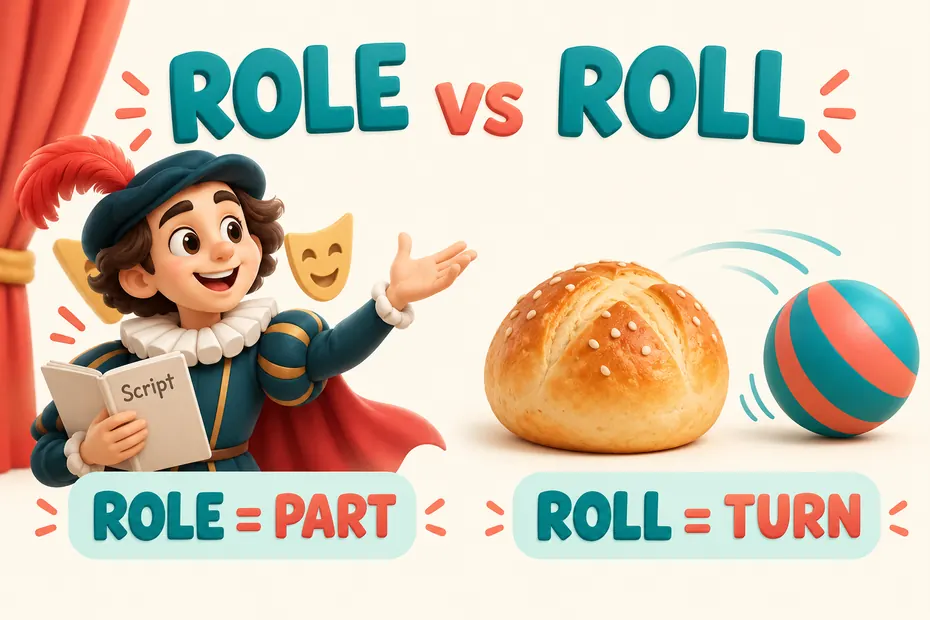
Role names a part, function, or responsibility; roll describes turning movement and also names items such as a bread roll, a rolled bundle, or a list of names. Role vs roll is a meaning distinction between words that sound alike. Write “play a role” for a part and “roll the ball” for movement.
Role vs Roll: Key Facts
- Role is a noun for a part or function.
- Roll can be a noun or a verb.
- An attendance roll is a list, not a responsibility.
- Role model uses the part-or-behavior spelling.
- On a roll uses the momentum-or-success spelling.
Which word fits the meaning?
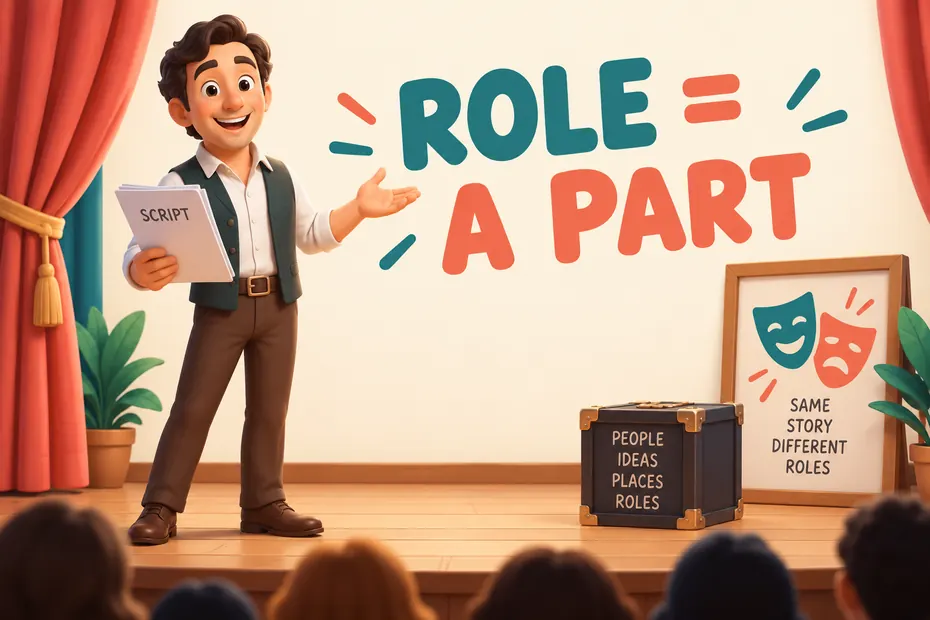
Use role when part or function fits, and roll when the context concerns movement, a list, or a rolled object. “Her role is to check the attendance roll” uses both spellings correctly. Role identifies her duty, while roll identifies the document containing the names.
| Meaning needed | Spelling | Original example |
|---|---|---|
| A character in a play | role | He auditioned for the lead role. |
| A function in a process | role | Planning has a central role. |
| Turning movement | roll | Roll the ball toward the marker. |
| A register of names | roll | The teacher checked the class roll. |
| A small bread item | roll | She served a warm bread roll. |
| A wound package | roll | We opened a roll of paper. |
The Merriam-Webster role entry covers acting parts and functions in activities or processes. A role therefore does not require a paid job or a stage performance. “The role of planning” identifies what planning contributes to an activity.
How do the grammar patterns differ?
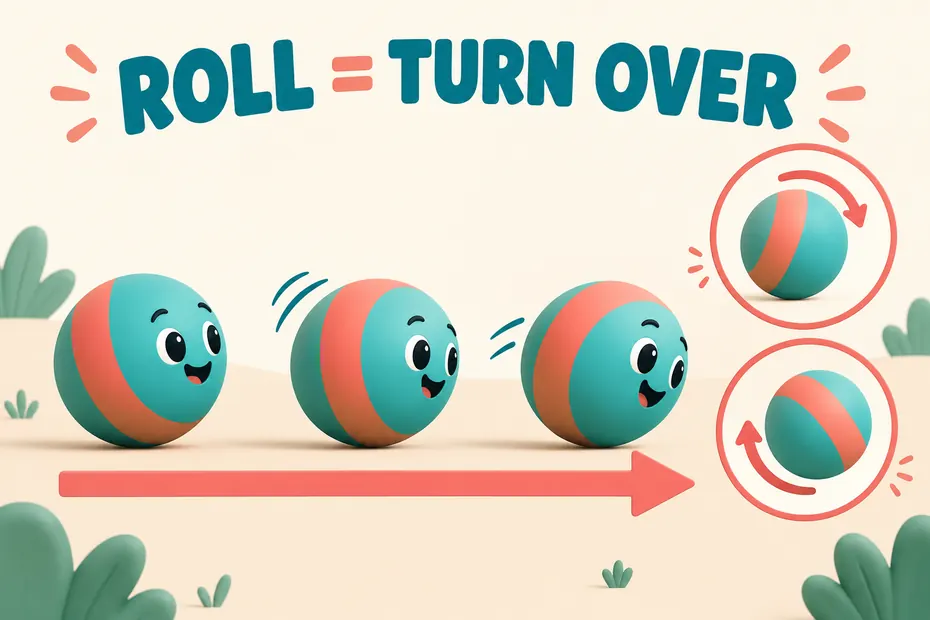
Role functions as a noun in the ordinary part-or-function sense: a role, her role, several roles. Roll changes as a verb: I roll, she rolls, we rolled, and they are rolling. The -ed and -ing forms identify an action, while roles usually names more than one function or part.
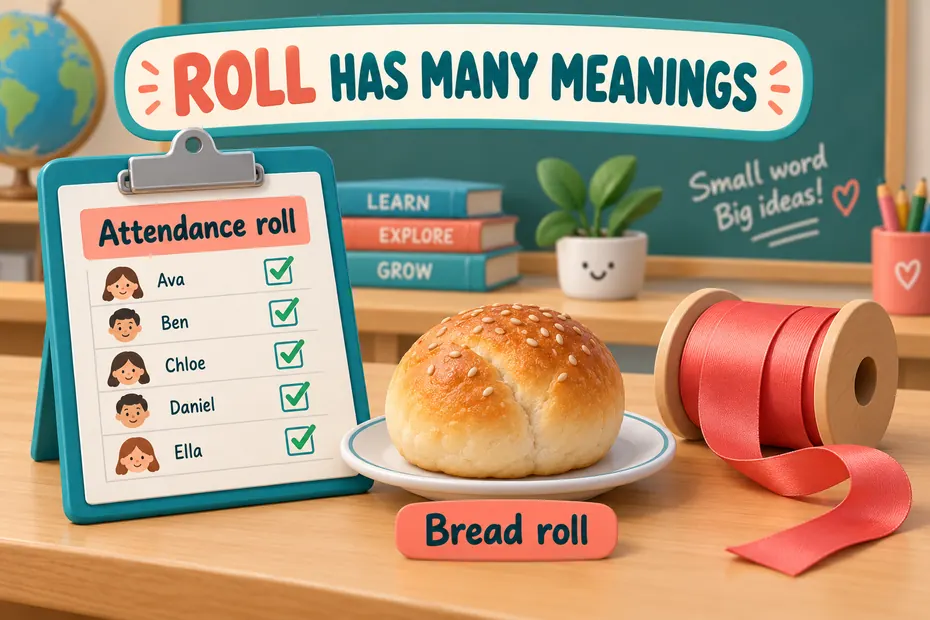
Roll also works as a noun, so “a roll” alone cannot be explained by saying roll always means movement. It might name bread, paper, a record, or a rolling action. The Merriam-Webster roll entry separates these senses. Add a modifier such as bread, attendance, or paper when needed.
Compare “The actors changed roles” with “The baker changed the rolls.” The first refers to their parts; the second refers to food. A spelling checker may accept either word because both are real. Reading for the intended subject and object catches the error that automatic spelling correction misses.
Which fixed phrases should you remember?
Write role model for someone whose behavior provides an example, and role play or role-playing for assuming a character or part. Write roll call for checking names, honor roll for a recognized list, and on a roll for an ongoing run of success. The phrase supplies the meaning even without a literal rotating object.
“Roll up your sleeves” describes turning the fabric back and can also be figurative for preparing to work. “Play a role” means contribute or perform a part. In “The volunteers played a role in the event,” role does not imply acting: the sentence says they contributed to what happened.
The preserved older explanation says roll can mean registering or enrolling. For ordinary course-registration instructions, “enroll in the course” is the clearer verb. The fact that a class has an attendance roll does not mean “roll in the course” is a natural substitute. Keep established phrases together rather than inventing replacements from related meanings.
A quick editing routine
- Try part or function. If either matches, use role.
- Check for turning movement, a rolled package, food, or a list. Use roll.
- Read the whole fixed phrase, such as roll call or role model.
- Check tense and number: rolled is an action; roles is a plural noun.
Practice “The volunteer’s ___ was to read the ___.” The answers are role and roll. Then try “The ball ___ under the bench.” Rolled fits the completed movement. Finally, “The actor accepted two ___” needs roles because the sentence names two parts, not two bread items.
Frequently Asked Questions
Is it “a role model” or “a roll model”?
Write role model when you mean someone whose behavior others may follow. Role concerns a part or pattern of behavior, while roll would introduce an unrelated movement, object, or list meaning. If the phrase is unfamiliar, explain whose behavior provides the example and what quality you admire.
Should I write “on a role”?
Use on a roll for a continuing run of success or progress: “After solving three puzzles, she was on a roll.” Role names a function or part and does not fit that idiom. “In a role” can be correct when you mean holding a position, but it expresses something different.
Can a thing have a role?
Yes. A thing, process, or condition can have a role when it contributes to an outcome. “The checklist has a useful role in preparation” identifies a function without referring to a person. Name that contribution when possible: “The checklist helps us confirm that every item is packed.”
Why is it roll call?
Roll can mean a list or register of names, so roll call concerns calling or checking the people on that list. It does not ask each person to describe a role. Compare “Read the roll” with “Explain your role”: the first concerns names, and the second concerns responsibilities.
How can I remember role vs roll?
Attach role to part and responsibility, then attach roll to movement or the specific object or list your sentence names. Practice “My role is to read the roll” to keep the distinction in one sentence. For a fixed phrase, remember its complete form rather than choosing by sound alone.
Are you often confused between the words “role” and “roll”? Don’t worry, you’re not alone. These two words may sound similar, but they have distinct meanings and should be used appropriately. In this text, I’ll guide you through the differences between “role” and “roll” and provide you with practical tips on how to use them correctly.
Understanding the difference between “role” and “roll” is essential for effective communication. While “role” refers to a character or function one plays in a particular situation or organization, “roll” is related to the act of turning or moving in a circular motion. Confusing these words can lead to misunderstandings and undermine the clarity of your message.
So, if you want to enhance your language skills and avoid embarrassing mistakes, read on. I’ll share some simple yet effective strategies to help you confidently use “role” and “roll” in their appropriate contexts. Let’s immerse and unravel the mystery behind these commonly misused words.
Key Takeaways
- “Role” and “roll” may sound similar, but they have distinct meanings and should be used appropriately.
- “Role” refers to a function or character one plays in a particular situation, while “roll” is related to movement or listing.
- Misusing “role” and “roll” can lead to confusion and misunderstandings in communication.
- “Role” is primarily used as a noun, while “roll” can be used as both a noun and a verb.
- It’s important to differentiate the definitions of “role” and “roll” and provide enough context when using them.
- Practice and review are key to improving the accurate usage of “role” and “roll” in different contexts.
Understanding the Difference between “Role” and “Roll”
As a language enthusiast, I understand the importance of mastering the subtleties and nuances of the English language. Today, I’d like to investigate into the often-confused words “role” and “roll”. By understanding their definitions and usage, we can confidently incorporate them into our writing and conversations. So let’s explore the difference between these two words and clarify any confusion once and for all.
? Definitions
- Role: It refers to the function or part that someone or something has in a particular situation or activity. It can also be seen as the character or function played by an individual in a specific context.
- Roll: This word has multiple meanings, but it commonly relates to the act of rotating or moving on an axis. It can also represent a list or record of names, events, or tasks.
? Differences
Now that we have a clear understanding of the definitions, let’s jump into the differences between “role” and “roll”:
- Meaning: While “role” focuses on the function or character performed by someone or something, “roll” is more about movement, rotation, or listing.
- Usage: “Role” is commonly used in the context of jobs, theater, or any situation where someone fills a specific function. On the other hand, “roll” can be used when referring to actions like rolling a dice, rolling up a carpet, or even making a list of names.
- Part of speech: “Role” is primarily used as a noun, such as in “He played the role of the detective.” Meanwhile, “roll” can function as both a noun (“Give me a roll of duct tape”) and a verb (“Let’s roll the dice”).
Remember, understanding the differences between these words is crucial for effective communication. Misusing them can lead to confusion and misunderstandings. So let’s look at some examples to solidify our grasp on their usage.
Examples
To illustrate how “role” and “roll” are used in context, let’s look at a few examples:
- “She played the role of Juliet in the school play.”
- “Can you roll the dice for me, please?”
- “I need a roll of paper towels.”
- “He is well-suited for the role of team leader.”
The Definition and Usage of “Role”
In this section, we will investigate into the meaning and application of the word “role.” Understanding the definition and proper usage of this term is crucial for effective communication.
The word “role” refers to the function or part that someone or something plays in a particular situation or context. It is used to describe the expected behavior or responsibilities associated with a specific position or purpose. The concept of “role” is commonly used in various domains, including social, professional, and theatrical settings.
Here are a few key points to consider about the definition and usage of “role”:
- Contextual Dependence: The meaning and expectations associated with a particular “role” can vary depending on the context. For example, the role of a teacher differs from that of a student, and the role of a parent differs from that of a child.
- Responsibilities and Duties: Each “role” carries its own set of responsibilities and duties. These obligations define the actions and behaviors expected of individuals fulfilling a specific role. For instance, a manager has the role of overseeing and coordinating the work of a team, while an employee has the role of completing assigned tasks.
- Social Norms and Expectations: “Roles” in society are often shaped by social norms and expectations. For example, gender roles prescribe certain behaviors and responsibilities traditionally associated with men and women.
- Flexibility and Adaptability: “Roles” can be dynamic and change over time or in different circumstances. Individuals may take on different roles depending on the situation. For example, a person may have the role of a student during the day and the role of a sibling at home.
Understanding the nuances of the word “role” enables us to communicate more effectively by using the appropriate terminology in the right context.Applying the right context and using the term accurately helps to ensure effective communication and avoids confusion. By using the term “role” accurately, we can communicate more effectively and avoid confusion.
Remember, the word “role” pertains to the function or part that someone or something plays in a particular situation or context. It carries responsibilities and duties specific to that role, and it can vary depending on the social norms and expectations prevalent within a society.
The Definition and Usage of “Roll”
When it comes to the word “roll,” it’s often confused with its homophone “role.” It’s important to understand the difference between the two to use them appropriately in your writing and communication. In this section, I’ll focus on the definition and usage of the word “roll.”
Definition of “Roll”
The word “roll” has multiple meanings and can be used as both a verb and a noun. Let’s jump into its different definitions:
- As a verb, “roll” can mean:
- To rotate or move by turning over, like a rolling ball.
- To form into a cylindrical shape by turning or folding.
- To make a repetitive rocking motion, like a boat on waves.
- To register or enroll in a course or membership.
- As a noun, “roll” can refer to:
- A small bread or pastry, typically shaped like a cylinder.
- A list or register, like a class roll or attendance roll.
- A document or manuscript rolled up for safekeeping.
- The act of rolling, such as a roll of the dice in a game.
Usage of “Roll”
The versatility of the word “roll” allows it to be used in various contexts. Here are a few common ways to use “roll”:
- In cooking and baking:
- I love eating sushi rolls.
- Can you pass the dinner rolls, please?
- In transportation:
- The truck’s tires started to roll down the hill.
- The train began its roll towards the next station.
- In academia and administration:
- Are you planning to enroll in that new course? Don’t forget to fill out the enrollment form.
- The teacher called out the names from the roll.
- In music:
- The drummer set the rhythm with a steady roll on the snare drum.
- The DJ played an oldies rock and roll song.
Remember, the key to using “roll” correctly is to understand its specific definition in the given context. Pay attention to how it is being used as a verb or a noun and what meaning it conveys.
By grasping the definition and usage of “roll,” you’ll be better equipped to avoid confusion with its close counterpart “role.” Now, let’s move on to exploring the concept of “role” in the next section.
Common Mistakes when Using “Role” and “Roll”
When it comes to the words “role” and “roll,” there are some common mistakes that people tend to make. Understanding the differences between these two words is essential for effective communication. Let’s take a closer look at some of the common mistakes and how to avoid them.
Using “role” when referring to a physical action or movement
One common mistake is using “role” when referring to a physical action or movement. For example, saying “I want to role the ball across the floor” is incorrect. The correct word to use in this context is “roll.” “Roll” is a verb that means to move or cause something to move in a particular direction. On the other hand, “role” is a noun that refers to a particular function or part in a situation or a play.
Confusing the definitions of “role” and “roll”
Another mistake is confusing the definitions of “role” and “roll.” It’s important to understand that “role” is used to describe a function or part played by someone or something in a particular situation, while “roll” refers to a movement or a list of names or items. Understanding the specific definitions of each word will help you to use them appropriately in context.
Using “roll” when referring to a character in a play or movie
Using “roll” instead of “role” is another common mistake. When talking about a character in a play or movie, the correct word to use is “role.” For example, saying “Tom Cruise played a roll in the movie” is incorrect. It should be “Tom Cruise played a role in the movie.”
Lack of clarity in the usage of “role” and “roll”
Sometimes, people use “role” and “roll” without providing enough context, which can lead to confusion. It’s important to be clear in your usage of these words, especially when writing or speaking. Make sure to define the role or roll you are referring to or provide enough context for others to understand your intended meaning.
Table: Common Mistakes with “Role” and “Roll”
| Common Mistakes | Correct Usage |
|---|---|
| Using “role” when referring to a physical action or movement | Using “roll” |
| Confusing the definitions of “role” and “roll” | Understanding the specific definitions of each word |
| Using “roll” when referring to a |
Tips for Using “Role” and “Roll” Appropriately
Understanding the proper usage of “role” and “roll” is essential for effective communication. Here are some tips to help you use these words correctly:
- Differentiate the Definitions: It’s crucial to grasp the specific meanings of “role” and “roll” to prevent confusion. While “role” refers to a character or function in a particular situation, “roll” signifies a physical movement or the act of turning over. By understanding this distinction, you can use the correct word in the appropriate context.
- Context is Key: Providing enough context when using “role” or “roll” is vital to avoid ambiguity. Clearly indicating whether you are referring to a character in a movie or the action of rolling something will ensure that your message is accurately understood by your audience.
- Avoid Common Mistakes: There are a few common mistakes that people make when using “role” and “roll.” Here are a few examples and how to avoid them:
- Using “roll” when referring to a character in a play or movie instead of using “role.”
- Using “role” to describe a physical action or movement, when “roll” should be used instead.
- Practice and Review: The best way to improve your usage of “role” and “roll” is through practice and review. Pay attention to how these words are used in various contexts, such as in movies, literature, or everyday conversations. This will help you become more familiar with their appropriate usage and reinforce your understanding.
Understanding the subtle differences between “role” and “roll” and using them correctly will greatly enhance your communication skills. By incorporating these tips into your writing and conversations, you can avoid common mistakes and convey your message with clarity and precision.
Now that we’ve covered some tips for using “role” and “roll” appropriately, let’s move on to exploring other commonly confused words and their correct usage.
Conclusion
Mastering the proper usage of “role” and “roll” is essential for effective communication. Throughout this article, we have delved into the nuances of these two words and highlighted common mistakes to avoid. By understanding their definitions and providing sufficient context, we can ensure clarity in our writing and speech.
Remember, practice makes perfect. Continuously reviewing and reinforcing your understanding of “role” and “roll” will help solidify their correct usage. As you become more comfortable with these words, you’ll be able to express yourself more confidently and accurately.
Moving forward, this article will continue to explore other frequently confused words and their appropriate usage. By expanding our knowledge and refining our language skills, we can become better communicators overall.
To conclude, understanding the distinctions between “role” and “roll” is crucial. By using them appropriately, we can effectively convey our intended meaning and avoid any confusion. So, let’s continue our journey of enhancing our language skills and exploring the intricacies of the English language.
Frequently Asked Questions
Q: What is the article about?
A: The article provides clarification on the differences between the words “role” and “roll” and emphasizes the importance of understanding these differences for effective communication.
Q: What are the common mistakes people make with “role” and “roll”?
A: Common mistakes include using “roll” instead of “role” or vice versa, confusing their meanings, and lacking enough context when using these words.
Q: How can I use “role” and “roll” appropriately?
A: To use them appropriately, differentiate their definitions, provide enough context, and practice and review their usage.
Q: Why is it important to use “role” and “roll” correctly?
A: Using “role” and “roll” correctly enhances communication skills and avoids confusion and misunderstandings.
Q: What will the article cover after “role” and “roll”?
A: The article will explore other commonly confused words and their correct usage.


