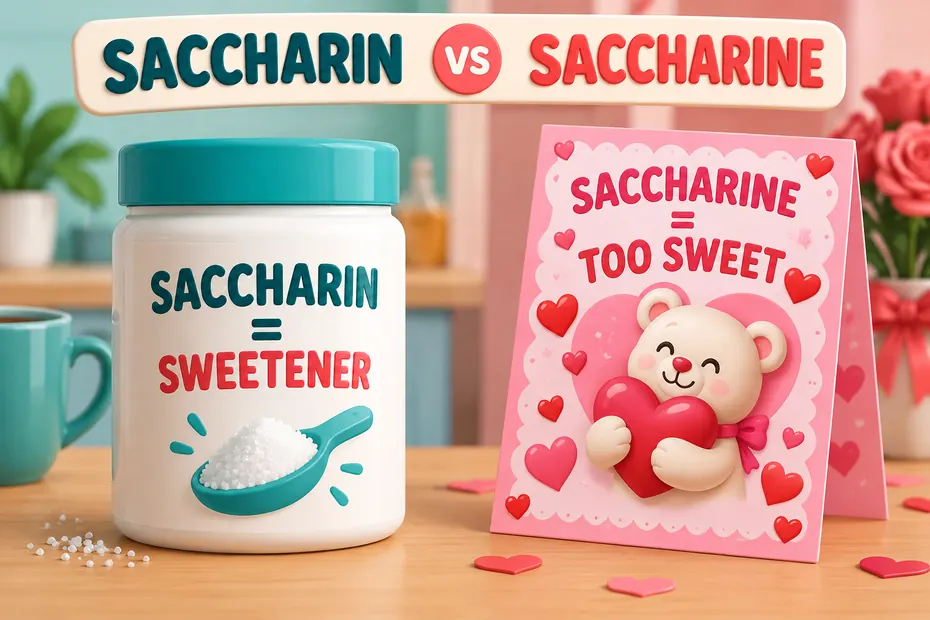
Saccharin is the noun naming a sweetener; saccharine is an adjective describing sugar-related sweetness or excessive sentimentality. Saccharin vs saccharine is therefore resolved by the thing or quality your sentence names. An ingredient list may mention saccharin, while a reviewer may call an overly sentimental ending saccharine.
Saccharin vs Saccharine: Key Facts
- Saccharin names a substance used as a sweetener.
- Saccharine describes a quality rather than naming that ingredient.
- Saccharine has literal sugar-related and figurative senses.
- A saccharine smile can imply exaggerated friendliness.
- The final e changes the word, not just its appearance.
Which spelling belongs in your sentence?
Use saccharin when identifying the sweetener itself, and saccharine when describing a sweet or excessively sentimental quality. “The label lists saccharin” identifies an ingredient. “The speech sounded saccharine” describes the listener’s reaction to its tone. Neither sentence can be corrected by swapping the words without changing its structure.
| Situation | Spelling | Role | Original example |
|---|---|---|---|
| Naming an ingredient | saccharin | Noun | The ingredient list mentions saccharin. |
| Excessive sweetness | saccharine | Adjective | The dessert had a saccharine flavor. |
| Overdone sentiment | saccharine | Adjective | The ending seemed saccharine. |
| Affected friendliness | saccharine | Adjective | His saccharine greeting felt rehearsed. |
The Merriam-Webster saccharin entry identifies the sweetener noun. In language-focused writing, an example naming an ingredient explains grammar; it does not establish a product’s actual ingredients. For a real product, copy the label accurately rather than inferring the contents from its taste or advertising.

Does saccharine always express criticism?
Saccharine often expresses criticism in descriptions of taste, dialogue, or emotion, but its full dictionary range is broader. The saccharine entry also records relating to sugar and containing or yielding sugar. A technical passage may therefore use the adjective without accusing anything of being sentimental.
“A saccharine farewell” usually suggests sentiment that the writer considers excessive. “A moving farewell” is more positive, while “a sentimental farewell” need not carry the same sharp criticism. Word choice communicates an evaluation, so do not use saccharine when you merely want to say a message is kind.
Give evidence in a review: “The ending seemed saccharine because every disagreement disappeared in a single speech.” The explanation identifies the storytelling feature behind the judgment. Calling an ending saccharine alone expresses an opinion without helping the reader understand what produced it.
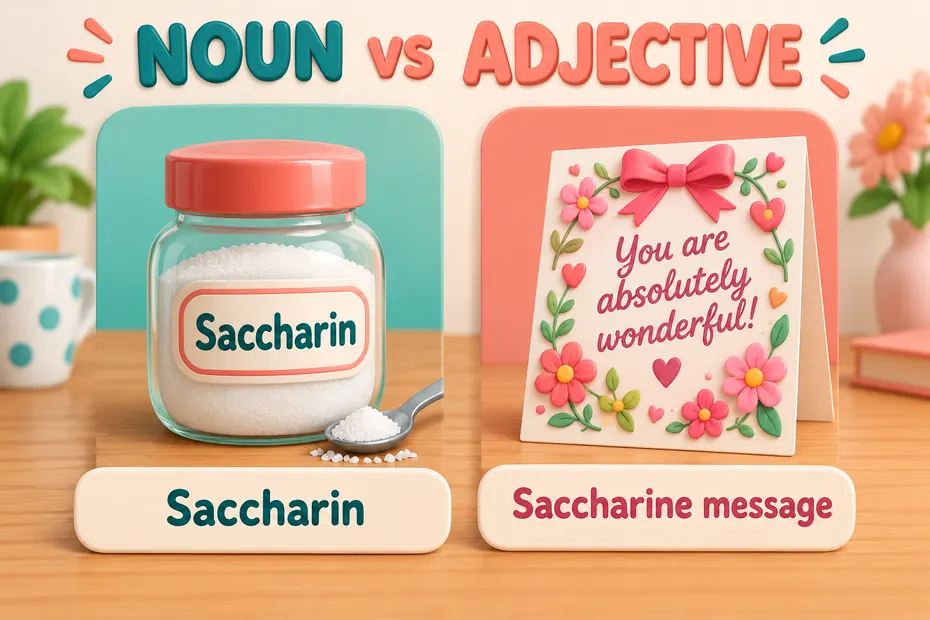
What should you correct in the older explanation?
Correction to the preserved article: the repeated claim that saccharine is derived from the sweetener noun saccharin reverses the apparent word-history relationship. The dictionary records saccharine earlier and connects its history with Latin saccharum. The useful modern rule is ingredient noun versus descriptive adjective, not that one was made by adding e to the other.
The statement that saccharine only means excessively sweet also needs qualification. Its literal sugar-related senses coexist with its critical figurative senses. Context determines whether a writer describes a chemical or agricultural property, a flavor, or an emotional tone. An adjective’s figurative use does not erase its literal uses.
Do not turn the vocabulary distinction into a health claim. Knowing how to spell saccharin does not tell you whether a particular product suits a particular person, and calling something saccharine does not identify its ingredients. Those are different factual questions. This guide explains the words and their sentence roles.
A practical editing check
- Find the role: ingredient name or descriptive quality.
- For the ingredient, substitute “the sweetener.” Saccharin is the noun.
- For a quality, substitute “overly sentimental” or a fitting sugar-related adjective.
- Check the context before assigning a negative judgment.
- Preserve the exact ingredient spelling when quoting a label.
Practice with “The label mentions ___” and “The greeting was ___.” The answers are saccharin and saccharine. Then try “The critic disliked the ___ ending.” Saccharine fits because it modifies ending. This grammar check is more dependable than assuming that similarly pronounced words are interchangeable.
Frequently Asked Questions
Can a film contain saccharin?
A film could mention or depict the sweetener, but the word saccharin does not normally describe its emotional tone. Write “a saccharine film” if you mean excessively sentimental. The distinction concerns meaning and grammatical role: one names a substance, while the other describes a quality of the work.
Is saccharine a compliment?
In everyday criticism, usually not. Calling a speech, smile, or story saccharine often suggests excessive sentiment or affected sweetness. If you mean warm, considerate, or heartfelt, choose those words instead. A dictionary’s literal sugar-related sense is different from the negative implication common in a review.
Does saccharine taste prove saccharin is present?
No. Saccharine can describe a sweet or overly sweet quality without identifying the ingredient responsible. The taste description and the ingredient name answer different questions. Check the actual ingredient information when identifying a product’s contents; an adjective in a review does not supply that evidence.
Can I use saccharin before another noun?
Yes. A noun can modify another noun, as in “saccharin concentration” or “saccharin content.” That construction still names the substance and specifies the kind of concentration or content. It does not make saccharin interchangeable with saccharine in “a saccharine message,” which describes emotional tone.
What is the quickest memory aid?
Keep saccharin attached to an ingredient list and saccharine attached to a description. Ask whether your sentence names the sweetener or judges a flavor or emotional effect. Checking noun versus adjective catches the common mistake without requiring you to settle the words’ pronunciation or reconstruct their history.
Key Takeaways
- Saccharin is a synthetic sweetener used as a sugar substitute in food and beverages, while saccharine is an adjective used to describe something as excessively sweet or sentimental.
- Saccharin is a white, crystalline powder that is intensely sweet and contains no calories.
- Saccharine is derived from the noun “saccharin” but has a different meaning and usage.
- Examples of saccharin usage: “I added saccharin to my coffee to make it sweeter.”
- Examples of saccharine usage: “The movie’s ending was too saccharine for my taste.”
- It is important to use these terms appropriately to avoid confusion and communicate effectively.
What is Saccharin?
Saccharin is a synthetic sweetener that is widely used as a sugar substitute in various food and beverage products. It is a white, crystalline powder that is intensely sweet, even though it contains no calories. Saccharin was first discovered in 1879 by Constantin Fahlberg, a chemist working at Johns Hopkins University.
The definition of saccharin is important to understand because it is often confused with the word “saccharine.” While saccharin is a specific substance used as a sweetener, saccharine is an adjective that describes something as excessively sweet or sentimental.
The difference between saccharin and saccharine lies in their usage and meaning. Saccharin is the actual sweetener, while saccharine is a descriptive term. For example, you could say, “I added saccharin to my coffee to make it sweeter,” but you would say, “The movie’s ending was too saccharine for my taste” to express that it was overly sweet or sentimental.
Summarizing, saccharin is a sweetener used in food and beverages, while saccharine is an adjective to describe things that are excessively sweet or sentimental. It’s important to use these terms appropriately to avoid confusion.
Definition of saccharin:
- Synthetic sweetener
- Crystaline powder
- Intensely sweet
- No calories
Difference between saccharin and saccharine:
- Saccharin is the sweetener
- Saccharine is an adjective to describe something as excessively sweet or sentimental
Examples:
- I added saccharin to my coffee to make it sweeter.
- The movie’s ending was too saccharine for my taste.
Keep reading to learn more about the uses and advantages of saccharin and saccharine without any conclusion paragraph or sentence.
What is Saccharine?
Saccharine is a term that is often confused with saccharin. Let’s clear up the confusion and understand what saccharine actually means.
Definition of Saccharine
Saccharine is an adjective used to describe something as excessively sweet or sentimental. When we say something is saccharine, it means it is overly sugary or cloying in taste or emotion. It is derived from the noun “saccharin,” but they have different meanings and uses.
Difference between Saccharin and Saccharine
While saccharin is a synthetic sweetener used in food and beverages, saccharine is used to describe the sweetness or sentimentality of something. The key difference lies in their usage and meanings. It is important to use these terms appropriately to avoid confusion.
Examples of Saccharine
Let’s look at a few examples to better understand how saccharine is used in context:
- “The movie was so saccharine that it made my teeth ache.”
- “Her saccharine smile didn’t seem genuine.”
- “The love letter was filled with saccharine words.”
As you can see from these examples, saccharine is used to convey the idea of excess sweetness or sentimentality. It is not related to the synthetic sweetener saccharin.
Understanding the difference between saccharin and saccharine is crucial for effective communication and to avoid confusion. Now that we have clarified the definition and usage of saccharine, let’s explore more about saccharin in the next section.
Next Section: What is Saccharin?
The Difference between Saccharin and Saccharine
When it comes to saccharin and saccharine, it’s important to understand the difference between the two. These words may sound similar, but they have distinct meanings and uses. Let’s take a closer look:
Saccharin: What is it?
Saccharin, first synthesized in the late 19th century, is a synthetic sweetener that is commonly used in food and beverages. It is known for its high level of sweetness and is often used as a sugar substitute for people who want to reduce their sugar intake or have dietary restrictions. One important thing to note is that saccharin is a noun, referring to the actual sweetener itself.
Saccharine: Definition and Usage
On the other hand, saccharine is an adjective used to describe something as excessively sweet or sentimental. It is derived from the word “saccharin” and is used to describe qualities or characteristics that are overly sweet or sugary, whether in taste or in emotional expression. For example, someone might refer to a love letter as “too saccharine” if they feel it is overly romantic or sentimental.
Examples to Illustrate the Difference
To better understand the difference between saccharin and saccharine, let’s look at some examples:
- “I prefer my tea without saccharin.” (Here, saccharin refers to the sweetener.)
- “The movie’s ending was saccharine; it was too predictable and sentimental.” (In this case, saccharine describes the overly sentimental nature of the movie.)
Remember, using these terms appropriately is crucial to avoid confusion. Understanding the difference between saccharin, the sweetener, and saccharine, the adjective, allows us to communicate effectively and accurately describe the level of sweetness or sentimentality in various contexts.
When to Use Saccharin
Saccharin, as mentioned earlier, is a synthetic sweetener commonly used in food and beverages. Knowing when to use saccharin correctly can help ensure effective communication and accurate descriptions of sweetness in various contexts. Here are a few situations where saccharin should be used:
- In food and beverage industry: Saccharin is widely used as a sugar substitute in various products, such as diet sodas, baked goods, and candies. When discussing the sweetness of these items or providing their ingredient information, it is crucial to use the term “saccharin” accurately.
- Scientific and medical discussions: Saccharin has been extensively researched and studied for its potential health effects. When discussing clinical trials, research papers, or any scientific documentation related to saccharin, it is important to use the proper terminology to convey accurate information.
- Labeling and packaging: Food and beverage products that contain saccharin must accurately label it as an ingredient. If you are responsible for labeling, packaging, or consulting on product information, it is essential to use the term “saccharin” correctly and avoid any confusion with other sweetening agents.
- Health and dietary discussions: If you are writing about dietary guidelines, nutrition, or sugar-free diets, correctly referring to saccharin will help ensure accurate information is communicated to readers. Understanding the distinction between saccharin and other sweeteners is crucial in these contexts.
By using the term “saccharin” appropriately in these situations, you can avoid confusion and ensure your communication is accurate and concise. Remember, saccharin is a noun referring to the sweetener itself, so it is important to use it correctly when discussing its usage, effects, or characteristics.
Let’s continue exploring the difference between saccharin and saccharine by diving into when and how to use the term “saccharine” correctly.
When to Use Saccharine
Saccharine is another word that is often confused with saccharin. It’s important to use these terms appropriately to avoid any confusion. Let’s explore when and how to use the term “saccharine” correctly.
Definition of Saccharine
Saccharine is an adjective that means excessively sweet or sentimental. It is derived from the noun “saccharin,” which refers to an artificial sweetener. It’s important to note that “saccharine” is used to describe things that are sweet or sentimental, while “saccharin” is used to refer to the sweetener itself.
Usage of Saccharine
Here are some examples of when to use the term “saccharine” correctly:
- Literature and Art: Use “saccharine” to describe overly sweet or sentimental portrayals in literature, art, or other creative works. For example, “The novel ended with a saccharine and predictable love story.”
- Emotions and Behavior: Use “saccharine” to describe someone who is excessively sweet or sentimental in their behavior or emotions. For example, “Her saccharine smile never seemed genuine.”
- Critique and Review: Use “saccharine” to express a critical opinion about something that is excessively sweet or sentimental. For example, “The movie was filled with saccharine dialogue that felt forced.”
Remember, the key difference between saccharine and saccharin is that saccharine is used as an adjective to describe something as excessively sweet or sentimental. By using the term “saccharine” accurately in these situations, you can effectively convey the intended meaning and avoid any confusion with the artificial sweetener saccharin.
Now that we have explored when and how to use the term “saccharine” correctly, let’s move on to the next section which will focus on the differences between saccharin and saccharine.
Conclusion
Understanding the distinction between saccharin and saccharine is crucial for effective communication. By using these terms appropriately, we can avoid any confusion that may arise. Throughout this article, we have explored the correct usage of saccharine in various contexts.
In literature and art, saccharine is employed as an adjective to describe something as excessively sweet or sentimental. This usage allows us to convey the intended meaning accurately. Also, saccharine finds its place when discussing emotions and behavior, providing a precise description of overly sugary or exaggerated sentiments.
Also, saccharine is valuable in critique and review, enabling us to express our opinions about something that may be overly sweet or sentimental. By utilizing saccharine correctly, we can ensure that our message is clear and unambiguous.
To conclude, understanding when to use saccharine appropriately is essential for effective communication. By adhering to the correct usage, we can avoid any confusion with saccharin, the artificial sweetener.
Frequently Asked Questions
Q: What is the difference between saccharin and saccharine?
A: Saccharin is an artificial sweetener while saccharine is an adjective used to describe something as excessively sweet or sentimental.
Q: When should I use the term saccharine?
A: Saccharine should be used when describing something as excessively sweet or sentimental, such as in literature, art, emotions, behavior, critique, or review.
Q: Why is it important to use saccharine correctly?
A: Using saccharine correctly helps to convey the intended meaning and avoid confusion with the artificial sweetener saccharin.
Q: How can using saccharine appropriately help in communication?
A: By using saccharine correctly, you can effectively convey the intended meaning and avoid any confusion with the artificial sweetener saccharin.
Q: Is saccharin the same as saccharine?
A: No, saccharin is an artificial sweetener while saccharine is an adjective used to describe something as excessively sweet or sentimental.


