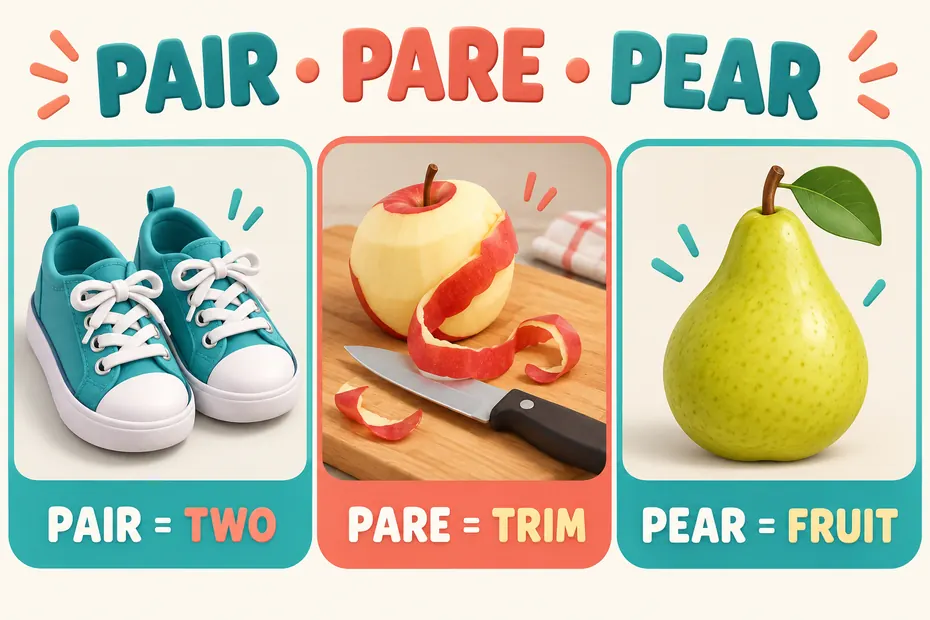
Pair means two associated things or to put things together; pare means trim or reduce; pear names the fruit; père means father in a particular name-distinguishing use. Pair vs pare vs pear vs pere is resolved by meaning and sentence structure. Write “pare a pear” to mean trim a pear, and “a pair of pears” for two fruits.
Pair, Pare, Pear and Père: Key Facts
- Pair works as a noun and a verb.
- Pare is a verb for trimming or reducing.
- Pear is a noun for the fruit or its tree.
- The dictionary spells the father term père, with a grave accent.
- Paired and pared are different past-tense spellings.
Which word matches your meaning?
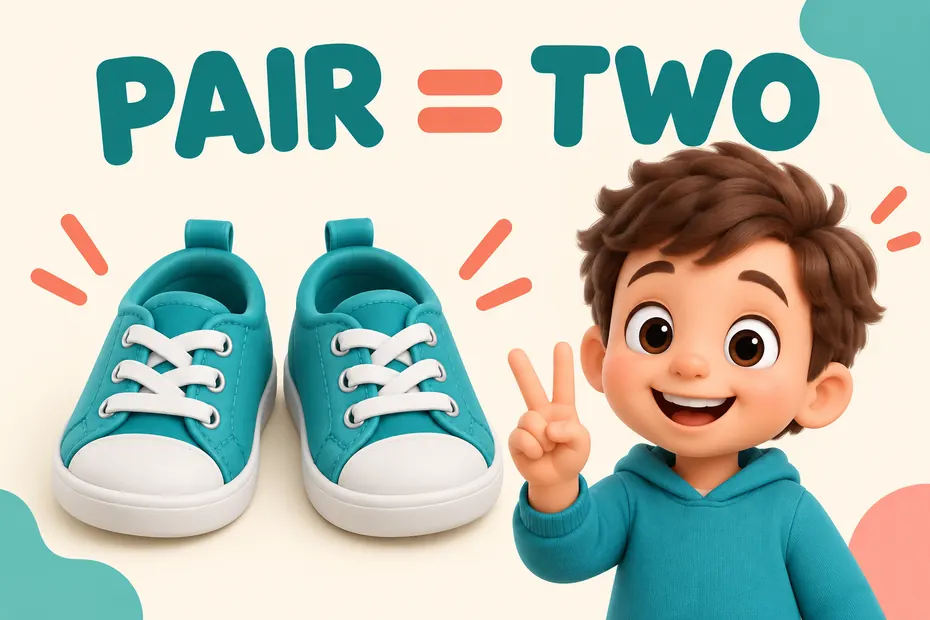
Select pair for a set of two or for joining things, pare for removing excess, and pear for the fruit. Père belongs to a narrower father-versus-son naming context. The everyday trio normally sounds alike, so a spelling choice based only on pronunciation will not solve the problem.
| Word | Role | Meaning test | Original example |
|---|---|---|---|
| pair | Noun | Two associated items | A pair of gloves lay by the door. |
| pair | Verb | Put together | Pair each question with an answer. |
| pare | Verb | Trim or reduce | Pare the draft down to one page. |
| pear | Noun | The fruit | A pear rolled across the counter. |
| père | Name distinction | The father rather than the son | The glossary explains père after a name. |
The pair entry includes both noun and verb uses. Two associated items need not be literally identical: a left and a right shoe can form a pair. The count concerns their relationship as two items, not perfect sameness.
How do paired and pared differ?
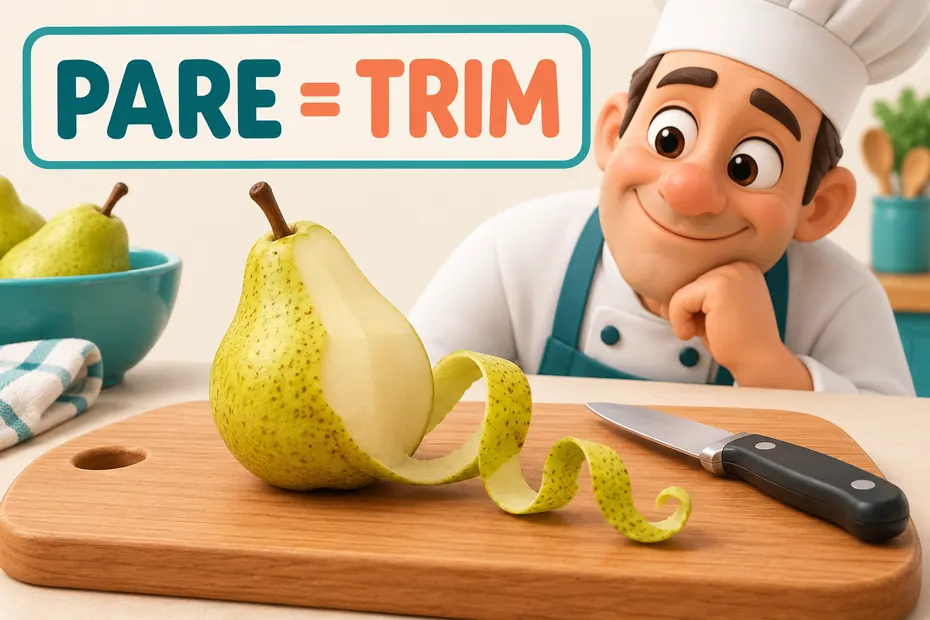
Paired means joined or matched; pared means trimmed or reduced. “We paired the illustrations with captions” combines corresponding elements. “We pared the captions down” shortens them. Both sentences concern editing, but they describe opposite kinds of operation: bringing elements together and taking excess away.
The pare entry supports physical trimming and figurative reduction. The verb drops its final e before -ing: paring. Pair keeps its base spelling in pairing. Therefore a paring knife is associated with trimming, while pairing students means arranging them into working partnerships.
Do not turn every example into food preparation. “Pare expenses” and “pare down a list” are ordinary figurative patterns. Name what is reduced so the reader can tell whether you mean cost, length, or quantity. “We pared it” is grammatical only when the surrounding context already identifies the object.
What does père mean in English writing?
Merriam-Webster’s père entry records father, used after a name to distinguish a father from a son. The accent belongs to that spelling. A reader seeing pere without the accent should examine the context rather than assume it means a fruit or a pair.
Correction to the preserved article: calling père simply an “archaic term” that has no place in modern writing is too broad. The dictionary gives it a specific name-distinguishing use. The older assertion about Shakespeare supplies no passage or source, so it should not be relied on as a verified literary example.
For a general English audience, “the father” or a person’s full name will often be clearer. When discussing a French-language source or a convention distinguishing people with the same name, retain the original form accurately and explain it once. The purpose is identifying a person, not displaying an unusual synonym.
Practice with complete sentences
- “There is a ___ of pears in the bowl.” Answer: pair.
- “Please ___ the list to five entries.” Answer: pare.
- “Each visitor received a ripe ___.” Answer: pear.
- “The teacher ___ the learners.” Answer: paired.
- “The editor ___ the paragraph.” Answer: pared.
After filling each blank, read the sentence with the meaning substituted: set of two, reduce, fruit, matched, or trimmed. This makes the distinction visible even when the words sound the same. Check tense separately; a sentence about yesterday’s editing needs pared rather than pare.
Frequently Asked Questions
Can I write “a pair of pears”?
Yes. Pair identifies a set of two, and pears identifies the fruits making up that set. The phrase is grammatical and useful as a memory aid. You can also write “two pears” when the grouping itself is unimportant. Neither version implies that the fruits must be identical.
Is it “pair down” or “pare down”?
Use pare down when you mean reduce: pare down a budget, a list, or a draft. Pair means match or join, so pair down does not express that ordinary reduction meaning. Compare “Pair the photos with captions” and “Pare down the captions” to see the distinct actions.
Does pear only name a fruit?
No. The pear dictionary entry also includes the tree that bears the fruit. In ordinary examples such as “I ate a pear,” the fruit sense is obvious. A gardening sentence may instead identify a tree. Context selects the intended noun sense.
What does pairing mean for devices?
Pairing can describe connecting compatible devices, as when someone pairs headphones with a phone. It is a use of pair, the joining verb. It has nothing to do with trimming or fruit. A technical instruction should still name the devices and follow the actual product’s connection procedure.
How do I remember all four spellings?
Remember pair as two things together, pare as trimming, and pear as fruit. Keep père separate as the father term in a naming context, including its accent. Then check whether the sentence needs a noun, an action, or a person-identifying convention rather than choosing by sound alone.
Have you ever found yourself confused between words that sound similar but have different meanings? Well, I certainly have. In this text, I’ll be diving into the world of “pair,” “pare,” “pear,” and “pere” to help you use them appropriately.
It’s not uncommon to mix up these words, as they all have their own unique spellings and pronunciations. But, understanding the distinctions between them is crucial for effective communication. Whether you’re writing an email, crafting a social media post, or simply engaging in a conversation, using the right word can make all the difference.
Key Takeaways
- The word “pair” refers to two identical or similar things considered as a single unit, such as a pair of shoes or a pair of glasses.
- “Pare” means to trim or cut off the outer layer of something, typically fruits or vegetables, like paring an apple.
- “Pear” specifically refers to a type of fruit that is juicy and has a rounded shape, like enjoying a ripe pear.
- “Pere” is an archaic term for “father” in French, not commonly used in modern English.
- Understanding the differences between these words is crucial for effective communication, ensuring accuracy and clarity in written and spoken language.
The Word “Pair”
When it comes to the word “pair,” it is important to understand its meaning and how it differs from similar-sounding words. So, let’s break it down to gain a clear understanding.
Definition of “Pair”
The word “pair” refers to two things that are identical or similar and are considered as a single unit. It is commonly used to describe a set of two objects or people that are meant to be used or seen together. For example, “I bought a new pair of shoes” or “She needs a pair of glasses.”
How “Pair” Differs from Similar Words
Let’s explore the differences between “pair” and other words that may sound similar but have different meanings:
- “Pare”: This word means to trim or cut off the outer layer of something, usually fruit or vegetables. For instance, “I’m going to pare the apple before eating it.”
- “Pear”: On the other hand, “pear” refers to a type of fruit that is juicy and typically has a round base and a narrower top. An example sentence could be, “She enjoys eating a ripe pear.”
- “Pere”: The word “pere” is an archaic term for “father” in French. While it is not commonly used in modern English, it adds an interesting historical perspective to the similarities between these words.
Using “Pair” Appropriately
To use the word “pair” correctly, it is important to consider its proper usage and context. Here are a few tips:
- Use “pair” when referring to two things that are meant to go together or are considered as a unit.
- Avoid confusing it with words like “pare” (to trim) or “pear” (a type of fruit).
- Pay attention to the plural form of “pair,” which is “pairs.”
Remember, understanding the differences between similar-sounding words like “pair,” “pare,” “pear,” and “pere” is essential for effective communication. By using these words appropriately, we can ensure clarity and precision in our writing and conversations. So, let’s continue exploring the distinctions between them in the next sections.
The Word “Pare”
Pare is one of those words that can easily be confused with others that sound similar. Let’s take a closer look at the definition and usage of “pare” to avoid any misunderstandings.
What is Pare?
Pare is a verb that means to trim, peel, or remove the outer layer of something. It is often used in the context of food preparation, such as peeling the skin off a fruit or trimming the fat from meat. But, it can also be used more generally to describe the act of removing or reducing something to its essence or bare minimum.
Difference between “Pair” and “Pare”
It’s important to note the difference between “pair” and “pare,” as they are often confused due to their similar pronunciation. While “pair” refers to two identical or similar things considered as a single unit, “pare” has a completely different meaning.
Examples of “Pare” in Sentences
Here are a few examples to help illustrate the proper usage of “pare”:
- I always prefer to pare my apples before eating them.
- The chef skillfully pared the excess fat from the steak.
- She carefully pared away the damaged petals from the flower.
In each of these examples, “pare” is used to describe the action of trimming or peeling away something.
Conclusion
Understanding the distinctions between words that sound alike but have different meanings, such as “pare,” is crucial for effective communication. By familiarizing ourselves with the definitions and contexts of these words, we can confidently use them in our writing and conversations. So remember, when it comes to “pare,” think trimming or peeling, and you’ll be using it correctly.
The Word “Pear”
When it comes to words that sound similar but have different meanings, “pear” is another example that can sometimes cause confusion. Let’s jump into the definition and proper usage of this word.
Definition of “Pear”: A “pear” is a type of fruit that typically has a rounded shape with a narrower top end and a wider base. It belongs to the Rosaceae family and is known for its sweet and juicy flesh.
The key here is to remember, “pear” refers specifically to the fruit itself and not to any other object or concept. Understanding this distinction is essential for clear communication.
So, how is “pear” different from the other similar-sounding words? Let’s take a closer look:
- “Pair”: As we discussed earlier, “pair” refers to two identical or similar things considered as a single unit. It’s important not to confuse “pear” with “pair” as they have completely different meanings and uses.
- “Pare”: Similarly, “pare” is a different word altogether. It means to trim or remove the outer layer or excess material from something, such as peeling the skin off an apple. Again, “pare” is distinct from “pear” and has its own distinct usage.
- “Pere”: Finally, an archaic term that may confuse some is “pere,” which means “father” in French. This term is not commonly used in contemporary English, so it’s not something you’ll likely encounter in everyday conversations or writing.
- I enjoyed a ripe, juicy pear for breakfast this morning.
- She baked a delicious pear tart for the dessert table.
- The orchard was full of luscious pears ready for harvest.
By understanding the differences between these similar-sounding words, we can ensure that our communication remains accurate and effective. Always remember to use “pear” when referring to the fruit and to choose the correct word for each specific context.
In the next section, we’ll explore the word “pare” in further detail and discuss its definition and proper usage. Stay tuned!
The Word “Pere”
The word “pere” may sound similar to “pair,” “pare,” and “pear,” but its meaning and usage are quite different. In fact, “pere” is an archaic term that means “father” in French. While it may not have much relevance in modern English, understanding its existence can help us appreciate the nuances of language and how words have evolved over time.
In the context of 16th and 17th-century literature, you may come across the term “pere” in old English texts or French literature. For example, William Shakespeare’s plays occasionally reference “pere” as a way to address or refer to a character’s father. It’s crucial to note that “pere” is not commonly used in contemporary English, and its primary significance lies in understanding its historical context.
As language evolves, it’s essential to differentiate between words that are still in use and those that have fallen out of common usage. While “pere” may have once held significance in English, it no longer has a place in modern conversations. By recognizing the difference, we can avoid confusion and better communicate with clarity and accuracy in today’s English-speaking world.
Understanding the distinctions between words such as “pair,” “pare,” “pear,” and even archaic words like “pere” is crucial for effective communication. By being aware of their definitions and usage, we can ensure that our words convey precisely what we intend, minimizing misunderstandings.
In the following sections, we will explore the definitions and proper usage of “pair,” “pare,” and “pear,” focusing on their relevance and importance in everyday English. So let’s dive deeper into these words and discover how they contribute to our language’s richness and clarity.
Remember, language is a living thing that continues to evolve, and our understanding of its intricacies helps us navigate the complexities of communication. By grasping the distinctions between similar-sounding words like “pair,” “pare,” “pear,” and even archaic terms like “pere,” we can communicate more accurately and confidently. Let’s continue our exploration of these words, building a strong foundation for effective communication.
Conclusion
Understanding the distinctions between words that sound similar but have different meanings is crucial for effective communication. In this text, we focused on the word “pair” and explored its definition and usage. We also discussed similar-sounding words like “pare” and “pear,” as well as the archaic term “pere.”
By using “pair” appropriately, we can convey the idea of two identical or similar things considered as a single unit. On the other hand, “pare” refers to trimming or cutting, while “pear” represents a type of fruit. Also, “pere” is an archaic term meaning “father” in French, which highlights the importance of understanding historical context.
To communicate accurately, it is essential to differentiate between words that are still in use and those that have fallen out of common usage. By familiarizing ourselves with the definitions and proper usage of “pair,” “pare,” “pear,” and “pere,” we can ensure clear and effective communication.
Remember, words may sound similar, but their meanings can differ significantly. By mastering these distinctions, we can avoid confusion and enhance our ability to express ourselves precisely in both spoken and written language.
Frequently Asked Questions
Q: What is the article about?
A: The article discusses the confusion that can occur between words that sound similar but have different meanings, with a focus on the word “pair.” It explains the definition of “pair,” provides examples, and highlights the importance of using the word correctly.
Q: What does “pair” mean?
A: “Pair” refers to two identical or similar things considered as a single unit. For example, a pair of shoes or a pair of socks.
Q: What is the difference between “pair” and “pare”?
A: While “pair” refers to two similar things, “pare” means to trim or reduce something, such as paring down a piece of fruit.
Q: What is a “pear”?
A: A “pear” is a type of fruit, distinct from the word “pair” which refers to two similar things.
Q: What is the meaning of “pere”?
A: “Pere” is an archaic term meaning “father” in French. It is important to understand its historical context when encountering it in older texts.
Q: Why is it important to understand these distinctions?
A: Understanding the differences between words that sound similar but have different meanings helps ensure accurate and effective communication.
Q: How should “pair” be used appropriately?
A: “Pair” should be used when referring to two identical or similar things considered as a whole unit. For example, “I bought a pair of earrings” or “She owns a pair of glasses.”
Q: What are some tips for using “pair” correctly?
A: To use “pair” appropriately, ensure that it is followed by a plural noun and is used to describe two things that match or go together. Also, avoid using “pair” with non-countable nouns or singular nouns.
Q: Which words should I differentiate between for accurate communication?
A: It is important to differentiate between “pair,” “pare,” “pear,” and “pere” to avoid confusion and accurately convey meaning.
Q: What other details does the article provide?
A: The article gives examples of “pare” usage in sentences to illustrate its proper usage and emphasizes the need to understand the historical context of “pere.” It also highlights the importance of understanding words that are still in use versus those that have fallen out of common usage for effective communication.


