
Neither tvscher nor tvsture has been verified here as a standard English word. Do not use tvsture as an established verb meaning adjust a television. The earlier article’s confident definition is unsupported. If that is the action you mean, write “adjust the TV settings,” “change the channel” or “turn down the volume.”
These two strings should be treated as a spelling or source-checking problem, rather than a normal pair of dictionary words with contrasting meanings. Without the original sentence, there is no reliable way to identify one intended correction. They could reflect a typo, corrupted text, a name or an explicitly invented term.
What can be said about the two spellings?
| String or replacement | Status in this guide | Useful action |
|---|---|---|
| tvscher | Unverified as a standard English word | Check the original source and surrounding sentence. |
| tvsture | Unverified; the TV-adjustment definition is unsupported | Do not teach the earlier invented definition as fact. |
| adjust the TV settings | Established ordinary wording | Use it if television settings are the intended topic. |
| texture | A real word with its own meanings | Consider it only if the original context supports it. |
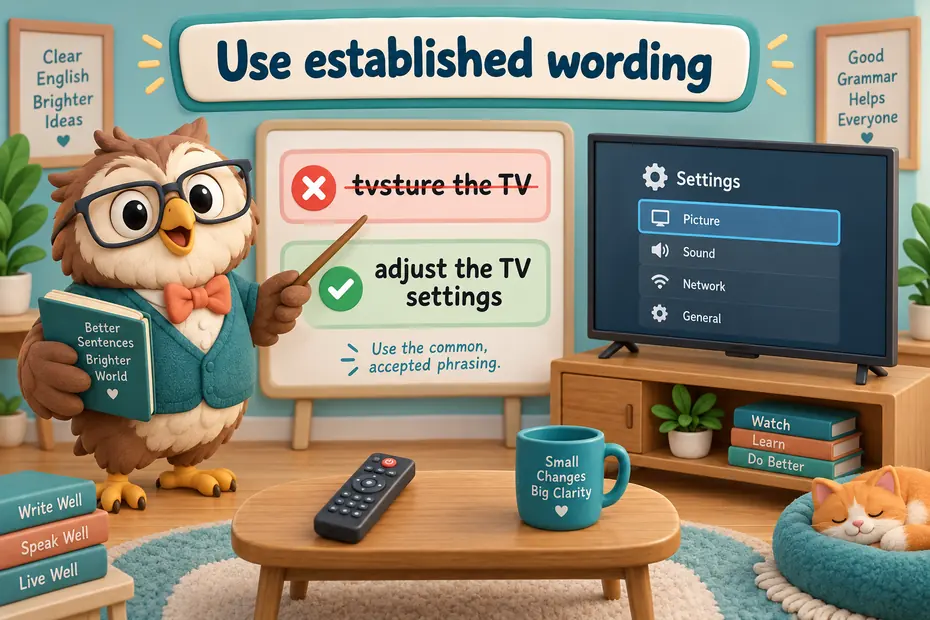
Use a clear phrase for a television action
Merriam-Webster’s adjust entry records the ordinary verb for changing something to a more suitable state or position. There is no need to invent a special verb for changing a television’s settings. “Adjust the picture settings” already expresses the action clearly.
Match the phrase to the actual task:
- “Turn down the volume” means make the sound quieter.
- “Change the channel” means choose a different broadcast channel.
- “Select another input” means choose a different input source.
- “Adjust the brightness” means change a picture setting.
- “Open the settings menu” means display the relevant controls.
These are language examples, not a model-specific troubleshooting sequence. Different televisions use different menu labels and controls. In an instruction sheet, follow the device’s actual wording so the reader can locate the intended setting.
For grammar, the adjust family is adjust, adjusts, adjusted and adjusting. Write “I adjusted the volume,” “She is adjusting the picture,” and “Did you adjust the setting?” The last sentence uses the base form after did. A clear established verb gives you predictable sentence patterns.
Check the source before choosing a replacement
If tvscher or tvsture appears in copied text, return to the original image, document or webpage. A character-recognition error can turn a familiar word into an unfamiliar string. A spelling suggestion may fix the appearance while still choosing the wrong meaning, so compare the complete sentence.

First identify the expected grammatical role. Does the sentence need a verb, a person’s surname, a material description or a product name? Then inspect the nearby words. A sentence about cloth may call for vocabulary different from a sentence about a television. Do not let the initial letters tv decide the topic by themselves.
Texture is a real word, described in Merriam-Webster’s texture entry. It can concern surface or material qualities, among other senses. A visually similar corrupted string may sometimes point toward texture, but that possibility is not proof that tvsture always means texture. The source sentence must support the correction.
Likewise, an unfamiliar sequence may be a name rather than an English common noun. Preserve a verified person’s or organization’s spelling, even if a spelling checker flags it. A vocabulary guide should not silently turn a name into a different word.
Invented words need an explicit explanation
Writers can invent words in fiction or wordplay, but an invention does not acquire an established dictionary meaning simply because someone gives it a confident definition. Merriam-Webster’s neologism entry concerns newly introduced words or senses. Evidence of wider use is different from one author’s local invention.
If you deliberately coin a term, explain it for the reader and keep its use consistent. For example, “In this story, we call the remote-control creature a tvsture” clearly announces a fictional label. That sentence does not support “Tvsture is the standard English word for handling a television.”
The earlier claims that either spelling automatically improves professionalism or expands a useful vocabulary are therefore too broad. An unexplained unfamiliar string can make instructions harder to follow. Choose the wording that helps the reader understand the intended action or reference.
A practical editing checklist

Read the whole sentence, verify the source, identify the intended meaning, and then choose the correction. If the meaning remains uncertain, mark the string for clarification rather than substituting an invented definition. Keep a note of the original wording when the change affects a quotation or a historical source.
Compare “Please tvsture the sound” with “Please turn down the volume.” The second is clear if quieter sound is intended. Compare “The fabric has a coarse tvsture” with “The fabric has a coarse texture.” The second may be an appropriate correction when the original image confirms that word. These are conditional examples of different contexts, not universal replacements.
The useful lesson is to distinguish an established word, a source error and an explicit invention. That habit prevents an unknown spelling from becoming a false definition in an article, classroom exercise or instruction manual.
Frequently asked questions
Is tvsture an established verb for adjusting a TV?
No reliable support for that claim was found in this research. Use an established phrase such as adjust the TV settings.
Should tvscher always be changed to tvsture?
No. The intended correction cannot be determined reliably without the original context.
Could either string be a proper name?
Possibly. Verify the source before replacing an unfamiliar name or label.
Is texture a possible correction?
Only when the original sentence and source support it. Visual resemblance alone is insufficient.
Can I invent a word in fiction?
Yes. Explain the invented meaning, and do not present it as an established English definition without evidence.
Key Takeaways
- “tvscher” is not a recognized word in the English language, while “tvsture” is a legitimate word that refers to handling or adjusting a television.
- Using “tvscher” allows for flexibility, linguistic invention, expanded vocabulary, language evolution, and wordplay.
- Using “tvsture” provides a clear definition, enhances effective communication, expands vocabulary, contributes to language evolution, promotes professionalism, and helps avoid miscommunication.
- When choosing between “tvscher” and “tvsture,” it is important to choose the correct word for clarity, effective communication, expanded vocabulary, language evolution, professionalism, and to avoid miscommunication.
Understanding the difference between tvscher and tvsture
When it comes to the English language, there are many words that can often be confused or misused. One such pair of words that people often struggle with are “tvscher” and “tvsture.” In this section, I will provide a clear understanding of the difference between these two words.
Definition of “tvscher”
First, let’s start by defining “tvscher.” The word “tvscher” is not actually a recognized word in the English language. It is likely a misspelling or a result of a typographical error. Hence, it is important to note that “tvscher” has no official meaning or usage.
Definition of “tvsture”
On the other hand, “tvsture” is a recognized word in the English language. It refers to a process or an act of handling a television or adjusting its settings. This could include changing channels, adjusting the volume, or even adjusting the picture settings.
The Difference Between “tvscher” and “tvsture”
The key difference between “tvscher” and “tvsture” is that “tvscher” is an incorrect or non-existent word, while “tvsture” is a legitimate word with a specific meaning. This is an important distinction to keep in mind, as using incorrect or non-existent words can lead to confusion and miscommunication.
While individuals may mistakenly use “tvscher” in place of “tvsture,” it is important to correct this error and use the correct word to accurately convey the intended meaning. Understanding the difference between these two words can help improve communication and ensure clarity in written and spoken English.
To conclude, “tvscher” is not a valid word, whereas “tvsture” refers to the act of handling or adjusting a television. By using the correct word, “tvsture,” we can better communicate and avoid confusion.
Features and benefits of tvscher
Tvscher is not a recognized word in the English language. It is likely a misspelling or typographical error. The correct word is “tvsture,” which refers to the act of handling or adjusting a television. But, let’s explore some of the features and benefits of using the word “tvscher” in our vocabulary.
- Flexibility: One of the key features of using the word “tvscher” is its flexibility. While not officially recognized, it allows for creative expression and experimentation with language. It gives us the opportunity to play with words and explore new linguistic possibilities.
- Invention: Using the word “tvscher” can be a form of linguistic invention. It allows us to create our own words and meanings, adding a personal touch to our communication. It can be an outlet for self-expression and creativity.
- Expanded Vocabulary: Incorporating the word “tvscher” into our vocabulary expands our linguistic repertoire. It challenges us to think outside the box and consider alternative words and meanings. This can enhance our communication skills and make our speech more engaging and captivating.
- Language Evolution: Language is constantly evolving, and new words are being added to our dictionaries regularly. By using the word “tvscher,” we contribute to the dynamic nature of language and drive its evolution. It reflects our ability to adapt and embrace new linguistic trends.
- Wordplay: The word “tvscher” can be a source of amusement and entertainment. It opens the door to wordplay and puns, allowing us to inject humor into our conversations. It adds a playful element to language and can spark laughter and enjoyment.
While “tvscher” may not be a recognized word, it still has its own unique features and benefits. It offers flexibility, encourages linguistic invention, expands our vocabulary, contributes to language evolution, and adds a touch of humor through wordplay. Even though this, it’s important to remember, using the correct word, “tvsture,” is crucial for effective communication. So, let’s continue to explore the definition and usage of “tvsture” to improve our language skills.
How to use tvscher effectively
When it comes to effectively using the word “tvscher,” there are a few important things to keep in mind. While it is not a recognized word in the English language, it can still be used creatively to add flair and playfulness to your writing. Here are some tips on how to use “tvscher” effectively:
- Context is key: Before using “tvscher” in your writing, make sure that the context allows for creative language usage. It’s essential to understand the nature of your audience and the purpose of your writing. If you’re writing a formal essay or a technical document, it’s best to stick with recognized and accepted words.
- Wordplay and linguistic invention: “Tvscher” offers a unique opportunity for wordplay and linguistic invention. You can use it to create neologisms or blend it with other words to form interesting combinations. But, remember, this should be done sparingly and judiciously to maintain clarity and coherence in your writing.
- Expanded vocabulary: Using “tvscher” can help expand your vocabulary and demonstrate your creativity with language. It allows you to explore alternative ways to describe actions or objects, adding a touch of novelty to your writing. Just remember to strike a balance and ensure that your unique word choices are still understandable to your readers.
- Language evolution and personal expression: Embracing words like “tvscher” in your writing can contribute to the evolution of the English language. Language is constantly changing and evolving, with new words and expressions being coined regularly. By using unconventional words like “tvscher,” you can demonstrate your willingness to explore and contribute to the linguistic world.
- Experimentation and artistic expression: “Tvscher” provides an avenue for experimentation and artistic expression. It allows you to break free from conventional language usage and explore alternative ways of expressing ideas and emotions. But, it’s crucial to remember, understanding your audience’s expectations and maintaining clarity should always be prioritized.
By following these tips, you can effectively incorporate “tvscher” into your writing, enhancing your creativity and linguistic dexterity. Remember, while it may not be a recognized word, it can still add a touch of playfulness and innovation to your writing when used appropriately. Explore the boundaries of language, but always keep in mind the context, purpose, and clarity of your writing.
Advantages of using tvscher over tvsture
As we investigate deeper into the area of the English language, it’s important to understand the differences between certain words and how they can impact our communication. In this section, I’ll highlight the advantages of using “tvscher” over “tvsture” and why incorporating it appropriately can enhance our writing.
Flexibility in Meaning
One of the advantages of using “tvscher” is its flexibility in meaning. Unlike “tvsture,” which has a specific definition related to handling or adjusting a television, “tvscher” allows for more creative interpretation. We can use it to convey various actions or concepts that may not have a defined term in the English lexicon. This flexibility opens up a world of possibilities for linguistic invention and artistic expression.
Expanded Vocabulary
By embracing the use of “tvscher,” we can expand our vocabulary and enrich our writing. Adding new words to our repertoire helps us to better express ourselves and communicate our thoughts effectively. Incorporating “tvscher” into our lexicon allows us to push the boundaries of language and contribute to its evolution.
Language Evolution
Language is constantly evolving, adapting to reflect the changing society and culture. Introducing new words like “tvscher” encourages language evolution and allows us to keep up with the pace of innovation. By embracing linguistic invention, we become active participants in shaping the future of the English language.
Wordplay and Creativity
Using “tvscher” also opens up opportunities for wordplay and creativity. Think of it as a tool that allows us to play with language, creating puns, rhymes, and clever expressions. Incorporating “tvscher” appropriately adds a touch of artistic flair to our writing and can make it more engaging and memorable.
So, while it’s important to use the correct word “tvsture” for effective communication, let’s not shy away from incorporating “tvscher” when appropriate. It offers flexibility in meaning, expands our vocabulary, contributes to language evolution, and adds a sense of creativity to our writing. Let’s embrace the power of linguistic invention and experiment with new words to enhance our communication skills.
Features and benefits of tvsture
As we investigate into the world of “tvscher vs tvsture,” it’s essential to understand the features and benefits of the word “tvsture.” Let’s explore why using this word appropriately can enhance your language skills and communication.
- Clear Definition: The word “tvsture” has a clear and specific meaning. It refers to the act of handling or adjusting a television. By using “tvsture,” we can ensure that our message is understood without any confusion or ambiguity.
- Effective Communication: Using the correct word enhances effective communication. When we express ourselves precisely, our thoughts and ideas are conveyed accurately. This can help avoid misunderstanding and promote clarity in our conversations.
- Expanded Vocabulary: Incorporating “tvsture” into our vocabulary expands our word choices and enriches our language skills. By using a range of words, we can express ourselves more precisely and add depth to our communication.
- Language Evolution: Embracing the appropriate word contributes to the evolution of language. Language constantly evolves over time, and by using words such as “tvsture,” we participate in this process. It helps us stay current and adapt to new terms and expressions that emerge.
- Professionalism: Using the correct word demonstrates professionalism and mastery of the English language. Employers, educators, and colleagues value individuals who can articulate their ideas accurately and effectively. By employing “tvsture,” you showcase your linguistic expertise.
- Avoiding Miscommunication: Misusing words can lead to miscommunication and confusion. By understanding the difference between “tvscher” and “tvsture,” we can avoid potential misunderstandings and ensure that our message is received as intended.
- Smoother Interactions: When we use the appropriate word, our interactions with others become smoother. By choosing the correct term, we can foster better understanding and engagement in conversations, whether it’s in a professional setting or daily interactions with friends and family.
It is important to remember the value and advantages of using “tvsture” accurately. Doing so not only promotes clear communication but also showcases our language proficiency and helps us navigate through the ever-evolving world of language.
The next section will explore the potential benefits and advantages of incorporating “tvscher” into our vocabulary creatively and appropriately.
How to use tvsture effectively
When it comes to using the word “tvsture,” it’s important to have a clear understanding of its definition and how it can be effectively incorporated into your writing and communication. Let’s explore some key strategies for using “tvsture” in a way that enhances your language skills and ensures effective communication.
- Understand the Definition:
First and foremost, make sure you have a solid grasp of the definition of “tvsture.” It refers to the act of handling or adjusting a television. By using this word accurately, you can convey your ideas more precisely and avoid any potential confusion or miscommunication. - Context is Key:
Consider the context in which you’re using “tvsture.” Is it a casual conversation, a professional document, or a creative piece? Adapting the usage of “tvsture” to the appropriate context ensures that your message is conveyed accurately and professionally. - Expand Your Vocabulary:
Take advantage of the opportunity to expand your vocabulary by incorporating “tvsture” into your writing. Using varied and precise language not only improves your communication skills but also enhances your overall writing style. - Contribute to Language Evolution:
By using “tvsture” appropriately, you can actively participate in the continuous evolution of the English language. Language evolves through the incorporation of new words and phrases, and by adopting “tvsture” correctly, you contribute to this ongoing process. - Embrace Wordplay and Creativity:
Don’t be afraid to incorporate wordplay and exercise your creativity with “tvsture.” Using this word with a touch of imagination can add flair and make your writing more engaging.
Remember, using “tvsture” effectively requires a clear understanding of its meaning and the appropriate context. By following these guidelines, you can confidently incorporate “tvsture” into your vocabulary and further enhance your language skills.
Next, I’ll investigate into the benefits of using “tvsture” accurately, including the advantages it provides in terms of clear definitions, effective communication, and smoother interactions.
Advantages of using tvsture over tvscher
When it comes to the words “tvsture” and “tvscher,” it’s essential to understand the distinction between them. While “tvscher” is not a recognized word, “tvsture” is a legitimate term that refers to the act of handling or adjusting a television. In this section, I’ll explore the advantages of using “tvsture” correctly in our vocabulary.
- Clear Definition: The first advantage of using “tvsture” over “tvscher” is the clarity it provides. “Tvsture” has a well-defined meaning in the English language, making it easier for others to understand your communication. Clear and precise terminology ensures effective communication and minimizes any potential confusion.
- Effective Communication: By using the correct word, “tvsture,” you can convey your message more accurately and effectively. When we choose language that aligns with commonly accepted definitions, it allows for smoother interactions and fosters better understanding between individuals.
- Expanded Vocabulary: Embracing the accurate word “tvsture” provides an opportunity for expanding our vocabulary. By incorporating commonly used words, we enhance our linguistic skills and become more adept at expressing ourselves in various contexts.
- Language Evolution: Using “tvsture” contributes to the ongoing evolution of language. Language evolves through the consistent use and acceptance of certain words. By utilizing “tvsture” correctly, we participate in shaping language and its development.
- Professionalism: In professional settings, it is crucial to use appropriate language to convey expertise and professionalism. By using “tvsture” accurately, you demonstrate your command of the language and establish credibility in your field.
- Avoiding Miscommunication: Choosing the correct word, “tvsture,” helps avoid miscommunication or unintentional misunderstandings. By being precise in our language usage, we minimize the potential for confusing or misleading others.
To conclude, there are numerous advantages to using the word “tvsture” correctly in our vocabulary. It provides clarity, enhances effective communication, expands our vocabulary, contributes to language evolution, promotes professionalism, and helps us avoid miscommunication. By understanding the definition and context of “tvsture,” we can incorporate it into our language usage and reap the benefits it offers.
Choosing the right option for your needs
When it comes to the words “tvscher” and “tvsture,” understanding their differences is crucial to use them appropriately and effectively. Let’s investigate into the distinctions between these two terms and determine the best choice for your needs.
Definition of “tvscher”: Unfortunately, “tvscher” is not a recognized word in the English language. It seems to be a misspelling or a typographical error. If you come across this word, it’s best to double-check your spelling and consider using “tvsture” instead.
Definition of “tvsture”: On the other hand, “tvsture” is a legitimate word that refers to the act of handling or adjusting a television. It is used to describe manipulating the settings, such as adjusting the volume, changing channels, or modifying the picture quality.
Understanding the difference between these two terms is important for effective communication. Here are a few key points to consider when choosing the right option:
- Clarity: When using the correct word, “tvsture,” your message will be clear and easily understood. People will immediately recognize your intention to refer to actions related to a television.
- Effectiveness in Communication: By using the recognized word, “tvsture,” you ensure that your message is conveyed accurately. There is less room for confusion or misinterpretation.
- Expanded Vocabulary: Incorporating the term “tvsture” into our vocabulary expands our linguistic repertoire. It allows us to express ourselves more precisely and effectively.
- Contribution to Language Evolution: By using the correct and recognized word, “tvsture,” we contribute to the organic evolution of language. This ensures that our communication remains up to date and aligned with the evolving linguistic world.
- Professionalism: Using the appropriate term, “tvsture,” demonstrates professionalism and a strong command of language. It shows that you pay attention to detail and strive for accuracy in your communication.
- Avoidance of Miscommunication: By choosing the correct word, “tvsture,” you minimize the risk of miscommunication. Clear and precise language avoids confusion and ensures that your message is received as intended.
Conclusion
To conclude, it is essential to understand the difference between “tvscher” and “tvsture” to communicate effectively. While “tvscher” is not a recognized word and likely a misspelling, “tvsture” is a legitimate term that refers to handling or adjusting a television. By using the correct word, we can avoid confusion and improve our communication skills.
Using “tvsture” has several advantages. First, it provides clarity in our language, ensuring that our message is understood without any ambiguity. Second, it enhances our effectiveness in communication by using the appropriate terminology. Also, incorporating “tvsture” expands our vocabulary and contributes to the evolution of language. It also adds a touch of professionalism to our communication, showcasing our linguistic dexterity.
But, it is worth noting that there may be instances where creatively incorporating “tvscher” can enhance our expression. Nonetheless, it is crucial to use it appropriately and in a way that does not compromise clarity.
To conclude, by understanding the differences between “tvscher” and “tvsture” and using the correct word, we can elevate our communication skills and ensure effective and clear messaging.
Frequently Asked Questions
Q: What is the difference between “tvscher” and “tvsture”?
A: “Tvscher” is not a recognized word, likely a misspelling or typographical error. On the other hand, “tvsture” is a legitimate word that refers to the act of handling or adjusting a television.
Q: Why is it important to use the correct word?
A: Using the correct word avoids confusion and improves communication.
Q: What are the advantages of using “tvsture” over “tvscher”?
A: Using “tvsture” offers benefits such as clarity, effectiveness in communication, expanded vocabulary, contribution to language evolution, professionalism, and avoidance of miscommunication.
Q: Can “tvscher” be used in any context?
A: Although “tvscher” is not a recognized word, it can be incorporated appropriately to enhance creativity and linguistic dexterity.
Q: How can using “tvsture” contribute to effective communication?
A: Using “tvsture” enhances communication by using the correct and recognized term, ensuring clarity and understanding among speakers and listeners.


