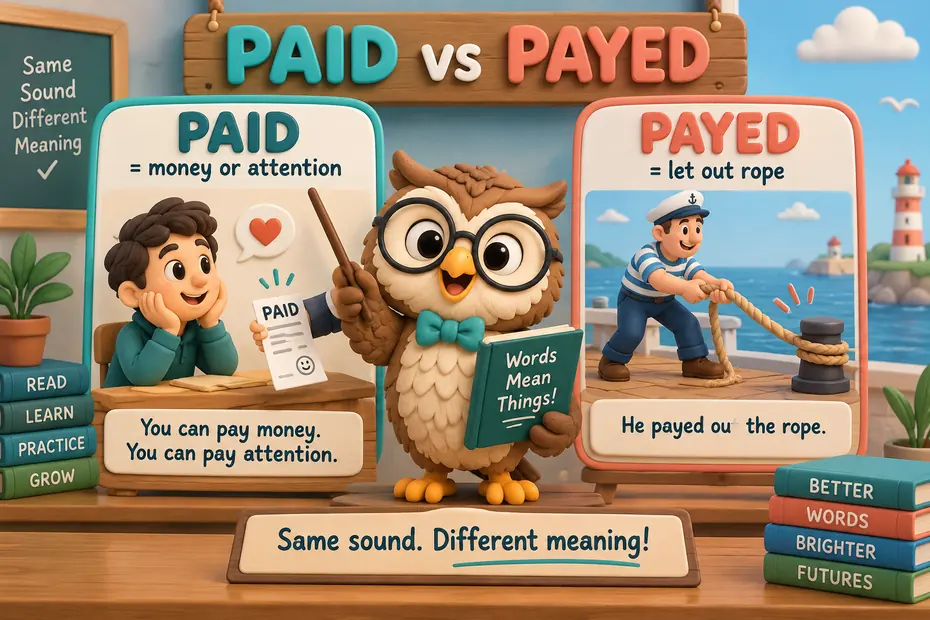
Use paid for money, attention, compliments and most ordinary past-tense uses of pay. Payed is a real but specialized form used when letting out rope or cable and when coating something with a waterproof material. “I paid the invoice” is correct; “I payed the invoice” is not the standard spelling for a payment.
The earlier guide makes the distinction too absolute. Paid is not confined to financial transactions, and payed is not restricted to coating a boat. Technical senses can also admit paid. The practical rule is simple: choose paid in everyday writing; check the particular technical meaning before choosing payed.
Paid and payed: the useful comparison
| Context | Useful spelling | Example |
|---|---|---|
| Money, bills or wages | paid | They paid the supplier. |
| Attention, respect or a compliment | paid | She paid attention to the instructions. |
| Consequences or a penalty | paid | He paid the price for his mistake. |
| Letting rope or cable run out | payed or paid in this technical sense | The crew payed out the rope. |
| Applying a waterproof composition | payed; paid is also recorded | They payed the seams with pitch. |

Paid covers much more than a payment
The ordinary verb pattern is pay → paid → paid. The second form is the simple past; the third is the past participle. “We paid the bill” describes a past action. “We have paid the bill” uses the participle after have. “The bill was paid” uses it in the passive voice.
Financial examples are easy to recognize: “The customer paid cash,” “I paid for lunch,” and “The employer paid the staff.” Notice that pay can take an object directly, as in paid the bill, or use for, as in paid for lunch. Avoid adding for automatically to every payment sentence.
Nonfinancial phrases still use paid:
- I paid attention during the explanation.
- She paid her respects to the family.
- The reviewer paid the performers a compliment.
- They paid a visit to their former teacher.
- He paid the price for ignoring the warning.
These examples explain why “paid means money” is an incomplete memory aid. The useful category is the ordinary pay family, including its established phrases. The spelling does not change just because nothing was bought.
Where payed belongs
Merriam-Webster’s pay entry records payed as an alternative in the sense of letting a rope run out, and records payed and paid for the separate waterproof-coating verb. This is a dictionary distinction between meanings, rather than a blanket rule based on whether a sentence happens on a boat.

“The crew payed out the rope” means they allowed more rope to run out. It does not mean they purchased the rope, made it stronger or coated it for ultraviolet protection. The earlier examples about payed ropes should therefore be read carefully: identify the actual action, rather than assuming that every rope-related sentence needs payed.
The waterproofing sense appears in descriptions of coating seams or other surfaces with a suitable composition. “The workers payed the seams with pitch” illustrates that older technical vocabulary. It is a word-usage example, not a recommendation for maintaining a particular modern boat or choosing a coating product.
Paid can appear in those technical senses too. That makes “paid and payed are never interchangeable” too broad. They are not interchangeable for an invoice, salary or attention, but a dictionary can recognize both forms for a specific technical action. If editing a technical document, follow its terminology and check a specialist source where necessary.
Grammar patterns that prevent common errors
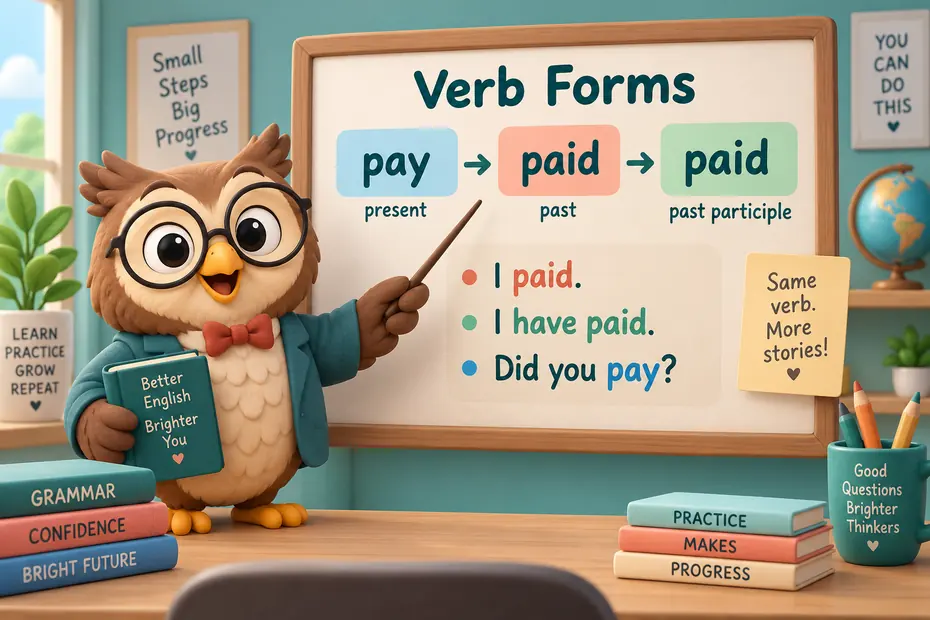
After did, use the base form pay: “Did you pay the bill?” and “I did not pay it.” Avoid “Did you paid?” The helping verb already carries the past-tense information. Similarly, write “We will pay tomorrow” and “They can pay online,” because will and can take the base form.
The ongoing form is paying, with the y retained: “She is paying now.” Adding -ed mechanically to pay produces the wrong form for ordinary payments. English has irregular past-tense patterns, and this is one worth learning as a complete three-part family.
Paid also describes a status in phrases such as paid leave, paid work and a paid subscription. Write “a well-paid employee” with a hyphen before the noun, but “the employee is well paid” in the usual predicative construction. Unpaid is the familiar opposite; neither word needs the spelling payed.
Check the meaning in a short practice set
Choose the spelling in “I ___ my rent,” “She ___ attention,” and “The sailor ___ out the line.” The first two require paid. The third permits payed for letting the line run out; paid is also recorded for that sense. If the sailor bought the line at a shop, however, the sentence would require paid.
When proofreading, replace the action mentally with bought, compensated, noticed, honored, released rope or waterproofed. This helps you identify the sense before choosing the form. A spelling checker can recognize payed as a valid word and still fail to catch “payed the rent.” Meaning remains the final check.
Frequently asked questions
Is payed a misspelling?
It is a misspelling when used for ordinary payments or attention. It is a valid word in the specialized rope-release and waterproof-coating senses.
Is “paid attention” correct?
Yes. The phrase uses the ordinary pay family even though it does not describe money changing hands.
Should I write “has paid” or “has payed”?
Use has paid for bills, wages, attention and other ordinary meanings. Has payed needs an appropriate technical sense.
Can paid refer to letting out a rope?
Yes. Merriam-Webster records paid and allows payed in that sense, so paid is not automatically wrong in a rope-release sentence.
Does being on a ship mean I should use payed?
No. “The captain paid the crew” still uses paid. Choose by the verb’s meaning, not the location.
Key Takeaways
- “Paid” is the past tense and past participle form of the verb “pay.” It refers to giving money or something of value in exchange for goods, services, or debts.
- “Payed” is a less commonly used term that primarily finds its application in nautical or maritime contexts. It refers to the process of sealing or coating a surface with tar, pitch, or a similar substance to protect it from moisture and damage.
- The key differences between “paid” and “payed” lie in their definitions and usage. “Paid” is widely used in everyday scenarios, while “payed” is specialized and predominantly used in nautical or maritime contexts.
- Always use “paid” for financial transactions involving money or payments. Reserve “payed” for situations related to boat maintenance or sailing.
- Regional variations in usage exist, but it is generally best to use “paid” for clarity and precision in communication.
- Understanding the proper usage of “paid” and “payed” helps avoid confusion and ensures accurate communication.
Definition of “Paid” and “Payed”
When it comes to using the words “paid” and “payed,” it’s important to understand their definitions and differences.
“Paid” is the past tense and past participle form of the verb “pay.” It refers to giving money or something of value in exchange for goods, services, or debts. For example, “I paid for my meal at the restaurant.”
On the other hand, “payed” is a less commonly used term that refers to sealing or coating a surface with tar, pitch, or a similar substance. It is primarily used in nautical or maritime contexts. An example of “payed” would be “The sailors payed the deck of the ship to protect it from water damage.”
Now that we have defined both terms, let’s explore their differences and usage.
Different Usage of “Paid” and “Payed”
As we investigate deeper into the world of words, it’s essential to understand the different contexts in which “paid” and “payed” are used. Let’s explore the specific usage of each term to gain a clearer understanding.
Definition of “Paid”
The term “paid” is the past tense and past participle form of the verb “pay.” It refers to giving money or something of value in exchange for goods, services, or debts. It is a widely recognized and commonly used term in everyday situations.
Definition of “Payed”
On the other hand, “payed” is a less frequently used term that primarily finds its application in nautical or maritime contexts. It refers to the process of sealing or coating a surface, typically a ship’s timbers, with tar, pitch, or a similar substance. This action helps to protect the surface from moisture and damage.
The Differences between “Paid” and “Payed”
To summarize, the key differences between “paid” and “payed” can be classified into two main categories: definition and usage.
Definition:
- “Paid” – refers to giving money or something of value in exchange for goods, services, or debts.
- “Payed” – refers to sealing or coating a surface with tar, pitch, or a similar substance, primarily in nautical or maritime contexts.
- “Paid” is the more commonly used term and is applicable in various everyday scenarios where transactions occur.
- “Payed” is a specialized term primarily used in specific nautical or maritime contexts.
Understanding these differences will help us use these terms appropriately in our written and spoken communication. It’s crucial to be mindful of these distinctions to ensure clarity and precision in our language usage.
Examples of Usage
To further illustrate the proper usage of these terms, here are a couple of examples:
- Paid: I paid for the groceries at the supermarket yesterday.
- Payed: The ship’s crew meticulously payed the deck with tar to protect it from moisture.
By examining these examples, we can see how “paid” and “payed” are used in different contexts, reinforcing the importance of using the correct term for precise communication.
Now that we’ve explored the definitions and differences between “paid” and “payed,” let’s move on to further elucidate their usage in practical contexts.
Common Mistakes: Confusing “Paid” and “Payed”
When it comes to the words “paid” and “payed,” it’s important to understand the difference between them to use them appropriately in your writing. Let’s jump into the definitions and usage of these words to clear up any confusion.
Paid is the past tense and past participle form of the verb “pay.” It is used in everyday situations to refer to giving money or something of value in exchange for goods, services, or debts. When you pay for something, you are fulfilling a financial obligation. Here are some examples to illustrate the correct usage of “paid”:
- I paid for my groceries at the checkout counter.
- She paid her monthly rent on time.
- The company paid the workers their salaries.
On the other hand, payed is a less commonly used term, primarily found in nautical or maritime contexts. It refers to the process of sealing or coating a surface with tar, pitch, or a similar substance. This practice was common in shipbuilding to protect and preserve the wooden structures. Here are a few examples of “payed” used in the correct context:
- The sailors payed the deck of the ship to weatherproof it.
- The shipbuilder payed the hull to prevent water damage.
- The crew payed the ropes to increase their strength and durability.
It’s crucial to keep in mind that “paid” and “payed” are not interchangeable. Using “payed” in everyday situations could lead to confusion and misunderstandings. Stick to using “paid” as the past tense of “pay” when referring to financial transactions, and reserve “payed” for specialized nautical contexts.
Understanding the distinctions between these two words will help you communicate clearly and accurately in your writing. Whether you are talking about paying for a meal or describing a shipbuilding technique, using the correct term will ensure your message is conveyed effectively.
By clarifying the definitions and appropriate usage of “paid” and “payed,” we can avoid the common mistake of confusing these words and enhance our overall communication skills. Keep these distinctions in mind the next time you encounter these terms, and you’ll be able to use them confidently and correctly.
Tips for Using “Paid” and “Payed” Correctly
Now that we have a clear understanding of the difference between “paid” and “payed,” let’s explore some helpful tips for using these words correctly in your writing. Understanding when and how to use each term will ensure that your communication is clear and accurate. Here are some guidelines to keep in mind:
1. Know the definitions: Familiarize yourself with the definitions of “paid” and “payed” to understand their specific contexts and meanings. Remember, “paid” is the past tense and past participle form of the verb “pay,” used in everyday situations to refer to giving money or something of value in exchange for goods, services, or debts. On the other hand, “payed” is a less commonly used term primarily used in nautical or maritime contexts to describe the process of sealing or coating a surface with tar, pitch, or a similar substance.
2. Use “paid” for financial transactions: When referring to transactions involving money or payments, always use “paid.” For example, “I paid my rent yesterday” or “She paid for her meal with a credit card.” This usage is the most common and widely accepted in general English.
3. Reserve “payed” for nautical contexts: If you find yourself in a nautical or maritime setting, such as discussing boat maintenance or sailing, you may come across the term “payed.” But, keep in mind that this usage is less common outside of these specific contexts. For instance, “The ship’s hull was payed to protect it from water damage.”
4. Be aware of regional variations: It’s worth noting that regional variations in usage exist for these terms. While “paid” is widely accepted as the correct form in most English-speaking regions, you may encounter instances where “payed” is used colloquially or in specific dialects. But, it’s generally best to stick to “paid” to ensure clarity and avoid confusion.
Remember, using the correct term “paid” or “payed” is essential for precise communication. By being aware of their definitions, contexts, and following these guidelines, you can confidently use these words correctly in your writing.
Examples of Proper Usage
Now that we have a clear understanding of the definitions and differences between “paid” and “payed,” let’s explore some examples to see how these words are used appropriately.
- Paid:
In everyday situations, we use “paid” to describe the action of giving money or something of value in exchange for goods, services, or debts. Here are a few examples:
- I paid for the groceries at the supermarket.
- They paid their rent on time.
- She paid her credit card bill online.
Remember, “paid” is the past tense and past participle form of the verb “pay.”
- Payed:
On the other hand, “payed” is a term primarily used in nautical or maritime contexts. It describes the process of sealing or coating a surface with substances like tar, pitch, or similar materials. Here are a few examples:
- The ship’s hull was payed to prevent water leakage.
- The sailors payed the ropes to protect them from UV damage.
- The boat’s deck was thoroughly payed before setting sail.
Keep in mind that “payed” is less commonly used outside of maritime contexts.
It’s important to note that accuracy and clarity are essential when using “paid” or “payed.” Using the wrong term can create confusion and misunderstanding. By understanding the proper usage of these words, we can ensure effective communication in various situations.
Now that we’ve explored examples of how to use “paid” and “payed” correctly, let’s move on to some helpful tips for using these words accurately.
Conclusion
Understanding the distinctions between “paid” and “payed” is crucial for effective communication. In everyday scenarios, “paid” is the appropriate term when referring to exchanging money or something of value for goods, services, or debts. On the other hand, “payed” is primarily used in nautical or maritime contexts, specifically to describe the process of sealing or coating a surface with tar, pitch, or a similar substance.
By using the correct term in the appropriate context, we can ensure clear and accurate communication. Misusing these words can lead to confusion and misunderstandings. Whether it’s discussing financial transactions or maritime activities, precision in language is vital.
Remember, “paid” is for financial exchanges, while “payed” is for maritime applications. Being mindful of these distinctions will enhance your ability to convey your message accurately and avoid any potential misinterpretations.
So, next time you find yourself in a situation where you need to use either “paid” or “payed,” remember the context and choose the correct term accordingly. Clarity in communication is key, and understanding the nuances of language is a valuable skill.
Frequently Asked Questions
Q: What is the difference between “paid” and “payed”?
Paid and payed are two different words with distinct meanings and usage. “Paid” is the past tense and past participle of the verb “pay.” It is commonly used in everyday situations when referring to giving money or something of value in exchange for goods, services, or debts. On the other hand, “payed” is primarily used in nautical or maritime contexts to describe the process of sealing or coating a surface with tar, pitch, or a similar substance.
Q: Can “paid” and “payed” be used interchangeably?
No, “paid” and “payed” have different meanings and uses. “Paid” is the correct term to use when referring to monetary transactions or fulfilling financial obligations. On the other hand, “payed” is specific to nautical or maritime situations only. Using the wrong term can lead to confusion and inaccuracies in communication. It’s important to use the appropriate term based on the context to ensure clear and precise communication.
Q: How can I use “paid” and “payed” correctly?
To use “paid” correctly, always use it when referring to financial transactions. For example, “She paid for her groceries at the store.” As for “payed,” it should only be used in nautical or maritime contexts. For instance, “The sailors payed the ship’s hull to protect it from water damage.” By understanding the distinct meanings and contexts of these words, you can ensure accurate and effective communication in both written and verbal communication.
Q: Why is it important to know the difference between “paid” and “payed”?
Knowing the difference between “paid” and “payed” is essential for precise communication. Using the wrong term can lead to confusion and misinterpretation. This is particularly important when dealing with financial matters, where accuracy is crucial. Using the correct term ensures that your message is clear, professional, and understandable. It also showcases your language skills and attention to detail. By understanding and using the appropriate term, you can convey your message effectively and avoid any potential misunderstandings.


