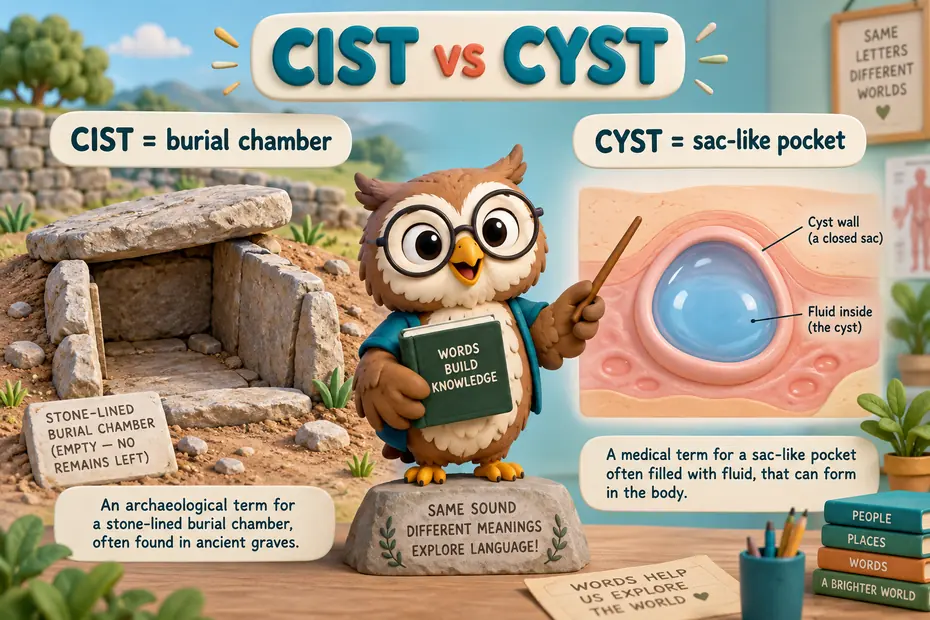
Cist is an archaeological word for a burial chamber, typically lined with stone. Cyst is a medical or biological word for a closed sac-like structure. Use cist for the burial feature and cyst for the relevant tissue or organism structure. The older anatomical claims below about a “pyloric cist” are unsupported; do not use cist as a routine alternative spelling for cyst or for a body cavity.
Cist vs cyst: key facts
The difference is not simply which spelling looks more familiar. Both are real nouns with established meanings. A cist may appear in an excavation report. A cyst may appear in a clinical report or biology text. The subject gives you a stronger clue than their similar sounds.
| Word | Common field | Meaning | Example |
|---|---|---|---|
| Cist | Archaeology | Burial chamber, often stone-lined | The excavation uncovered a cist. |
| Cyst | Medicine or biology | Closed sac-like pocket or related biological structure | The report described a cyst. |
Merriam-Webster’s cist entry describes a burial chamber associated with prehistoric periods and records both “sist” and “kist” pronunciations. Its cyst entry includes the body-sac meaning and additional biological senses. There is no meaningful pronunciation rule involving a “hard s” versus a “soft s,” as the older discussion suggests.
Using cist in archaeology
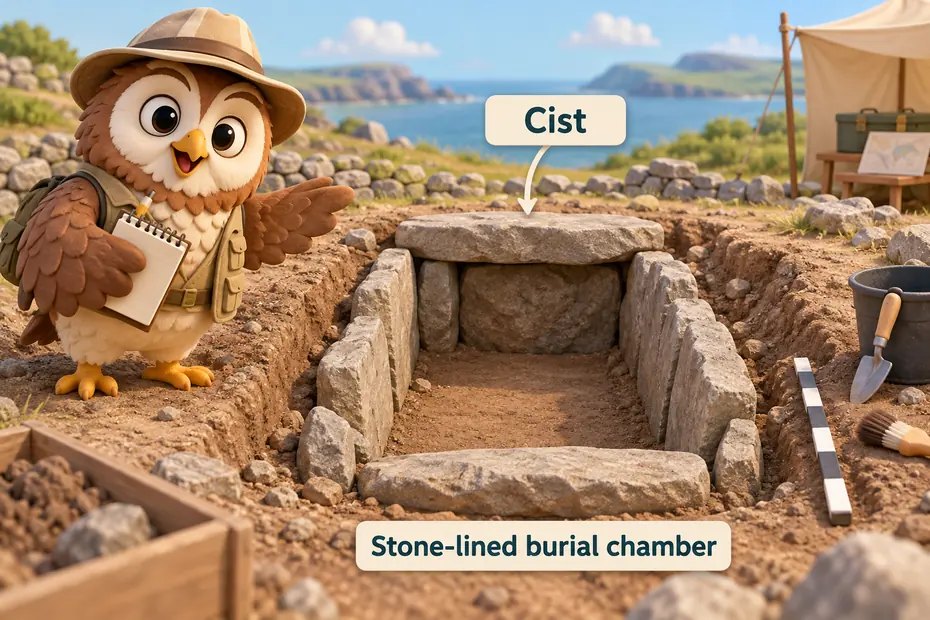
A cist is a burial structure. It is often described as a chamber formed or lined with stone slabs. An archaeological report may discuss its dimensions, construction, contents and relationship to surrounding features. The word names the structure, not a medical condition affecting a person.
- The archaeologists recorded the cist’s dimensions.
- A capstone covered the burial cist.
- The survey identified two cists near the mound.
- The museum label describes a stone-lined cist.
Use modifiers only when the evidence supports them. “Stone-lined cist” describes construction; “Bronze Age cist” adds a dating claim. The word cist alone does not tell you the exact date of a particular find. In a report, separate what was observed from what further analysis established.
Using cyst in medicine
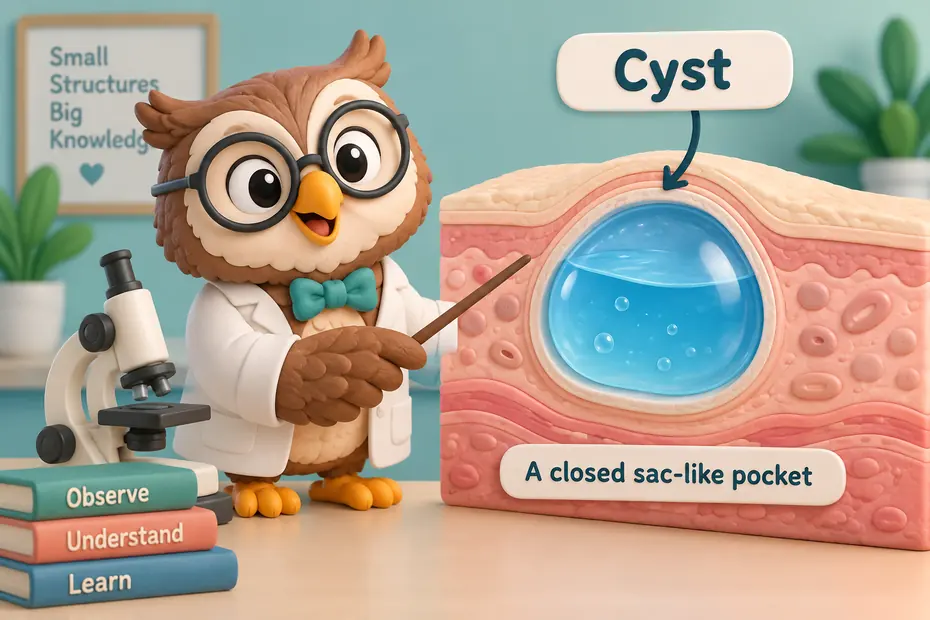
The National Cancer Institute defines cyst as a closed, sac-like pocket of tissue that may contain fluid, air, pus or another material. It notes that most cysts are benign. This is the spelling for the medical term; cist is not a substitute chosen according to how the word sounds.
- The clinician discussed the cyst with the patient.
- The report recorded the cyst’s location.
- The glossary explains the term cyst.
- The study compared several cysts.
The word alone does not establish the type, cause or treatment of a particular finding. Preserve any additional description in a medical report rather than reducing it to a broad spelling explanation. A dictionary definition does not determine whether a particular lump is a cyst.
For example, “a cyst was described on the scan” reports wording from a scan result. “I think this lump is a cyst” reports an assumption. They are not equivalent statements. NHS skin-cyst guidance recommends seeing a GP when you have a skin lump and do not know what it is. The appropriate vocabulary should follow an established finding rather than supply a diagnosis by itself.
Cyst also has biological uses
Cyst is not restricted to human tissue. Dictionaries record structures associated with certain algae and protective or resting-stage capsules of small organisms. In those contexts, use cyst and retain the scientific description that explains which organism or structure is meant.
This broader range does not turn cist into a biological synonym. A biology worksheet and an excavation report may each contain a container-like structure, but resemblance is not enough to choose the same word. Technical vocabulary follows the established term in the relevant field.
Correcting misleading anatomy claims
The older section titled “When to use the term cist” treats it as a general anatomical chamber word and gives “pyloric cist” as an example. The reliable dictionary entries linked here do not support that guidance. Use the actual named anatomical structure from a reliable source; do not invent a cist label because the structure has a cavity.
Cisterna is a separate term with its own established uses. Its appearance in a named structure does not establish cist as a replacement noun. Likewise, an ordinary vessel used in a preparation process is not automatically a cist merely because both descriptions involve a container.
Plurals, possessives and pronunciation
The regular plurals are cists and cysts. The singular possessives are cist’s and cyst’s; the plural possessives are cists’ and cysts’. In “The report describes two cysts,” no apostrophe is needed. In “The cist’s capstone was measured,” the apostrophe marks a relationship to one burial chamber.
Cyst normally sounds like “sist.” Cist can also sound like “sist,” but “kist” is another accepted dictionary pronunciation. Therefore, the pair may be homophones for some speakers. Do not rely on hearing a distinction that the speaker may not make.
A quick context check
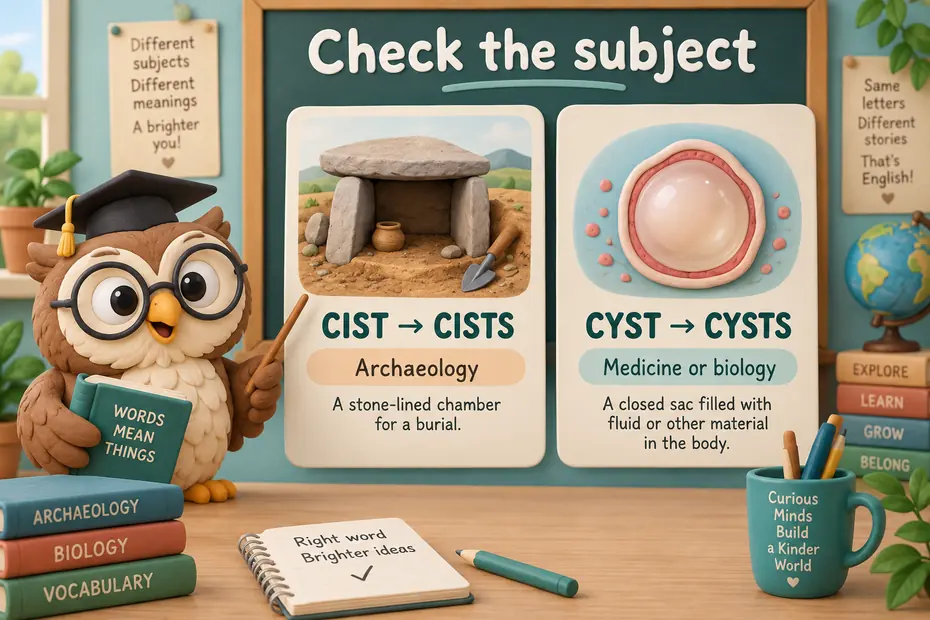
Replace cist with burial chamber and cyst with sac-like pocket. “The team excavated a burial chamber” points to cist. “The scan described a sac-like pocket” points to cyst. Then verify any technical modifier against the source document.
Frequently asked questions
Is cist a misspelling?
No. It is an established archaeological noun. It is a spelling error if used in place of the medical word cyst.
Are they always pronounced differently?
No. Cist has both “sist” and “kist” pronunciations; cyst uses “sist.”
Does cyst mean cancer?
The word alone does not establish that. NCI says most cysts are benign; a specific finding needs its own assessment.
What are the plurals?
Cists for burial chambers and cysts for the medical or biological structures.
Can I call any body cavity a cist?
No. Use the established anatomical term. The unsupported chamber-word guidance in the older discussion should not be followed.
Key Takeaways
- A cyst is a closed sac or pocket in the body that contains fluid, air, or semi-solid material.
- Cysts can develop in various parts of the body and can cause discomfort and pain.
- A cyst is different from a tumor, as a cyst is typically filled with fluid or semi-solid material, while a tumor is an abnormal growth of cells.
- A cist, pronounced as “sist,” refers to a burial structure used by ancient civilizations, while a cyst is a sac or pocket in the body.
- The term “cist” is not commonly used in everyday conversation, unless in archaeological or historical contexts.
- Understanding the difference between cysts and cists is important for effective communication, especially for students of medicine, biology, archaeology, or history.
What is a cyst?
A cyst is a common medical term that refers to a closed sac or pocket in the body that contains fluid, air, or semi-solid material. Cysts can develop in various parts of the body, including the skin, ovaries, kidneys, and liver.
The definition of a cyst may vary depending on its location and characteristics. It is important to note that not all cysts are harmful or require treatment. While some cysts may be asymptomatic and go unnoticed, others can cause discomfort, pain, and other symptoms.
Cysts can be characterized by their size, shape, and composition. They can range in size from a few millimeters to several centimeters. The shape of a cyst can vary, from round or oval to irregular. Also, the composition of a cyst can include various substances such as clear or turbid fluid, pus, blood, or even solid material.
One difference between a cyst and a tumor is that a cyst is typically filled with fluid or semi-solid material, while a tumor is an abnormal growth of cells. Tumors can be cancerous or non-cancerous, whereas most cysts are non-cancerous.
It is worth mentioning that not all growths are cysts. Any abnormal growth or lump in the body should be evaluated by a qualified healthcare professional for an accurate diagnosis.
In the next section, we will explore the characteristics and usage of the word “cist,” highlighting its differences from the term “cyst.” Let’s understand the confusion and clarify its appropriate usage for better communication.
What is a cist?
A cist is a term that is often confused with the word “cyst.” While both words sound similar, they have distinct meanings and usage in the English language. In this section, I will define what a cist is and clarify its appropriate usage to help improve your communication skills.
Definition of Cist
A cist, pronounced as “sist,” refers to a receptacle or container, especially one used for burial purposes. It is commonly associated with archaeology and is used to describe a stone-lined grave or burial chamber. These structures were used by ancient civilizations to inter the deceased along with their personal belongings, providing valuable insights into their cultural practices and beliefs.
Difference Between Cist and Cyst
It’s important to note that there is a significant difference between a cist and a cyst. While a cist is a burial structure, a cyst, as discussed in the previous section, is a closed sac or pocket in the body filled with fluid, air, or semi-solid material. The distinction lies in their pronunciation, meaning, and context of usage.
Appropriate Usage
In everyday conversation, the term “cist” is not commonly used. Its usage is more prevalent in archaeological or historical discussions. Hence, unless you are engaging in these specific contexts, it’s unlikely that you will come across the word “cist” in your day-to-day life.
But, for students of archaeology or history, understanding the meaning and appropriate usage of “cist” is essential. It allows you to accurately describe and discuss burial structures, enhancing your ability to communicate your knowledge effectively.
To summarize, a cist refers to a burial structure used by ancient civilizations, while a cyst is a sac or pocket in the body containing fluid, air, or semi-solid material. By understanding the difference between these two words, you can confidently use them in their respective contexts.
In the next section, I will investigate into the characteristics and usage of the word “cyst” to provide you with a comprehensive understanding of this commonly confused term.
Differences between cyst and cist
Let’s now investigate into the differences between a cyst and a cist. By understanding their unique characteristics, you’ll be better equipped to use these terms appropriately in your writing or conversations.
- Definition of Cyst: A cyst is a sac or pocket in the body that is filled with fluid, air, or semi-solid material. It can occur in various parts of the body, including organs, tissues, or bones. Cysts can be benign (non-cancerous) or malignant (cancerous). They often develop due to infections, blockages, or genetic factors.
- Definition of Cist: On the other hand, a cist refers to a specific type of burial structure used by ancient civilizations. It is a stone-lined grave or tomb that was commonly used for the interment of human remains. Cists were constructed by placing stones vertically and horizontally to create a rectangular or square-shaped enclosure. These structures were primarily used for single burials or small groups of individuals.
Now that we’ve defined these terms, let’s explore the distinguishing factors between cysts and cists:
- Usage and Context: The primary difference lies in their usage and context. While cysts are commonly referred to in medical and biological contexts, cists are predominantly used in archaeological or historical discussions.
- Pronunciation: Another noticeable distinction is in their pronunciation. Cyst is pronounced as “sist” with a soft “s” sound, whereas cist is pronounced as “sist” with a hard “s” sound.
- Origin and Meaning: Cysts derive their meaning from the Greek word “kustis” meaning “bladder” or “pouch.” On the other hand, cist originates from the Latin word “cista” meaning “box” or “chest.”
It’s important to note that the term “cist” is not commonly used in everyday conversation unless you’re involved in archaeological or historical studies. But, understanding the difference between these terms is fundamental for students of archaeology or history as it allows them to accurately describe and discuss burial structures.
Now that we have explored the differences between cysts and cists, it’s time to investigate deeper into the characteristics and usage of the word “cyst.” Stay tuned for the next section!
Throughout this article, we have discussed the definition, pronunciation, meaning, and context of usage that distinguishes a cyst from a cist.
When to use the term “cyst”
A cyst is a common medical term that refers to a sac or pocket in the body filled with fluid, air, or semi-solid material. Understanding when to use this term is essential for students in the field of medicine or biology. Let’s explore some scenarios where the term “cyst” is appropriately used.
1. Medical Conditions: The term “cyst” is commonly used to describe various medical conditions. For example:
- Ovarian Cyst: It refers to a fluid-filled sac that develops on the ovary. This condition may cause pain or discomfort in the lower abdomen.
- Sebaceous Cyst: This type of cyst develops beneath the skin and is filled with a thick, yellowish substance called sebum. It can often be found on the face, neck, or back.
- Ganglion Cyst: It is a noncancerous lump that typically forms on the joints and tendons of the wrist or hand. This type of cyst can cause pain or restrict movement.
2. Diagnostic Tools: In medical diagnostics, the term “cyst” is used to describe abnormal growths or lesions that can be detected through imaging techniques. For instance:
- Renal Cyst: It refers to a fluid-filled sac found in the kidneys. Renal cysts can be identified during an ultrasound or CT scan and are often monitored for changes in size or shape.
- Breast Cyst: This is a common condition where fluid-filled sacs develop within the breast tissue. Mammograms or breast ultrasounds can help identify these cysts.
3. Interpretation of Pathology: In the field of pathology, the term “cyst” is significant when describing abnormal growths or tissue structures. For example:
- Ovarian Cystic Teratoma: This is a type of ovarian tumor that contains various types of tissue, such as hair, teeth, and bone. The term “cystic” is used to describe the appearance of the tumor.
- Radicular Cyst: It is a type of dental cyst that forms around the roots of an infected tooth. The term “radicular” refers to its origin from the root.
When to use the term “cist”
In the medical field, there are often terms that sound similar but have different meanings. Two such terms that often cause confusion are “cist” and “cyst”. While they sound alike, they have distinct definitions and applications in medical terminology. In this section, I will clarify when to use the term “cist” and provide examples to illustrate its usage.
The term “cist” refers to a chamber or container, particularly in reference to anatomical structures. It is derived from the Latin word “cista,” meaning box or chest. Medical professionals use this term to describe certain parts of the body that have a cavity or enclosed space.
Here are some key points to help you understand the appropriate usage of the term “cist”:
- Anatomical Structures: “Cist” is commonly used to describe specific anatomical structures that have a chamber or enclosed space. For example, the term “pyloric cist” refers to a section of the stomach that acts as a reservoir for food before it enters the small intestine.
- Herbal Medicine: In the context of herbal medicine, the term “cist” is used to refer to a container or receptacle for holding medicinal preparations or substances. For instance, a “distilled cist” is a vessel used for collecting condensed liquid during the distillation process.
- Historical Usage: While less common in modern medical terminology, the term “cist” was historically used to describe various anatomical structures. For example, in ancient Greek and Roman texts, the “cisterna chyli” was referenced as a sac-like structure located near the base of the spine.
It is important to note that the term “cist” is not as widely used or recognized as “cyst” in contemporary medical practice. But, understanding its proper usage can enhance your understanding of medical texts and terminology.
Overall, the term “cist” is used to describe anatomical structures that have a chamber or enclosed space. Its usage is not as prevalent as “cyst,” but it is still important to recognize and understand its meaning when encountered in medical literature or historical texts.
By clarifying the distinction between “cist” and “cyst,” students in the field of medicine can confidently navigate medical terminology and enhance their ability to communicate effectively in their professional practice.
Conclusion
Understanding the appropriate usage of the terms “cyst” and “cist” is crucial for students in the field of medicine or biology. Throughout this article, we have explored the different contexts in which these terms are used and their distinct meanings.
A cyst is a sac or pocket in the body filled with fluid, air, or semi-solid material. It is commonly used to describe various medical conditions, such as ovarian cysts, sebaceous cysts, and ganglion cysts. Also, the term “cyst” is used in medical diagnostics and pathology to describe abnormal growths or lesions that can be detected through imaging techniques or tissue analysis.
On the other hand, “cist” refers to a chamber or container, particularly in reference to anatomical structures. It is used to describe specific anatomical structures that have a chamber or enclosed space, such as the pyloric cist in the stomach. While less common in modern medical terminology, “cist” was historically used to describe various anatomical structures.
By recognizing and understanding the distinction between “cyst” and “cist,” students in the field of medicine can confidently navigate medical terminology and enhance their ability to communicate effectively in their professional practice. So next time you encounter these terms, you’ll know exactly how to use them appropriately.
Frequently Asked Questions
Q: What is a cyst?
A: A cyst is a sac or pocket in the body filled with fluid, air, or semi-solid material. It is commonly used to describe medical conditions like ovarian cysts, sebaceous cysts, and ganglion cysts. It is also used in medical diagnostics for abnormal growths detected through imaging techniques, such as renal cysts and breast cysts. In pathology, it describes abnormal growths or tissue structures like ovarian cystic teratomas and radicular cysts. Understanding the appropriate usage of the term “cyst” is important for students in medicine or biology.
Q: What is the difference between “cist” and “cyst”?
A: While “cyst” refers to a sac or pocket filled with fluid, air, or semi-solid material, “cist” refers to a chamber or container, specifically in anatomical structures. It is used to describe structures with enclosed spaces, such as the pyloric cist in the stomach. “Cist” can also be used in the context of herbal medicine to denote a container for holding medicinal preparations. Although less common in modern medical terminology, recognizing the meaning of “cist” in medical literature or historical texts is crucial for professionals in the medical field.


