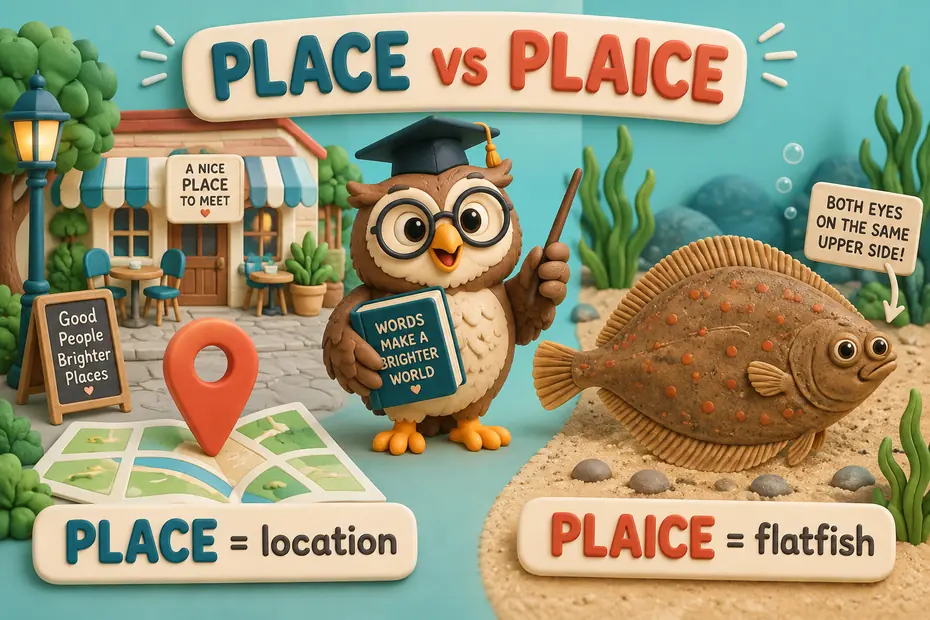
Place means a location, position or the action of putting something somewhere. Plaice names a flatfish. Write “a quiet place,” “first place” and “place the book on the table.” Use plaice when the sentence concerns the fish. The older advice below to avoid place as a verb is incorrect: place is a standard noun and verb.
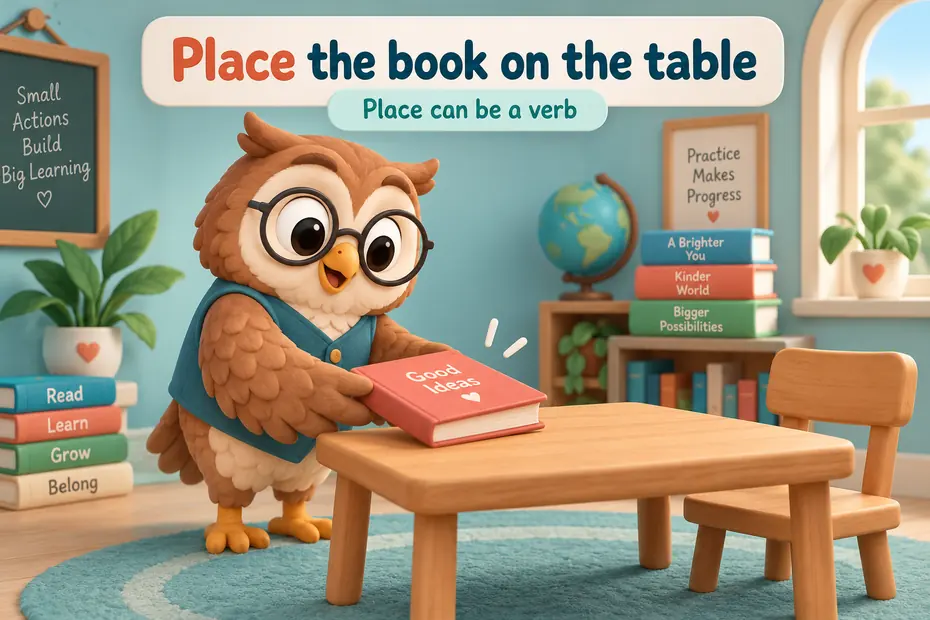
Place vs plaice: the useful distinction
Both words are normally pronounced alike, so the sound does not identify the spelling. Place has several common meanings; plaice has a much narrower fish meaning. Decide whether the sentence concerns where something is, where it ranks, where it should be put, or a flatfish.
| Word | Use | Example |
|---|---|---|
| Place | Location | This is a good place to meet. |
| Place | Position or rank | She finished in first place. |
| Place | Put or position | Place the parcel by the door. |
| Plaice | Flatfish | The menu includes plaice. |
Merriam-Webster’s place entry lists both noun and verb senses. Its plaice entry defines a group of flatfish, especially the European species Pleuronectes platessa. The fish spelling contains an extra i; it is not a decorative alternative for an ordinary location.
Using place as a noun
A place can be a town, a building, a room, a seat or a particular spot. It can also refer to a position in a competition or sequence. You do not need a physical address for every use: “I lost my place in the book” concerns where the reader had reached.
- We found a sheltered place for the picnic.
- There is a place for everyone at the table.
- He finished in second place.
- Keep your place in the line.
Place is useful when the exact kind of location is unimportant or already understood. “Meet me at my place” can naturally refer to someone’s home. If a reader needs an exact meeting location, provide it. Greater precision may improve that sentence, but place itself is not a grammatical mistake merely because a more specific noun exists.
Using place as a verb
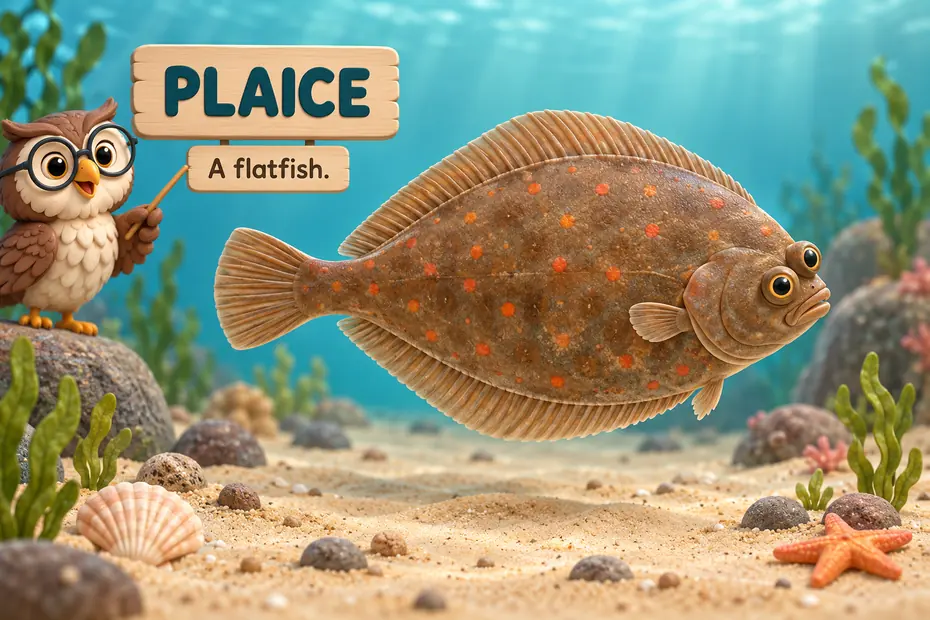
Place can mean put something in a particular position. It usually takes an object: place the vase, place the book, place the chair. You can then add a phrase explaining where it goes. “Place the book on the table” is a complete and natural instruction.
- Please place the forms in the tray.
- She placed the photograph beside the lamp.
- They are placing signs near the entrance.
- The company placed an order for new desks.
The verb also appears in expressions such as place an order, place a call and place someone in a position. In a competition, “She placed third” describes a finishing position. These uses are standard. The question is whether the sentence uses the right meaning, not whether place is allowed to act as a verb.
Using plaice for the fish
Plaice is a fish word. It often refers to European plaice, a flatfish with colored spots on its upper side, but dictionaries also use it for other flatfish. The older claim that every plaice reference must concern one particular European species is too absolute. If a species distinction matters, name it explicitly.
- The fishmonger displayed fresh plaice.
- We ordered grilled plaice at the restaurant.
- The field guide includes a drawing of European plaice.
- The report counted plaice in the survey.
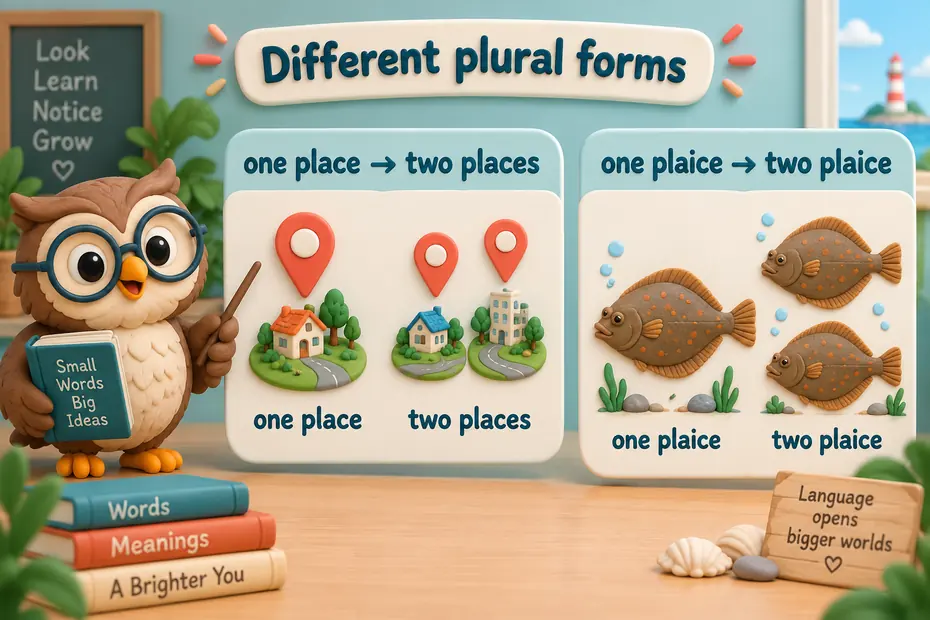
In a food context, plaice can refer to the fish as food without counting individual fish: “There is plaice on the menu.” In a count context, the dictionary plural remains plaice: “one plaice,” “two plaice.” This differs from one place and two places.
Forms and spelling patterns
| Family | Forms |
|---|---|
| Place as a noun | place, places |
| Place as a verb | place, places, placed, placing |
| Plaice as a noun | plaice; plural plaice |
Placing drops the final e before adding -ing. Placed keeps the base spelling and adds d. Do not insert i into those verb forms: “She is placing the plates” is about positioning them, even if the plates contain plaice. Read both nouns and verbs when the sentence includes a fish meal.
Useful phrases with place
Take place means happen: “The meeting will take place on Friday.” In place can mean in the correct position or ready: “The arrangements are in place.” In place of means instead of: “Use this chair in place of the broken one.” Out of place describes something that does not fit its location or surroundings.
These expressions use place without i. They do not become fish references because they sound like plaice. If you are editing a pun in a seafood advertisement, the spelling may intentionally play on both meanings; make sure the surrounding wording makes the joke clear.
A quick editing check
Try location, position or put for place, and flatfish for plaice. “Put the book on the table” supports place as a verb. “We ordered flatfish” supports plaice. A spellchecker may accept both, so substitute the meaning rather than relying on a red underline.
Frequently asked questions
Can place be a verb?
Yes. “Place the book on the table” and “She placed third” are valid verb uses.
What is the plural of plaice?
Plaice is the dictionary plural. Write “two plaice” for two fish.
Is plaice always European plaice?
The term especially names European plaice, but dictionaries also include other flatfish. Specify the species when it matters.
Is it take place or take plaice?
Take place means happen. Take plaice could concern taking fish, which is a different meaning.
How can I remember the extra i?
Associate plaice with fish and reserve place for locations, positions and the verb put. Meaning is the main check.
Are you confused about the difference between “place” and “plaice”? You’re not alone! As an expert writer, I’ve seen many people struggle with these two words. In this text, I’ll shed some light on the proper usage of “place” and “plaice” to help you avoid common mistakes.
First, let’s clarify the meaning of each word. “Place” refers to a location, position, or space, while “plaice” is a type of flatfish commonly found in European waters. Even though their similar pronunciation, these words have distinct meanings and should not be used interchangeably.
Key Takeaways
- “Place” refers to a location, position, or space, while “plaice” is a type of flatfish commonly found in European waters.
- “Place” has multiple meanings, including a physical location, a position in a sequence or hierarchy, and a role or status in society.
- Use “place” appropriately by considering the context, being specific, and exploring synonyms to diversify your vocabulary.
- “Plaice” should not be confused with “place” and refers specifically to a type of flatfish found in European waters.
- Common mistakes to avoid when using “place” and “plaice” include misusing “place” as a verb, using “place” instead of a more precise word, and confusing “plaice” with “place”.
Understanding the Meanings of “Place” and “Plaice”
As an expert blogger with years of experience, let me help clarify the distinct meanings of “place” and “plaice.”
When we talk about “place,” we are referring to a location or position. It could be a physical space, such as a city, a room, or an address. But “place” can also have a non-physical meaning, referring to a position or rank in society or a particular context. It’s a versatile word that encompasses a wide range of meanings.
On the other hand, “plaice” is a specific type of flatfish found in European waters. It is not just any fish, but one that has a distinctive appearance and taste. So when you come across the word “plaice,” you can be certain that it refers to this particular fish.
It’s important to note the difference between these two words, as they are often confused due to their similar pronunciation. Remember, “place” is about a location or position, while “plaice” refers to a type of fish.
Now that we’ve covered the definitions of “place” and “plaice,” let’s explore some examples to further clarify their usage.
Examples:
- I found a cozy place to enjoy my morning coffee. (referring to a physical location)
- She earned a high place in the company due to her hard work. (referring to a position or rank)
- The restaurant serves delicious plaice dishes fresh from the European waters. (referring to the fish)
- I’m planning to visit my favorite place in Europe, which happens to be known for its abundant plaice population. (using both words in the correct contexts)
Remember, understanding the meanings of words like “place” and “plaice” is crucial for clear and effective communication. Now that you have a clearer understanding, you can confidently use these words appropriately and avoid confusion.
How to Use “Place” Appropriately
When it comes to using the word “place” appropriately, it’s important to understand its definition and how it can be used in different contexts. Let’s jump into the details!
Definition of “Place”
The word “place” refers to a location, position, or space. It can be both physical and non-physical, allowing for a wide range of meanings and applications. Here are a few key points to keep in mind:
- Physical Location: “Place” can be used to describe a specific spot or area in the physical world. For example, when referring to a city, town, or country, we would use “place” to indicate where something is located.
- Position or Rank: “Place” can also be used to describe someone’s position in a hierarchy or ranking system. It can denote a specific standing or order within a group or competition.
- Space or Area: Also, “place” can refer to a particular space or area, whether it’s a room, a seat, or even a spot at a table.
How to Use “Place” Appropriately
To use “place” appropriately, consider the following guidelines:
- Context is key: Pay attention to the context in which you’re using “place.” Is it referring to a physical location, a position, or a space? Understanding the intended meaning will help you choose the appropriate usage of the word.
- Precision in communication: Clarity is crucial when using “place” in your sentences. Be specific about the location or position you’re referring to to avoid any confusion.
- Consider synonyms: If you find yourself repeating “place” too often, explore alternatives to diversify your vocabulary. Words like “location,” “position,” “site,” or “area” can be used interchangeably in certain contexts.
Examples of “Place” in Use
To further illustrate how to use “place” appropriately, here are a few examples:
- “I’ll meet you at your place” (referring to a physical location)
- “She secured first place in the competition” (referring to a position/rank)
- “Please take a place at the table” (referring to a space or area)
Identifying the Difference Between “Place” and “Plaice”
When it comes to words that are similar in both pronunciation and spelling, it’s essential to understand their meanings and usage to communicate effectively. Two such words that often get mixed up are “place” and “plaice.” Let’s investigate into the nuances of these words and learn how to use them appropriately.
What is “Place”?
The word “place” has multiple definitions and can refer to a physical location, a position in a sequence or hierarchy, or even a role or status in society. Here are some key points to help you grasp the concept:
-
Definition:
- A specific point or area in space.
- A spot that is occupied or intended to be occupied by someone or something.
- A position or rank in an organization or society.
-
Examples of Usage:
- “I love going to my favorite place on the beach to relax.”
- “New York City is a vibrant and bustling place.”
- “He worked hard to secure a top place in the company.”
What is “Plaice”?
On the other hand, “plaice” refers to a type of flatfish commonly found in European waters. It is important to note that “plaice” is a specific word related to fish, and it should not be confused with the more general term “place.”
The Key Differences
To summarize, the main difference between “place” and “plaice” lies in their meanings:
- “Place” is a versatile word used to describe locations, positions, and roles.
- “Plaice” is a type of flatfish found in European waters.
Understanding the distinctions between these two words will enable you to express yourself accurately and eloquently. Always consider the context and choose the word that aligns with your intended meaning.
To further enhance your understanding and usage of these words, let’s explore some examples that demonstrate their appropriate use in various contexts.
Common Mistakes to Avoid When Using “Place” and “Plaice”
When it comes to using the words “place” and “plaice,” it’s easy to get them confused due to their similar pronunciation. But, it’s important to understand the differences between them to avoid making mistakes in your writing or speaking. Let’s take a closer look at some common mistakes to avoid when using “place” and “plaice.”
Misusing “place” as a verb: One common mistake is misusing “place” as a verb when it should be used as a noun. For example, saying “I will place the book on the table,” is correct, but saying “I will table the book on the place” is incorrect. Remember, “place” is used to indicate a location or position.
Using “place” instead of a more precise word: Another mistake to avoid is using “place” as a generic term when a more specific word would be more appropriate. For instance, instead of saying “I went to a nice place for dinner,” it would be better to say “I went to a fancy restaurant for dinner.” Being precise in your communication not only enhances your writing but also adds clarity to your message.
Confusing “plaice” with “place”: The word “plaice” is often confused with “place” due to their similar spelling and pronunciation. But, it’s important to note that “plaice” is not a synonym for “place.” “Plaice” refers to a type of flatfish found in European waters. So, if you’re talking about a location or position, use “place,” but if you’re referring to a fish, use “plaice.”
By being aware of these common mistakes, you can ensure that you are using “place” and “plaice” appropriately. Remember to use “place” when talking about a location or position, and reserve “plaice” for when you’re referring to a type of fish. Being mindful of these distinctions will help you express yourself accurately and avoid any confusion in your communication.
Now that we’ve discussed the common mistakes to avoid, let’s move on to exploring more about the proper usage and context of the word “place” in the next section.
Conclusion
Understanding the difference between “place” and “plaice” is essential for effective communication. While “place” refers to a location or position, both physical and non-physical, “plaice” is a specific type of flatfish found in European waters. These two words are often confused due to their similar pronunciation, but they have distinct meanings.
By avoiding common mistakes, such as using “place” as a verb or substituting it for a more precise word, we can express ourselves accurately. It’s important to note that “plaice” is not a synonym for “place” and should not be used interchangeably.
To conclude, mastering the proper usage of “place” and “plaice” allows us to articulate our thoughts with precision and eloquence. By understanding the distinctions between these words, we can avoid confusion and convey our ideas effectively. So, next time you come across these words, remember their unique meanings and use them appropriately.
Frequently Asked Questions
Q: What is the difference between “place” and “plaice”?
A: “Place” refers to a location or position, while “plaice” is a type of European flatfish.
Q: Why are these words often confused?
A: The confusion arises due to their similar pronunciation.
Q: Can you provide examples of how to use these words correctly?
A: Sure! “I will meet you at the designated place.” “He caught a plaice while fishing in European waters.”
Q: What are some common mistakes to avoid?
A: Avoid using “place” as a verb and using “place” when a more precise word is needed.
Q: Is “plaice” a synonym for “place”?
A: No, “plaice” is not a synonym for “place.” It refers specifically to a type of flatfish.


