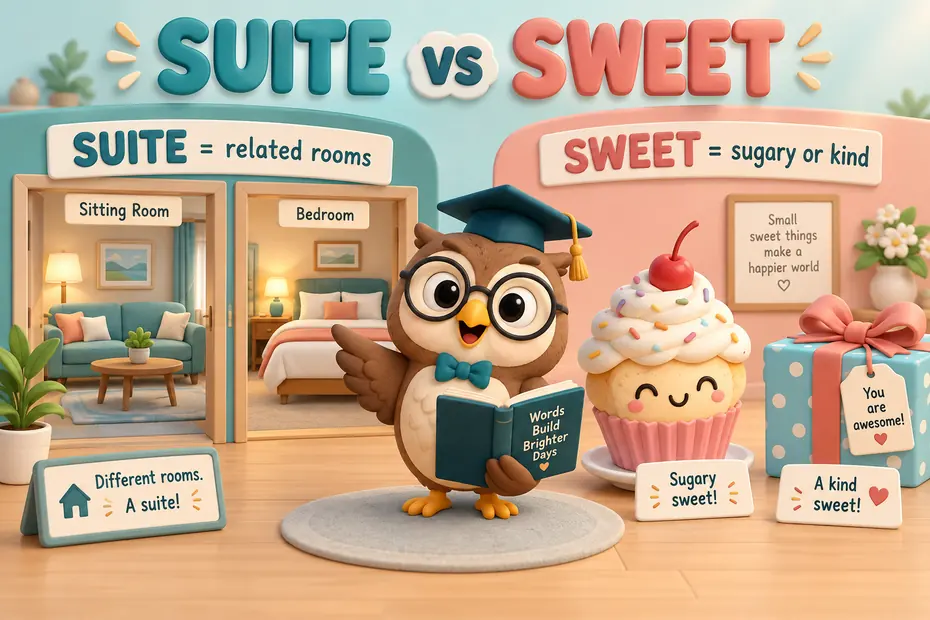
Suite is a noun for a related set, such as rooms, musical pieces or software. Sweet usually describes a sugary taste, a pleasant quality or a kind action. Write “a hotel suite” for accommodation and “a sweet cake” for taste. Both words are normally pronounced exactly alike, ending in a t sound; suite does not have an extra vowel at the end.
Suite vs sweet: the key comparison
The common distinction is a thing or group versus a quality. Suite names a set that belongs together. Sweet describes how something tastes or feels, or how a person behaves. You can even use both in one sentence: “The hotel suite had a sweet welcome gift.” The room arrangement is a suite, while the gift is sweet.
| Word | Common use | Example |
|---|---|---|
| Suite | Related rooms | They booked a suite. |
| Suite | Related pieces or tools | The composer wrote a suite. |
| Sweet | Sugary or pleasantly flavored | The fruit tastes sweet. |
| Sweet | Kind or pleasant | That was a sweet gesture. |
| Sweet | A confection or dessert in noun uses | She offered us a sweet. |
The Merriam-Webster suite entry covers related rooms, musical pieces and coordinated groups. Its sweet entry records several adjective and noun meanings. The words differ by meaning, not by one being inherently formal and the other inherently informal.
Suite for rooms and accommodation
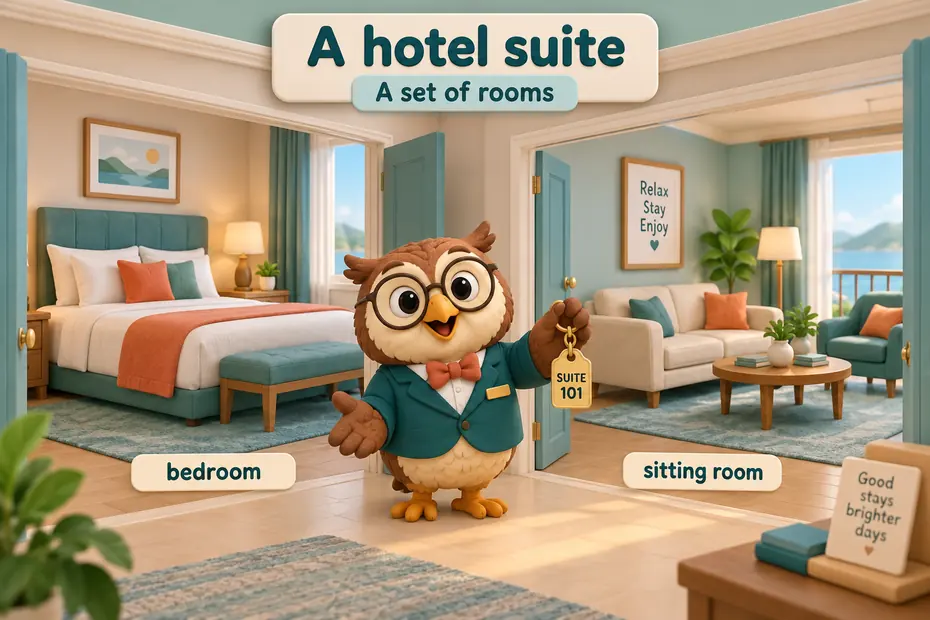
A hotel suite commonly contains a group of connected rooms used together. An office suite can similarly be a group of rooms for a business. The word does not automatically guarantee a kitchenette, a particular size or a luxury standard. A booking description should state the actual layout and amenities separately.
- We booked a suite with a separate sitting room.
- The company moved into an office suite.
- The reception desk is outside Suite 204.
- The listing describes a two-bedroom suite.
In an address, suite can identify a particular office or unit. Preserve the building’s actual address wording and number. Changing Suite 204 to Sweet 204 produces a different word, even though the spoken address might sound the same. Capitalization often follows address formatting; it does not turn sweet into the correct noun for rooms.

Suite for music, furniture and software
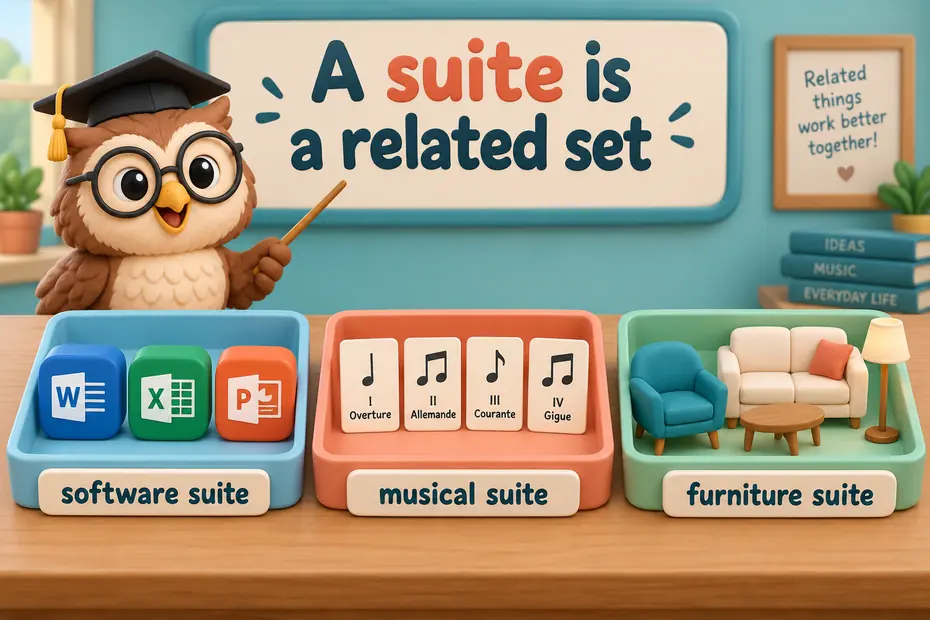
A musical suite groups pieces or movements into a larger work. A furniture suite consists of coordinated items, such as matching chairs and a sofa. A software suite groups related applications or tools. Across these contexts, the shared idea is a set of connected things.
- The orchestra performed a musical suite.
- The room contains a matching furniture suite.
- The team uses an office software suite.
- The package includes a suite of editing tools.
Not every collection is called a suite in every context. Use the term when it is an established description or when the items form a coordinated set. For software, calling something a suite describes the grouping; it does not establish what every program can do. Add the specific tools or functions when the reader needs that information.
Sweet for taste, kindness and enjoyment
Sweet often describes a sugary taste: sweet fruit, a sweet drink, sweet icing. It also describes pleasant sounds or smells and affectionate or considerate behavior. A sweet note can be kind without having any connection to food.
- The peaches were surprisingly sweet.
- She sent a sweet message after the visit.
- A sweet scent came from the flowers.
- They enjoyed a sweet moment of success.
Sweet can also be a noun. In British English, sweets commonly means confectionery or candies. A sweet can be a dessert in some contexts. These noun uses do not mean that suite and sweet have become interchangeable. A box of sweets still concerns food; a suite of rooms still concerns a related group.
Forms, pronunciation and the word suit
The plural of suite is suites: “The hotel has twelve suites.” Sweet can become sweeter or sweetest when comparing a quality: “This apple is sweeter.” Sweetly is an adverb, as in “She smiled sweetly.” Sweetness is a noun naming the quality.
Suite and sweet share the usual pronunciation /swiːt/. The final e in suite is not an extra spoken syllable. The older pronunciation note below suggesting an additional long-e sound at the end is misleading. Sound cannot choose between these homophones, so check meaning.
Suit is another word, usually pronounced /suːt/ in standard English. Suit can name a set of clothes and can also be a verb: “That time suits me.” A business suit is clothing; a business suite is office accommodation or a related set, depending on context. Do not add the final e merely because you want a more formal-looking spelling.
A quick editing test
Replace suite with related set or group of rooms. Replace sweet with sugary, kind or pleasant. “A group of rooms with a balcony” points to suite. “A kind thank-you message” points to sweet. If the sentence concerns clothing or something being suitable, you may need suit instead.
A spellchecker can accept both suite and sweet. Read the noun beside an adjective and the description around a suite. “A suite gesture” is likely sweet gesture. “The bridal sweet has two rooms” is likely bridal suite. Let the sentence tell you whether it names accommodation or describes a quality.
Frequently asked questions
Is it honeymoon suite or honeymoon sweet?
Honeymoon suite is the accommodation term. Sweet may describe a gift or experience, but it does not name the rooms.
Are suite and sweet pronounced differently?
Not in their usual standard pronunciations. Both end in t and sound alike.
Does every suite have a kitchen?
No. The word alone does not promise particular amenities. Check the actual description.
Can sweet be a noun?
Yes, particularly for a confection or dessert. Its noun meaning differs from a related set called a suite.
What is the plural of suite?
Suites. Write “two hotel suites” or “several software suites,” depending on the subject.
Key Takeaways
- “Suite” refers to a set of rooms or a collection of items, while “sweet” describes something as pleasing or sugary.
- “Suite” is typically used in the context of hotels, accommodations, or music, whereas “sweet” can describe anything enjoyable or kind-hearted.
- Pay attention to the pronunciation – “suite” is pronounced as “sweet,” but with a long “e” sound at the end.
- “Suite” can refer to hotel accommodations, musical compositions, or a self-contained unit within a larger building, while “sweet” can describe food/drink, someone’s personality, or enjoyable experiences.
What is the difference between “suite” and “sweet”?
As a language expert, I often come across confusion between similar-sounding words. Today, I want to shed some light on a common pair of words that often cause confusion: “suite” and “sweet.” While both words may sound alike, their meanings and usage are quite distinct. Let’s explore the differences between these words and ensure that you can use them appropriately in your writing.
Firstly, let’s start with the definition of “suite.” In English, “suite” refers to a set of rooms or a designated area that is used for a specific purpose. It is commonly associated with a luxurious hotel accommodation, but it can also refer to a set of rooms in a private residence or a collection of related items or pieces of music.
On the other hand, “sweet” has a completely different meaning. It is an adjective that describes something as pleasing, sugary, or enjoyable. You may think of candies, desserts, or pleasant smells when you hear the word “sweet.” Also, “sweet” can also describe someone who is kind or affectionate.
Now that we have a clear understanding of the definitions, let’s look at the differences between “suite” and “sweet”:
- Meaning: “Suite” refers to a set of rooms or a collection of items, while “sweet” describes something as pleasing or sugary.
- Usage: “Suite” is typically used in the context of hotels, accommodations, or music, whereas “sweet” can describe anything enjoyable or kind-hearted.
- Pronunciation: Pay attention to the pronunciation – “suite” is pronounced as “sweet,” but with a long “e” sound at the end.
To illustrate their proper usage, here are a few examples:
- “I stayed in a luxurious suite during my vacation.”
- “The hotel offered a honeymoon suite for newlyweds.”
- “She has a sweet tooth and loves eating desserts.”
- “He wrote a sweet note to express his gratitude.”
Definition and usage of “suite”
When it comes to the words “suite” and “sweet,” it’s easy to see how they can be confused. But, their meanings are quite distinct. In this section, I’ll focus on the definition and usage of “suite” to help clarify any lingering confusion.
So, what exactly is a “suite”? Well, a “suite” refers to a set of rooms or a designated area that forms a unified whole. This term is commonly used in the context of hotels, accommodations, or even musical compositions.
In the hospitality industry, a hotel suite typically consists of multiple interconnected rooms, offering a more spacious and luxurious experience for guests. These suites often include a separate living area, bedroom, and even a kitchenette. It’s a step up from a standard hotel room and is designed to provide added comfort and convenience.
In the area of music, a suite refers to a collection of independent musical pieces that are intended to be performed as a single cohesive work. Each piece within the suite is usually connected thematically or stylistically, creating a delightful musical journey for the listeners.
Now that we have a clearer understanding of what a “suite” is, let’s investigate into its usage. Here are a few common scenarios where you might encounter this word:
- Hotel Accommodations: When booking a hotel, you might come across options such as “Deluxe Suite” or “Executive Suite.” These denote more spacious and luxurious room offerings.
- Musical Performances: If you’re a fan of classical music, you may attend concerts featuring symphonies or orchestras performing well-known suites like Tchaikovsky’s “The Nutcracker Suite” or Bach’s “Orchestral Suite No. 3.”
- Real Estate: In the area of real estate, a “suite” can refer to a self-contained unit within a larger building, such as a commercial office building or an apartment complex.
Remember, the key difference between “suite” and “sweet” is that “suite” refers to a set of rooms or a designated area, while “sweet” describes something as pleasing or sugary. Keeping this distinction in mind will help you use these words appropriately in your writing and conversations.
Definition and usage of “sweet”
When it comes to the word “sweet,” it has a different meaning and usage compared to “suite.” Let’s jump into the definition and usage of “sweet” to better understand its context.
The word “sweet” is an adjective that describes something as pleasing, sugary, or having a pleasant taste. It can also be used to describe something as kind, endearing, or delightful. Here are some key points to know about the definition and usage of “sweet”:
1. Pleasing taste: “Sweet” is commonly used to describe food or drinks that have a sugary flavor. For example, we say a dessert is sweet or that a cup of tea needs some sugar to make it sweet.
2. Kind and endearing: “Sweet” can also be used to describe someone’s personality as kind, gentle, and affectionate. We often use this term to compliment someone’s nature or behavior. For instance, we might say, “She has such a sweet smile” or “He’s a sweet and caring friend.”
3. Delightful or enjoyable: In broader contexts, “sweet” can be used to describe something as delightful, enjoyable, or pleasant. This can refer to experiences, moments, or situations that bring joy or satisfaction. For example, we might say, “That movie was really sweet” or “I had a sweet time at the beach.”
It’s important to note that the word “sweet” can also be used as a noun, referring to a sugary treat or a flavor. But, in this context, we are focusing on its usage as an adjective.
To summarize, the word “sweet” is used to describe something as pleasing, sugary, kind, endearing, or delightful. Its usage extends beyond the area of taste and can be applied to various aspects of life.
Common mistakes and confusion between “suite” and “sweet”
As an experienced blogger, I have encountered numerous instances where people mistakenly interchange the words “suite” and “sweet.” Understanding the proper usage of these words is crucial to effective communication. Let’s jump into some common mistakes and the key differences between “suite” and “sweet.”
Definition and Usage of “Suite”
Many mistakenly use the word “suite” when referring to something pleasing or sugary, which is actually the domain of “sweet.” “Suite,” on the other hand, refers to a set of rooms or a designated area that forms a unified whole. It is commonly used in the context of hotels, accommodations, or musical compositions.
Common Scenarios of “Suite” Usage
- Hotel Accommodations: Hotels often offer suites, which are larger and more luxurious than standard rooms. They typically include a bedroom, a living area, and sometimes even a kitchenette or dining space.
- Musical Performances: In the area of music, a suite is a collection of independent musical pieces that are performed as a single cohesive work. Each piece within the suite may vary in style, tempo, or mood, but together, they create a unified musical experience.
- Real Estate: Within the context of real estate, a suite refers to a designated area within a larger building. It could be an office suite, a retail suite, or even a medical suite.
Definition and Usage of “Sweet”
Unlike “suite,” “sweet” is used to describe something as pleasing or sugary. It can be used to describe food or drinks with a sugary flavor. For example, a piece of cake or a fruity beverage can be referred to as “sweet.”
- Describing Personality: “Sweet” can also be used to describe someone’s personality as kind, affectionate, or endearing. It indicates an individual who is pleasant and considerate in their interactions with others.
- Joyful Experiences: We often describe experiences, moments, or situations that bring us joy or satisfaction as “sweet.” It is a way of expressing delight or contentment in a particular experience or memory.
Understanding the distinctions between “suite” and “sweet” is vital for effective communication. By using these words correctly, you can enhance your writing and avoid potential confusion. So the next time you encounter these words, remember their respective definitions and appropriate usage.
Tips for using “suite” and “sweet” appropriately
As we’ve learned about the difference between “suite” and “sweet” and their respective definitions and usage, it’s important to use these words appropriately in our communications. Here are some tips to help you navigate their correct usage:
- Understand the Definitions: Clarifying the meaning of “suite” and “sweet” is the first step towards using them correctly. While “suite” refers to a set of rooms or a designated area, “sweet” describes something as pleasing or sugary.
- Context is Key: Pay attention to the context in which the words are used. “Suite” is commonly encountered in scenarios such as hotel accommodations, musical performances, or real estate, where it indicates a luxurious or connected set of rooms. On the other hand, “sweet” can describe the taste of food or drinks, someone’s personality, or moments that bring joy or satisfaction.
- Be Specific and Accurate: Use the word that accurately conveys your intended meaning. If you’re referring to a group of interconnected rooms, use “suite.” If you want to describe something as pleasing or sugary, use “sweet.” Being specific and accurate in your choice of words will prevent confusion and enhance clarity in your communication.
- Consider Tone and Style: Consider the tone and style of your writing or speech. “Suite” is more formal and typically used in professional or upscale settings. “Sweet,” on the other hand, has a more casual and informal tone, often used in everyday conversations or informal writing.
- Proofread and Edit: After writing, take the time to proofread and edit your work for any errors or inconsistencies. Pay special attention to the usage of “suite” and “sweet” to ensure they are being used appropriately in context.
By following these tips, you can confidently use “suite” and “sweet” in your everyday communications and avoid the common mistakes and confusion that often arise with these words. Understanding their distinctions is crucial for effective and clear communication, ensuring that your message is accurately conveyed.
Conclusion
By understanding the definitions and nuances of the words “suite” and “sweet,” we can effectively communicate and avoid any confusion. It is crucial to pay attention to the context in which these words are used, as well as being specific and accurate in our word choice. Also, considering tone and style helps us convey our intended meaning with clarity.
Proofreading and editing our communications for errors or inconsistencies is also essential. This ensures that we present ourselves as knowledgeable and confident in our use of language.
By following these tips, we can confidently incorporate “suite” and “sweet” into our everyday conversations, both written and spoken. Remember, using the appropriate word adds credibility to our communication and helps us effectively convey our thoughts and ideas.
So, whether we’re discussing a luxurious hotel accommodation or indulging in a delectable treat, let’s embrace the power of language and use “suite” and “sweet” appropriately.
Frequently Asked Questions
Q: What does the word “suite” mean?
A: “Suite” refers to a set of rooms or a designated area.
Q: How is the word “sweet” defined?
A: “Sweet” describes something as pleasing or sugary.
Q: What should I consider when using these words?
A: Pay attention to the context, be specific and accurate in word choice, consider tone and style, and proofread and edit for errors or inconsistencies.
Q: Why is it important to understand these words?
A: Understanding their definitions helps in using them appropriately and avoiding confusion in communication.
Q: Can you give an example of using these words correctly?
A: “I stayed in a luxurious suite during my vacation” (suite) and “The cake tasted incredibly sweet” (sweet).


