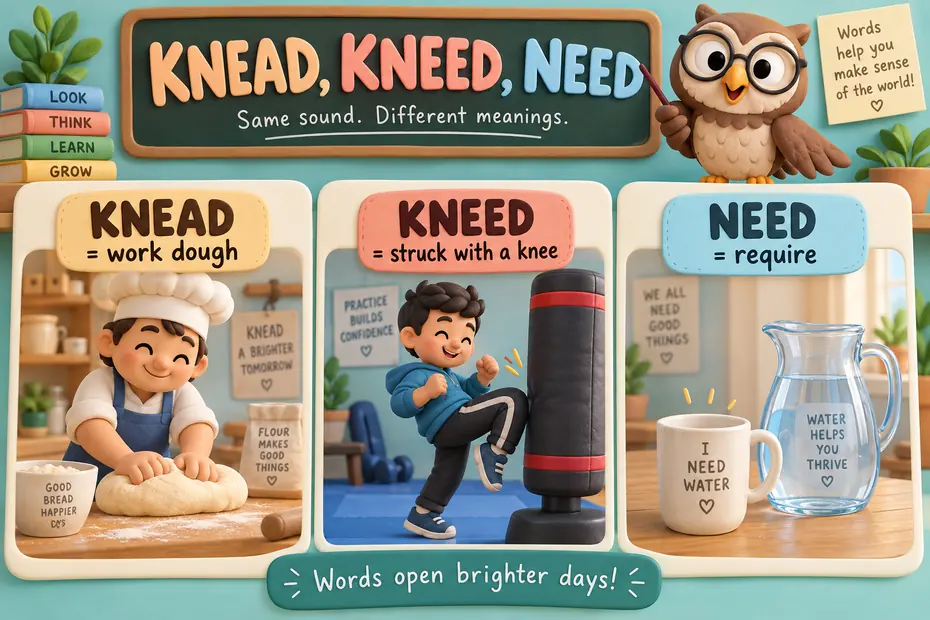
Knead means work or press dough or another material; kneed is the past tense and past participle of knee, meaning strike with the knee; need means require or a requirement. All three spellings are valid when used for the right meaning. The older advice below that kneed is not a word is incorrect.

Knead, kneed and need: three different jobs
The words sound alike in standard pronunciation, but they belong to different families. Knead is a base verb. Kneed is an inflected form of knee. Need is both a verb and a noun. This matters because kneed is not the past tense of knead; the past tense of knead is kneaded.
| Spelling | Meaning | Useful example |
|---|---|---|
| Knead | Press and work a material | Knead the bread dough. |
| Kneed | Struck with a knee | He accidentally kneed the padded bag. |
| Need | Require; a requirement | We need more flour. |
The Merriam-Webster knead entry includes working a mass and a kneading or massage movement. The knee entry explicitly lists kneed and kneeing as verb forms. Its need entry records the requirement meanings. Check the relevant base word rather than assuming an unfamiliar spelling is invalid.
How to use knead
Knead commonly appears in baking: you knead dough by pressing and working it. It can also describe working other pliable materials or a kneading movement in massage. The older claim that knead must never be used outside dough is too narrow. The important idea is the pressing and working action.
- The baker kneads the dough on the counter.
- She kneaded the clay before shaping it.
- The machine was kneading the mixture.
- The description compares the motion to kneading.
Knead normally takes an object that tells the reader what is being worked: knead the dough, knead the clay. In “I need to knead the dough,” need expresses the requirement and knead names the action. Their shared sound does not make one spelling replace the other.

How to use kneed
Kneed describes an action performed with a knee. It is the past form of the verb knee, not a spelling variant for require. “The player accidentally kneed the ball” reports what happened. “The player needed the ball” reports a requirement. The sentences have different meanings even though kneed and need sound alike.
You can write “He kneed the training pad” or “The pad was kneed during the demonstration.” The first uses the simple past; the second uses the past participle. Whether a particular sporting action is permitted is a separate question. The spelling lesson only identifies the verb form.
Kneed also occurs in adjectives such as knock-kneed. In that construction it describes a characteristic of the knees rather than a past action. Do not remove the d or replace the whole adjective with need. An unfamiliar word can still be standard English.
How to use need
Need as a verb expresses a requirement: “We need a larger bowl.” It can take a noun phrase, such as more time, or an infinitive, such as to finish. As a noun, it names a requirement: “There is a need for more volunteers.” The natural pattern is need for something, not knead for something.

- I need a new notebook.
- They need to leave before noon.
- The school identified a need for extra chairs.
- We helped a neighbor in need.
For a negative statement, “You do not need to wait” is a familiar construction. “You need not wait” is another standard pattern. The older example “If you have questions, need not hesitate” is missing its subject. Write “If you have questions, you need not hesitate to ask,” or simply “Please ask if you have questions.”
Compare the verb families
| Base | Past | -ing form |
|---|---|---|
| Knead | Kneaded | Kneading |
| Knee | Kneed | Kneeing |
| Need | Needed | Needing |
The initial k in knead and knee is silent. Keep it in writing because it helps identify the family. Kneaded and needed each have an added -ed syllable in ordinary pronunciation; kneed is the short past form of knee. Do not form the baking past tense as kneed merely because it looks convenient.
A practical correction method
Replace knead with work the material, kneed with struck with a knee, and need with require. “I require a notebook” supports need. “She worked the dough” supports kneaded. “He struck the pad with his knee” supports kneed. Choose the meaning first, then select the right tense.
A spellchecker may accept every spelling in this group. Read the object too: dough, a requirement and a contact made with the knee point toward different verbs. In “We need to knead the dough,” both homophones are correct because they perform separate jobs.
Frequently asked questions
Is kneed a real word?
Yes. It is the past tense and past participle of knee, and it also appears in knee-related adjectives.
What is the past tense of knead?
Kneaded. “She kneaded the dough yesterday” is correct.
Can knead describe clay?
Yes. The word can describe pressing and working materials other than dough, as well as a kneading massage movement.
Is it need to knead or knead to need?
“Need to knead” is the usual phrase for being required to work dough. Each word keeps its own meaning.
Does need have a noun use?
Yes: “a need for help” and “people in need” both use the noun. Knead and kneed do not replace it.
Have you ever found yourself confused between “knead,” “kneed,” and “need”? Don’t worry, you’re not alone. As a language enthusiast and expert, I’ve encountered countless individuals who struggle with these similar-sounding words. In this text, I’ll guide you through the proper usage of “knead,” “kneed,” and “need,” helping you avoid those embarrassing language mishaps. By the end, you’ll be equipped with the knowledge and confidence to use these words appropriately in your everyday communication. So, let’s immerse and unravel the mysteries of “knead,” “kneed,” and “need” together.
Key Takeaways
- “Knead” is the correct spelling and usage when referring to working dough or a similar substance.
- “Kneed” is not a valid word in most contexts and should be avoided.
- “Need” is a verb that expresses a requirement or desire and can also function as a noun.
- When using “knead,” it is important to do so in the context of working with dough or a similar substance.
- Understanding the proper usage of “knead,” “kneed,” and “need” is crucial for effective communication and avoiding common mistakes.
Understanding “knead,” “kneed,” and “need”
When it comes to the English language, there are several words that can easily be confused due to their similar spellings or pronunciations. One such trio of words is “knead,” “kneed,” and “need.” In this section, I’ll provide you with a clear understanding of the differences between these words and how to use them appropriately.
Definition of “knead”
Let’s start by defining the word “knead.” Knead is a verb that means to work a substance, usually dough, by pressing, folding, and stretching it with the hands. This action is typically done to mix ingredients thoroughly or to develop the gluten in bread dough, resulting in a desirable texture when baked.
Difference between “knead” and “kneed”
Let’s explore the key difference between “knead” and “kneed.” “Knead” is the correct spelling and usage when referring to the act of working dough or a similar substance. On the other hand, “kneed” is not a commonly used word in the English language and does not have a specific meaning or usage. Hence, it’s important to remember, “kneed” is not a valid word in most contexts.
Definition of “need”
Moving on, let’s discuss the word “need.” “Need” is a verb that expresses a requirement or necessity for something. It indicates a lack or absence of something that is essential or desired. It can also serve as a noun, representing a requirement or desire.
Difference between “knead” and “need”
While “knead” and “need” sound similar, they have distinct meanings and uses. The key difference lies in their intended purpose. “Knead” refers to the action of working dough or similar substances, while “need” relates to the requirement or necessity for something.
To summarize the differences:
| Word | Meaning | Usage |
|---|---|---|
| Knead | To work dough or a similar substance | Verbing action, such as “I knead the dough to make bread” |
| Need | To require or desire something | Verbing action or a noun, such as “I need a vacation” or “The need for food” |
How to use “knead” correctly
When it comes to using the word “knead,” it’s important to understand its proper usage and context. Allow me to provide you with some guidance on how to use this word correctly.
Definition of “knead”: “Knead” is a verb that refers to the action of working dough or a similar substance with your hands to make it smooth and elastic. It is commonly associated with baking and cooking. For example, when you’re making bread or pizza dough, you need to knead the dough to develop the gluten and create a soft texture.
Here are a few tips on how to use “knead” correctly:
- Know the purpose: “Knead” is specifically used when referring to the action of working dough. It should not be used in any other context. For example, you would not say “I need to knead this paper to make it smoother.” Instead, you would use a word like “smooth” or “flatten.”
- Pair it with the right ingredients: When using “knead,” it is important to do so in the context of working with dough or a similar substance. For example, you would say “I need to knead the bread dough” or “She kneaded the pastry dough until it was smooth.” By using the word in the appropriate context, you can convey your message clearly and accurately.
- Use proper verb tense: Depending on the sentence structure and time frame, “knead” may require conjugation. For example, “He kneads the dough every morning” or “I kneaded the dough yesterday.” Ensure that the verb tense matches the context of your sentence for grammatical accuracy.
Understanding how to use “knead” correctly is essential for effective communication. By following these guidelines, you’ll be able to confidently incorporate this word into your written and spoken English. Remember, practice makes perfect!
Now that we have a clear understanding of how to use “knead” correctly, let’s move on to discussing the differences between “knead,” “kneed,” and “need” in more detail.
Differentiating between “kneed” and “need”
As we continue our exploration of the confusing trio of words – “knead,” “kneed,” and “need,” let’s dive deeper into distinguishing between “kneed” and “need.” Understanding the differences will help us use these words appropriately in our everyday language.
Definition of “kneed”: First off, it’s important to note that “kneed” is not a valid word in most contexts. So, in regular English usage, you won’t come across this term. Instead, if you want to refer to the action of pressing something with your knee, you would use a phrase like “using my knee to apply pressure” or “pressing with my knee.”
Definition of “need”: On the other hand, “need” is a common word with multiple uses. As a verb, it expresses a requirement or necessity for something. For example, “I need a cup of coffee to wake up in the morning.” Also, “need” can also function as a noun, representing a lack or requirement, as in “I have a need for speed.”
Let’s focus on the key differences between “kneed” and “need”:
- Purpose: While “kneed” refers to a specific action of pressing with the knee, “need” encompasses a broader range of requirements or necessities in both verb and noun forms.
- Usage: As mentioned earlier, “kneed” is not a widely recognized word, so it’s best to avoid using it. But, “need” is frequently used in everyday communication.
- Common phrases: Some common phrases using “need” include “in need of,” “if need be,” and “needless to say.” These idiomatic expressions highlight the importance or urgency of a specific requirement or condition.
To further clarify the distinction, let’s look at a couple of examples:
- Incorrect: “I kneed a new book to read.”
- Correct: “I need a new book to read.”
- Incorrect: “If you have any questions, kneed not hesitate to ask.”
- Correct: “If you have any questions, need not hesitate to ask.”
Examples of proper usage
To provide a better understanding of how to use “knead,” “kneed,” and “need” appropriately, let’s take a look at some examples of their proper usage:
- Knead
- Example 1: When making bread, knead the dough for at least 10 minutes to develop gluten and achieve a light, airy texture.
- Example 2: The pastry chef expertly kneads the dough to create flaky layers in the croissants.
- Kneed
- Remember, “kneed” is not a valid word in most contexts. But, if you need to describe an action similar to pressing with the knee, you could use alternative phrases such as “apply pressure with the knee” or “use the knee to push down.”
- Need (as a verb)
- Example 1: I need to finish this assignment before the deadline.
- Example 2: We need to buy groceries on the way home.
- Need (as a noun)
- Example: There is a urgent need for more volunteers in the community.
Understanding the correct usage of these words is crucial for effective communication. Whether you’re cooking, writing, or expressing requirements, using the right word will ensure clarity and precision in your message.
Remember, the key difference between “knead” and “need” lies in their intended purpose. “Knead” is specifically used when working dough or a similar substance, while “need” expresses a requirement or necessity for something. When in doubt, refer to these examples to guide you.
In the next section, we will further explore common phrases and expressions related to “knead,” “kneed,” and “need,” providing additional context to strengthen your understanding of these words.
Common mistakes to avoid
One of the most common mistakes that people make with these words is mixing up “knead,” “kneed,” and “need” due to their similar spellings. But, understanding the differences between these words is crucial for effective communication. Let’s explore some common mistakes to avoid when using these words appropriately.
Confusing “Knead” with “Kneed”
One major mistake that people make is using “kneed” in situations where it is not a valid word. Remember, “kneed” is not a valid word in most contexts. It is essential to use the correct alternative phrases when describing the action of pressing with the knee. Here are a few examples:
- She applied pressure with her knee.
- He pressed his knee against the door.
By using these alternative phrases, you can avoid the confusion and ensure that your communication remains accurate and clear.
Using “Need” Incorrectly
Another common mistake is using “need” incorrectly. To effectively use “need,” you must understand its purpose and usage. While “need” is primarily a verb that expresses a requirement or necessity for something, it can also function as a noun.
Here are a few examples to clarify the correct usage of “need”:
- I need to finish this project by tomorrow. (verb)
- There is a need for more resources in the community. (noun)
Remember, “need” is a versatile word with multiple uses. Understanding its correct usage will prevent misunderstandings and enhance your overall communication skills.
Neglecting Context and Intended Purpose
One more common mistake to avoid is neglecting the context and the intended purpose of these words. Each word serves a specific function, and using them interchangeably can lead to confusion. Here’s a quick recap:
- “Knead” is a verb that means to work dough or a similar substance.
- “Kneed” is not a valid word in most contexts, and using alternative phrases is necessary.
- “Need” is a verb expressing a requirement or a noun denoting a necessity.
By keeping the context and intended purpose in mind when using these words, you can ensure your message is clear and accurately conveyed.
Conclusion
Understanding the differences between “knead,” “kneed,” and “need” is crucial for effective communication. By avoiding common mistakes, such as using “kneed” when it is not a valid word, and using “need” incorrectly, we can ensure clear and accurate communication.
It is important to consider the context and intended purpose of these words. “Knead” refers to the action of pressing and manipulating dough or other materials with the hands, while “need” can be used as both a verb and a noun, indicating a requirement or desire. Neglecting these distinctions can lead to confusion and misinterpretation.
Remember, using the correct word in the appropriate context is essential for conveying your message accurately. By familiarizing ourselves with the definitions and nuances of “knead,” “kneed,” and “need,” we can confidently express ourselves and avoid common errors.
So, the next time you find yourself in doubt, take a moment to consider the correct usage of these words. By doing so, you will ensure that your communication is clear, concise, and effective.
Frequently Asked Questions
Q: What is the article about?
The article discusses the confusion between the words “knead,” “kneed,” and “need” and emphasizes the importance of understanding their correct usage for effective communication.
Q: What are some common mistakes to avoid when using these words?
One major mistake is using “kneed” in situations where it is not a valid word. Examples and alternative phrases are provided to describe the action of pressing with the knee. Another common mistake is using “need” incorrectly as a verb or noun. The article gives examples to clarify its correct usage.
Q: What is the importance of understanding the context and purpose of these words?
Neglecting the context and purpose of these words can lead to misunderstandings. Understanding the definitions and nuances of “knead,” “kneed,” and “need” ensures clear and accurate communication.
Q: How can readers ensure clear and accurate communication?
By avoiding common mistakes and understanding the correct usage of these words, readers can ensure clear and accurate communication. The article provides examples and explanations to help readers use these words appropriately.


