
Attendance describes being present, a record of presence or the number attending. Attendants is the plural of attendant, commonly meaning people who provide a service. Write “Attendance was high” for turnout and “The attendants were helpful” for the people assisting. If you mean ordinary participants at an event, attendees is usually the clearest choice.

Attendance vs attendants at a glance
These words can sound almost identical in ordinary speech, but their endings carry different information. Attendance ends in -ance and names presence or turnout. Attendants ends in -ants and usually identifies several people. A school checks attendance; an airline employs attendants. The spelling determines whether you are describing participation or naming a group.
| Word | What it usually describes | Natural sentence |
|---|---|---|
| Attendance | Presence, turnout or a presence record | Attendance has improved. |
| Attendant | One person providing service | An attendant helped us. |
| Attendants | Several such people | Two attendants helped us. |
| Attendees | People attending an event | The attendees received badges. |
The Merriam-Webster attendance entry includes attendance as an act, a number and an account of who attended. Its attendant entry records the service role but also other senses. The distinction above is practical guidance for common sentences, rather than a claim that attendant can never mean someone simply attending.
Using attendance for school, work and events
Attendance often describes a pattern over time. “Her attendance is excellent” means she regularly comes when expected. “The teacher took attendance” means the teacher recorded who was present. Neither sentence refers to a staff member called an attendant.
- The class has a good attendance record.
- Attendance at the workshop is optional.
- The organizer recorded attendance before the talk.
- Rain reduced attendance at the outdoor concert.
The phrases attendance at and in attendance do different jobs. Attendance at the meeting names presence at that event. “Twenty guests were in attendance” says that they were present. A person “in attendance” is not necessarily an employee or helper. The phrase does not turn a guest into an attendant.

Using attendants for people
Attendants commonly help, serve or accompany others. A parking attendant assists with parking. Gallery attendants may help visitors and monitor rooms. Wedding attendants support the couple. Because these roles differ, the word itself does not specify every duty the person performs; the surrounding description should supply the relevant details.
- The attendant showed us the entrance.
- Two attendants checked the cloakroom tickets.
- The flight attendants prepared the cabin.
- The bride thanked her attendants.
In a sentence about several helpers, attendants takes a plural verb: “The attendants are ready.” For one helper, use attendant and a singular verb: “The attendant is ready.” Attendance usually takes a singular verb in its ordinary abstract or collective use: “Attendance is required.”
Where attendees fits
A conference attendee comes to participate. A conference attendant commonly has a role assisting others. At the same event, an attendee might ask an attendant where to find a room. Attendance could then refer to the overall turnout. All three words fit one setting because they describe different aspects of it.
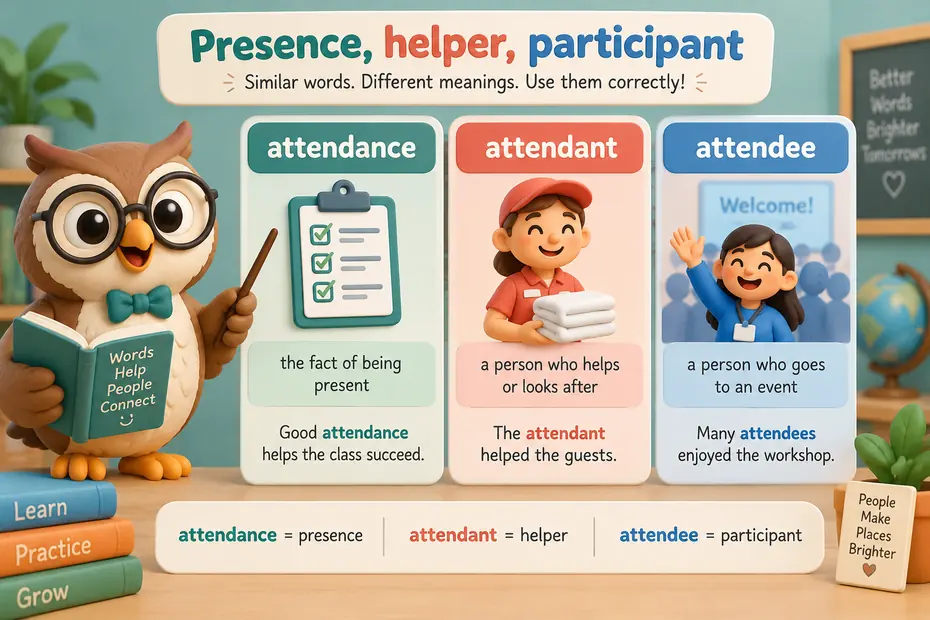
Merriam-Webster defines attendee as a person present on an occasion or at a place. Use attendees when your readers need to distinguish participants from staff. Although attendant has an attendee sense in some dictionaries, choosing attendees for general participants avoids a likely misunderstanding in modern event writing.
Editing numbers, agreement and apostrophes
“There were 200 attendance” is not the usual way to count people. Write “There were 200 attendees,” “Attendance was 200,” or “Two hundred people attended.” The first names participants, the second reports turnout, and the third describes their action. Choose the version that matches the point you want to make.
Similarly, “Three attendance helped us” needs attendants if you mean three helpers. “The attendants was high” needs attendance if you mean the turnout was high. A helpful replacement test is to try presence or turnout for attendance, and helpers for attendants. If neither makes sense, the sentence may need attendees or the verb attended instead.
Attendants is a plain plural with no apostrophe. “The attendant’s badge” belongs to one attendant; “the attendants’ badges” belong to several. An attendance register records presence. The word attendance does not need an apostrophe simply because it appears before register or record.
Frequently asked questions
Is it take attendance or take attendants?
Take attendance means record who is present. Take attendants would describe taking people somewhere or selecting them, depending on the sentence.
Is everyone at a conference an attendant?
Attendant can have a broader dictionary sense, but attendees is clearer for general participants. Reserve attendants for service or support roles when you need that distinction.
Is attendance always singular?
It is ordinarily singular in “Attendance is high.” Attendances can refer to separate attendance totals or occasions in some contexts. It does not normally replace attendees when counting people.
Can attendant be an adjective?
Yes. In “the attendant problems,” it means accompanying or resulting problems. That adjective use is different from the plural noun attendants.
How can I remember the spellings?
Connect attendance with an attendance record, and attendants with individual people called attendants. Then check whether your sentence reports presence or names those people.
Have you ever wondered about the difference between “attendance” and “attendants”? As an expert in language and communication, I’ll shed some light on this common confusion. In this text, I’ll explain the correct usage of these two terms and provide examples to help you use them appropriately.
When it comes to “attendance,” it refers to the act of being present or the number of people present at a particular event or place. On the other hand, “attendants” refers to the individuals who are present to provide assistance or service. While both words are related to being present, they have distinct meanings and should be used accordingly.
Understanding the difference between “attendance” and “attendants” is crucial for effective communication. Using the right term in the right context will ensure clarity and avoid any misunderstandings. So, let’s immerse and explore the nuances of these words to enhance your language skills.
Key Takeaways
- “Attendance” refers to the act of being present or the number of people present at an event, while “attendants” are individuals who are present to provide assistance or service.
- Understanding the difference between “attendance” and “attendants” is crucial for effective communication and avoiding misunderstandings.
- “Attendance” is a general term, while “attendants” are the individuals responsible for ensuring a smooth and pleasant experience.
- Proper usage of “attendance” and “attendants” ensures clarity and avoids potential confusion in conveying the intended message.
- “Attendance” focuses on being present, while “attendants” are the people present to help or serve.
- Using the correct term between “attendance” and “attendants” demonstrates professionalism, accuracy, and attention to detail in language usage.
The Difference between “Attendance” and “Attendants”
As a language expert, I understand that certain words in English can be confusing, especially when they sound similar or have related meanings. In this section, I’ll investigate into the difference between “attendance” and “attendants” to help you use them correctly and effectively in your writing and conversations.
What is “attendance”?
“Attendance” is a noun that refers to the act of being present or the number of people present at an event, gathering, or class. It signifies participation and is often used in the context of checking who is present or absent. For example:
- “The attendance at the conference was impressive.”
- “The teacher takes attendance every morning.”
What is an “attendant”?
On the other hand, “attendants” is a plural noun that refers to individuals who are present to provide assistance, service, or support. They can be found in various settings such as conferences, events, hospitals, and even on airplanes.
- “The flight attendants offered excellent customer service during the flight.”
- “The conference had friendly and helpful attendants at every corner.”
The key difference between “attendance” and “attendants”
The main distinction between these two words lies in their usage. While “attendance” focuses on the act of being present or the number of people present, “attendants” refers specifically to the individuals who are present to provide a service or assistance. “Attendance” is a general term, while “attendants” are the individuals responsible for ensuring a smooth and pleasant experience.
Summarizing
To recap, “attendance” is about being present, while “attendants” are the people who are present to help or serve. Understanding the difference between these two words is crucial for effective communication. Let’s look at a few examples for further clarity:
- “The attendance at the concert was high, and the attendants did a fantastic job of maintaining order.”
- “The school pays close attention to attendance, and the attendants in the office are available to assist with any inquiries.”
By correctly using “attendance” and “attendants,” you can avoid potential confusion and ensure that your message is clear and concise.
Now that we’ve explored the difference between “attendance” and “attendants,” let’s move on to another commonly misused word pairing in the following section.
Usage of “Attendance”
When it comes to the word “attendance,” it refers to being present or the number of people present at an event, meeting, or class. It’s important to understand and use this word correctly to ensure effective communication. Let me explain it further.
The definition of “attendance” is the action or state of being present or the act of attending. It can also refer to the number of people present in a particular place or event. For example, if someone says, “The attendance at the conference was high,” it means that a large number of people were present at the conference.
Understanding the difference between “attendance” and “attendants” is crucial. While “attendance” refers to being present, “attendants” refers to individuals who are present to provide assistance or service. For instance, at a conference, the attendees are the people who are there to participate, while the attendants are the staff members who assist with logistics and ensure smooth functioning of the event.
Here are a few more examples to illustrate the usage of “attendance”:
- “The school had a perfect attendance record, with all students showing up for class.”
- “The concert had a low attendance due to bad weather.”
- “Employees are required to record their attendance in the attendance register.”
Remember, using the word “attendance” correctly is essential for conveying your message accurately. It ensures that there is no confusion about the number of people present or the act of being present yourself.
In the next section, I will investigate into the usage of “attendants” to further clarify the distinction between these two words.
Examples of “Attendance”
When it comes to understanding the word “attendance,” it’s crucial to grasp its meaning and usage. Let me provide you with some examples to help clarify its usage in different contexts.
- School Attendance: In the context of schools, “attendance” refers to the act of being present in class. For example, if a student attends all their classes, their attendance record will be perfect.
- Meeting Attendance: In a professional setting, “attendance” pertains to the number of individuals present at a meeting or conference. For instance, if a team member cannot attend a meeting, their absence impacts the overall attendance count.
- Event Attendance: When discussing events, “attendance” signifies the number of people present. For instance, if a concert has a high attendance rate, it indicates a large number of people attended the event.
- Sports Attendance: “Attendance” also plays a significant role in sports. It represents the number of spectators present at a game or match. A high attendance at a sporting event contributes to its success and popularity.
Remember, “attendance” always focuses on the act of being present or the number of people present. It’s vital to use this word correctly to convey the intended meaning and avoid confusion or miscommunication.
In the next section, we’ll cover examples of the word “attendants” to further highlight the distinction between these two commonly confused words.
Note: This section provides examples of “attendance” to illustrate its proper usage in different contexts. Understanding the examples will enhance your ability to use this word appropriately.
Usage of “Attendants”
As we continue to explore the difference between “attendance” and “attendants,” let’s jump into the usage of the word “attendants.” Understanding how to apply this term correctly will further emphasize the distinction between these commonly confused words.
Definition of Attendants
The word “attendants” refers to individuals who are present to provide assistance, service, or support in a particular setting or event. They are the people who attend to the needs, safety, or duties associated with a specific role or position.
Examples of Attendants
To grasp the practical application of “attendants,” let’s consider a few examples:
- Flight Attendants: On an airplane, flight attendants are responsible for ensuring the safety and comfort of passengers during the flight. They provide assistance, perform safety demonstrations, and tend to any passenger needs.
- Hospital Attendants: In a medical setting, attendants are the individuals who assist patients with various non-medical tasks, such as transporting them to different departments, delivering meals, or maintaining cleanliness in hospital rooms.
- Wedding Attendants: During a wedding ceremony, attendants are often designated roles such as bridesmaids, groomsmen, ushers, or flower girls. They support the couple, assist with logistics, and contribute to the overall wedding experience.
Difference between Attendance and Attendants
While “attendance” refers to the act of being present, “attendants” specifically implies individuals who are present with a particular purpose or role. Understanding this distinction is crucial to ensure accurate communication and avoid confusion.
In the next section, we’ll investigate deeper into the usage of “attendance” and provide clarification on when and how to use this term appropriately.
| Definition | Examples | |
|---|---|---|
| Attendants | Individuals present to provide assistance, service, or support | Flight attendants, hospital attendants, wedding attendants |
Examples of “Attendants”
As we investigate deeper into the usage of “attendance” and “attendants,” it’s important to understand the distinct role that “attendants” play in various settings. Unlike “attendance,” which refers to the act of being present, “attendants” specifically implies individuals who are present with a particular purpose or role. Let’s explore some examples to gain a better understanding:
- Flight attendants: When you board a plane, you’ll encounter the friendly and helpful flight attendants. They ensure your comfort, safety, and provide assistance during the flight.
- Hospital attendants: In a medical setting, hospital attendants have a crucial role in taking care of patients’ day-to-day needs. They assist with tasks such as transporting patients, maintaining cleanliness, and providing support to the medical staff.
- Wedding attendants: Wedding attendants, also known as bridesmaids and groomsmen, have key responsibilities throughout the wedding ceremony and celebration. They help with tasks such as arranging the wedding venue, supporting the couple, and ensuring the smooth flow of events.
- Conference attendants: During a conference or seminar, attendees are individuals who are present, while conference attendants are the individuals responsible for managing the event. They assist with registration, provide information, and ensure the smooth running of the conference.
- Art gallery attendants: In an art gallery, gallery attendants are there to provide information about the artwork, answer visitors’ questions, and ensure the safety of the exhibits. Their presence ensures a pleasant and educational experience for the visitors.
Remember, while “attendance” refers to the act of being present, “attendants” signify individuals who are present with a specific function or role. Properly understanding and using these terms will help you communicate your ideas accurately and confidently.
The Importance of Using the Correct Term
As a writer, it is crucial to understand the difference between similar words and use them appropriately. In this section, I’ll emphasize the significance of using the correct term between “attendance” and “attendants.” Let’s immerse!
Understanding the Difference
To begin with, let’s clarify the definitions of these words. “Attendance” refers to the act of being present or the number of people present at a particular event, meeting, or gathering. On the other hand, “attendants” specifically implies individuals who are present with a particular purpose or role.
Accuracy is Key
Using the right word demonstrates your command of the English language and ensures clear communication. By correctly choosing between “attendance” and “attendants,” you convey your ideas accurately and avoid any potential confusion or ambiguity.
Context Matters
Consider the context in which you are using these words. For example, if you are referring to the number of people present at a conference, you would use “attendance.” But, if you are talking about the individuals who are directly responsible for assisting attendees at a conference, you would use “attendants.”
Professionalism and Clarity
Using the correct term demonstrates your professionalism and attention to detail. It shows that you are knowledgeable about the nuances of language and that you take the time to communicate precisely. Whether you are writing a report, an email, or an article, using the appropriate word enhances your credibility and leaves a positive impression on your readers.
Avoid Miscommunication
Incorrect usage of “attendance” and “attendants” can lead to confusion. Imagine if you were discussing the roles of flight attendants on an airplane but accidentally referred to them as “attendance.” It would not only sound odd, but it could also create confusion or misinterpretation.
Crafting Engaging Content
Using the right term helps you create compelling and engaging content. By choosing the appropriate word based on the specific context and intended meaning, you can capture your audience’s attention and hold it throughout your writing. Engaging your readers ensures they stay focused and fully understand your message.
To conclude, using the correct term between “attendance” and “attendants” is essential for effective communication. By understanding the differences and using them appropriately, you showcase your language proficiency and contribute to clear and precise communication. Let’s move on to explore more examples and applications of these terms.
Conclusion
Using the correct term between “attendance” and “attendants” is crucial in demonstrating command of the English language and ensuring clear communication. By understanding the differences and using these terms appropriately, we showcase our language proficiency and attention to detail.
Considering the context in which these words are used is essential. Using the appropriate term not only demonstrates professionalism but also helps avoid confusion and miscommunication. It allows us to convey our message accurately and effectively.
Besides, using the right word contributes to creating engaging content. It helps us connect with our audience and maintain their interest. By using the appropriate term, we demonstrate our ability to communicate clearly and precisely.
To conclude, whether we are writing an article, giving a presentation, or engaging in any form of communication, using the correct term between “attendance” and “attendants” is vital. It showcases our language proficiency, attention to detail, and contributes to clear and precise communication. Let’s strive to use these terms appropriately to ensure effective communication in all our endeavors.
Frequently Asked Questions
1. What is the main point of the article?
The main point of the article is to highlight the importance of using the correct term, either “attendance” or “attendants,” to ensure clear communication and demonstrate language proficiency.
2. Why is using the correct term important?
Using the correct term is important because it showcases professionalism, attention to detail, and language proficiency. It helps to avoid confusion and miscommunication, ensuring that the message is accurately conveyed in different contexts.
3. What should I consider when choosing between “attendance” and “attendants”?
You should consider the context in which these words are used. “Attendance” refers to the act of being present at an event or meeting, while “attendants” refers to people who assist or serve in some capacity.
4. How does using the correct term contribute to engaging content?
Using the appropriate term enhances the clarity and precision of the content, making it more engaging for the readers. It shows a command of the English language, which helps in creating compelling and informative articles.
5. What does understanding the differences between these terms demonstrate?
Understanding the differences between “attendance” and “attendants” demonstrates language proficiency and the ability to choose the right word for a specific context. It showcases attention to detail and contributes to clear and precise communication.


