
Holey means having holes; holy means sacred or connected with religion; wholly means completely or entirely. Holey and holy are adjectives, while wholly is an adverb. Write “holey socks,” “a holy place,” and “a wholly different plan.” The intended meaning and grammatical role identify the correct spelling even when the words sound alike.
Key facts about holey, holy and wholly
- Holey keeps the spelling of hole before the final Y.
- Holy describes sacredness or religious association.
- Wholly connects with whole and has a double L.
- Replace wholly with completely to test its role.
- A spelling checker may accept all three words, leaving the meaning check to you.

When should you write holey?
Use holey when something has holes. Merriam-Webster’s holey entry confirms that adjective meaning. “The old sock was holey” describes the sock’s condition. “She replaced the holey gloves” places the adjective before the noun. Neither sentence refers to religious significance or to the degree of an action.
The holes need not make the object useless. A design may intentionally include openings, while a worn garment may have unintended holes. “Holey” says that holes are present; the surrounding description tells the reader whether that is damage, design, or a natural feature. In a technical description, perforated, porous, or “with openings” may give a more precise description when those words match the object.
When should you write holy?
Use holy when the sentence concerns sacredness, religious dedication, or something regarded with religious reverence. Merriam-Webster’s holy entry records those meanings and some intensive or exclamatory uses. “The visitors treated the site as holy” reports how the site was regarded; “a holey wall” instead describes physical openings.

When writing a factual description of another community’s practices, identify whose perspective is being reported: “The community regards the grove as holy.” That wording tells readers what the adjective means in context without requiring an unsupported universal judgment. For a secular reaction, plainer words such as solemn, remarkable, or awe-inspiring may express the intended meaning more precisely.
When should you write wholly?
Use wholly when you mean completely, entirely, or to the full extent. Merriam-Webster’s wholly entry records this adverb. “The revised plan is wholly different” says how different the plan is. The word modifies the adjective different; it does not describe a sacred object or an object containing holes.
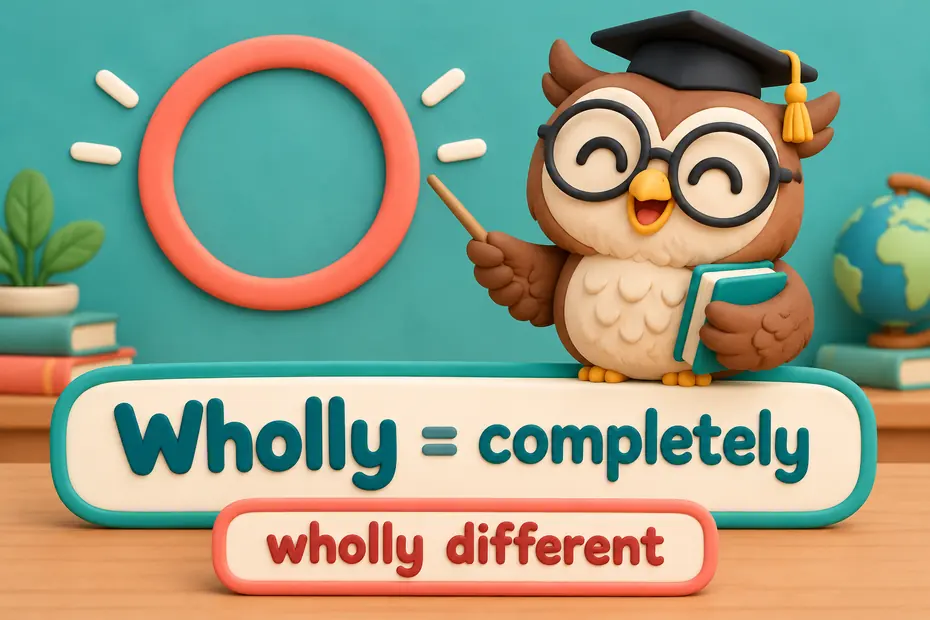
“The delay was wholly avoidable” can be tested by substituting “completely avoidable.” “The package was wholly intact” similarly means fully intact. A statement using wholly makes a strong completeness claim, so use it only when that degree is intended. “Mostly intact” reports something different from “wholly intact.”
Holey vs holy vs wholly: a comparison table
| Word | Meaning | Part of speech | Original example | Substitution check |
|---|---|---|---|---|
| Holey | Having holes | Adjective | His holey hat needed repair. | A hat with holes |
| Holy | Sacred or religious | Adjective | The shrine is a holy place. | A sacred place |
| Wholly | Completely or entirely | Adverb | The accounts were wholly inaccurate. | Completely inaccurate |
Compare “a holey book cover,” “a holy book,” and “a wholly revised book.” The first describes holes in the cover. The second describes religious significance. The third describes the extent of revision. A topic such as books can accommodate all three spellings, so the topic alone cannot determine the answer.
How does grammar help with the choice?
An adjective can describe a noun directly: “holey shoes” or “holy ground.” An adverb such as wholly can modify an adjective or another relevant expression: “wholly unsuitable shoes” or “wholly private grounds.” The word after the blank is therefore useful evidence. In “a ___ different arrangement,” wholly fits because the intended meaning is completely different.
A grammar clue is not a guarantee. “The building is holy” and “The building is holey” both have possible adjective patterns, but they describe different properties. To choose, identify whether the writer means religious significance or holes. If that meaning is unclear, ask for context rather than replacing the word solely because one version is more familiar.
A short proofreading exercise
- “The socks were ___ after years of use.” Choose holey for holes.
- “The pilgrims visited a ___ site.” Choose holy for sacredness.
- “The two accounts are ___ inconsistent.” Choose wholly for completely.
- “She ___ disagreed with the proposal.” Choose wholly for entirely.
Explain each correction in plain language: “This means completely, so it needs wholly.” That creates a repeatable check. Simply memorizing three similar sounds cannot catch a wrong-word error when all three spellings are valid English words.
Frequently asked questions
Is wholly an adjective?
No. Wholly is an adverb meaning completely or entirely. In “a wholly new design,” it modifies new. Holey and holy are adjectives that can directly describe a noun. Identify the intended role and test whether replacing the word with completely preserves the meaning.
Does holey always mean damaged?
No. Holey indicates that holes are present, but the holes may be intentional or natural. “The holey material let light through” does not by itself say the material was ruined. Add a more specific description when the reason for the openings, their shape, or their function matters.
Can holy be used outside religious descriptions?
Yes. The dictionary records intensive and exclamatory uses, including familiar expressions of surprise. Those uses depend on tone and context. In a factual description, choose wording that communicates the intended property clearly; a dramatic exclamation does not establish that an object is literally regarded as sacred.
How do you remember the double L in wholly?
Connect wholly with whole, then remember the adverb’s double L. Pair the spelling with its meaning, completely. “Wholly finished” becomes “completely finished” in a quick check. The reminder helps with spelling, while rereading the sentence confirms that the completeness meaning is actually intended.
Can all three words appear in one sentence?
Yes. “The holey cloth covering the holy object was wholly replaced” uses each word for a different purpose. Holey describes openings, holy describes sacred significance, and wholly describes the extent of replacement. Check each role separately rather than applying one spelling to every similar sound.
Original discussion
Have you ever wondered about the difference between “holey,” “holy,” and “wholly”? As a language enthusiast, I’ve often found myself caught in the web of confusion when it comes to these three words. In this text, I’ll be diving deep into the nuances of each word and providing you with a clear understanding of how to use them appropriately.
First, let’s tackle “holey.” This term refers to something that is filled with holes or has gaps in it. We’ll explore its usage in various contexts and provide examples to help you grasp its meaning effortlessly.
Next up is “holy.” This word carries a sacred connotation and is often associated with religious or spiritual contexts. We’ll explore its different meanings and guide you on when and how to use it correctly.
Finally, we’ll unravel the mysteries of “wholly.” This term signifies something that is complete or entire. We’ll discuss its usage and provide you with practical examples to ensure you never mix it up with the other two words again.
Key Takeaways
- “Holey” refers to something that has holes or gaps in it, whether physically or metaphorically.
- “Holy” is associated with sacred or religious contexts and describes things that are revered or considered divine.
- “Wholly” means complete or entire and emphasizes the thoroughness or completeness of something.
- It’s important to understand the distinctions between these words to use them appropriately and avoid confusion.
- “Holey” is used for physical objects with holes, “holy” for religious or sacred contexts, and “wholly” for emphasizing completeness or entirety.
- Clarity in communication is essential, and understanding the meanings and usage of these words can help avoid misunderstandings.
Exploring “Holey”
When it comes to the words “holey,” “holy,” and “wholly,” it’s easy to see why they can be confusing. In this section, we’ll take a closer look at the word “holey” and its meaning and usage.
Definition
The word “holey” is an adjective that describes something that has holes or is full of holes. It is derived from the noun “hole,” which refers to a hollow or empty space. When something is “holey,” it means it has one or more openings or gaps.
Usage
“Holey” is often used to describe physical objects that have holes in them. For example, you might say, “I need to throw away these holey socks” or “The bag is holey, so be careful with it.” It can also be used metaphorically to describe situations or arguments that have weaknesses or gaps, such as “His explanation was holey and didn’t convince me.”
Difference between “Holey” and “Holy”
One common mistake is confusing “holey” with “holy.” While they may sound similar, they have different meanings and usage.
The word “holy” is an adjective that means sacred or dedicated to a religious purpose. It is often used to describe things that are considered to be divine or blessed. For example, you might say, “The holy water is used for baptism” or “He entered the holy place with reverence.”
Examples
Here are a few examples to help further illustrate the usage of “holey”:
- The old sweater is so holey that I can’t wear it anymore.
- The cheese has a holey texture, which adds to its uniqueness.
- Be careful with that strainer, it’s quite holey and may let small pieces through.
Remember, “holey” refers to something that has holes, while “holy” refers to something that is sacred or associated with religion.
In the next section, we’ll explore the meaning and usage of the word “holy” in more detail.
Understanding “Holy”
Understanding “Holy”
When it comes to words that sound similar, it’s important to understand their distinct meanings to avoid confusion. In this section, we’ll dive deeper into the word “holy” and unravel its definition and usage.
What is “holy”?
“Holy” is an adjective that describes something as sacred, dedicated, or associated with a religious purpose. It refers to things that are revered or considered to be of great religious significance. The word “holy” is often used to describe places of worship, religious texts, rituals, or objects that hold special religious value.
Definition of “holy”:
- Adjective that denotes sacredness or religious dedication
- Implies reverence and respect
Usage of “holy”:
- Religious Context: In religious discourse, the word “holy” is commonly used to describe things that pertain to deities, divinity, or spiritual practices. For example:
- The holy scripture of Christianity is the Bible.
- Jerusalem is considered a holy city for Christianity, Islam, and Judaism.
- Figurative Usage: “Holy” can also be used metaphorically to convey a sense of awe, reverence, or solemnity. It adds emphasis to something considered significant or exceptional, even outside religious contexts. For example:
- That was a holy moment of pure joy.
- The view from the mountaintop was truly holy.
- Derived Terms: “Holy” is often found in compound words or phrases to further emphasize religious significance or sacredness. For example:
- Holy grail: Represents an object of great significance or importance.
- Holy communion: A Christian sacrament that symbolizes the sharing of the body and blood of Christ.
Summarizing
Understanding the word “holy” is crucial to using it appropriately. It conveys religious dedication, sacredness, and significance. Whether in religious contexts or in figurative language, “holy” adds depth and reverence to the subject being described.
Remember, clarity in communication is essential, and by grasping the differences between words like “holy” and “holey,” you can effectively express yourself and avoid any misunderstandings.
Unraveling the Mysteries of “Wholly”
Wholly is another word that often gets confused with holey and holy due to their similar spellings. But, their meanings and usage are quite distinct. Let’s investigate into the definition and appropriate usage of “wholly.”
What is “Wholly”?
“Wholly” is an adverb that signifies completeness or entirety. It is derived from the adjective “whole,” meaning complete or undivided. When we use “wholly,” we are emphasizing that something is done entirely or in its entirety. It suggests a sense of completeness or thoroughness in a particular action or state.
Definition of “Wholly”:
- Adverb meaning entirely or completely.
- Derived from the adjective “whole.”
- Emphasizes the complete or thorough nature of an action or state.
How to Use “Wholly” Appropriately:
When using “wholly,” it’s important to ensure that you are expressing the idea of completeness or entirety. Here are a few examples to illustrate its appropriate usage:
- I wholly agree with your proposal. (I completely agree)
- She decided to wholly dedicate herself to her studies. (She completely dedicated)
- The team worked wholly independently on their projects. (They worked completely independently)
It’s important to note that “wholly” is commonly used in formal or more serious contexts, emphasizing a strong sense of completeness. But, it is not as frequently used compared to its counterparts, “holey” and “holy.”
Understanding the differences between “holey,” “holy,” and “wholly” is crucial to using these words appropriately and avoiding confusion. So, the next time you come across these words, you can confidently navigate their usage and convey your intended meaning effectively.
Conclusion
Now that we have explored the differences between “holey,” “holy,” and “wholly,” it is clear that each word has its own unique meaning and usage. While “holey” refers to something that has holes, “holy” is used to describe something that is sacred or blessed. On the other hand, “wholly” emphasizes completeness or entirety.
Understanding the distinctions between these words is essential for using them correctly and effectively in our writing. By using “wholly” appropriately, we can convey a sense of thoroughness or completeness in our descriptions or actions. It is important to note that “wholly” is commonly used in formal or serious contexts.
By mastering the appropriate usage of these words, we can avoid confusion and ensure that our writing is clear and precise. So, the next time you come across these words, remember their unique meanings and choose the one that best fits the context.
Frequently Asked Questions
Q: What is the difference between “holey,” “holy,” and “wholly”?
A: “Holey” refers to having holes, especially in fabric. “Holy” refers to something sacred or related to a deity. “Wholly” means completely or entirely.
Q: How is “wholly” defined?
A: “Wholly” is an adverb that emphasizes completeness or entirety. It derives from the adjective “whole.”
Q: In what contexts can “wholly” be used?
A: “Wholly” is commonly used in formal or serious contexts to convey complete or thorough action or state.
Q: Can you provide examples of how to use “wholly” in a sentence?
A: Sure! “She was wholly committed to her studies.” “The company’s success is wholly dependent on its employees’ dedication.”
Q: Why is understanding the difference between these words important?
A: Understanding the differences between “holey,” “holy,” and “wholly” is crucial for using them appropriately and avoiding confusion in writing and communication.


