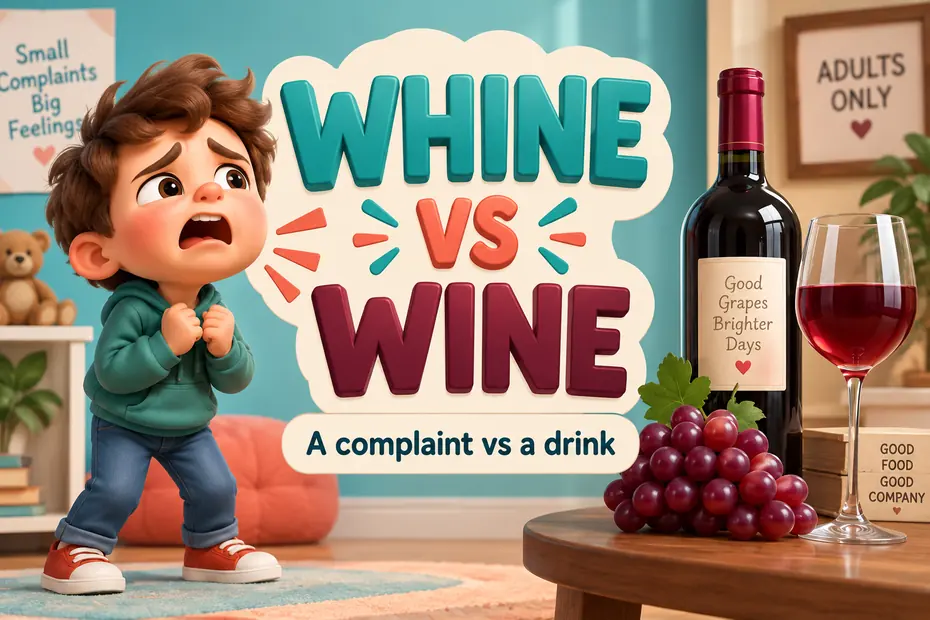
Whine means to make a plaintive, high-pitched sound or complain; wine usually means a fermented alcoholic drink. Write “Please do not whine” for complaining and “a glass of wine” for the beverage. The words sound alike for many speakers, so meaning and sentence context are the dependable spelling checks.
Key facts about whine and wine
- Whine can be a verb or a noun: “The dog whines”; “a high whine.”
- Wine is usually a beverage noun, but it also has a verb use.
- The past-tense forms are whined and wined.
- The -ing forms are whining and wining, each with one N.
- A machine can whine without making a complaint; the word can simply describe its sound.
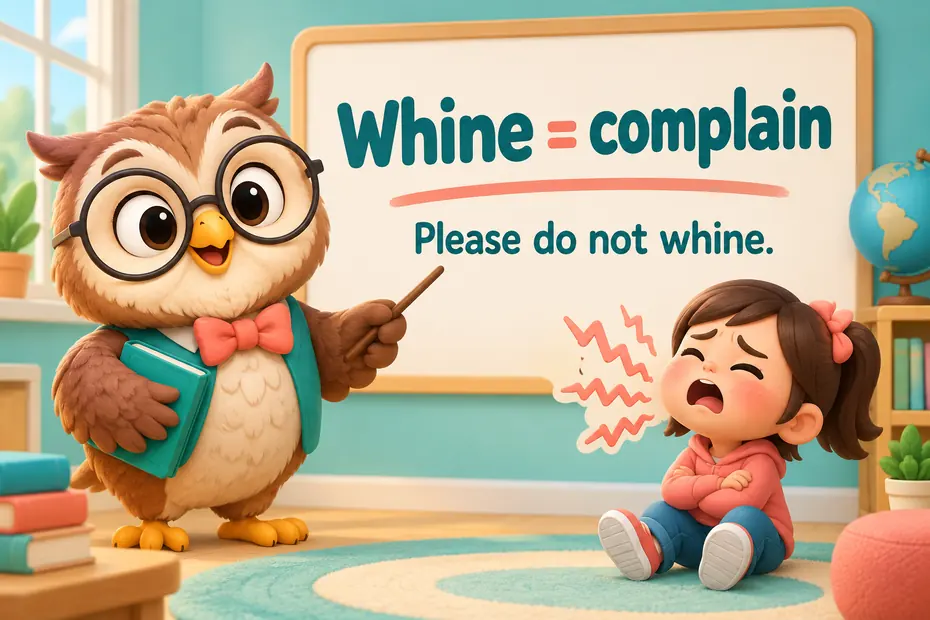
When should you write whine?
Use whine when the intended meaning concerns a high-pitched, plaintive sound or a complaint delivered in that manner. Merriam-Webster’s whine entry records noun and verb senses, including similar sounds from nonhuman sources. The word therefore covers more than an annoyed person: “The motor began to whine” describes the noise made by the motor.
Choose the grammatical form that fits the sentence. “The puppy whined beside the door” uses a past-tense verb. “A whine came from behind the door” uses a noun. “The puppy was whining” combines was with the -ing form. All three describe a sound, but they organize the sentence differently.
When writing about a person, whine can carry an unfavorable judgment about how a complaint was expressed. If your purpose is to report a concern neutrally, consider “She complained about the missing instructions” or “She asked for clearer instructions.” Those sentences describe an action without requiring the reader to accept a judgment about the speaker’s tone.
When should you write wine?
Use wine for the beverage in an ordinary food, menu, or shopping context. Merriam-Webster’s wine entry gives the familiar grape beverage sense and also records other plant-based fermented beverages. “The recipe calls for red wine” is a noun use. The sentence does not involve anyone complaining or making a high-pitched sound.

“A glass of wine” refers to a serving, while “three wines” can refer to three varieties or selections. The surrounding nouns often help: bottle, glass, cellar, menu, and grape all support the beverage meaning. Still, do not rely on a single nearby word. “A whine interrupted the wine tasting” correctly contains both spellings, because the sentence mentions a sound and a drink.
Whine vs wine: sentence patterns
| Meaning | Pattern | Original example |
|---|---|---|
| Complain | Whine about + topic | He whines about every delay. |
| Make a high sound | Subject + whine | The old fan whines at high speed. |
| Name the sound | A/the + whine | A thin whine came from the speaker. |
| Name the drink | Wine as a noun | The menu lists a local wine. |
| Entertain with food and drink | Wine and dine | The hosts wined and dined their guests. |
How do the spellings change with tense?
Write whined for the past of whine: “She whined about the timetable yesterday.” Drop the final E before adding -ing: “She is whining again.” The same spelling process gives wined and wining from wine. The H remains the distinction between the two word families.

Keep wining separate from winning. “The team is winning” means it is succeeding in a competition. “The hosts are wining and dining visitors” describes entertaining them. The double N in winning belongs to win, not to wine. A word processor may accept all three spellings, leaving this meaning check to the writer.
A quick proofreading exercise
- “A glass of ___ stood on the table.” Choose wine; the blank names a beverage.
- “The gears began to ___.” Choose whine; the blank describes a sound.
- “They were ___ about the queue.” Choose whining; the blank describes complaining.
- “The club ___ and dined its guests.” Choose wined; the phrase describes hospitality.
For each answer, state what the word means before checking its letters. This prevents a common editing trap: choosing a spelling merely because you remember seeing it more often. When both words are familiar, the sentence’s meaning must settle the choice.
Frequently asked questions
Can whine describe a machine?
Yes. A fan, engine, or electronic device can make a high sound that a writer describes as a whine. No literal complaint is involved. “The pump whined throughout the test” uses the verb; “The pump’s whine was distracting” names the sound with the noun form.
Is wine only a noun?
No. Wine can also be a verb, particularly in the familiar expression wine and dine. “They wined and dined the visitors” uses the past tense. That less frequent verb meaning explains why wined and wining are real spellings rather than automatic errors.
Is whining the same spelling as wining?
No. Whining retains the H from whine and describes a plaintive sound or complaining. Wining comes from wine and concerns wine or hospitality. Both have a single N. Check the intended activity rather than assuming that every unfamiliar -ing form is a typo.
Should every complaint be called a whine?
No. Whine evaluates the manner of expression, whereas complaint can name a concern neutrally. In a work report, quotation, or factual summary, state what was said and use neutral wording unless the tone itself is relevant. A justified concern can be expressed calmly or plaintively.
What is an easy spelling reminder?
Associate the H in whine with a high-pitched sound. Use wine without the H for the drink. This is a memory aid rather than a rule about word history. Follow it with a final sentence check, especially where an intentional joke uses both words together.
Original discussion
Key Takeaways
- “Whine” and “wine” are two words that sound similar but have different meanings.
- “Whine” refers to a high-pitched complaining sound, while “wine” is an alcoholic beverage made from fermented grapes or other fruits.
- It is important to use these words correctly to avoid confusion and miscommunication.
- The difference between “whine” and “wine” lies in their sound, context, and spelling.
- “Whine” is associated with complaining or displeasure, while “wine” is associated with enjoyment, relaxation, and socializing.
- By understanding and utilizing the distinctions between these words, you can communicate more accurately and effectively.
The Difference between Whine and Wine
When it comes to language, words can often sound similar but have completely different meanings. One such pair of words that frequently causes confusion is “whine” and “wine.” It’s important to understand the distinction between these two words, as using them correctly can greatly enhance your communication skills.
What is Whine?
Let’s start with the definition of “whine.” When we talk about whining, we’re referring to a high-pitched, complaining sound that often accompanies dissatisfaction or annoyance. It can be the sound a child makes when they’re unhappy or the grumbling of someone dissatisfied with a situation.
What is Wine?
On the other hand, “wine” is an alcoholic beverage made from fermented grapes or other fruits. It has a wide range of flavors, colors, and aromas, and is enjoyed by many people all over the world. Wine can be red, white, or rosé, and its taste can vary from sweet to dry.
The Difference between Whine and Wine
Now that we have a clear understanding of what each word means, let’s explore the key differences between “whine” and “wine”:
- Sound: Whine is a sound, while wine is a beverage.
- Context: Whine is often used to describe complaining or displeasure, whereas wine is associated with enjoyment, relaxation, and socializing.
- Spelling: Note the difference in spelling – “whine” has an “h,” while “wine” does not.
It’s crucial to use these words appropriately to avoid confusion and miscommunication. Imagine describing a glass of wine as a whine, or vice versa! By mastering the correct usage of these words, you’ll be able to express yourself more accurately and effectively.
To illustrate these distinctions further, let’s look at a couple of examples:
- When my little sister didn’t get her way, she would whine and complain all day long.
- I love indulging in a glass of red wine after a long day.
Remember, the difference between “whine” and “wine” lies in their meaning, pronunciation, and usage. By understanding and utilizing these distinctions correctly, you’ll be able to confidently navigate conversations and avoid any potential confusion.
Keep reading to discover more commonly confused words and improve your overall language skills.
Understanding Whine: Definition and Examples
Understanding Whine: Definition and Examples
Whine and wine may sound similar, but they have completely different meanings. In this section, I’ll explain the definition of “whine” and provide examples to help you understand how to use it correctly.
When we talk about the word “whine,” we are referring to a high-pitched complaining or disapproving sound. It is often associated with a person or an animal voicing their dissatisfaction or annoyance. For example, a child might whine when they don’t get what they want, or a dog might whine when they’re begging for attention.
Whining can also be used to describe a constant, irritating noise. For instance, a car engine that makes a high-pitched sound can be said to whine. Also, we can use “whine” figuratively to describe someone who complains excessively about trivial matters.
To better illustrate the correct usage of “whine,” here are a few examples:
- My little brother constantly whines about having to do his assignments.
- The neighbor’s dog whined at the door, wanting to come inside.
- The car engine began to whine as it struggled up the steep hill.
It’s important to note the difference between “whine” and “wine.” While “whine” refers to a complaining sound, “wine” is an alcoholic beverage made from fermented grapes or other fruits. Remember, one is a sound, and the other is a drink.
To conclude, understanding the definition and usage of “whine” can help you communicate more effectively. Avoiding confusion between “whine” and “wine” is essential for clear and accurate communication. Now that we’ve covered the definition of “whine,” let’s move on to the next section for a better understanding of the word “wine.”
Stay tuned for more examples and explanations of commonly confused words to improve your language skills.
Understanding Wine: Definition and Examples
When it comes to the words “whine” and “wine,” the difference between them may seem subtle, but it’s crucial to understand their respective meanings and usage. In this section, I will provide you with a clear definition of “wine” and give you some examples to help you grasp its proper usage.
What is wine?
Wine is an alcoholic beverage made from fermented grapes or other fruits. It has been enjoyed by people for centuries and is known for its wide range of flavors, aromas, and colors. While the primary ingredient of wine is grapes, it can also be made from various fruits like cherries, apples, and plums.
Definition of wine:
Wine (noun): An alcoholic beverage made from fermented grapes or other fruits.
- I love enjoying a glass of red wine with a delicious steak.
- The sommelier recommended a crisp white wine to accompany the seafood.
- She celebrated her promotion with a bottle of sparkling wine.
As you can see from these examples, wine is commonly associated with meals, celebrations, and social gatherings. Its diverse varieties offer a spectrum of flavors and characteristics, appealing to a wide range of tastes and preferences.
Understanding the difference between “whine” and “wine” is vital for effective communication. While “whine” refers to a high-pitched complaining or disapproving sound, “wine” is an alcoholic beverage. So, remember to use the word “wine” when you’re talking about the delightful drink and save “whine” to describe a complaining tone or sound.
Stay tuned for more examples and explanations of commonly confused words. I’ll continue to guide you through the intricacies of the English language, helping you become a more confident communicator.
Common Confusions: Whine or Wine?
As I continue to investigate into the intricacies of the English language, I come across words that are often confused or misused. Today, let’s tackle two words that may sound similar but have completely different meanings: “whine” and “wine.”
Whine, pronounced like “wine,” is a verb that refers to a high-pitched complaining or disapproving sound. It’s the sound we hear when someone expresses dissatisfaction or annoyance. Imagine a child who wants a toy and continuously makes a high-pitched sound until they get their way. That’s whining.
On the other hand, wine, pronounced like “whine,” is a noun that refers to an alcoholic beverage made from fermented grapes or other fruits. It’s a drink enjoyed by many, with a wide variety of flavors and types to choose from. From a robust red to a crisp white, wine adds pleasure and sophistication to many social occasions.
The key difference between whine and wine lies in their meanings and contexts. Whine is all about complaining and expressing dissatisfaction, while wine is a delightful libation that brings people together.
Let’s look at a few examples to better understand the distinction between these two words:
- “Stop whining about your assignments! Just get it done.”
- “I love sipping a glass of wine while watching the sunset.”
- “The dog whined when it couldn’t reach its favorite toy.”
- “This bottle of wine has a rich aroma and a smooth taste.”
Tips for Using Whine and Wine Appropriately
When it comes to the words “whine” and “wine,” it’s important to understand their distinctions and use them appropriately. Here are some tips to help you navigate the proper usage of these commonly confused words.
- Understand the Difference: First and foremost, it’s crucial to grasp the distinction between “whine” and “wine.” While they may sound similar, their meanings are completely different. “Whine” is a verb that refers to a high-pitched complaining or disapproving sound, whereas “wine” is a noun that refers to an alcoholic beverage made from fermented grapes or other fruits.
- Context is Key: To use these words accurately, pay attention to the context in which they are used. Ask yourself whether the word is related to expressing discontentment or complaining (whine), or if it pertains to a beverage made from fermented fruits (wine). This simple exercise can go a long way in ensuring proper usage.
- Usage Examples: To further clarify the appropriate use of “whine” and “wine,” here are some examples:
- “She always whines about her workload.” (verb)
- “The baby won’t stop whining for his toy.” (verb)
- “I enjoy a glass of red wine with my dinner.” (noun)
- “The restaurant offers an extensive selection of fine wines.” (noun)
- Practice Makes Perfect: Like any other aspect of language learning, practice is essential for mastering the correct usage of words. Challenge yourself to incorporate “whine” and “wine” into your daily conversations or written exercises. The more you practice, the more comfortable and confident you’ll become.
Conclusion
Understanding the difference between “whine” and “wine” is crucial for effective communication. “Whine” refers to a high-pitched complaining or disapproving sound, while “wine” is an alcoholic beverage made from fermented grapes or other fruits. By mastering the appropriate usage of these words, we can avoid confusion and convey our intended meaning accurately.
To use “whine” and “wine” appropriately, it is important to consider the context in which they are used. Paying attention to the tone and subject matter of a conversation or written piece can help us determine whether “whine” or “wine” is the appropriate choice. Practicing their usage in daily conversations or written exercises can also enhance our confidence and fluency with these words.
Remember, “whine” and “wine” have distinct meanings and should not be used interchangeably. By honing our understanding of their definitions and practicing their usage, we can communicate more effectively and avoid any unintentional misunderstandings.
So, let’s embrace the knowledge we’ve gained and incorporate “whine” and “wine” into our everyday vocabulary with confidence. Cheers to clear and precise communication!
Frequently Asked Questions
Q: What is the difference between “whine” and “wine”?
A: “Whine” refers to a high-pitched complaining or disapproving sound, while “wine” is an alcoholic beverage made from fermented grapes or other fruits.
Q: Can you provide examples of how “whine” can be used?
A: Sure! Examples include: “Stop whining about the weather,” “She always whines when things don’t go her way,” and “The child’s constant whining was annoying.”
Q: How can “wine” be used in different situations?
A: “Wine” can be used to describe enjoying a glass of red wine with dinner, attending a wine tasting event, or saying, “I would like a glass of white wine, please.”
Q: Why is it important to understand the difference between “whine” and “wine”?
A: Understanding the distinction between “whine” and “wine” is crucial for effective communication, as using the wrong word can lead to confusion or misunderstandings.
Q: Any tips for using “whine” and “wine” appropriately?
A: To use these words accurately, it’s important to grasp their definitions, pay attention to context, and practice their usage in sentences. For example, write sentences like “He tends to whine when he doesn’t get his way” and “I enjoy pairing a good wine with my meal.”
Q: Do you have more examples of how “whine” and “wine” can be used?
A: Certainly! Examples include: “The dog whined when left alone,” “The customer complained with a whine in her voice,” and “I bought a bottle of wine to celebrate the occasion.”
Q: Any final advice for incorporating “whine” and “wine” into conversations or writing?
A: Practice using these words regularly in your daily discussions or written exercises to become more comfortable and confident in their proper usage. This will help you enhance your communication skills.


