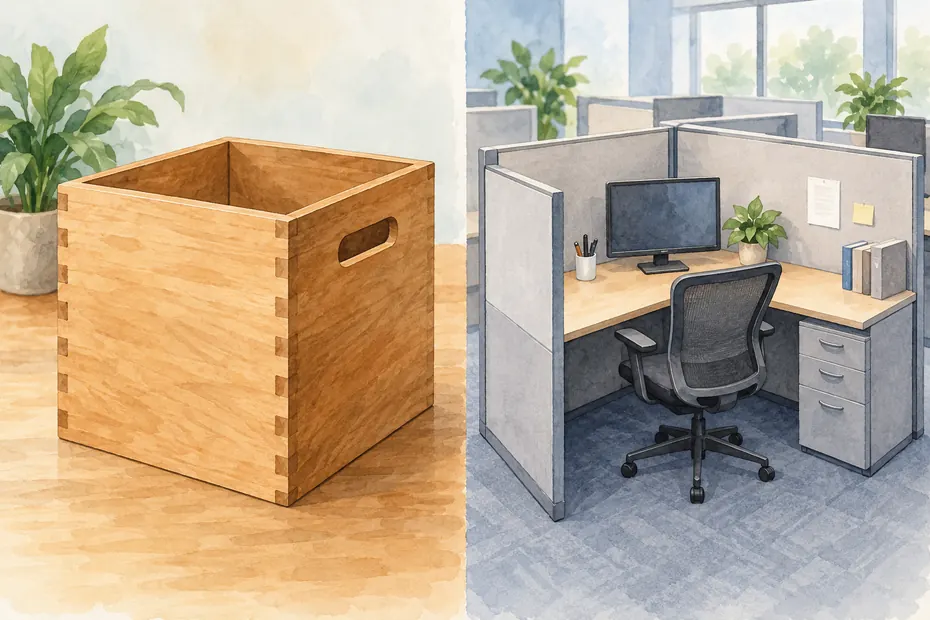
Cubical vs Cubicle: Shape or a Partitioned Space?
Cubical vs cubicle distinguishes an adjective from a noun. Cubical means shaped like a cube, and it can also relate to volume. Cubicle names a small partitioned space, often an office workstation. A cubicle does not need to have equal length, width, and height, and it need not be in an office.
Clarification to the preserved article: cubicle is broader than an office workstation; sleeping and study compartments also fall within its dictionary meanings. The word predates the modern office systems discussed below. Equal dimensions alone are not a complete geometric definition of a cube: its six faces must be squares meeting at right angles.
- Cubical describes a shape or, in another sense, volume.
- Cubicle names a small partitioned space.
- A rectangular office cubicle is still a cubicle.
- A cube-shaped box is cubical, even outside an office.
- Cubicles is the plural noun; cubical does not become a plural noun here.
| Question | Cubical | Cubicle |
|---|---|---|
| Usual word type | Adjective | Noun |
| What does it identify? | Cube-like shape | A partitioned compartment |
| Example | A cubical container | An office cubicle |
| Does it require an office? | No | No |
What makes an object cubical?
An object is cubical when its form resembles a cube. A geometric cube has six square faces, twelve equal edges, and eight vertices. Each meeting edge forms the right-angle structure of the cube. The dictionary definition of cube provides the shape behind the adjective.
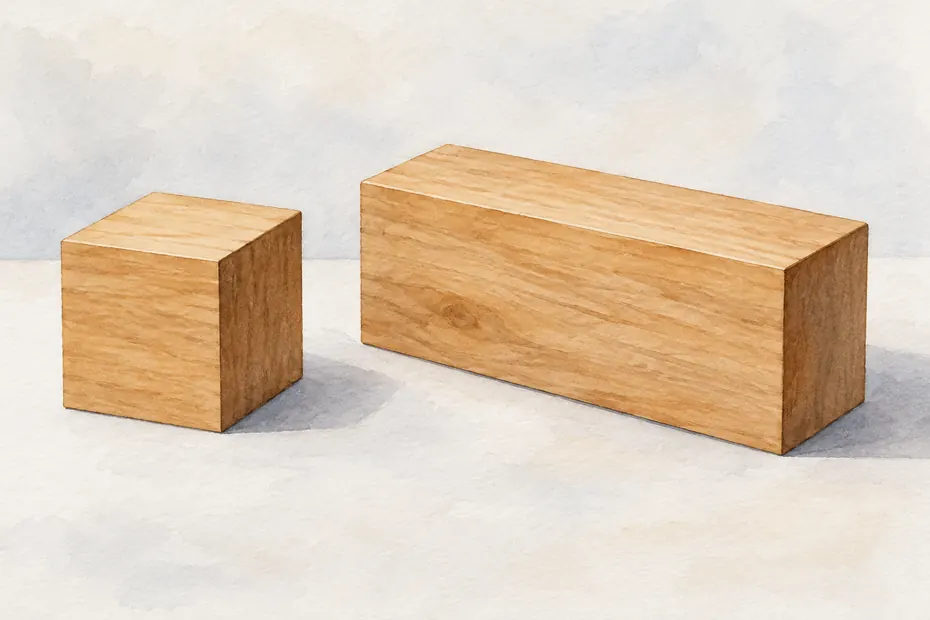
A storage box measuring 30 centimeters in length, width, and height, with square faces and right angles, supplies a clear example. A box measuring 30 by 30 by 60 centimeters is a rectangular prism, rather than a cube. Its square footprint does not make the complete three-dimensional object cubical because its height differs.
In ordinary description, cubical may allow approximate resemblance rather than laboratory precision. A wooden block with slightly rounded corners can still look cubical. For technical specifications, state the actual dimensions and tolerances instead of relying only on the adjective. A supplier needs measurements to distinguish a nearly cube-shaped container from an exact specified geometry.
What does cubicle include beyond an office desk?
A cubicle is a small compartment or partitioned space. An office workstation is one common example, but the noun also covers a partitioned sleeping space and a study carrel. The Merriam-Webster cubicle entry records these meanings and dates the word’s first known use to 1858.
An office cubicle typically contains a desk within partial partitions. Its walls may be lower than the ceiling, and its plan may be rectangular or irregular. Those features do not disqualify it as a cubicle. The noun identifies the compartment’s role and separation, rather than imposing the geometry described by cubical.
Compare “The library has several study cubicles” with “The display uses cubical stands.” The first names small spaces for individual study. The second describes the shape of objects supporting a display. A cubicle could contain a cubical stand, but neither word determines the meaning of the other.

How does grammar identify the right spelling?
Use cubical to modify a noun, and use cubicle to name the space itself. “A cubical room” says what shape the room has. “A cubicle” identifies the kind of compartment. In an ordinary office sentence, “My cubical is near the window” should normally read “My cubicle is near the window.”
The cubical dictionary entry identifies the word as an adjective and includes a volume-related sense. “The container is cubical” is grammatical because the adjective describes the subject after is. “The container is a cubicle” would instead classify the container as a compartment, changing the intended claim.
A noun can also modify another noun: “cubicle wall,” “cubicle partition,” and “cubicle layout” use cubicle to identify the thing those features belong to. Replacing cubicle with cubical would suggest a shape description. “Cubical partition” is therefore not the usual spelling for the wall of an office cubicle.
| Intended message | Correct wording |
|---|---|
| Name my workstation | My cubicle |
| Describe a box’s shape | A cubical box |
| Name multiple workspaces | Three cubicles |
| Identify workspace partitions | Cubicle partitions |

Which office descriptions need more precision?
Calling a workspace a cubicle does not establish its acoustic privacy, size, or suitability for confidential conversations. Those properties depend on the actual partitions and surroundings. In an office description, specify dimensions, partition height, access, and the available enclosed meeting spaces when those details affect a reader’s decision.
For example, “a 2-by-3-meter cubicle with partial-height partitions” gives useful layout information without claiming the space is a cube or soundproof. A colleague arranging a private discussion needs to know whether an enclosed room is available, rather than merely knowing the workstation has partitions.
- Ask whether you are naming a compartment or describing a shape.
- For a compartment, choose cubicle and add a modifier such as office or study.
- For a shape, choose cubical and name the object being described.
- For technical planning, include measurements instead of relying on either word alone.
Frequently asked questions
Are cubical and cubicle pronounced differently?
The Merriam-Webster entries give the same standard pronunciation for these words. Hearing the word therefore does not reliably identify its spelling. Choose according to meaning and grammar: an adjective describing cube-like form requires cubical, while the noun naming a small partitioned workspace requires cubicle.
Can a cubicle be rectangular?
Yes. Cubicle identifies a partitioned space rather than a precise geometric solid. A rectangular office workstation remains a cubicle even when its length, width, and height differ. Cubical would describe cube-like form, so it should not be inferred solely from the fact that a workstation has partitions.
Is cubical a misspelling?
No. Cubical is a valid adjective. It becomes the wrong choice when a writer intends the noun cubicle, as in “I left the file in my cubical.” Correct that office sentence to cubicle, but retain cubical when it accurately describes an object’s shape.
What is the simplest memory aid?
Associate cubical with a cube-shaped object and cubicle with a compartment. For cubical vs cubicle, ask whether the sentence answers “What shape?” or “What space?” That distinction also handles study compartments, sleeping compartments, and office workstations without incorrectly requiring every cubicle to be a cube.
Preserved original article
Hey there! Have you ever wondered about the difference between “cubical” and “cubicle”? Well, I’ll let you in on a little secret: it’s not just a matter of spelling. In this text, I’ll be diving into the world of cubicles and exploring how to use these office spaces appropriately.
First off, let’s clarify the distinction between “cubical” and “cubicle.” While “cubical” refers to something that is shaped like a cube, “cubicle” specifically refers to those little workstations you find in offices. Now that we’ve got that sorted, we can investigate into the dos and don’ts of using these spaces effectively.
Key Takeaways
- “Cubicle” and “cubical” are two different terms with distinct meanings and usage.
- “Cubical” is an adjective that describes something shaped like a cube, while “cubicle” refers to small workstations in offices.
- It is crucial to use the correct term based on your intended meaning to ensure accurate communication.
- Understanding and using cubicles effectively requires respecting personal space, keeping noise levels low, customizing the workspace appropriately, maintaining cleanliness, and organizing the cubicle for maximum productivity.
- Shared cubicle spaces require proper etiquette and behavior, including respecting personal space, keeping noise levels to a minimum, maintaining cleanliness, and avoiding excessive clutter.
Exploring the Difference between “Cubical” and “Cubicle”
When it comes to the words “cubical” and “cubicle,” there is often confusion and misuse. Let’s jump into the difference between these two similar-sounding terms and explore their meanings and usage.
Definition of “Cubical”
The word “cubical” refers to something that is shaped like a cube. It describes objects or spaces that have equal measurements on all sides and angles, resembling a geometric cube. For example, a Rubik’s Cube or a dice can be considered cubical in nature.
Definition of “Cubicle”
On the other hand, “cubicle” specifically refers to the small workstations commonly found in office settings. These individual work areas are often divided by low partitions or walls, providing employees with a degree of privacy while still promoting collaboration and an open office environment.
Now that we have established the definitions, let’s dive deeper into the differences between these two terms.
The Difference
The main distinction lies in their usage and context. While “cubical” is an adjective that describes the shape of an object, “cubicle” is a noun that denotes a specific type of workspace. Here are a few key points to remember:
- “Cubical” describes objects that have a cube-like shape, such as a box or a room with equal dimensions on all sides.
- “Cubicle” refers to small office workstations, often surrounded by partitions or walls, designed to maximize individual productivity within a shared workspace environment.
While the terms may sound similar, understanding this difference is important to ensure accurate communication. Using the right word in the right context will help you convey your ideas clearly and effectively.
In the next section, we’ll explore the dos and don’ts of using cubicles effectively in the office environment. Stay tuned for valuable insights and tips to make the most out of your cubicle workspace.
Remember to use the correct term based on your intended meaning. Whether you want to describe the shape of an object or refer to a specific type of office workstation, using “cubical” or “cubicle” appropriately will showcase your language proficiency and clarity of thought. Let’s continue our journey by discussing the best practices for utilizing cubicles effectively.
Understanding the Definition of “Cubical”
When it comes to the words “cubical” and “cubicle,” it’s important to understand their definitions and how they differ. So let’s jump into the meaning of “cubical” to gain a clearer understanding.
First off, “cubical” is an adjective that describes something shaped like a cube. It refers to objects or structures that have the same length, height, and width, giving them a cubic shape. This word is often used in mathematics or geometry to describe three-dimensional figures with equal sides.
For example, imagine a storage container that has a length of 1 meter, a height of 1 meter, and a width of 1 meter. This container would be considered cubical because it has equal sides and a cubic shape.
It’s important to note that “cubical” should not be confused with “cubicle.” While they sound similar, they have distinct meanings.
In contrast to “cubical,” “cubicle” is a noun that specifically refers to small workstations or compartments found in offices. These individual work spaces are often separated by partitions to provide privacy and reduce distractions in a shared working environment.
Now that we’ve covered the definition of “cubical,” it sets the foundation for understanding the distinction between “cubical” and “cubicle.” In the next section, we’ll explore the definition of “cubicle” in more detail and discuss its practical application in the office environment.
But first, let’s recap what we’ve learned so far:
- “Cubical” is an adjective that describes something shaped like a cube.
- It refers to objects or structures with equal length, height, and width.
- “Cubicle” is a noun that specifically refers to small workstations or compartments in offices.
Let’s continue our exploration by delving into the definition of “cubicle” and its significance in the workplace.
Defining the Concept of a “Cubicle”
When it comes to understanding the difference between “cubical” and “cubicle,” it is essential to start with a solid understanding of what a “cubicle” actually is. In this section, I’ll provide a clear definition of a “cubicle” and explore its significance in the workplace.
A cubicle is a noun that specifically refers to small workstations or compartments found in offices. These workstations are typically enclosed spaces that provide employees with their own dedicated area to work in. Cubicles are commonly found in open-plan office layouts, where several workstations are positioned side by side, separated by partitions.
The concept of the cubicle was first introduced in the 1960s as a way to maximize workspace efficiency while still maintaining individual privacy. It was seen as a revolutionary design that allowed for better organization and utilization of office space. Since then, cubicles have become a common feature in numerous workplaces, ranging from corporate offices to government buildings.
Cubicles offer several benefits in the workplace. They provide employees with a sense of personal space and privacy, allowing them to focus on their tasks without many distractions. The partitions also help reduce noise levels, creating a quieter and more productive work environment. Also, cubicles can be easily customized with desks, shelves, and other accessories, allowing employees to personalize their workspace to some extent.
The design and layout of cubicles can vary significantly across different organizations and industries. Some cubicles may be more open and spacious, while others may have higher partitions for increased privacy. The size and configuration of cubicles can also differ, depending on the specific needs and requirements of the company.
It’s important to note that “cubical” is not the same as “cubicle.” While “cubical” is an adjective that describes something shaped like a cube, often used in mathematics or geometry, “cubicle” specifically refers to the individual workspaces found in offices.
Now that we have a clear understanding of what a “cubicle” is, the next section will explore the similarities and differences between “cubical” and “cubicle,” helping you use these words appropriately in your everyday communication.
The Dos and Don’ts of Using Cubicles
When it comes to using cubicles, there are certain guidelines and considerations that can help you make the most of this office workspace. Here are the dos and don’ts to keep in mind:
Do: Respect Personal Space
One of the key benefits of cubicles is the provision of personal space. It’s important to be mindful and respectful of others’ workspace boundaries. Avoid invading their cubicle unless invited or necessary. Respecting personal boundaries helps create a harmonious and productive work environment.
Don’t: Be Too Noisy
While cubicles offer a certain level of privacy, they are not soundproof. Be considerate of your colleagues and keep noise levels to a minimum. Avoid loud phone conversations or playing music without headphones. Keeping noise under control allows everyone to concentrate and work efficiently.
Do: Customize Your Workspace
Cubicles often allow for personalization. Adding a few personal touches can make your workspace more comfortable and inspiring. Consider decorating your cubicle with photos, plants, or artwork. A personalized cubicle can boost your morale and make the work environment feel more welcoming.
Don’t: Treat Cubicles as Total Privacy
Although cubicles provide some privacy, it’s important to remember, they are still part of an open-plan office. Confidential conversations should be taken to private meeting rooms or designated spaces. Being mindful of the shared workspace helps maintain professionalism and respect for others’ privacy.
Do: Maintain a Neat and Organized Cubicle
Keeping your cubicle tidy and well-organized has numerous benefits. It enhances productivity, reduces distractions, and creates a professional impression for clients or visitors. Invest in storage solutions or organization tools to keep your belongings in order. A clutter-free cubicle promotes a focused and efficient work environment.
Don’t: Abuse the Space
While customization is encouraged, it’s essential to avoid going overboard and cluttering the workspace. Excessive decorations or personal items can create distractions and hinder productivity. Find a balance between personalization and maintaining a functional workspace.
Remember, understanding the dos and don’ts of using cubicles can contribute to a harmonious and efficient office environment. By respecting personal space, controlling noise levels, customizing your workspace appropriately, and maintaining cleanliness, you can maximize the benefits of working in a cubicle.
Organizing Your Cubicle for Maximum Productivity
When it comes to maximizing productivity in the workplace, organizing your cubicle plays a crucial role. A well-organized workspace can help you stay focused, reduce distractions, and eventually enhance your overall efficiency. Here are some tips to help you create a productive and functional cubicle setup:
1. Define Your Work Zones
One of the first steps to organizing your cubicle is to define different work zones within your limited space. Consider designating areas for tasks such as workstation for computer work, reference materials, writing area, and storage. By clearly marking out the different areas, you’ll be able to find what you need quickly, preventing unnecessary searching and interruptions.
2. Use Vertical Space
When you’re working with a compact area like a cubicle, vertical space is your friend. Take advantage of wall-mounted shelves, over-the-desk organizers, and file holders to store frequently used items within easy reach. This will free up valuable desk space and keep everything neatly organized.
3. Keep It Clutter-Free
A cluttered workspace can be both visually overwhelming and mentally distracting. Keeping your cubicle clutter-free is essential for maintaining focus and productivity. Regularly go through your items and remove any unnecessary or unused ones. File away documents, keep pens and stationery in designated holders, and generally strive for a clean and tidy workspace.
4. Harness the Power of Labels
Labels are an effective way to keep your belongings organized and easily accessible. Use labels or color-coded systems for folders, storage boxes, and containers to ensure everything has a designated place. This will help you quickly locate what you need, saving you valuable time and reducing frustration.
5. Personalize Within Limits
While it’s important to make your cubicle feel like your own space, it’s crucial to personalize within limits. Avoid excessive decorations that may clutter your workspace or distract you from your tasks. Opt for a few meaningful items that inspire and motivate you, such as pictures of loved ones or a small plant.
Implementing these cubicle organizing tips can help you create an environment that fosters productivity and efficiency. Remember, a well-organized cubicle not only enhances your own performance but also contributes to a harmonious and productive work atmosphere.
Etiquette and Behavior in a Shared Cubicle Space
When it comes to working in a shared cubicle space, it’s crucial to be mindful of proper etiquette and behavior. Respecting personal space, maintaining a quiet environment, and keeping the workspace clean are essential aspects of creating a harmonious working environment. Let’s explore some dos and don’ts for using cubicles in a shared workspace:
- Respect personal space: Just as you would want others to respect your personal space, it’s important to extend the same courtesy to your fellow coworkers. Avoid leaning or intruding into another person’s work area, as it can cause distractions and discomfort.
- Keep noise levels to a minimum: Cubicles are not soundproof, so it’s essential to be mindful of the noise you create. Keep phone conversations, music, and conversations with colleagues at a respectful volume. If you need to have a more extended discussion, consider finding a designated meeting space.
- Maintain cleanliness: A clean workspace not only looks professional but also helps create a positive and productive atmosphere. Be sure to clean up after yourself, throwing away trash, and keeping your workspace tidy. Avoid leaving food or drinks at your desk for extended periods to prevent unwanted odors or spills.
- Avoid excessive clutter: While it’s essential to personalize your workspace, be mindful not to go overboard with decorations or personal items. Excessive clutter can be distracting and make it challenging to stay focused. Keep the balance between personalization and maintaining a clean and organized workspace.
Implementing these etiquette guidelines can help create a positive and collaborative environment in a shared cubicle space. By showing respect for personal space, keeping noise levels to a minimum, maintaining cleanliness, and avoiding excessive clutter, you contribute to a more pleasant and productive workplace.
Remember, we spend a significant amount of time in our workspaces, so it’s crucial to foster a harmonious and respectful atmosphere for everyone.
Conclusion
To conclude, it is crucial to understand the distinction between “cubical” and “cubicle” to effectively communicate in various contexts. While “cubical” refers to something shaped like a cube, often used in mathematical or geometric contexts, “cubicle” specifically refers to small workstations or compartments found in offices.
Throughout this article, we have explored the dos and don’ts of using cubicles in the workplace. By respecting personal space, keeping noise levels to a minimum, customizing the workspace, maintaining cleanliness, and avoiding excessive clutter, we can create an environment that fosters productivity and efficiency.
Also, organizing our cubicles for maximum productivity by defining work zones, utilizing vertical space, keeping them clutter-free, using labels, and personalizing within limits can further enhance our work experience.
In a shared cubicle space, it is essential to practice proper etiquette and behavior, such as respecting personal space, maintaining a quiet environment, and keeping the workspace clean. By adhering to these guidelines, we can cultivate a positive and collaborative atmosphere.
By understanding and implementing these tips and guidelines, we can optimize our cubicle experience and create a conducive work environment that promotes success and professionalism.
Frequently Asked Questions
What is the difference between “cubical” and “cubicle”?
“Cubical” is an adjective that describes something shaped like a cube, often used in mathematics or geometry. On the other hand, “cubicle” is a noun that specifically refers to small workstations or compartments found in offices.
How should I organize my cubicle for maximum productivity?
To maximize productivity in your cubicle, define work zones, utilize vertical space, keep it clutter-free, use labels, and personalize within limits.
What are the dos and don’ts of using cubicles in the workplace?
Dos: Respect personal space, keep noise levels to a minimum, customize your workspace, maintain cleanliness, and avoid excessive clutter.
Don’ts: Intrude into another person’s work area, make excessive noise, and create unnecessary clutter.
How can I ensure etiquette and proper behavior in a shared cubicle space?
To ensure proper etiquette and behavior in a shared cubicle space, respect personal space, maintain a quiet environment, and keep the workspace clean. Avoid intruding into another person’s work area, keep noise levels low, and prevent excessive clutter.


