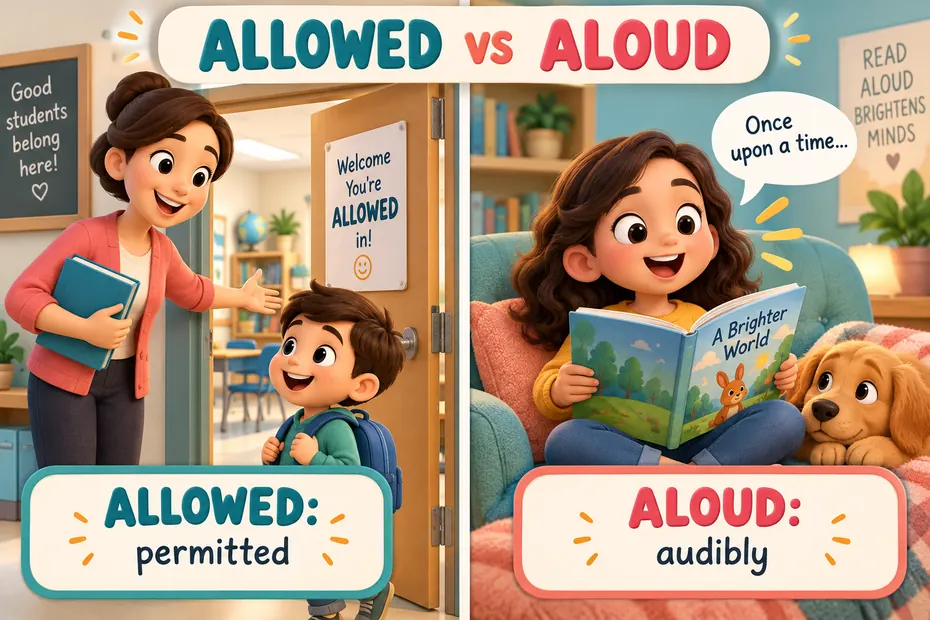
Allowed vs aloud: permission or audible speech?
Allowed is the past tense and past participle of allow, commonly meaning permitted. Aloud is an adverb meaning with the speaking voice so that it can be heard. Write “I am allowed to read” for permission and “I read aloud” for audible reading.
The words can sound the same, but their grammatical roles differ. The earlier explanation correctly distinguishes permission from speech; this update adds an important precision: aloud does not necessarily mean shouting or speaking at high volume. Someone can read aloud softly enough for a nearby listener to hear.
- Allowed relates to permission in “The teacher allowed us to leave.”
- Aloud describes how someone speaks or reads.
- “Allowed to” commonly introduces a permitted action.
- “Read aloud” contrasts with reading silently.
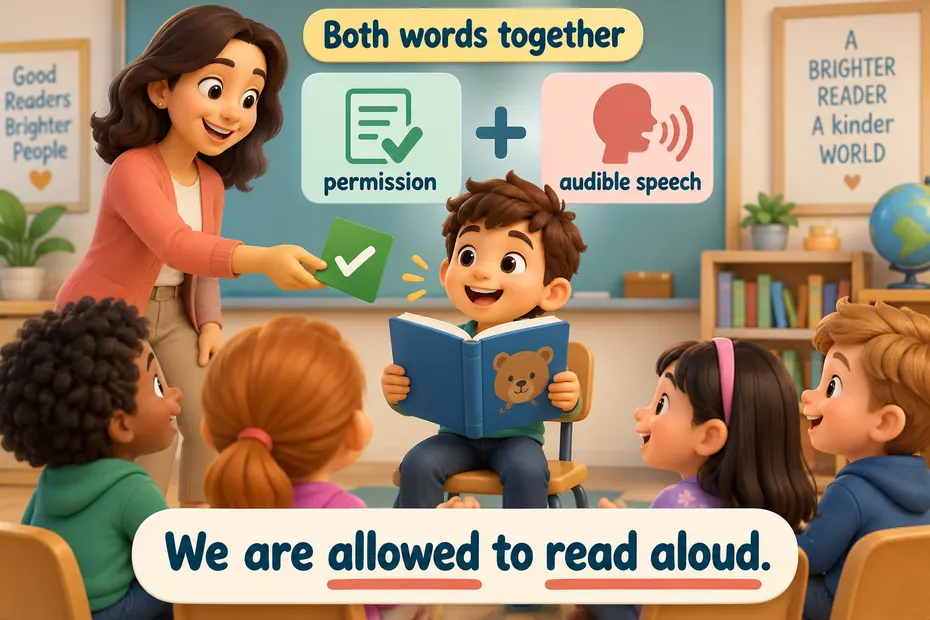
- One sentence can contain both: “We were allowed to read aloud.”
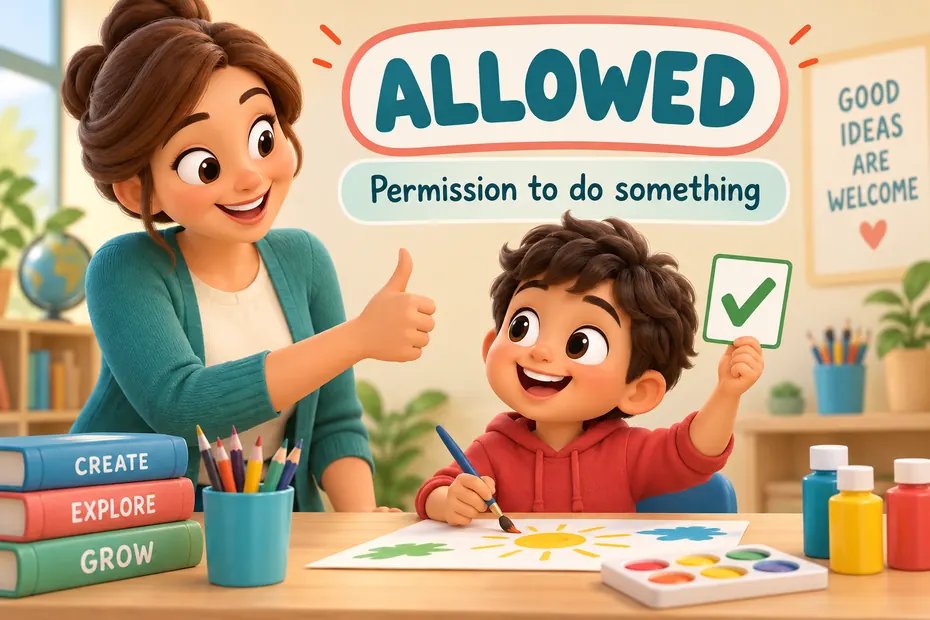
How does allowed work in a sentence?
Allowed is a form of allow, rather than a separate base verb. Merriam-Webster’s allow entry lists allowed among its forms. Distinguishing the base verb from its past form helps you avoid “Does the school allowed it?”
Write “The school allows visitors,” “The school allowed visitors yesterday,” and “Does the school allow visitors?” In the passive construction, write “Visitors are allowed” or “Visitors were allowed.” The surrounding verb marks the time and structure, while allowed remains the past participle.
In “The librarian allowed me to borrow the atlas,” the librarian grants permission, me identifies the recipient, and the infinitive identifies the action. The corresponding passive is “I was allowed to borrow the atlas.” This transformation is useful when the recipient matters more than the person granting permission.
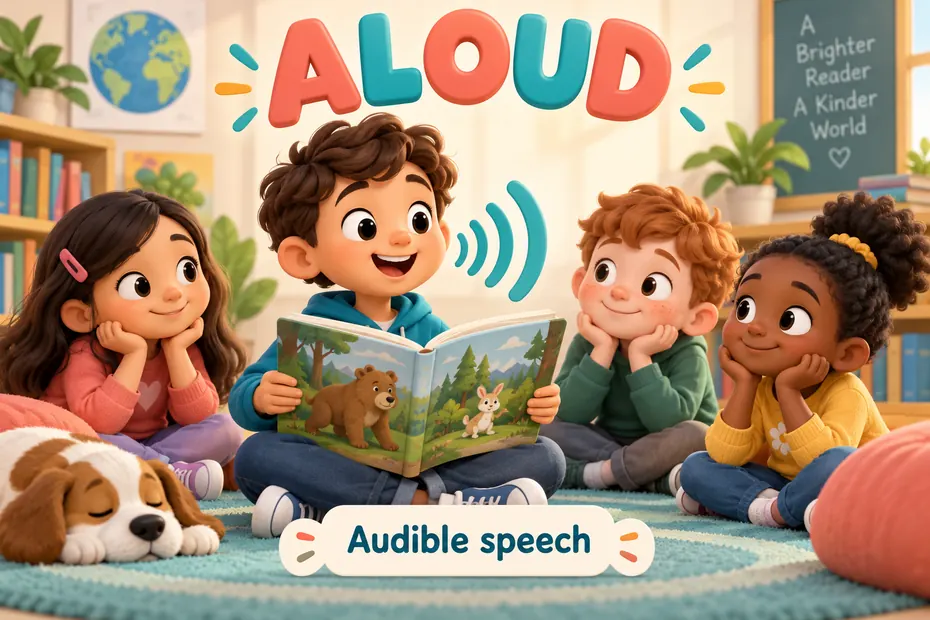
What does aloud add to a verb?
Aloud tells the reader that words were spoken audibly rather than remaining unspoken or being read silently. The Merriam-Webster aloud entry identifies the word as an adverb. In “She read the instructions aloud,” it modifies the reading action.
Useful patterns include read aloud, say aloud, speak aloud, and think aloud. Thinking aloud means expressing thoughts in words as you think through them. It does not imply that the speaker obtained permission to think.
Compare “He read the message aloud” with “He read the message loudly.” The first establishes audible speech; the second emphasizes volume. Both may describe the same event, but the descriptions answer different questions. Use loudly when loudness is the information your reader needs.
Which spelling fits the meaning and structure?
Try permitted for allowed and audibly or out loud for aloud. These replacement tests work well for the central meanings in this comparison. They are clues rather than complete definitions of every use of allow.
| Sentence | Choice | Meaning |
|---|---|---|
| Pets are ____ in this room. | Allowed | Permission is given |
| Please read the title ____. | Aloud | Say the words audibly |
| The coach ____ a short break. | Allowed | The coach permitted it |
| She wondered ____ about the answer. | Aloud | She voiced her thoughts |
| We were ____ to speak ____. | Allowed; aloud | Permission plus audible speech |
“No food allowed” is a shortened notice meaning that food is not permitted. “No reading aloud” prohibits audible reading. Changing the spelling changes the message, and both phrases may pass a basic spellcheck because allowed and aloud are valid words.
The pattern “aloud to” usually signals a problem if the writer means permission: “We are aloud to enter” should become “We are allowed to enter.” By contrast, “She read aloud to the children” is correct because to the children identifies the listeners, not a permitted action.
What other meanings can allowed have?
Allowed can also describe making provision for something or conceding a point. Permission is the central contrast with aloud, but it is not the only sense of allow. Context resolves examples where replacing allowed with permitted sounds unnatural.
“We allowed an hour for the journey” means that we allocated or made provision for an hour. “She allowed that the proposal had advantages” means that she conceded the point. Neither sentence concerns audible speech, so neither takes aloud.
For an editor, the practical lesson is to use the replacement test as a first check and then read the whole clause. A rule limited to permission might falsely flag a valid planning sentence such as “They allowed extra time.” The broader verb family helps explain why that sentence is correct.
Practice allowed and aloud
Choose the correct words: “The teacher ____ a second attempt.” “Maya read her answer ____.” “We are ____ to discuss the problem.” “She thought ____ while solving it.”
Answers: allowed, aloud, allowed, aloud. The first and third describe permission, while the second and fourth describe audible expression. Next try the combined sentence: “The class was allowed to think aloud.” It grants permission for students to voice their reasoning.
Frequently asked questions
Is out loud an acceptable alternative to aloud?
Yes. “Read out loud” and “read aloud” both describe audible reading in ordinary English. Choose the expression that fits your sentence’s tone and rhythm. Neither expression grants permission; “allowed to read” answers that separate question. You can combine the ideas when both matter.
Does allowed always describe the past?
No. As a past participle, allowed appears with verbs that establish other time relationships. “Visitors are allowed today” concerns current permission, while “Visitors will be allowed tomorrow” concerns future permission. “The guard allowed them yesterday” uses allowed as a simple past-tense verb.
Can I say I am aloud?
Usually you need an action verb to explain the audible expression: “I am speaking aloud” or “I am reading aloud.” If you mean permission, specify the action: “I am allowed to speak.” If you mean high volume, “I am being loud” expresses a different idea.
What quick check catches most mistakes?
Ask whether the sentence concerns permission or audible expression. Then check the structure: “allowed to do something” commonly concerns permission, while “read aloud” concerns manner. For less common senses of allow, such as allocating time, consult the surrounding clause rather than forcing the permission test.
Allowed vs aloud: use allowed for the relevant form of allow and aloud for audible speech. “We are allowed to read aloud” shows how both words work together.
As a language enthusiast, I often come across words that sound similar but have distinct meanings. One such pair is “allowed” and “aloud”. These words may seem interchangeable, but they actually have different usage and implications. In this text, I’ll investigate into the differences between “allowed” and “aloud” and provide practical tips on how to use them appropriately in various contexts. Understanding the nuances of these words can help you avoid common mistakes and enhance your communication skills. So, let’s immerse and explore the intriguing area of “allowed” versus “aloud”.
Key Takeaways
- “Allowed” and “aloud” are two words that may sound similar but have distinct meanings and usage.
- “Allowed” is a verb that means to give permission or consent for someone to do something, while “aloud” is an adverb that means to speak or read audibly or out loud.
- When using “allowed,” you are talking about permission, authorization, or consent. On the other hand, when using “aloud,” you are referring to speaking or reading audibly.
- Common mistakes include using “allowed” instead of “aloud” when talking about speaking or reading aloud, and vice versa.
- Pay attention to the context in which you are using these words to ensure accuracy and avoid confusion.
- Practice using “allowed” and “aloud” correctly in your speaking and writing, and seek feedback to improve your understanding and usage.
Definition of “allowed” and “aloud”
When it comes to the English language, there are many words that can sound similar but have completely different meanings. Two such words that often cause confusion are “allowed” and “aloud.” Understanding the distinction between these words is crucial for effective communication. Let’s jump into their definitions and how they should be used appropriately.
Allowed is a verb that means to give permission or consent for someone to do something. It indicates permission or authorization. For example, if I say, “I am allowed to bring my pet to work,” it means that permission has been granted for me to bring my pet. Here are a few more examples:
- I won’t be allowed to enter the event without a ticket.
- You are not allowed to use your phone during the exam.
- The sign clearly states, “No food allowed in the library.”
On the other hand, aloud is usually used as an adverb and means to speak or read something audibly or out loud. It refers to the volume or manner of speaking. Here are some examples to help clarify its usage:
- The teacher asked us to read the passage aloud.
- Please don’t talk aloud during the movie.
- She laughed aloud at the funny joke.
Now that we have a clear understanding of the definitions, let’s explore some examples to illustrate the difference between these two words.
- Correct: I am allowed to sing aloud at the concert.
- Incorrect: I am allowed to sing allowed at the concert.
- Correct: The teacher asked us to solve the math problem aloud.
- Incorrect: The teacher asked us to solve the math problem allowed.
By using “allowed” or “aloud” correctly, we can avoid misconceptions and convey our thoughts accurately in various contexts. Understanding the differences between these words allows us to communicate effectively and clearly.
Remember, allowed refers to permission, while aloud is about speaking or reading audibly. It’s essential to use the right word in the right context to ensure effective communication.
Understanding the Differences between “allowed” and “aloud”
When it comes to the English language, there are many words that sound similar but have completely different meanings. Two such words that often cause confusion are “allowed” and “aloud.” In this section, I’ll explain the difference between these two words and provide examples to help you understand how to use them correctly.
Let’s start with the word “allowed.” It’s a verb that means to give permission or consent for someone to do something. When you are allowed to do something, it means you have been granted permission to do it. For example, if your teacher allows you to use your calculator during a math test, it means you have permission to do so.
On the other hand, “aloud” is usually used as an adverb and means to speak or read something audibly or out loud. When you read a book aloud, you are reading it in a way that others can hear you. For instance, when you read a storybook to your younger sibling, you read it aloud so that they can listen and understand the story.
Now that we understand the definitions of “allowed” and “aloud,” let’s investigate deeper into their usage. It’s important to use the right word in the right context to avoid confusion and ensure effective communication.
Here are a few examples to illustrate the correct usage of these words:
- I am allowed to bring my own snacks to the movie theater.
- The teacher allowed us to work in groups for the project.
- Please read the passage aloud so that everyone can hear it.
Remember, “allowed” is about giving permission, while “aloud” is about speaking or reading audibly. Keeping this distinction in mind will help you use these words correctly in your speaking and writing.
Understanding the differences between “allowed” and “aloud” ensures that you convey your intended meaning accurately and avoid confusion. So next time you’re in doubt, take a moment to consider whether you need permission or if you want to speak or read something audibly.
Common Mistakes with “allowed” and “aloud”
When it comes to the words “allowed” and “aloud”, it’s easy to get confused. They sound similar, but they have different meanings and uses. In this section, I’ll walk you through some of the most common mistakes people make with these words and how to use them correctly.
- Using “allowed” instead of “aloud”: One common mistake is using “allowed” instead of “aloud” when talking about speaking or reading something audibly. For example, saying “He wasn’t aloud to speak during the meeting” is incorrect. The correct sentence should be “He wasn’t allowed to speak during the meeting.” Remember, “allowed” is used to indicate permission or consent, while “aloud” is used to describe speaking or reading audibly.
- Using “aloud” instead of “allowed”: Conversely, another common mistake is using “aloud” instead of “allowed” when talking about giving permission. For instance, saying “I wasn’t loud to bring my phone to school” is incorrect. The correct sentence should be “I wasn’t allowed to bring my phone to school.” Don’t forget that “allowed” is the correct term to express permission or consent.
- Confusing the meanings: It’s essential to understand the specific meanings of “allowed” and “aloud” to use them correctly. “Allowed” means to give permission or consent for someone to do something, while “aloud” refers to speaking or reading audibly. Keep in mind that using the right word ensures clear and effective communication.
- Using the wrong word in context: When using “allowed” or “aloud,” pay attention to the context in which they are used. Ask yourself if you are talking about permission or audibly speaking. This will help you choose the appropriate word and avoid confusion. Remember, the correct word choice enhances your communication skills.
By being aware of these common mistakes, you can confidently use “allowed” and “aloud” correctly in your writing and conversation. Now that we’ve covered the challenges associated with these words, let’s move on to understanding their definitions and examples.
Definitions of “allowed” and “aloud”
- Allowed: As a
Tips for Using “allowed” and “aloud” Appropriately
As a language expert, I understand that using the right words in the right context is crucial for effective communication. In this section, I’ll share some practical tips on how to use “allowed” and “aloud” appropriately. Let’s immerse!
- Understand the Definitions:
- “Allowed”: This is a verb that means to give permission or consent for someone to do something. It indicates permission granted by someone in authority.
- “Aloud”: This is usually used as an adverb and means to speak or read something audibly or out loud. It involves producing sound with the voice.
- Pay Attention to Context:
Both “allowed” and “aloud” might sound similar, but they have distinct meanings. To use them appropriately, it’s important to consider the context in which they are being used. Here are a few examples:
- When speaking about granting permission, use “allowed,” such as “I allowed my friend to borrow my car.”
- When referring to speaking or reading audibly, use “aloud,” for example, “She read the poem aloud to the class.”
- Be Aware of Common Mistakes:
Many people mistakenly use “allowed” instead of “aloud” and vice versa. To avoid these errors, familiarize yourself with their specific meanings and usage:
- Incorrect: “I’m not aloud to talk during the exam.”
(should be “allowed”) - Incorrect: “Please read the instructions loud.”
(should be “aloud”)
- Practice and Seek Feedback:
To improve your usage of “allowed” and “aloud,” practice incorporating them correctly in your speaking and writing. Seek feedback from others, such as teachers, friends, or language experts, to ensure you’re using these words appropriately.
Remember, using the correct word can help convey your intended meaning accurately and avoid confusion. So, take the time to understand the differences between “allowed” and “aloud” and practice using them correctly.
By following these tips, you’ll enhance your language skills and confidently use “allowed” and “aloud” in your everyday communication.
Examples of Correct Usage for “allowed” and “aloud”
One common mistake that people make is using “allowed” when they actually mean “aloud.” It’s important to understand the difference between these two words and use them appropriately in different contexts.
Let’s start by clarifying the definitions of each word.
- “Allowed” is the past tense of the verb “allow.” It means to give permission or consent for something to happen or be done. For example, if a sign says “No smoking allowed,” it means that smoking is not permitted in that area.
- On the other hand, “aloud” is an adverb that describes speaking in a voice that can be heard. When you read a book aloud, you are reading it out loud for others to hear.
Understanding these definitions is crucial to avoid confusion and ensure accurate usage. Now, I’ll provide you with a few examples to illustrate the correct usage of each word.
Examples of correct usage for “allowed”:
- The teacher allowed the students to use their calculators during the exam.
- Smoking is not allowed in this restaurant.
- Please make sure you are allowed to bring your pet before bringing it into the building.
Examples of correct usage for “aloud”:
- She read the poem aloud to the class.
- He was laughing aloud at the comedian’s jokes.
- Can you please speak aloud so that everyone can hear you?
By using these examples, you can see how “allowed” and “aloud” are used appropriately in different contexts. Remember, “allowed” is about giving permission, while “aloud” is about speaking in a voice that can be heard.
To further reinforce your understanding, I recommend practicing these words in sentences and seeking feedback from teachers or language experts. This will help strengthen your usage skills and ensure that you are communicating accurately.
In the next section, we will explore some common mistakes people make with “allowed” and “aloud” and how to avoid them. So, let’s move on to the next part of our discussion.
Conclusion
Understanding the correct usage of “allowed” and “aloud” is essential for effective communication. By familiarizing ourselves with the definitions of these words and paying attention to the context in which they are used, we can avoid common mistakes and ensure accurate language usage.
To strengthen our understanding and usage skills, it is recommended to practice using “allowed” and “aloud” in sentences. Seeking feedback from teachers or language experts can provide valuable insights and help us refine our usage.
Remember, “allowed” refers to permission or authorization, while “aloud” refers to speaking or making sounds audibly. By understanding the subtle differences between these two words, we can confidently use them in the appropriate context.
To conclude, mastering the correct usage of “allowed” and “aloud” will enhance our communication skills and prevent misunderstandings. By practicing and seeking feedback, we can confidently navigate these words and express ourselves accurately. So, let’s continue to refine our language skills and avoid the common mistakes associated with “allowed” and “aloud”.
Frequently Asked Questions
Q: What is the article about?
A: The article provides practical tips on correctly using the words “allowed” and “aloud” in various contexts. It emphasizes the importance of understanding their definitions and paying attention to the context.
Q: What are common mistakes people make with these words?
A: Common mistakes include using “allowed” instead of “aloud” or vice versa, not understanding the difference between the two words, and incorrect usage in specific contexts.
Q: What is the suggested approach for learning proper usage?
A: The article suggests seeking feedback from teachers or language experts, practicing the correct usage in sentences, and being mindful of the context in which these words are used.
Q: Can you provide examples of correct usage for both words?
A: Sure! Example of correct usage for “allowed”: “Smoking is not allowed in this building.” Example of correct usage for “aloud”: “He read the story aloud to his classmates.”
Q: Any recommendations to avoid common mistakes?
A: The article advises practicing the correct usage of these words in various sentences, seeking feedback, and being aware of specific contexts in which they are used.
Q: What can I expect in the next section of the article?
A: In the next section, the article will delve into common mistakes people make with “allowed” and “aloud” and provide tips on how to avoid them.


