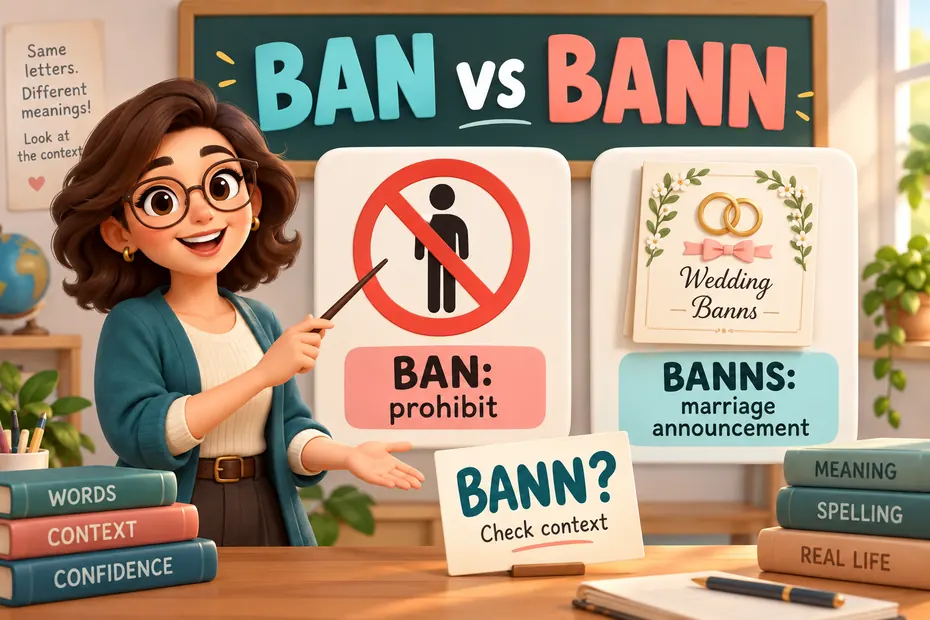
Ban vs bann: the modern spelling and context
Ban is the standard modern English spelling for a prohibition or the act of prohibiting. Do not substitute “bann” in ordinary sentences such as “The club banned smoking.” Banns, with two n’s and an s, is a separate established term for public announcements of an intended marriage.
Clarification of the older explanation below: treating “bann” as a freely interchangeable archaic English verb is too broad. Historical forms and words in other languages need their own source and context. The reliable everyday distinction is between ban, its forms banned and banning, and the specialized marriage term banns.
- Ban can be a noun: “a ban on food in the archive.”
- Ban can be a verb: “The archive bans food.”
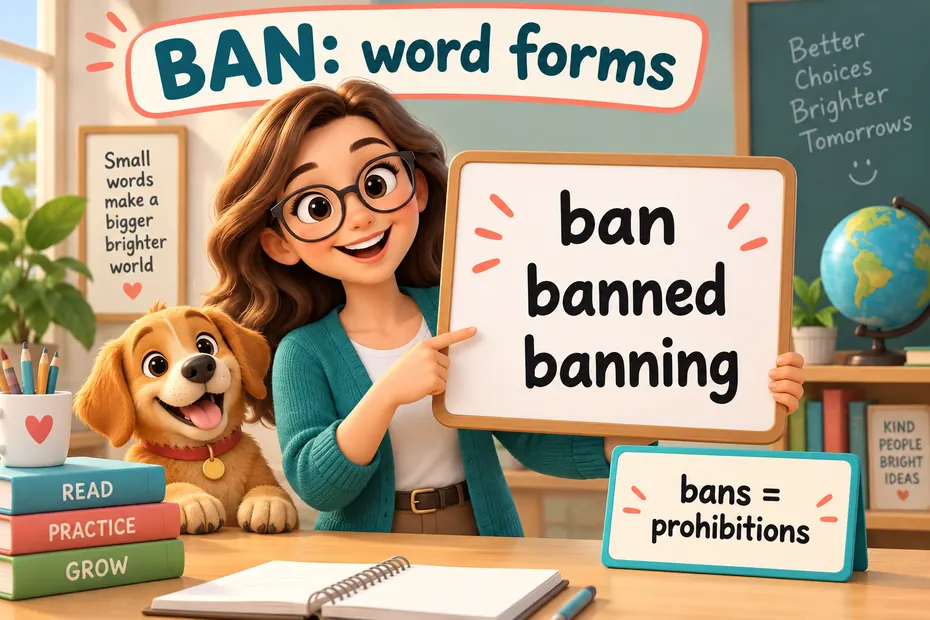
- Banned and banning double the final n when the ending is added.
- Banns concerns a marriage announcement, not an ordinary prohibition.
- An unfamiliar historical spelling should be checked against its actual document.

How does ban work as a noun and a verb?
As a noun, ban names a prohibition; as a verb, ban describes imposing one. Merriam-Webster’s ban entry documents both roles. The same rule can therefore be expressed as “The venue has a ban on outside food” or “The venue bans outside food.”
The noun often appears with on: “a ban on recording,” “a ban on parking,” or “a ban on single-use cups.” The verb can take the thing prohibited directly: “The organizer banned recording.” For a person excluded from an activity or place, from makes the relationship clear: “The player was banned from the tournament.”
These are language examples, not statements about a particular law or venue. A precise real-world report should identify who imposed a ban, what it covers, and where it applies. “A ban exists” can be grammatical while omitting information a reader needs to understand its scope.
Why do banned and banning have two n’s?
Ban doubles its final consonant before the endings in banned and banning. The dictionary lists these forms together with bans. The doubled consonant belongs to those inflected forms; it does not mean the base verb is spelled “bann.”
Write “They plan to ban littering,” “They banned littering,” and “They are banning littering.” With a singular present-tense subject, write “The club bans littering.” After an auxiliary, return to the base form: “Does the club ban littering?” or “The club will ban littering.”
The noun plural is bans: “The report compares three bans.” It is not banns when you mean three prohibitions. That extra n changes the written word into a specialized term with a different meaning, so a spellchecker may accept the error while missing your intended reference.

What are banns of marriage?
Banns are public announcements of an intended marriage. Merriam-Webster’s banns entry identifies the term as a plural noun. It should not be read as a plural spelling of the everyday prohibition noun.
The Church of England’s explanation of reading banns describes an announcement of a couple’s intention to marry and an opportunity to raise a reason the marriage may not lawfully take place. This is one current institutional use, rather than evidence that the word has disappeared from modern language.
A sentence such as “The banns were read in church” concerns a marriage announcement. “The bans were discussed by the committee” concerns prohibitions. Wedding arrangements have institution-specific requirements, so confirm the process with the relevant officiant rather than treating this spelling guide as procedural advice.
Which form should you choose?
Choose the form from the meaning and its grammatical role. The following examples separate the base verb, inflections, noun plural, and marriage term without treating every double-n spelling as the same word.
| Intended meaning | Form | Example |
|---|---|---|
| Prohibit, base verb | Ban | We may ban outdoor fires. |
| One prohibition | Ban | The ban starts tomorrow. |
| Past action | Banned | The venue banned glass bottles. |
| Continuing action | Banning | They are banning glass bottles. |
| Several prohibitions | Bans | The council reviewed two bans. |
| Marriage announcements | Banns | The banns were read. |
For an unfamiliar “bann” in an old source, first identify the language, date, and transcription method. Keep a quoted spelling faithful to the source and explain any proposed modernization. An archaic-looking word alone does not establish its exact grammatical role or authorize an invented historical example.
Practice the spelling in context
Fill the gaps: “The club will ____ glass bottles.” “The club ____ them last year.” “The report compares several parking ____.” “Their marriage ____ were read.”
Answers: ban, banned, bans, banns. The future verb uses the base spelling, the past form doubles n, the ordinary plural adds s, and the marriage announcement uses the specialized double-n term. Keep those four relationships separate during proofreading.
Frequently asked questions
Is bann always a meaningless spelling?
No. The same letter sequence can occur in names, historical material, and other languages. That does not make it the standard modern English verb for prohibiting. Identify the source before assigning a meaning, and write “ban” in ordinary English when you mean prohibit.
Can a company ban something?
Yes, the verb is not restricted to national legislation. A company, club, or venue may impose a prohibition within its rules or scope of authority. State the relevant setting in a real report. Whether a particular restriction is legally valid is a separate question from the word’s meaning.
Are bans and banns pronounced by counting letters?
No. Extra consonant letters do not automatically create a separate spoken syllable. Spelling distinguishes these terms even when their sounds are similar. In writing, check whether the context concerns restrictions or marriage announcements; counting the intended meaning is more useful than trying to hear an extra n.
What is the shortest proofreading reminder?
Remember “ban, banned, banning” for prohibition and “banns” for marriage announcements. Then check the sentence’s subject and tense. A correct spelling in the wrong context still creates an error, particularly when “banns” is accidentally used as the plural of ordinary “ban.”
Ban vs bann: use ban for ordinary modern prohibitions; verify an isolated bann against its source. Keep the established marriage term banns distinct from bans.
Have you ever been confused about when to use “ban” and when to use “bann”? Well, I certainly have. In this text, I’ll clarify the appropriate usage of these two words and help you avoid common mistakes. Understanding the difference between “ban” and “bann” is crucial for effective communication, whether you’re writing an academic paper or a casual email. So, let’s immerse and explore the nuances of these words, so you can confidently use them in your everyday language. Let’s get started on our journey to banish the confusion surrounding “ban” and “bann” once and for all.
Key Takeaways
- The difference between “ban” and “bann” is crucial for effective communication.
- “Ban” is a commonly used verb that means to officially or legally prohibit something, while “bann” is an archaic form of “ban” rarely used in contemporary English.
- Confusing the meanings and verb forms of “ban” and “bann” can lead to misunderstandings and misinterpretation.
- Pay attention to context when using “ban” and “bann” and choose the appropriate word accordingly.
- “Bann” should be avoided in modern writing as it is considered outdated and can confuse readers.
- Proofreading and editing are essential to ensure correct usage of “ban” and “bann” in your writing.
What is the difference between “ban” and “bann”?
Understanding the difference between “ban” and “bann” is essential for effective communication. While these two words may seem similar, they have distinct meanings and usages. Let’s investigate into the definitions and nuances of each word to clarify their appropriate usage.
Definition of “Ban”:
- “Ban” is a verb that means to officially or legally prohibit or forbid something. It involves imposing a restriction or prohibition on a person, group, or activity.
- It can also be used as a noun, representing the act of prohibiting or the state of being prohibited.
Definition of “Bann”:
- “Bann” is not a commonly used word in the English language. It is an archaic form of the word “ban,” mainly found in old literature or historical texts.
- It is important to note that “bann” is considered outdated and rarely used in contemporary English. Hence, for most practical purposes, we should focus on understanding and using “ban” correctly.
Given the distinction between “ban” and “bann,” it is crucial to use the appropriate word in the relevant context. Confusing the two can lead to misunderstandings and inaccuracies in communication. Let’s explore some examples to further illustrate the difference between these words.
- The government decided to ban smoking in public places to protect people from the harmful effects of secondhand smoke.
- The city council has banned the use of plastic bags in an effort to reduce environmental pollution.
- In medieval times, kings would issue a bann against anyone who posed a threat to their rule.
As you can see from these examples, “ban” is used to describe official prohibitions or restrictions on activities, while “bann” is a less common variation of the word “ban” that is typically found in historical or literary contexts.
By understanding the difference between “ban” and “bann,” you can avoid common grammar mistakes and communicate more effectively. Let’s continue exploring other frequently confused words to enhance our language skills.
Common mistakes to avoid when using “ban” and “bann”
When it comes to using words like “ban” and “bann,” it’s important to be aware of the differences between them. By understanding their definitions and proper usage, you can avoid common mistakes and communicate more effectively. Let’s explore some pitfalls to watch out for:
1. Confusing the Meanings: The key to using “ban” and “bann” correctly is understanding their respective definitions. While “ban” is a commonly used verb that means to officially or legally prohibit something, “bann” is an archaic form of “ban” that is rarely used in contemporary English. Mixing up the meanings can lead to confusion and misinterpretation.
2. Incorrect Verb Form: Another common mistake is using the incorrect verb form of “ban” or “bann.” Remember, “ban” is the present tense form, while “banned” is the past tense and past participle form. Using the wrong verb form can make your sentence grammatically incorrect and doesn’t convey the intended meaning.
3. Not Paying Attention to Context: Context plays a crucial role in using “ban” and “bann” accurately. Make sure to consider the specific situation and use the appropriate word accordingly. For instance, if you’re referring to a government’s action of prohibiting something, “ban” would be the correct choice. On the other hand, if you’re using it in a historical or literary context, “bann” might be more appropriate.
4. Using Outdated Language: As mentioned earlier, “bann” is an outdated form and not commonly used in modern English. While it’s important to have a good grasp of the English language, using “bann” in contemporary writing or conversation could make you seem out of touch or even confuse your readers or listeners.
5. Lack of Proofreading and Editing: Mistakes can easily slip through the cracks, even for experienced writers. Always take the time to proofread and edit your work to double-check for any errors in your usage of “ban” and “bann.” This will ensure that your writing is clear, accurate, and reflects your language skills in the best possible way.
Tips for using “ban” and “bann” appropriately
Understanding the difference between “ban” and “bann” is crucial for effective communication. Here are some useful tips to help you use these words appropriately:
- Know the definitions: Start by understanding the definition of both words. “Ban” is a commonly used verb that means to officially or legally prohibit something. On the other hand, “bann” is an archaic form of “ban” that is rarely used in contemporary English. By knowing the definitions, you can choose the right word for the right context.
- Pay attention to context: Context plays a significant role in using “ban” and “bann” appropriately. Consider the situation and the intended meaning before selecting the word. Is it a current prohibition or a reference to an older period? By paying attention to the context, you can ensure that your writing is clear and accurate.
- Avoid confusing the meanings: While “ban” and “bann” have similar meanings, it’s essential to avoid confusing one with the other. Stay aware of the differences between the two and choose the correct word accordingly. This helps to prevent any misunderstandings or misuse of the words.
- Use the correct verb form: When using “ban,” make sure to use the appropriate verb form. Remember to conjugate it correctly based on the subject and tense of the sentence. This will ensure that your writing is grammatically correct and coherent.
- Avoid outdated language: As mentioned earlier, “bann” is an archaic form of “ban” that is rarely used today. So, while it’s good to have a broad understanding of the English language, it’s advisable to focus on contemporary usage. Stick to using “ban” in most cases to avoid confusion and using outdated language unnecessarily.
- Proofread and edit: Always take the time to proofread and edit your writing carefully. Mistakes can easily slip through, especially with commonly confused words like “ban” and “bann.” By thoroughly reviewing your work, you can eliminate any errors and ensure that your writing is clear and professional.
Examples to clarify the usage of “ban” and “bann”
Now that we have a clear understanding of the definitions and differences between “ban” and “bann,” let’s explore some examples to help clarify their usage.
Example 1:
During the pandemic, certain countries imposed a ban on travel from high-risk areas. This means that individuals from those areas are not allowed to enter those countries for a specified period of time. Here, “ban” is used as a noun to indicate a prohibition or restriction.
Example 2:
The school administration decided to ban cell phones on campus. Students are not permitted to use their phones during school hours. In this example, “ban” is used as a verb to convey an action of prohibiting or forbidding.
Example 3:
I received a notice that my account has been banned from the online forum due to repeated violations of the community guidelines. Here, “bann” is used as a verb to indicate an action of excluding or suspending someone from participating in a platform or community.
Example 4:
The chef banned garlic from the recipe because some customers have allergies. In this case, “bann” is used as a verb to express an action of excluding or removing something from a particular context.
It is important to note that “ban” tends to be the more commonly used word in contemporary English, while “bann” is considered archaic or outdated. Hence, when writing, it is advisable to use “ban” to maintain a modern and natural style.
Remember, context is key when using these words correctly. Pay attention to the part of speech and the specific meaning required in your sentence.
By understanding the definitions and observing these examples, you can confidently navigate the usage of “ban” and “bann” in your writing.
Conclusion
Understanding the difference between “ban” and “bann” is crucial for effective communication. By grasping their definitions and appropriate usage, we can convey our thoughts accurately. Throughout this article, I have provided examples to illustrate how these words are used in various contexts.
It’s important to note that “ban” is widely used in contemporary English, while “bann” is considered archaic or outdated. Hence, it is essential to pay attention to the context and choose the appropriate word accordingly.
To conclude, mastering the proper usage of “ban” and “bann” enables us to express ourselves clearly and avoid any confusion. By using these words appropriately, we can enhance the impact of our communication and ensure that our message is accurately conveyed. So, remember to consider the specific meaning required in a sentence and choose the right word to convey your thoughts effectively.
Frequently Asked Questions
Q: What is the article about?
A: The article discusses the difference between the words “ban” and “bann” and provides tips for their proper usage. It emphasizes the importance of understanding the definitions of these words to communicate effectively.
Q: How can I use “ban” and “bann” correctly?
A: To use these words correctly, it’s important to understand their meanings. “Ban” is commonly used in contemporary English, while “bann” is considered archaic or outdated. Pay attention to context and use the word that fits best to convey your intended meaning.
Q: Can you give me some examples of using “ban” and “bann”?
A: Sure! Here are some examples to clarify their usage: “The city council voted to ban smoking in public places.” (using “ban”) and “The king issued a bann on trading with neighboring kingdoms.” (using “bann”).
Q: Why is it important to understand the specific meaning required when using these words?
A: Using the right word is crucial to ensure accurate communication. “Ban” and “bann” have distinct meanings, so understanding which one is appropriate for a particular sentence will help convey the intended message correctly. Paying attention to context is key in using these words effectively.
Q: What is the main takeaway from the article?
A: The main takeaway is that understanding the definitions and proper usage of “ban” and “bann” is essential for effective communication. While “ban” is commonly used, “bann” is considered outdated. By paying attention to context and choosing the appropriate word, you can accurately convey your intended meaning.


