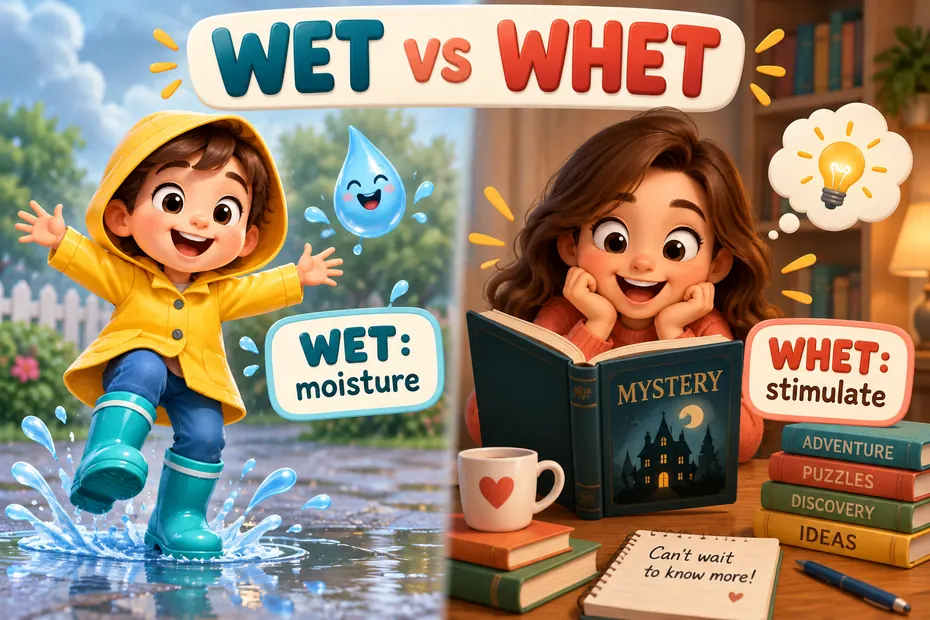
Wet vs whet: moisture or stimulation?
Wet describes moisture or means to make something moist. Whet means to sharpen something or stimulate an appetite, interest, or desire. Write “wet your whistle” when you mean have a drink, and “whet your appetite” when you mean awaken a desire for food or another experience.
- Wet can describe a state: “The towel is wet.”
- Wet can describe an action: “Wet the cloth.”
- Whet is a verb: “The preview whets my curiosity.”
- The standard phrase is “whet your appetite,” with an h.
- The standard phrase is “wet your whistle,” without an h.

When does a sentence need wet?
Use wet for moisture, liquid, or the action of making something wet. The Merriam-Webster wet entry documents both adjective and verb uses. You can therefore write “The sponge is wet” and “Wet the sponge” without changing the spelling.
“The path was wet after the rain” describes a surface. “Please wet the brush before painting” gives an instruction. “The rain wet our clothes” describes an action in the past. The word does not have to imply complete soaking: a thin layer of liquid can make a surface wet.
Pay attention to the object. Wetting a cloth is a physical action, while stimulating curiosity is an abstract effect. Replacing “wet” with “make damp” often clarifies literal examples, although idioms and specialized meanings need their own interpretation. Do not use the replacement as a universal dictionary definition.

What does whet mean beyond sharpening?
Whet means to sharpen or stimulate, and its figurative uses describe increasing a desire or interest. The Merriam-Webster whet entry includes the literal blade meaning and the appetite-related meaning. Modern everyday examples often concern curiosity rather than a sharpening task.
“The opening chapter whetted my curiosity” means the chapter made me want to know more. “The tasting menu whetted their appetite” means the small tastes stimulated a desire to eat. Neither sentence says that someone poured water on an abstract feeling.
Whet normally appears with an object that is sharpened or stimulated: whet a blade, whet an appetite, or whet someone’s interest. For routine literal writing, “sharpen” may be easier for readers. For an anticipation-building effect, “whet” precisely names the way a small introduction makes someone want more.
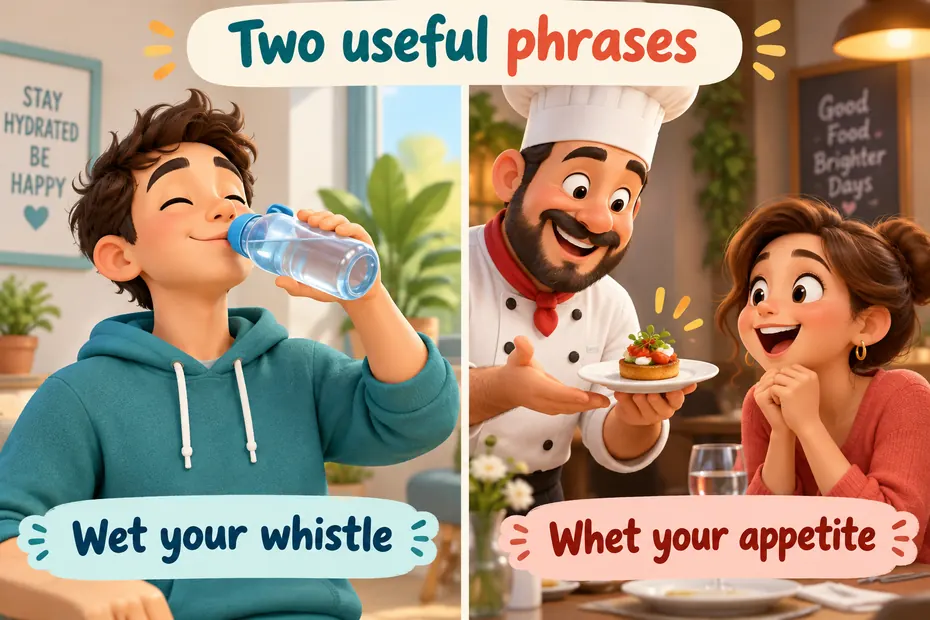
Which spelling belongs in familiar phrases?
Keep “wet your whistle” and “whet your appetite” separate. Their similar sounds can conceal their different meanings. One concerns drinking; the other concerns stimulating desire, whether for food, travel, entertainment, or knowledge.
| Meaning | Write | Example |
|---|---|---|
| Make a cloth moist | Wet | Wet the cloth before wiping. |
| Describe rainy weather | Wet | We had a wet weekend. |
| Have a drink | Wet your whistle | Stop for water to wet your whistle. |
| Stimulate hunger or desire | Whet your appetite | The sample whetted my appetite. |
| Increase curiosity | Whet | The clue whets the reader’s curiosity. |
| Sharpen an edge | Whet | The craftsperson whetted the blade. |
A travel article can “whet your appetite for a walking holiday” even though no food is involved. The phrase describes anticipation. Conversely, “wet the whistle” is not the general phrase for creating enthusiasm. The objects and their meanings determine the spelling.
How do wet and whet change in different tenses?
Whet becomes whetted and whetting; wet can become wet or wetted in the past and becomes wetting in the progressive form. Do not drop the h from whetted or add one to wetted. Their similarity remains a spelling risk even after the endings change.
Compare “The trailer whetted her interest” with “The splash wetted her sleeve.” The first sentence describes stimulation, and the second describes moisture. For a continuing action, write “The preview is whetting my appetite” or “The gardener is wetting the soil.”
Subject agreement works normally: “The preview whets my interest,” but “The previews whet my interest.” After an auxiliary such as does, use the base form: “Does the preview whet your interest?” Checking agreement separately keeps a spelling correction from introducing a grammar mistake.
Practice wet vs whet with context
Choose the word or form that fits: “The rain left my coat ____.” “That excerpt will ____ your curiosity.” “She ____ the sponge before cleaning.” “The aroma ____ our appetite.”
Answers: wet; whet; wet or wetted; whetted. The first example describes a state. The second describes stimulation in the future. The third permits the dictionary’s two past-tense forms of wet. The fourth uses the past tense of whet. Meaning and tense both matter.
A useful editing sequence is to circle the object, identify moisture or stimulation, choose wet or whet, and then check the ending. This catches phrases such as “wetted my curiosity,” where the tense looks plausible but the chosen verb does not match the intended meaning.
Frequently asked questions
Can whet describe an appetite for learning?
Yes. “The demonstration whetted their appetite for learning” uses appetite figuratively for a desire to learn. No hunger or eating is required. Specify what the appetite concerns when context might be unclear, such as “an appetite for more examples” or “an appetite for travel.”
Does whet mean satisfy?
No. Whetting an appetite stimulates desire; satisfying an appetite meets that desire. A short preview may whet your interest while leaving your questions unanswered. A full explanation may satisfy your curiosity. Choose the verb according to whether the experience creates a desire for more or resolves it.
Is whetting a whistle the usual phrase?
No. The established drinking expression is “wet your whistle.” If you are referring literally to a physical whistle, describe the intended action plainly. The everyday idiom does not mean sharpening an instrument, and adding an h changes the verb to one with a different meaning.
Can a spellchecker catch wet instead of whet?
A basic spellchecker may accept both because both are correctly spelled English words. Read the phrase and its object: a sleeve can become wet, while curiosity can be whetted. Fixed expressions deserve special attention because familiar sound patterns can encourage a writer to overlook the wrong word.
Wet vs whet: choose wet for moisture and whet for sharpening or stimulating. Remember the two phrase anchors: wet your whistle, whet your appetite.
Are you confused about when to use “wet” and when to use “whet”? Don’t worry, I’ve got you covered. In this text, I’ll break down the differences between these two words and provide you with some tips on how to use them appropriately. Understanding the nuances of these terms is essential for effective communication, so let’s dive right in.
When it comes to “wet,” we often think of something being moist or damp. But, “whet” has a completely different meaning. It means to sharpen or stimulate. These two words may sound similar, but their usage is distinct. By the end of this article, you’ll have a clear understanding of when to use “wet” and when to use “whet” in your writing. So, let’s get started and unravel the mystery behind these commonly confused words.
Key Takeaways
- “Wet” refers to something being moist or damp, while “whet” means to sharpen or stimulate.
- “Wet” describes a physical state of being damp or soaked, such as wet clothes or wet hair.
- “Whet” is used in the context of sharpening a blade or stimulating an appetite or curiosity.
- Understanding the difference between “wet” and “whet” is crucial for clear and accurate communication.
- Use “wet” when referring to moisture and “whet” when indicating sharpening or stimulation.
- Pay attention to context and use the appropriate word to convey the intended meaning.
Wet vs Whet: Understanding the Difference
When it comes to the English language, there are many words that can be easily confused or misused. Two such words that often cause confusion are “wet” and “whet.” While they may sound similar, their meanings and usage are quite different. In this section, I’ll investigate into the nuances of these two words and help you understand how to use them appropriately in your writing.
Wet is a word that most of us are familiar with. It refers to something being moist or damp. When an object or surface has come into contact with water or some other liquid, we often describe it as wet. For example, if you leave a glass of water on the table without a coaster, the table may become wet from the condensation. Or if you’re caught in the rain without an umbrella, you’ll likely get wet.
Whet, on the other hand, means to sharpen or stimulate. It is often used in the context of sharpening a blade or appetite. For example, if you want to prepare your kitchen knife for slicing vegetables, you would whet the blade by running it on a sharpening stone. In a different sense, if something piques your interest or arouses your curiosity, you might say it whets your appetite.
To summarize, the main difference between “wet” and “whet” is that “wet” refers to moisture or dampness, while “whet” means to sharpen or stimulate. Understanding this distinction will help you use the words accurately in your writing.
Here’s a quick definition of each word:
- “Wet”: Being moist or damp due to contact with water or another liquid.
- “Whet”: To sharpen or stimulate, either in a literal sense (such as sharpening a blade) or in a figurative sense (such as arousing curiosity).
By keeping these definitions in mind, you can avoid confusing the two words and ensure that your writing is clear and accurate.
The Meaning of “Wet”
When it comes to the word “wet,” it refers to something that is moist or damp. Understanding its meaning and usage is essential for effective communication. Let’s investigate deeper into the definition and examples to grasp its nuances.
The primary meaning of “wet” is quite straightforward – it describes an object or substance that is saturated with liquid. It can refer to a variety of scenarios, such as a wet towel, wet clothes, or wet hair. Also, it can describe the weather when it’s raining or when dew is present on surfaces.
Importantly, “wet” can also be used metaphorically to express emotions or experiences. For example, we might describe a thrilling movie as “keeping us on the edge of our seats, wet with suspense.” It’s remarkable how the word can be used in different contexts to convey a range of meanings.
Understanding the distinction between “wet” and similar words is crucial to avoid confusion. For instance, “damp” is synonymous with “wet” but typically implies a lesser degree of moisture. On the other hand, “soaked” suggests a higher level of wetness, often implying saturation or complete immersion.
Summarizing, “wet” is a versatile word that describes something that is moist or damp. It can refer to physical objects, the weather, or even emotions. By grasping the nuances of its usage, you’ll be able to communicate more effectively and accurately.
The Meaning of “Whet”
Understanding the meaning and usage of the word “whet” is an important aspect of expanding your vocabulary and communicating effectively. Let’s explore the definition and nuances of this often-misused word.
“Whet” is a verb that means to sharpen or stimulate. It is typically used in relation to sharpening something, such as a knife or appetite. But, it can also be used metaphorically to describe the process of arousing or stimulating interest, curiosity, or desire.
Here are a few key points to keep in mind when using “whet” correctly:
- Definition: “Whet” specifically refers to the action of sharpening or stimulating something. It is not synonymous with the word “wet,” which relates to moisture or dampness.
- Sharpening: In a literal sense, “whet” is often used to describe the act of sharpening a blade, tool, or instrument. For example, “I need to whet my knife before cooking.”
- Stimulation: Figuratively, “whet” is used to express the act of arousing or stimulating something, such as an appetite or curiosity. For example, “The chef’s description of the dish really whet my appetite.”
- Difference from “Wet”: It is crucial to differentiate between “whet” and “wet.” While “whet” involves sharpening or stimulation, “wet” pertains to moisture or dampness. Understanding this distinction will help you avoid confusion and use the words appropriately.
Now that we have a clear understanding of the meaning of “whet,” we can explore its usage in various contexts. In the next section, we will investigate into examples and further explanations to enhance our comprehension of this word.
But before we move on, take note of the difference between “wet” and “whet”:
| Word | Meaning |
|---|---|
| Wet | Moist or damp |
| Whet | Sharpen or stimulate |
Remember, honing your vocabulary skills is an ongoing process, and grasping the intricacies of words like “whet” enables you to communicate more effectively. Let’s jump into some examples and expand our understanding even further.
When to Use “Wet”
When to Use “Wet”
Now that we’ve discussed the meaning and usage of “whet,” let’s turn our attention to the word “wet.” Understanding the distinction between “wet” and “whet” is crucial for effective communication.
To put it simply, the word “wet” is used to describe something that is damp or moist. It refers to the state of being covered or saturated with liquid. Here are a few instances where you would use “wet” correctly:
- Weather Conditions: When it’s raining outside, we say that the ground is wet.
- Water Activities: If you go swimming, your clothes will get wet.
- Spills or Accidents: If you spill your drink on the table, it will become wet.
It’s important to note that “wet” is an adjective and can also be used as a verb. But, as a verb, it means to make something wet, rather than describing the state of being wet. For example:
- I accidentally wet the floor while mopping.
Remember, “wet” is focused on describing the physical state of something being damp or soaked. It doesn’t have the same connotation of sharpening or stimulating like “whet” does.
Understanding the correct usage of “wet” can prevent confusion and improve your communication skills. Keep in mind that mastering the distinction between “wet” and “whet” is an ongoing process, but with practice, you’ll become more proficient in using them appropriately.
When to Use “Whet”
As we explore the distinction between “wet” and “whet,” it’s important to understand the specific situations in which we should use “whet.” To fully grasp the proper usage of this word, let’s investigate into its meaning and context.
Definition of “Whet”: “Whet” is a verb that means to sharpen or stimulate, particularly in regards to one’s appetite or curiosity. It’s important to note that “whet” is not used to describe something being damp or moist like “wet.”
Difference between “Wet” and “Whet”: While “wet” refers to the state of being damp or moist, “whet” is used more figuratively to describe the action of sharpening or stimulating. Understanding this key difference helps us avoid confusion and choose the appropriate word in different contexts.
Let’s explore some common scenarios in which “whet” should be used:
- Whetting the Appetite: When describing the act of stimulating someone’s interest or desire for something, “whet” is the word to use. For example:
- The tantalizing aroma from the bakery whetted my appetite for freshly baked bread.
- The movie trailer whetted my curiosity, and I couldn’t wait to see the film.
- Whetting Curiosity: “Whet” can also be used to express sharpening or stimulating someone’s curiosity. Here are a few examples:
- The intriguing question whetted my curiosity, compelling me to seek the answers.
- The enigmatic puzzle whetted my interest, driving me to solve it.
Remember, in these instances, using “whet” instead of “wet” is crucial to convey the appropriate meaning and enhance effective communication.
To conclude, understanding when to use “whet” is essential for effective communication. By using it correctly, you can accurately express the idea of sharpening or stimulating someone’s appetite or curiosity. Throughout this article, we’ve explored the differences between “wet” and “whet” and provided examples to illustrate their proper usage. Moving forward, let’s continue to practice and refine our language skills to avoid confusion and ensure clear communication.
Tips for Using “Wet” and “Whet” Appropriately
The difference between “wet” and “whet” can sometimes be confusing, but with a few tips, you can easily use these words correctly. Here are some guidelines to help you:
- Understand the Definitions: To use “wet” and “whet” appropriately, it’s important to know their meanings. “Wet” is an adjective that describes something that is damp or moist, while “whet” is a verb that means to sharpen, stimulate, or arouse. Understanding the definitions of these words is key to using them correctly in your writing and speaking.
- Pay Attention to Context: The context in which you are using the word is crucial in determining whether it should be “wet” or “whet.” Consider the overall meaning of your sentence and the specific intention behind the word. Are you describing a physical state of being damp or arousing someone’s curiosity or appetite? This will help you choose the right word and avoid confusion.
- Use “Wet” for Moisture: When referring to something that is damp or moist, always use “wet.” For example, “The ground was wet after the rain” or “She stepped into the puddle and got her shoes wet.” Using “wet” in these contexts is the correct way to describe a state of being damp or moist.
- Use “Whet” for Arousal or Stimulation: If you want to indicate the act of sharpening, stimulating, or arousing someone’s interest, use “whet.” For instance, “The new book excerpt whetted my curiosity” or “The smell of the cooking food whetted my appetite.” Using “whet” in these contexts is the appropriate way to convey the idea of arousal or stimulation.
Remember, choosing the right word can make a significant difference in the clarity and effectiveness of your communication. By understanding the distinctions between “wet” and “whet” and following these tips, you can confidently use these words appropriately in your writing and speaking.
Proper usage of “wet” and “whet” showcases your command over the English language and enhances your communication skills. So, keep practicing and refining your language skills to become an even more effective communicator.
Conclusion
Understanding the difference between “wet” and “whet” is crucial for effective communication. As we have discussed in this text, “wet” is used to describe something that is damp or moist, while “whet” is used to mean to stimulate or sharpen. By using these words appropriately, we can avoid confusion and enhance our communication skills.
Remember, when talking about moisture or dampness, use “wet.” For example, “The rain made my clothes wet.” On the other hand, when talking about stimulating or sharpening, use “whet.” For instance, “The smell of freshly baked bread whetted my appetite.”
Choosing the right word can make a significant difference in the clarity and effectiveness of our communication. With practice and refinement of our language skills, we can ensure that we are using “wet” and “whet” appropriately in various contexts.
So, let’s continue to pay attention to the definitions and context, and practice using these words correctly. By doing so, we can improve our communication and convey our intended meanings more accurately.
Frequently Asked Questions
Q: What is the meaning of the word “wet”?
A: “Wet” is an adjective used to describe something that is damp or moist.
Q: How is “wet” used as a verb?
A: “Wet” can be used as a verb to mean to make something wet.
Q: What is the difference between “wet” and “whet”?
A: “Wet” refers to moisture, while “whet” means to arouse or stimulate.
Q: When should I use “whet”?
A: Use “whet” when referring to arousing an appetite or curiosity.
Q: Why is it important to understand the difference between “wet” and “whet”?
A: Understanding the distinction between the two words ensures effective communication.
Q: How can I use “wet” and “whet” correctly?
A: Pay attention to context and use “wet” for moisture and “whet” for arousal or stimulation.
Q: What are some tips for effective language skills?
A: Practice, refine your skills, and choose the right word for clear and effective communication.


